Wednesday, August 31, 2011

Andrew and the 2 Alexanders


Mystery still not solved. I've tried all of the traditional records but still no definitive relationship between these men found? My assumption has been that Alexander Forgey of Washington County, Virginia is the father of both Alexander and Andrew of Knox County, Tennessee (Alexander Forgey later migrated to Tippecanoe, IN, and Andrew to Maury County, TN).
Here are some reasons why I think Alexander and Andrew are closely related and may have been brothers. Both Alexander and Andrew purchased land from James Forgey (apparently a relative) on the same day in 1801. They apparently each bought half of James's 500 acre land grant. Alexander Forgey married Elizabeth Sawyers in Knox County, TN in 1805. Andrew and Alexander both witnessed a Sawyer's family document. The document they witnessed is Hannah Sawyers Will dated 27 December 1806. Apparently she was a sister-in-law of John Sawyers, Elizabeth's father. Andrew also was an executor for another  Sawyers. He was the administrator of Betsy Sawyers Will in 1818 Maury County, TN.
Here is why I think Alexander Forgey might be the father of these two men. It is assumed that Alexander living in Washington County in the late 18th century is a brother of Andrew of  Hawkins County, TN. He may be the same man who is listed with Andrew Forgey in Cumberland County, PA in the early 1770's . If so he would have been old enough to be Andrew and the younger Alexander Forgey's  father. We know Alexander Forgey of Washington County,Va was an adult in 1783 when he appeared on a taxlist. Only those over 21 were listed. We know Andrew Forgey was over 45 as listed on the 1820 Census Maury County, TN. So he was born before 1775. There is disagreement as to where he was born. A great grandson stated Ireland in a County Biography sketch. A son said Pennsylvania on the 1880 Census. Another son stated he was born in Maryland on the 1880 Census. These birthplaces given on the Census's seem to echo their mother's birthplaces, and is likely not accurate. However Pennsylvania would make sense if this were Alexander's son because we know he lived there in the 1770's, at the time when Andrew was born. Unfortunately since Andrew died in the early 1820's we do not have a Census entry with his birthplace.


James G. Forgey great-grandson of Andrew Forgey states he was born in Ireland and so were his grandparents?


John H. Forgey, Andrew's son, stated he was born in Pennsylania along with his mother


Andrew's son Samuel Scott Forgey 1880 Census says he was born in Maryland,
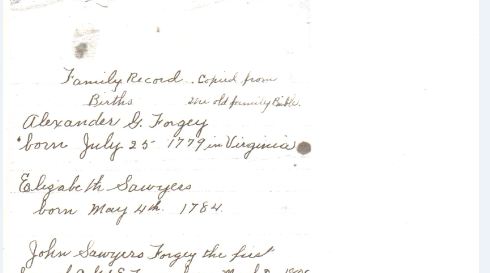
We do however have a Census birthplace entry for Alexander Forgey which states he was born in Virginia. There seems to be universal agreement regarding his birthplace. The family bible also states he was born 1779 in Virginia. All of the entries I have found for his children seem to agree. It is known that the likely brother of Alexander Senoir, Andrew, was in Virginia in 1779 according to a court case in Washington County, VA. 


Alexander Forgey 1850
Family Bible entry for Alexander Forgey

So we have a definite link between the Junior Alexander and Virginia. If he wasn't born there he certainly had a memory of living there early in his childhood. There were other Forgeys living in Virginia in the 1700s. Robert Forgey of Dumfries was the earliest. This family generally used the Forgie spelling. Daniel seemed to be the only surviving son of Robert. There was also a Joseph Forgay named in a Will in Augusta County, VA. The Sawyers family lived in Augusta County, VA. Don't know if there is any connection? Could not find any other references to Forgeys in Augusta County, only a single reference. Hugh Forgey who later settled in Kentucky was married in Greenbier, VA in 1786. With very few records for these areas before 1800 it is difficult to establish who the father of Alexander and Andrew was. Based on proximity and interactions between these men and the Hawkins County, Tennessee line, I still lean in that direction.

Reference to a Joseph Forgay in Augusta County, VA dont' know the year?

Thursday, August 25, 2011

Interpreting Taxlists

I finally received my Washington County, VA Taxlist microfilm from Salt Lake City. I had some problems interpreting these lists. Some of the lists have column titles with detailed names. Other taxlists have columns without names. I copied the pages with Alexander Forgey's entries and should have noticed the absence of column heading on some of the lists. There may have been headings on previous pages?
I found a nice explanation of these lists at a family website which I copied as an image (see above). I agree with this person that some of the info can be conflicting. It does appear that who's taxed  and what's taxed could change from year to year. Also I have not been able to find a list of who might be exempt? I have not been able to find any websites with early Virginia tax statutes which would help me to understand the lists better.
It was very disappointing not being able to find Andrew Forgey, husband of Eleanor Randall, in any of these lists. The 1787 taxlist seemed to point to the possibility that the male in Alexander's household was Andrew. Since the 1786 and previous lists contain the names of only males over 21 he would likely not have been old enough to be listed. The 1788 taxlist does note the number of males over 16; so there should be someone over 16 noted in Alexander's household but there is not. If indeed the 1787 list noted Andrew than possibly he left his father's household to work on another farm or was a member of the Militia. I am not sure who might have been exempt from taxation so he may have been exempt? Another possibility is the person noted was a slave belonging to Alexander's wife Anne named Jane? He was only married to Anne briefly around this time. Also so many taxlists with only one tithable per household leads me to believe there may have been some deception, and some households may not have devulged all tithables.
1794 Taxlist Alexander Forgey
Every year from 1788 to 1793 lists only one tithable in Alexander's household. In 1794 three are noted, but one year later only one is noted which is very perplexing? I came to the conclusion that Alexander G. Forgey was the son of the Alexander. He was born in July of 1779 in Virginia according to a family bible. So Alexander Forgey the younger would not have been 16 in 1793 and would not have been noted. Alexander also would not appear in the 1795 list either because he turned sixteen a few months after the April taxes were collected. I was not able to establish any connections between all these men using the taxlists.  Alexander sold his property in 1795 and does not appear on the taxlists again. It is unknown what happened to him after the sale of his property. Hopefully something will surface to clear all this up.

Friday, August 19, 2011

How the Forgeys earned their Bread


Cecil Clair Forgey's Store in Freetown, IN

The occupations of the Forgeys reflect the era they lived in. The earliest Forgeys to settle America were generally farmers; a typical occupation for that era. Early America was a nation of Farmers and cheap land attracted those engaged in this pursuit in the old world. Many Forgey families owned large tracts of land. Some of these purchases can be found at the BLM site. According to wikipedia in 1870 70-80 percent of the population was involved in agriculture. 
The Forgeys Scots-Irish heritage can be seen in the occupations of the Forgey immigrant generation. The Scots-Irish in Ireland were often associated with the textile trade. Robert Forgy of PA was a weaver by trade. William Forgy also an immigrant to PA was a Tailor. Whiskey making was another skill which the Scots Irish brought to America with them. Andrew Forgey was convicted of selling liquor without a license and above the rates in late 18th Century Virginia.The Forgey's supplemented their farming income in fields such as Whiskey making, Blacksmithing and Tanning. Such jobs were often a sideline to farming. It looks like Archibald Forgey of Scott County, VA did blacksmith's work. My ancestor Hugh Forgey of Jackson County, IN worked as a Tanner.

By the 1880's a shift was occurring which can be seen when studying Forgey Census records. There is a gradual shift from farming to other modern occupations. Some of the earliest alternative occupations can be found in the mining industry such as coal and metals mining. James Forgey was a quartz miner at the Saw -Tooth Mining company in Idaho. My ancestor Andrew Forgey's sons  Clark and Elisha migrated to Colorado where mining was the primary source of employment. Clark worked as a Teamster and his mother cooked for the miners.
New forms of transportation also led to new job types. Frank Forgey of Craighead Arkansas worked as a fireman on a Locomotive in 1900, and by 1920 he worked his way up to engineer. James Forgey of  Hamblen Tennessee either owned or worked at an auto dealership in the 1930's.
New technology led to many new job catagories. The phonograph led to  an increase in the number of music stores. Harland Forgey of Hamblen, Tennessee either owned or was employed by a music store in 1920. James Forgey of Hawkins County, TN line seems to have been the most prosperous. James had invested in land early on. He owned large tracts of land. His descendants inherited much of the land and parlayed the profits into other investments. Some of the profits were used for education. So this line of the Forgey family was able to take advantage of opportunities available to those with an education.  According to the 1880 Census James R. Forgey was a Stock Trader. By 1900 he is listed as Bank President.
The propensity towards litiagation in this country also resulted in a large legal bureaucracy. James Forgey of Iowa became a lawyer but was later imprisoned for larceny. Several Forgey were Justices of the Peace; one of which was Archibald Forgey of Scott County, VA.
The booming comumer culture of the early 20th Century led to an increase in the number of merchants.  Many Forgey family members were employed as salesmen. A few also were entrepreneurs opening shops of their own. My great uncle Cecil Clair Forgey ran a small store in Freetown, Indiana.


Wednesday, August 10, 2011

The Rise of Peer Culture

Popular among his peers David Shields Forgey belonged to the Pan-hellenic Council, Sigma Alpha-Epsilon ,  The Eddies, Mcallie Club, Tennessee Club


Searching for the descendants of James Forgey I found yearbooks from the early 20th century with entries for two of his descendants. Looking through these brought to mind my study of the rise of peer culture during this era. I think that subject is fascinating. The move from the Victorian era to the modern era can be seen when you look at early twentieth century yearbooks.
Victorian society was very strict and rigid. The parents of Louise Taylor Forgey and David Forgey were brought up in a different world. A place where children were expected to remain silent and assist the family on the farm when needed. Extreme modesty in dress was stressed for women. These rigid standards caused the next generation to seek liberation.
The middle classes, like David and Louise's family, and upper classes were the first to embrace the new modern ethos of this peer culture society. The parents of David and Louise may have embraced or at least were aware of the new child rearing techniques being advocated in books. Children at this time became centers of attention for families, whereas, before daily tasks for survival were the focus of family energy. Families were freed from time consuming daily tasks by new labor saving devices. Now the nurturing, emotional and intellectual growth of children could become the focus of families. Child development became a popular field of study, opposing theories were debated in the press. It was felt by some that mothers were becoming too indulgent and permissive. Although some of the new theorists felt rigid structure stifled the creative development of children. The progressive educational movement popular when David and Louise were children also stressed encouragement of creativity in children as opposed to rote learning.
These products of the new child rearing techniques were given freedom from responsibility for a much longer time than earlier generations. Middle class teenagers did not have to help provide for the family anymore. A growing number of high schools and colleges in the early 20th century allowed them to continue their education, and as a result they spent more time with peers than family. 
Louise Forgey and brother David were club joiners. Louise is
pictured  here as a member of the Kodak Club.
The more lax upbringing of these children is reflected in the later behavior of these individuals. Previous dress codes became more and more lax along with moral standards. Teenagers and young adults wanting to assert their independence tried to set themselves apart from their parents generation by adopting fads and new dress styles. A culture of  conformity also sprang up. To be considered a part of the peer group you had to fit in and conform to their culture. Fitting in meant joining clubs in school. Athletics became a way to achieve status on campus.
Peer culture sometimes led to irresponsible behavior. As a counter to this YMCA and YWCA clubs were formed.
The peer culture of teenagers and young adults did help prepare them for the modern business world where networking became important to success. (It's nice too be able to put my research into a famiy perspective.) 


Friday, August 5, 2011

52 Weeks of Personal Genealogy & History - Grandparents' House


My Forgey grandparents purchased the family home and 2 acres of property in about 1939. It was located at 248 4th avenue in La Puente, California (by the way another unrelated Forgey family lived on 4th Street in the same town, which led to confusion with their mail lol). My grandfather Charles Forgey, as stated in the 1930 Census, worked as a carpenter after leaving the Marines. He built the first family home in La Cresenta, California. The family lost that house during the Depression. They rented homes in Glendale California until they saved enough to buy a home and some property. My grandfather used his carpentry skills to fix up the little old farmhouse they bought. He added two rooms on basically by himself; but hired an electrician for the wiring.
By the time I was born in 1963 my grandparents had been living in that house about 24 years; and the house was filled with mementos and memories. My grandfather was born and raised on a farm in Indiana and had a green thumb. The family had a little truck style farm there on 4th avenue for many years. They also kept some small livestock such as chickens and goats. I fondly recall the fruit trees my grandfather planted on the property. I remember visiting there in the Summer and eating tons of mulberries, plums and apricots. The fruit was delicious and much tastier than you can find in the supermarket.
I remember the old timey kitchen with it's red checked curtains and old concrete or granite counter tops.The family always ate at the antique oak table in the kitchen.  My grandmother,Graciela, was a great cook and loved to cook; so spent many hours in that kitchen. She also loved people too, and invited many friends over for meals.
I also recall  the old bathroom with it's old fixtures.The one bathroom was fairly roomy for a small house with a large claw foot tub.
My grandfather was a hunter and fisherman. He devoted a whole room to memorabilia connected with these pursuits. He hung animal heads on the walls and stuffed birds.  I also remember his gun cabinet. I would sometimes take a nap in that room when I was a baby lol.
Something that really stands out in my mind when I think of the house is all of the family pictures my grandmother loved to display. I was told that my grandparents had a picture of their baby daughter Isis Forgey taken after she died. I was a little afraid of coming upon that picture. I don't think they ever displayed that one? Most of the pictures were of the many grandchildren. I loved seeing my own picture which was one of the largest on display. My father would always say who is that monkey on the wall :).
My Picture from my Grandparents house

Another prominent picture in the house that fascinated me was a picture of my great-grandmother Isis Forgey which hung in the living room. I always admired it. Just a couple of weeks ago one of my cousins was cleaning out her garage and found the large framed picture. She asked if I wanted it which of course I did and I am thrilled to have it. 
The house remained in the family until about 1978. When the property was sold the house was torn down. At least I still have the pictures and fond memories.

My Great-Grandmother's picture (Isis Browning-Forgey) from my grandparents' house

Thursday, July 28, 2011

DNA and the Percentages


I've been looking at the database set up for the descendants of Benjamin Franklin. Of course they were able to construct a massive DNA project. Looking at this site has helped me understand what DNA can do for family historians. The chart (see above) with the predicted relationship percentages was especially helpful. Now I can see you can predict relationships 24 or more generations back, and also look at more recent generations. I did notice that mutations did not happen frequently.
It would be nice to have a known relative of James Forgey or Andrew Forgey tested. I have been trying again to find descendants. This is what I came up with.
James Forgey born 1766 Ireland had one son James R. Forgey
James R. Forgey  had two sons who left male children Gabriel and James R.
Gabriel Forgey's sons:
James N. Forgey
Gabriel Forgey he had two sons Versel Ray Forgey and Gabriel R. Forgey 
James N.  had two sons who lived in Bristol, Tennessee Charles and James Forgey. Charles died in the 1990s I don't know if he left any children.
James R. Forgey Sr.'s sons:
James R Forgey b. 1886 died 1931 Didn't leave any children? Could not find any listed on Census
Frank Harland Forgey b. 1894 d. 1968 Only had two daughters Marion and Catherine
David S. Forgey b. 1898 Was in WWII and stated at that time he had no children?


Saturday, July 23, 2011

The Complexities of DNA

The envelope with the DNA Kit

After a great deal of reading about the different DNA tests available I came to the conclusion that the Y test would be the most useful. I ordered the Y 37 marker test. The autosomal test is too general to be useful at this point. I decided to test someone in the line of the Forgey family I have established a circumstantial case for. I am hoping someone in my line will be tested soon. If this person decides not to then I will have my uncle tested.
I am not sure exactly how many generations back I might be able to go with this test? It seems from what I read it establishes a family relationship 8 generations ago with a high degree of certainty.  Hopefully there won't be too many mutations in the markers tested. Over the generations mutations occur occasionally . I am hoping for at least a 35 out of 37 match between my family and John Forgey's descendants.
I am hoping two tests will breakdown my brickwall. I have been searching for other male descendants of Andrew Forgey and Margaret Reynolds in case I need more individuals for my DNA study. I found out there were few male descendants in their son James Forgey's line. He had only one son. Their son John Forgey had the largest number of male descendants. Most of his descendants still live around Chattanooga Tennessee. I don't know where the descendants of Andrew and Margaret's son Andrew settled? They lived in the Shelby County, Tennessee area in the late 1800's. I am not sure if there are any male descendants living now? They don't appear to be in that area now.
I should have no problem finding males in the Andrew Forgey and Anna Roller line to test. There are a number of male descendants in that line. A few years ago someone compiled a list of all know descendants in that line. It was 42 pages and listed a number of males. This list wasn't even complete.
I have been talking about a Forgey DNA study for years. Finally it seems like I am making progress in that direction. I have found two, Forgie and Forgy, results already posted on the internet to compare with as soon as I get the results. Hoping for a breakthrough soon!

Sunday, July 17, 2011

Now for something a little different


I thank Liz Tapley the author of the blog My Tapley Tree... and it's Branches , and Randy Seaver Genea-Musings ,  for the chart idea. I made an ethnicity chart for myself. My ethnic breakdown is certainly more complicated than this. I probably have some Native American ancestry, and my Nicaraguan/Spanish line includes some German. My Austro-Hungarian line is likely also Jewish. Which brings me to a quandary should I take an autosomal DNA test, or have my uncle's Y DNA tested? When I started out with my DNA research in 1998 my primary question was whether the Kapple family was substantially Jewish as far as Ethnic origin. I was never really able to verify this using available records. It sounds like I might be able to get a percentage of Jewish ancestry with the autosomal test. On the other hand I have been doing lots of research on my Forgey line and would like to verify what I have found in records for the family. I mainly have a circumstantial case on this line. I would like to buy both tests but can't afford to now; it's either one of the other. Family Tree Finder is having a sale which only lasts until July 21st. So I will have to make a decision
quick.

Monday, July 11, 2011

Roller Church Records


I received a reply from the Reformation Lutheran Church in New Market, VA regarding their records for the Roller family. Unfortunately Anna Roller was not baptized there. The older children were. This is what they wrote:

I just got an email from our historian. Here is the news...we have what we think are complete records, but Anna's baptism is not recorded in any that we have. 

We've found Jacob and wife Eva Roller had three children baptized: Maria Magdalina, Johannes, and Eliner. Grandparents were Johannes and Catarina Roller. 

These entries are in Davidsburg Church Baptisms 1785-1845, New Market, VA . 
We also have Johannes Rolled, no date.

Our Historian found no cemetery records with those names and suggested you check Rader's church records at the Heritage Center, Dayton, VA. She thinks she saw Roller records there.


According to the snippet above Lewis Zirkle donated the land for Davidsburg Church now Reformation Lutheran church. The Rollers may not have lived in New Market, but had their children baptized there because of the family connection? 
I have priced around the cost of getting a copy of these records at several places. The library of Virginia has the manuscripts of these records. They want $25 for a copy.  I've decided to order a microfilm copy from the FHL and save $20. This is a description of the records: http://lva1.hosted.exlibrisgroup.com/F/ITAU4IQ1GUUP4H2V5UGDP9LBCQVIEKT41XNLSD2UMJ3BKKCVJN-15204?func=full-set-set&set_number=005332&set_entry=000004&format=999 

Friday, July 8, 2011

Alex Forgey's Son?

1787 Tax List For Washington County VA

A piece of info which could be a major breakthrough regarding Alexander Forgey and his line surfaced this week.  A descendant of Alexander G. Forgey brought a 1787 Washington County Tax List to my attention. A very useful bit of info was provided on this list. A column was set up to record males between the ages of 16 and 21. They were not identified by name, only the number of those in that age range living in household were provided. One male in that age range lived in Alexander Forgey's household. We presume this is a son, but with no ID don't know for sure?  I have ordered an  FHL Microfilm with tax lists from 1782 to 1805. I hope that one of these lists contains the name of Andrew Forgey at some point (the film is on back order, so I may have to wait awhile to see it). 
The 1787 and 1797 Washington County, Virgina Tax Lists are free online. They are selling CDs with the intervening years for $20.00 apiece at this site. No Forgeys appear on the 1797. Alexander Forgey sold his 300 acre land grant in 1795. It appears that the family relocated elsewhere at that point in time. I am thinking they migrated to Knox County, TN, near family. 
It was thought by the author of the book A genealogical history of the Forgy, Forgey, and Forgie families in America, Lucille Wallace, that Jacob Forgey and Hugh Forgey, sons of Archibald, were Alexander's sons. Archibald's line does not use the name Alexander at all. Instead this family uses the same naming patterns as the Hawkins County, Tennessee Forgeys.

A genealogical history of the Forgy, Forgey, and Forgie families in America,  By Lucille Wallace.

Sunday, July 3, 2011

Alex Forgey Washington County, VA


I am doing some research on the presumed brother of  Andrew Forgey b. 1732 i.e. Alexander Forgey. My goal is to find out whether Alexander G. and Andrew are his sons.  He and Andrew apparently migrated to Washington County, VA around the latter part of the 1770's. Washington County, VA research is challenging because of record losses. This snippet from The Annals of Southwest Virginia describes some of the missing records:

I've found very few documents mentioning Alexander Forgey. He married Agnes Meeks in Washington County, VA in 1786. I also found Alexander in the Washington County, VA will book. This entry is not related to a will, but is a bill of sale between himself and his father-in-law Samuel Meek. An image of this is posted above.I interpret the above document as meaning that Alexander Forgey's wife went back to her father? I found an Agnes Forgy marrying a James Rogers on 26 Apr 1789 in Washington County, VA. I don't know whether that is a reference to his daughter? (By the way Anne is a nickname for Agnes) I wondered whether Agnes may have divorced Alexander. This is unlikely because early divorces were legislative and none seem to have been awarded before 1803, and only about half a dozen were awarded for that County after 1803 up until divorce was outlawed in the mid nineteenth century. I checked the Legislative Petition Database  and did not find any references at all to Forgey/Forgy.
The land sale below seems to confirm that he didn't have a wife in 1795. All of the other sales on the page refer to husbands and wives.


Land records are some of the few surviving records for that county. A 1782 Commissioner's Certificate for Alexander refers to the same land as the 1785 Grant Document, and the land sale posted above. The land Grant was awarded to him by then Governor Patrick Henry.  It sounds like he was assigned the commissioner's certificate by someone else. These Certificates were awarded to those who settled the area before 1778.


These are some of my sources for Alexander Forgey.


Saturday, June 25, 2011

More James Forgey 1802 bible analysis


The page with my likely ancestors entries is a puzzle. It does look like Andrew Forgey's birth info was added after his death info? So everything in that column was more than likely added after the death date of  3 Aug 1809. We can probably surmise this because someone accidentally wrote his death info on the birth side then crossed it out and recopied it in the correct column. 
How, when and by whom all of this was written is a mystery. Was Nancy and Sally's info added before Andrew's? Or were all three added the same day?  It is possible that Andrew's death was recorded around 1809. Margaret's death entry is phrased differently and the handwriting is different. The other death entries have the latin phrase anidomini  and "departed this life". The 1828 death entry is more straight forward and says died.  The 1833 entry for her grand daughter appears to have been added later. It would appear that the last two entries on the page were entered around their times of death. So the impression is that the entries on this page were made between 1809 or a few years before, for Nancy and Sally, and the last entry was recorded in 1833.
The 1833 entry marked the end of the page and the death entries were continued on another page. The second page of deaths appear to be recorded in chronological order as they happened. Entries were recorded in several hand writings, apparently by several people. The phrasings for death ranged from died, departed this life, and deceased.


Apparently someone wanted to clarify the jumbled and partially illegible info from the page with Andrew & Margaret and son James info and recorded this:

Could be the same person who recorded the previous entry? They seem to phrase the entries the same. Also they both misspelled February as Fabruary. 
More thoughts on the bible. It appears that the style of writing most often used in the bible is called copperplate mixed with round hand style.. It was very popular in the 18th century. I was also thinking that maybe a minister recorded the marriage entry for Margaret Forgey in the bible? I don't know whether this may have been customary?  
Also noted an entry for Margaret Forgey mother of James included the abbreviation for senior? Not often used for women.
There is a lot of handwriting to compare in this bible, and a lot to think about as far as word usage and phrasing. Maybe someone with more experience analyzing this sort of thing would be able to nail down the entry dates better.


Friday, June 24, 2011

Nan's Trip Docs/ 1) James Forgey Bible


Nan's trip to our ancestral area in East Tennessee and extensive research and copying has really assisted me in my documentation of our family history. I did not have any original copies of such sources as Andrew Forgey's Will or the much quoted Family Bible.
Above is the citation I created for the bible at Rootsmagic. I find their citation templates so helpful. Another template which I will being using for the bible citation has fields for provenance and analysis. 
I have been analyzing this bible as my time permits. The first thing I took note of is that the bible was published in 1802 in Philadelphia. According to the book Families of Hawkins County, Tennessee, 1786-1994 , the Forgeys brought a family bible with them from Ireland? They came from Ireland in 1760's. I suppose there could be another bible, but I think this is the one they were referring to. Likely no one checked the publication date. 


The purchase date was recorded as 1805 which is also well after their migration to America.

This person F seems different than all other entries?
 Now let's plunge into some handwriting analysis. I love handwriting analysis ( I remember many years ago, when I was a child I had my handwriting analysed by a computer at the local mall) . This kind of analysis can be tricky. Sometimes several people in the same family can have very similar handwriting. For instance my mother and her brother at one time had nearly identical handwriting. My Grandfather Forgey and his brother also had similar handwriting.  This probably has something to do with the style of writing being taught at their local school during that time period, and siblings observing one another.
This is James Forgey Sr.'s bible. He was born in Ireland in 1764. The earliest entry records the birth of Andrew Forgey  4 February 1732, the owner's father. 


 It looks like the birth records for James Forgey's children were added to the family record before  Nov 1810? I assume this because the baptismal info was added later under the original entires for two children. They were both baptized 17 Nov. 1810. All of the birth date entries appear to have been entered by the same person? The 1823 entry for Gabriel Rogers was added later, from the appearance of the writing.


At first glance all of the writing looks similar. On closer inspection there are differences. An example of this is found in the marriage records section. Entry one and two seem to have been written by two different people. The first entry was written by someone who didn't slant their writing as much, and wrote in a larger hand. These two entries are not phrased the same. The first of the two was for the marriage of the bible owner, James Forgey, recorded in bible well after the actual 1791 year of marriage. The second is for his daughter Margaret in 1812, which could have been recorded around the date of marriage? 


It's interesting that most of the entries on this page are in chronological order except the one at the bottom of the page for 1817 which should be above the previous entry for 1830.  Most of the entries were made at different times possibly by three different people? The third writing style is a less elaborate style. Below is a sample of the third writing style appearing on the same page.


It looks like the final entry is in 1853 for the death of the bible owner's son James R. Forgey. It looks like James P. but it is a little hard to read?


I don't know whether James Forgey actually wrote any of the above? I have three examples of what I believe to be his writing. He had a distinctive way of forming his r's and g's which gave the impression when grouped together of a large y? Other people misread that as a K. His y's in the two examples I have show a distinctive curl to the tail, which I don't see in the bible. His writing style somewhat matches one of the early writing styles in the bible, but is a little different. I suppose when you are writing in a public place you may write more hurriedly than at home? This may account for the differences? It is possible that he did write the early entries.

I believe this is and example of his James Forgey's writing?

The provenance of the bible seems to be as follows: it was purchased by James Forgey Sr. passed down to son James Forgey Jr., and then to his son Gabriel Rogers Forgey. then to Gabriel's daughter Evalena Forgey-Morrison then to her son Crockett Morrison.
In conclusion it appears that at least three people, possibly more, made entries in the bible. Some entries were made at an early date, others later. An analysis of writing styles at different periods of time would be helpful.  I think it also would be helpful to see the handwriting of all these owners in order to determine by who and when the entries were written.

Another writing example for James Forgey

Friday, June 17, 2011

Germans and Women


I've been doing a reanalysis of my family history data at Roots Magic and adding more detail to some vague sources. I have been focusing on my German lines. Much research has already been done on these lines. I am doing my best to verify what has been done. There really is a lot to look at and consider. Since much of this info is not sourced it's not alway easy to track down. Luckily many of the males left detailed wills. The family female lines are more difficult. Females seldom appear in early records which makes tracing their families difficult.
 A case in point Maria Eva born about 1713, maiden name believed to Bear? She married  Johannes Ludwick Zirkle. She and her husband lived in Telford, Pennsylvania before his death in 1746.  After his death she relocated to then Augusta County, Virginia with her children. I find her very interesting because she is one of the few female ancestors mentioned in early local records. 
I am trying to verify that Maria Eve's maiden name was Bear or Bare. Her name was recorded as Bear in a Zirkle Association newsletter published many years ago. No source for this info was provided. I've searched using google for any new info regarding this. Many people continue to use Bear as her maiden name, but no one has provided any sources. Doing some more research at the website for the Virginia State Library, the Memory Project, I found a grant conveyed to her in 1755 for 54 acres in Augusta County, VA. A John Bare was a neighbor. Eve Sircle also is mentioned in volume 3 of  The Chronicles of the Scotch Irish Settlement in Virginia by Lyman Chalkley. The references in  this book also regard land transactions, one of which I have a copy of (the one I found at the state library site). The other property reference refers to a patent for 130 acres which was transferred to her by John Bair in 1761. Her eldest son's name is said to be Michael Sircle.


Since Maria Eve did not migrate to Virginia with her husband, she must have traveled there with her family. Since she did live next to a John Bare, and had land conveyed to her by him, maybe he was indeed a relative? I have not been able to locate the deed for 130 acres yet, that may provide some additional info. Someone at ancestry.com gave her father's name as Jack Bear. They did not provide any source for this either? It would be nice to have a source for her maiden name. The record survival rate for this area is pretty good so there could be a solution eventually.


Tuesday, June 7, 2011

Inferential Genealogy Case Study 2


I just finished studying the second case for the Inferential Genealogy course. I found that I had to go through the whole thing twice before I understood. Since there were so few documents with Obediah's name I forgot what the goal was the first time around :(. I also misunderstood and thought the Partlows were descendants, which wasn't important anyway. The instructor came up with many more details than I recorded in my conclusion and assumptions.
I tend to get bogged down in details. It is difficult for me to pick out the most relevant details. I always have to go over documents numerous times before I  make sense of all the info. I do need practice in the process of document analysis, as I've gleaned for this case study.
This course has helped me recognize that I have not searched broadly enough. I should search the records of neighboring counties. Many of my family locations have suffered record losses, so searching nearby jurisdictions may be helpful. I generally have not researched records after my ancestors' deaths. Searching a generation after may be helpful too. I also have a feeling that I have not seen all of the court documents regarding my ancestors. Like he said the probate process, especially, generated a great deal of paperwork. Sometimes all of these papers were filed in several places including bound volumes, loose paperwork etc. I've found probate documents filed in deed books also. I don't live near my ancestral locations, so I can't visit courthouses easily. If I could visit I am sure I would find all of these various court records which can't be accessed any other way.
After studying this course it is clear that studying all documents regarding your ancestors, and their associates, is essential to solving difficult problems. Looking for every minute detail.

Saturday, June 4, 2011

Fergus/ Forgey


While combing through everything related to Forgey at Footnote I came upon a Forgey family unknown to me. I've tried to place all of the Forgey and Forgy families in relation to their immigrant line. Could not place this family at all. I found a progenitor of this family listed in a revolutionary war pension file. A John Forgey was named as a magistrate in Elbert County Georgia. I found him also named in a probate document in Rutherford County, North Carolina. I discovered that this family normally spelled their name Fergus. I also found out the family initially settled in the same area of Pennsylvania as my family, Cumberland County and Chester County. I had noticed Fergus families in Ireland sometimes went by Forgey too. I didn't know that happened in this country. This supports the origin of the name as a variant spelling of the name Ferguson .
I'll have to make note of this family so they don't confuse me in the future. I thought the revolutionary war pension file for James Fergus was fascinating. He kept a journal during his service and presented it as evidence to qualify for his pension. I copied a snippet above regarding his opinion of hospitals at the time. I thought that part was especially fascinating.


Wednesday, June 1, 2011

Broad Search

We are studying Tom Jones's course on Inferential Genealogy at Second Life, which is available at https://www.familysearch.org/learn/researchcourses . I am presenting an example here of how a broad search helped me to solve a genealogy problem.
My focused goals were to find the parents of my ancestor Nancy Melvin and where in Maryland she was born. She married Elijah Hicks 28 Feb 1823 in Bracken County, KY. I checked online family trees, but could not find one listing her parents.
Step 1. Searched 1820 US Census Kentucky for possible fathers. I found only one possible father in Bracken County, KY. His name was John, and a female in her age range was listed in his household. I also searched Clermont County, Ohio where Nancy lived after her marriage. A William Melvin lived there in 1820, but didn't have daughters in her age range.
Step 2. I ordered a copy of the marriage record for Elijah Hicks and Nancy Melvin from the Bracken County genealogy Society. I received a copy of their marriage bond which John Melvin signed. At this point I felt like it was more likely than not that John Melvin was Nancy's father.

Signatures from 1823 Marriage Bond of Elijah Hicks and Nancy Melvin

Step 3. Searched 1850 Bracken County, KY Census. Found a John Melvin, but he said he was born in Pennsylvania same as his wife. I figured this might be wrong, and just an echoing of the birthplace for his wife.
John Melvin 1850 Census for Bracken County, KY with third wife

Step 4. According to all available census records Nancy was born in Maryland (all Melvins listed in Census records for Clermont County, OH and Bracken County, Ky stated they were born in Maryland). So I searched the 1810 Census for all of Maryland. I found 3 possible fathers in Maryland. One in Worcester, where many Melvin families lived. There was a John Melvin with a female in her age range in Worcester County. A William Melvin also lived in the area.
Step 5. Looked at online marriage records for Worcester, Maryland. Found a marriage for John Melvin and Mary Redden.. They married 24 Nov 1800. Nancy Melvin's eldest daughter was named Mary. A William Melvin married around the same time.
Step 6. I did a survey of all available records for Worcester, Maryland online. Nothing linking the Worcester County Maryland Melvins to Bracken County, KY.
Step 7. Went back to Bracken County 1850 Census looked for neighbors from Maryland. Found a Purnell Redden. Searched online family trees for him, where I found one giving his birth place as Worcester County, Maryland. His father Shadrack was said to be the brother of the Mary Redden, who married John Melvin. At this point felt like I was on to something :)!
Purnell Redden 1850 Census he appears on the page previous to John Melivn (his wife was a Norris and John Melvin's third wife was related to the Norris family)

Step 8. Went back to Worcester Records online and found Shadrack Redden listed in these records which confirmed he came from there. An online probate transcription did name a Shadrack and Mary Redden as brother and sister.
Step 9. Ordered all avaibable land and court microfilms for Bracken County, Ky from the LDS Family History Library. Was not able to make a definite connection between John Melvin and the Redden family.
Step 10.  Decided to research William Melvin of neighboring Clermont, Ohio. Nancy Melvin lived in Clermont after her marriage. She used many of the same names as the William Melvin family, such as Stephen, for her children. The name Stephen was also used by the Melvin family in Worcestor, Maryland. My research in Clermont Ohio records produced nothing either.
Step 11. I posted queries at Forums for Worcester, Bracken, and Clermont explaining how I was trying to link these families and what I had found.

My query paid off big time :)! Someone contacted me by email and told me that there was a biography published in an Indiana County history, which stated that William Melvin's daughter was born in Snow Hill, Maryland, which is the town in Worcester County where the Melvin Family I have been researching lived.

Centennial history of Grant County, Indiana, 1812 to 1912

 I did not have the name of this daughter because she left the Clermont area. I would never think to check a county history in Indiana :). So I now have a fairly good circumstanial case, and feel pretty confident Nancy Melvin was the daughter of John Melvin and Mary Redden of Snowhill, Worcester, Maryland. I am continuing to research this family for further confirmation.