Tuesday, May 13, 2014

DNA News of the Week: What is really Provable?

The names in red  represent lines I've had DNA matches on. I've had a Forgey matches out past  my paper trail.


An important statement recently regarding DNA standards and ethics, which was recently drafted, was brought up at  last week's NGS conference. You can read more about it here at The Legal Genealogist's blog. It raises questions about how test results should be used and interpreted. I was aware of the possibility of NPE's back in 2011 when I started DNA testing relatives. I didn't have to deal with any of these events until recently. The possibility of uncovering long forgotten family secrets is a bomb shell issue, and not my favorite part of the process. So we are all trying to navigate this booby trapped maze. Advice on handling our results is appreciated.

Another very interesting bit of information coming out of the NGS conference regards ancestral predictions at AncestryDNA. AncestryDNA had been using megabase matches to predict relationship degree. Fall 2013 they switched to using centimorgans. Anyone testing earlier than that still has results based on megabases. Another hint coming out of the conference was that Ancestry does intend to offer more tools to better analyse your results. Doesn't sound like a chromosome browser? We'll have to wait and see how useful they are? You can read more about what was gleaned regarding AncestryDNA at NGS from CeCe Moore's "You Genetic Genealogist" blog.
It was confirmed in the past week that Family Tree DNA did give a couple of customers the wrong DNA results due to samples becoming switched. I think the error rate is generally low, from what I hear. It is probably best to confirm your results with a second company if your results don't make sense. 

Since myOrigins came out last week I've done more reading about the admixture results the DNA companies provide. As everyone agrees the sample populations are still too small to base any definite conclusions. Also as the Genographic project puts it if you are very mixed ethnically, the results can become very complicated. 

A very interesting blog post about the new myOrigins utility was posted at the DNAeXplained-Genetic Genealogy blog. I borrowed Roberta Estes' idea, and chart, to see if I could infer my father's likely results. I came out with a 30% difference, meaning I didn't inherit this DNA from my mother. It was an interesting exercise, the differences became very apparent when I charted them. All of this is really speculation at this point. We'll see how much more unambiguous the results can become?

I borrowed Roberta Estes' chart to compare our results. Undetermined was 30. 

So what can we definitely prove with DNA without question? 
  1. With Y DNA we can prove a definite relationship between two men. We can only estimate when that relationship occurred. 
  2. With mtDNA we can also prove two people are related, and estimate when.
  3. atDNA can prove relationships in the past few generations, and we can speculate on possible relationships beyond that. This test requires a family tree going back at least 5 generations and preferably 11. 
  4. As far as admixture results we can only predict European, African, Asian and Native American ancestry with a high degree of accuracy. We can't reliably predict any more precisely than those broad areas. 
  5. Y DNA is more reliable in giving us more precise ancestral locations. SNP's provide us with the possibility of finding a very specific ancestral locations.
  6. Solid DNA matches can prove our paper trail. DNA without a paper trail proves nothing, and a paper trail without DNA confirmation doesn't prove a blood relationship. 
My DNA goals:
  1. After attempting to reconstruct possible results for my father I've decided I need to find a stand in for him. I will try to get one of his 4 sisters to test.
  2. We need more Forgey/Forgy & Forgie men to take the Y DNA test. We need at least one confirmed haplo for each line. We can also use more atDNA testers
  3. I would love to find more Owens DNA matches. So far I do have one moderate match at AncestryDNA. We may need to recruit more Owens relations for DNA testing.
  4. I don't have any matches on Urmey, Brower, or Hicks. Since AncestryDNA's surname search doesn't work reliably (meaning it doesn't bring up every instance of the name you are searching for) I need to page through all my matches looking for these names
  5. I am also attempting to breakdown my Sarah Campbell brickwall. I found a couple of moderate DNA matches at AncestryDNA which may lead to a breakthrough. 
So what have I proven to date using DNA? I now know that my Forgey family was Scottish. We used SNP DNA testing to prove this. We also know that the most common Haplogroup for the Forgeys is I-L126. We know Andrew Forgey of Maury County, Tennessee, Andrew Forgey of Hawkins County, TN and Samuel Forgey of North Carolina are definitely related. These men were also related to a Forgie family of Co. Down , Ireland. The surname did derive from Ferguson and our group has close matches with the surname Ferguson. My Forgey family, along with the others have had no NPE's since around 1600. I've confirmed my blood relationship to a number of my lines (see pedigree charts). I've discovered Native American, and African ancestry. 

Still waiting on a YDNA result at FTDNA. This test is taking much longer than usual. I'm hoping they don't have to rerun it? I was thrilled to learn I may be able to breakdown a brickwall on my Thurman line when a descendant in my line takes a Y 37 marker test. Hoping his test comes back sooner than our last test! 


Tuesday, May 6, 2014

DNA Extra: Ancestors Falling through the Cracks

My Grandfather Rudolph and children
The Inzenhof Koppel Family had an interesting look.
Some family tended to a dark complexion, others were very fair.


Well I seem to have found my Iberian ancestors at myOrigins. The heat maps now include Spain. It still puzzled me why my Mom only has 10% Mediterranean? The description of population reference groups at the Genographic project cleared my confusion up. The average Iberian only has 48% Mediterranean. Their DNA is so similar to Northern European you can't tell it apart. They also have some small amounts of Southwest Asian.


This may also apply to my Kapple or Koppel ancestors? Koppel is an Ashkenazi surname. The family lived on the border between Austria and Hungary. Everyone believed they were Ashkenazi based on the surname and the Semitic look of some of our family members. This is not showing up in my DNA. Ancestry did find less than 1% of Ashkenazi DNA. I have 4% Middle Eastern DNA which may related to the Kapple side of my family? It's not showing up in my Mom's results. Her Middle Eastern isn't from North East Africa like mine. I do have 8% Eastern European, but I'm sure which side this is from? I know few people in the Koppel village area have taken any kind of DNA test. A few have taken a Y test. My Kapple cousin Darryl's Y DNA is J2B. I'm thinking the problem using DNA to find our Koppel ethnic heritage relates to not enough data. The chart Doug McDonald gave me a few years ago showed areas marked not enough data which may relate to the Koppel DNA?


More Koppel Family


Monday, May 5, 2014

DNA News of the Week: MyOrigins vs AncestryDNA

myOrigins 

Finally we got a look at the new myOrigins ethnicity charts, which replaces Population Finder at Family Tree DNA. Sorting through all this brings to mind talk show guests who purport to communicate with dead relatives. They ask audience members, for instance, do you know someone with an R in their name. Is it a male? Is his name Robert or Roger? Not too impressive. The DNA companies do tell us instead of asking about our ancestors origins. At the same time giving themselves plenty of wiggle room by not completely committing to anything specifically. You might be told some your ancestors were from Italy. The fine print says give or take a few thousand miles. Basically your ancestors were from Europe somewhere, but who knows exactly where? That's difficult to exactly pinpoint with DNA. Broad regions can be predicted reliably however.
Actually the old Population Finder results came close to committing to a specific area. My mother was said to be 18% Mozabite with an error rate of less than 1%. Her new results have completely backed away from that. She now has 10% Mediterranean and  8% Middle Eastern. Only 2% is now in the Morocco/ Algeria area. My Middle Eastern is only 4% now, and it was 13% with a high level of confidence. So the old Population Finder was quite inaccurate. We should have been given margins of error close to 50%.
Turning to our head to head competition between AncestryDNA and myOrigins; we find we need to translate the regional descriptions in order to compare. Western Europe seems to be covered by European Coastal Plain.

Round 1. European Coastal Plain at myOrigins and Western Europe at AncestryDNA. This is where we see the most stark contrast. Ancestry only gave me less than 1% for this area. My Origins gives me 50% for this region. Both could make some sense. I do have a substantial number of French Canadian and German matches, which could point to my inheriting more DNA than would be expected considering how far removed I am from these ancestors. Ancestry does say I could have plus 3% since they do present a margin of error. If you calculate shares of inheritance based on generations I could have around 3% of German and combined French? I could have inherited more than that, but I would not think it would be 50%. I would have to give that round to Ancestry.

Round 2. Our next round considers British Isles ancestry. Ancestry breaks that down between Britain and Ireland. Combine these two result I get 60% British Isles. MyOrigins gives me 29%. I would say 29% would be closer if you break my heritage down by generation. That round goes to MyOrigins. Ancestry gave themselves lots of wiggle room on this one with high margins of error however.

In Round 3 we compare Eastern European results. Here we have a tie with both results around the same percentage. AncestryDNA gives me 6% with a high margin of error, and myOrigins gives me 8%.

Round 4 Scandinavian. I am not aware of any Scandinavian in my family. I've heard that Ancestry gives unusually frequent results, and high percentages for Scandinavian. I will give them the benefit of the doubt and assume this relates to the Vikings in Scotland. This round goes to AncestryDNA.

Round 5 Finland/ Northwest Russia. May relate to Hungarian? This round goes to AncestryDNA. No comparable myOrigins result.

Round 6 European Jewish. I would give to AncestryDNA because I believe there should be a trace of European Jewish which myOrigins does not show. I would like to see myOrigins show more trace regions.

Round 7 Pacific Islander Melanesia. Don't know what to make of that? It's only 1% but is completely puzzling to me? myOrigins didn't show an equivalent. I'll just scratch this round.

Round 8 Middle East is another tie round with both results very close. AncestryDNA gives me 5% and myOrigins gives me 4%. The edge does go slightly to myOrigins because they gave me a more specific area. Half point extra myOrigins.

Round 9 Native American is also very close. AncestryDNA gives me 6% and myOrigins gives me 3%. I'll give this round to AncestryDNA because FTDNA pulled their old estimate of 5.2% Native American and their specific result of Central American Native American. The old estimate had a low margin of error and I don't know why they are backing down on that?

Round 10 Africa. This result leads me to believe that the myOrigins populations are becoming more accurate. I had no African with their previous Population Finder. My mtDNA turned out to be African, so it's confirmed we do have some African. Both AncestryDNA and myOrigins give the exact same result of 2%. Half a point to AncestryDNA for a specific location Senagal. It's a tie round otherwise.

Round 11 Mediterranean. Ancestry gives me 7% and myOrigins 3%. I tend to go with the higher results because my cousin's Y DNA of J2b pointed us in that direction. I would give this round to AncestryDNA.

Round 12 Iberian. This isn't an area well covered by the new myOrigins. Ancestry gives me 5%, which I believe should be higher since one of my Grandmother's, Graciela Del Castillo, would have had a high percentage of this regional DNA. This round goes to AncestryDNA.

Final results Ancestry gets 7 1/2 points and myOrigins gets 1 1/2 
Plus 3 tied Rounds. 

myOrigins is brand new and I'm sure changes will be made at some point which may reconcile some of my results. 

Below are some charts I made. The first compares my percentages between AncestryDNA and myOrigins. The second would be a chart I made showing my known ancestral breakdowns.

Comparison Between myOrigins and AncestryDNA


My knowledge of my Ancestry

Tuesday, April 29, 2014

My DNA News of the Week: SNPs and AncestryDNA Search

Many SNPs available for sale in the R Haplo

Last Friday, April 25, Family Tree DNA began to offer again for sale individual SNPs. They also expanded the number of SNPs available for purchase by including newly identified SNPs which have been discovered in partnership with the Genographic Project. These SNP markers are useful in identifying ancient migrations of the human population.
DYS425 Null for
M284
Several of our testers in our Forgey/Forgy & Forgie Project have done deep clade testing to determine the origins our family. Our surname sounds vaguely French, and the spelling looks a little French. According to Lucille Wallace, the author of an extensive family history, the surname was most likely derived from the surname Ferguson and was Scots-Irish. It was still possible that the family had been Norman. A distant cousin Roger Forgey took an SNP test recommended by the Ferguson group administrator, which turned out to be positive for the SNP L126/S165+. This suggests our family has been in Brittan for thousands of years. This particular SNP also points to the family being in Scotland for 1500 to 5000 years. So our family wasn't Norman. Testing a single SNP was an inexpensive way to answer our question about family origins. Even after the release of the expanded SNP tree at Family Tree DNA that SNP is still a terminal one with no options for further testing at this time. Our question has been answered to my satisfaction at this time anyway.   I think SNP testing is worthwhile only if you can test an SNP that is unique enough to be useful. I suspect many are too broad ranging to be useful.

I was inspired by all this SNP talk to Google our SNP again and see what the latest research has uncovered about it. Sounds like the definition of this SNP is the same as in 2011. I did however find an interesting Forum post about the determination of the broader Haplo M284. Dr. Kenneth Norveldt explained that a null value on marker DYS425 was a hallmark of this Haplo. Only one person in our group tested 67 markers and the DYS 425 marker. I did find the null value which confirms this haplo. Nice to see that confirmation.

My AncestryDNA search isn't working correctly again. I searched Forgey and two of my matches aren't showing up. I searched another surname I had problems with before and it's not displaying correctly either. I suspect more accounts may have the same problem; but, some of these customers probably aren't aware that some of their surnames aren't showing up. Bugs in these massive databases seem to be common and difficult to repair. Here is an example of my current issue:

These are the results I got when the surname search worked correctly

These are the results I'm currently getting. Two matches are missing and they still are in my match list.

I was hoping we would have the new Population Finder at Family Tree DNA by now. They may not release it until a conference in late May? Our Y DNA project is still awaiting another result in batch 563 which may come in this week?


Tuesday, April 22, 2014

DNA News of the Week: Why Surname Project Admins. Drink


YDNA surname project administrator sounds like a pleasant little hobby/project. It would be easy if everyone with the same surname actually matched when expected. Meaning everyone descended from the same ancestors actually matched. The first half dozen men who tested in our Forgey/Forgy & Forgie DNA project all did match one another. Even those not known to have descended from the same ancestors matched. Our luck ran out a few weeks ago when someone did not match anyone in the group and actually descended from a maternal line. I thought the odds would be against this happening again with our next test results. Unfortunately, it happened again. Our batch number finally came up, our kits were in the 562 weekly batch at FTDNA. Results were posted around 8:00 pm Friday night on Good Friday/ Black Friday. I was completely floored when one of our testers didn't match anyone else. We expected him to match either our line or the line of their supposed distant cousin. Their distant cousin didn't match anyone in our group either, they had tested outside our group a few years ago. This cousin tested as I1, better known as the Viking Haplo group. The rest of  our group belongs to the I2, Scottish clade. Our last Forgy result Friday turned out to be R1. This is the most common haplo group in Europe. His STR signature is also very common with 761 perfect matches. So we had no match at all between the I1 and R1 cousin.

The Correct Forgety family
Friday we also got a result for our Forgety tester. It was thought this family had changed its name from Forgey to Forgety due to a family dispute. This turned out not to be the case with our tester testing positive for the Haplo R1. That is turning into a happy ending with this family now linking themselves to there correct line of Forgety or Forgaty. This tester didn't have a common STR signature; he only got 28 matches with 12 markers tested. 

We have one more result coming in soon. This tester is in batch 563, so should not be far behind the others. This was a 37 marker test so it may take longer.Our previous tests actually took 6-7 weeks. The kits sat unprocessed for several weeks before being check in. 

It would be great to have one confirmed Haplo group for every individual Forgey/ Forgy & Forgie line. Our phase 2 of testing hasn't not brought us any closer to this goal due to the NPE's (non paternal events). I think one of the two testers on the Robert Forgy and Elizabeth Beatty line must carry Robert's haplo based on the odds? I might be wrong and both families may have a break in the paternal line? With these two family representatives not matching we need a third descendant from a different child than these two to test. I'm hoping such a person turns up eventually. We need to do some reverse genealogy to find one. 

Last Tuesday I got my Ancestry.com results back. They came in just short of 3 weeks from the time Ancestry received them. This kit didn't sit at Ancestry waiting to be checked in so this test came back in half the time FTDNA took. I am finding the layout of the Ancestry DNA site to be outstanding with many great features. After the NPE's in our Y project I've been looking to my autosomal DNA results to verify my paper trails. I have had about 12 or so matches at FTDNA which have helped verify our family stories and paper trail. I'm finding even more cousins at Ancestry. The trees posted by my matches have been very helpful. Some people say you can't rely on these mostly unsourced trees. Well if you match the person and find a common ancestor on their tree I would say their tree is right. I have such unusual ancestry that it's easy for me to determine where I connect with most of my matches. One of my Grandmothers was Nicaraguan, and one of my Grandfathers was from Burgenland, Austria, a Great Grandmother was from County Galway Ireland, and a Great-Great Grandfather was from Quebec, Canada. One of my Grandfather's, on my maternal side, had purely early American lines. The only early American line on my father's side belonged to his Great-Grandmother. If a person's ancestors all come from the same general area it's much more difficult to determine how you connect with matches. 

Hopefully, next week the new FTDNA Population Finder will have been unveiled. Possibly by this time next week we should have our next DNA Y result. I will be completely discouraged if this person doesn't match anyone. I may then give up Genealogy and take up bird watching?


Sunday, April 13, 2014

DNA News EXTRA

Here is where we stand with our DNA testing

The world of genetic genealogy is really the booming segment of genealogy now. The ethnic results presented in detail by 23andme and Ancestry.com with visually appealing charts can be understood by everyone. Many people not interested in genealogy before have ordered these autosomal tests. Many will go no further, but some will become involved in more in depth research. So it is great news that Family Tree DNA will be offering  a similar ethnic breakdown now by improving their Population Finder. This should increase interest among non genealogists in testing with them. I can't wait to see this improved Family Finder tool myself!

I've been wondering since I became involved with DNA testing and gotten some unexpected results how accurate the results given by all these genealogy related companies really were? Human error is always a possibility. I had never heard of someone getting a completely wrong result before. I've heard of very slightly off results. This week someone came forward with news of getting a completely different haplo group from Family Tree DNA which didn't match the results they got from 23andme. A number of people have tested with both Family Tree DNA and 23andme so they have verified their Y and mtDNA Haplos. I don't think a majority of people test with more than one company. So we really don't know exactly what the error rate is? It's a good idea to test with more than one company to verify your haplo if yours turns out to be an unexpected result, which can't be explained using other sources. One member of our Forgey/Forgy & Forgie group tested his Y DNA with Ancestry.com. His results matched what we got from Family Tree DNA. My mtDNA result matched my cousins at 23andme.

A little over a week ago we received our first DNA result back from the 2nd Phase of our Forgey/Forgy & Forgie Y DNA testing. We got the results back exactly 21 days after the lab received his kit, on a Tuesday. Unfortunately, the results were useless because this person's surname came through a female line. I didn't explain how this test worked in enough detail to the tester, and they didn't know that fact would affect the results. In the future before I buy a test for someone I need to verify their descent from a strictly male line.

I'm hoping our next results come in this week which will be 21 days after they were received by the lab. The next two kits are in batch 562, and we have another one in 563. All of the results are going to be useful, but the first 2 have us on pins and needles. We have a Robert Forgy descendant who didn't match half dozen other testers. The options here are old NPE (non paternal event) and no blood relationship to us, or another Ferguson line took the name Forgy, but aren't blood relations to our Ferguson line, or the name Forgy came through a maternal line? This result is of great interest for those reasons. The other exciting result will be for the Forgety family. Are they blood relatives of our Forgey family as a family story suggests, or are they really descendants of an unrelated Forgaty family in Virginia? Hopefully we will be put out of our misery soon?

I have an Ancestry.com test in progress right now. I've been trying to gage when it might come back. From other testers I've gleaned results come back at about 30 days after they receive the kit. So they generally come in before the expected date of 6 to 8 weeks, if they don't there is a problem. I find this is also true with Family Tree DNA with test results coming in 3 to 4 weeks after the lab gets the kits. My experience also has been, with Family Tree DNA, that they batch the kits on a Wednesday and the lab generally gets the kits a day before they are batched. It can take them weeks to batch a kit after they receive it in the mail.
We'll see how long it takes for our results to come back? We will be in suspense until we see the new Family Finder Ethnic breakdowns and get our long waited DNA results!

The Autosomal test coverage for our surnames is nearly complete

Saturday, March 29, 2014

Awaiting DNA Results/Getting ready


We had a moderate quake where I live here in Whittier, California last night (and many small ones since that one). I was thinking I hope the earth doesn't swallow me up before we get our latest round of DNA test results back. We have been given expected completion dates of early May for two kits, and late April for one. I expect to get the results before then, but it's hard to predict since I know FTDNA has its hands full with the new Big Y tests kits. 


Top bars on page show
Paternal and Maternal segments
I've just tested with Ancestry.com and expect my results about the same time as the others. I have other distant cousins in the process of testing or planning to test. It's very difficult to keep track of so many results. My mom and I tested with FTDNA and some cousins tested with 23andme. Gedmatch had been a wonderful tool for comparing with cousins who tested at Ancestry.com and 23andme. A new tool I've been using is Genome Mate, a program that groups matches by chromosome and allows you to visually see the length of the shared segments. There are many nice features in this program which allow you to analyze your matches, and keep notes for them. When you upload a gedcom file along with your browser CVS file from FTDNA the program compares your family surnames with those of your FTDNA matches. I'm currently adding more collateral family surnames to my family tree in order to compare as many names as possible with my matches. You can also mark each match according to which side of the family they are from. You can then see charts with maternal and paternal shared segments for each chromosome. The Genome Mate  program also allows 23andme data uploads.

Something else I'm doing is combining family group sheets with test results so I can more easily remember where my matches fit in the scheme of things.
The earth is still moving non stop here in Whittier. We hope the next shake up is only from our DNA test results?

Sunday, March 16, 2014

Two Hugh Forgeys?


Hugh Forgey Pension Document states date of birth, and place, and his locations in America

I didn't realize we had two contemporary Hugh Forgeys wandering around  Kentucky. An Alexander Forgey researcher, Paula Solar, shared some of her info with our Forgey/Forgy Facebook group. An obit for Alexander Forgey stated he was raised by his Uncle Hugh Forgey after his father died, which confirms this is not the same Hugh I had in mind. I was thinking his Uncle, or Grandfather, was Hugh Forgey of Bourbon County, KY. It can't be the same man because the Hugh Forgey I've always been familiar with lived and died in Bourbon County, KY where he left a will. This other Hugh died in Lawrence County, Ohio 10 years later. I've decided, armed with this new information, I need to reevaluate the evidence. I need to go back to Pennsylvania and Kentucky and reevaluate the Hugh Forgey records and decide which Hugh is being referred to, and where were these men living and when?

We do know the Bourbon County, KY Hugh was a Revolutionary War Veteran. We find detailed personal information for him in his pension. He stated in this pension application document that he was born in 1754 in Co. Antrim, Ireland. He also stated that he landed at the Port of New Castle, Delaware in 1774; from there he migrated to Lancaster, Pennsylvania where another Samuel Forgey had been living since the 1850's or 1860s. After the War we find this Hugh in Greenbrier, West Virginia. In 1787 he married Mary Dyer in Greenbrier. This would be a late first marriage for a male born in 1754. I have a feeling he was married before, and may have had at least a couple of children already? In 1794 we find him at his long time home in Bourbon County, KY. We know he is there by then because of his marriage in that year to Sally Everman. His wife Mary apparently died in childbirth.

Hugh Forgey's 1848 Lawrence County. OH will
Moving on to the other Hugh Forgey, we first find him on an 1800 Tax list for Montgomery, Kentucky along with his brother James. We know his brother's name was James because this fact is stated in his will. James Forgey married Peggy Rogers in Winchester, Clark County, Kentucky in 1797. Winchester is 18 miles from Bourbon County, Kentucky. It's assumed that Hugh Forgey was also in this same area in 1797. Hugh later migrated to Lawrence County, Ohio with his nephew Alexander Forgey, son of James, who he raised after his father's death. We know he was there by 1817 when Hugh married an Elizabeth Kneff. He was probably in Ohio in 1812, because there is a Hugh Forgey listed as a War of 1812 Veteran serving in an Ohio battalion.

So we have both Hughs living between 17 and 20 some miles away from each other in the early 19th Century. It's difficult to say whether they both settled in that part of Kentucky because they were relatives or it's just coincidence? If they are related could Hugh have been their father? Hugh had a young family with Sally Everman and they had sons named James and Hugh. Could Hugh have much older children with the same names? There was no law against that. That's a possibility. Another possibility would have been that Hugh was their uncle. We saw a previous instance an uncle raising Nephews. We have a John Forgey in Mason County, KY in 1800. Could he be another brother of theirs? He seemed to be either a recent immigrant based on a naturalization document or he was John Forgy of Cumberland County, PA's son?

We also have an Alexander Forgey in Washington County, Virgina who has no identified children. James and Alexander could be his sons? Alexander Forgey was born around 1740, while James and Hugh were born between 1770 and 1780.

About 200,000 immigrants came to America from Ireland before the Revolutionary War. For a few decades after the war another 100,000 Scots-Irish migrated from Ireland. Another possibility is Hugh and his brother James were part of the wave of immigration after the war, and had no close relationship to any of the earlier families? It doesn't look like that is the case. We don't find them living in Pennsylvania or landing at a port there. It was typical for immigrants to stop over for a brief time in Pennsylvania after arrival.

I looked again at the 1790 Census for Pennsylvania and considered who the Hugh Forgey of York County might have been. I forgot that this Hugh was probably not a Forgey at all, but instead was a Fergus. He appears on most tax lists for York as Hugh Fergus. We actually have a small number of Forgey immigrant families, probably less than a dozen. With just a handful of immigrants it shouldn't be that enormous of a job to place them in proper family units? Land records may help to link some of these families? DNA is also an important tool because so few records survive. I'm hoping it will be useful in our case. So far all of the Forgey males who have tested are tightly related sharing a common ancestor sometime in the past 300 years. I'm hoping that our next round of testing will uncover more diversity so we can separate families into family into groups.

New Castle, Delaware the port where Hugh Forgey landed in 1774
and popular port for Scots-Irish immigrants

Friday, February 21, 2014

DNA Project How To


The most important first step in a DNA project is to set your goals. Randomly test individuals carrying the same surname, for instance, will not produce the targeted results needed if you are trying to answer particular questions about your ancestors.
The goals in our Forgey/ Forgy & Forgie DNA project are as follows:
  1. To identify all of the family branches using branch tags (branch specific marker mutations) or new unrelated lines through the discovery of families from different Haplo groups
  2. To extend our pedigrees by connecting branches 
  3. To find a possible ancestral locations in the Old World
To move towards those ends it's necessary to locate as yet untested family branches, and find a male carrying the name to test for that branch. Since testing is expensive it's important to stay focused on our goals.
I found the colorized group Y DNA charts to be the most useful when analyzing results. The color coding of the mutations tells you how far away from the modal (or common result) that person's marker was, minus is blue; plus is pink. In order to see the color coding you have to set up subgroups on the subgroup page, then place each person in a subgroup. I also found the marker title coloring to be useful. Red background markers are fast moving markers, and change often.
Our project is now in the process of testing 3 men to find out whether they are related to the other testers, and they are all from different branches. All of the first phase testers were related.  
I made the video above so I can remember everything I learned over the last few years. If anyone has any corrections or useful tips please share them.


Monday, February 10, 2014

My Rootstech 2014 Highlights

Something Spencer Wells and I have in common. He said visiting this exhibit influenced his career choice. I was inspired to study Art History in college after visiting this exhibit. This is my actual ticket.

I attended the 2014 Rootstech conference virtually by watching the streaming video. This year's streamed sessions and keynotes were thought provoking. I appreciated the intellectual sophistication of Spencer Wells keynote speech. Lisa Louise Cooke's iPad presentation introduced me to all the possibilities for using one to aid in my genealogy research. The Stephanie Nielson keynote, the final keynote speech of the conference, was very inspiring and a real tear jerker. I recommend watching it if you haven't
I'll share some of the notes I took during the sessions. I recorded many of the key points in Spencer Wells' speech. Introduced as the "Indiana Jones" of DNA, he is the founder of the Genographic DNA Project. He said when he put his idea forward regarding offering DNA tests to the public his colleague didn't think it would take off. The first day 10,000 test kits were sold, which immediately proved his colleague wrong with his prediction that maybe he would sell only few hundred or thousand kits over many years. After one year 100,000 kits were sold. About a decade later 1 million kits had been sold by DNA companies. In the one year period between 2013 and 2014 nearly 1 million more people have taken a DNA test. DNA testing has now become viral. He also explained that all humans share 99.9 percent of the same DNA. This is because mutations in DNA are very rare. We all descend from common ancestors in Africa 200,000 years ago. Migration began 60,000 years ago. Africans have accumulated the most mutations which points to Africa as the place of origin of mankind. As he said copy errors in DNA are rare but do happen at rate of about 100 per generation which represents a smalls fraction of our DNA. These collected errors allow us to identify our DNA cousins who share the same sequences. Spencer Wells wants us to spread the word about our experience with DNA to encourage others to test. I agree, the more testers we have the more we'll learn.
I also enjoyed the streaming session "Introduction to DNA for Genealogists". The overview of all the tests offered and companies offering them was interesting. I have not tested with Ancestry.com, and was I interested in the presenter's results. Ancestry groups matches according to their confidence level. At low confidence level the presenter has around 4000 matches. As he stated the high number of matches are overwhelming to deal with. The solution to this problem would be if everyone who tested posted a tree so it wouldn't be necessary to contact thousands of people to request their information. It really surprised me that with all his matches only about 4 people actually posted trees. This is a problem with all the testing companies. Few people post family trees. He talked about the changing nature of DNA test results, and how your current results may change as the science advances. He felt that the study of SNPs will lead to better matching in the future.
Here are some to the other tips and highlights:
  1. During the "FamilySearch Family Tree: What's New and What's Next"presentation it was announced that there would be hints attached to names on your tree, like the Ancestry.com shaky leaves. Photo uploading will be made easier too.
  2. Puzzilla is an app you can use with your Familysearch tree to see your terminal tree branches. I looked at my tree with this app and discovered that wrong additions were made to some of my lines.
  3. I didn't know that you could dictate with your iPad instead of typing. Lisa Louise Cooke with her "Become an iPad Power User" sold me on an iPad which will likely be my next computer.
  4. During Joshua Taylor's session "Information Overload: Managing Online Searches and Their Results" I was persuaded to try to use the search Yippy engine. It categorizes your searches which can be handy. He also said that when looking for a specific kind of document think about all the possible people or agencies that might have it and search accordingly. 
  5. "5 Ways to Do Genealogy in Your Sleep"session introduced me to some new strategies such as setting up an alert on Ebay for a family bible. One of my names is rare, Forgey, so I can just set up an alert for anything coming up on that name.
  6. The "Getting the Most Out of Ancestry.com" presenter Christa Cowan had some great advice regarding searching that site. She said if your search results don't produce a possible match at the top of the match page continue to narrow your search. I will also start using the general location box in my searches. 
As Christa Cowan's young nephew's observation in a cemetery confirms, we have more dead relatives than living ones, and we need all the help with can get to keep them all straight and discover more. Here is a link to videos of the streamed session :


Puzzilla Tree

Saturday, February 8, 2014

atDNA: What Do Cousin Matches Look Like

The RootsTech 2014 presentation on DNA was very interesting, and I plan on watching it again when the video becomes available. I do think one point that should have been brought up wasn't. The presenter made it sound like all atDNA matches are related within the last 5 generations. This is also the genetic distance which the testing companies use as the cut off point when suggesting relationships. They don't suggest relationships past 5 generations. If you read the full explanation of possible relationships twenty generations is a possibility when looking at distant matches.
I decided to take a look at our atDNA matches that I've confirmed a shared ancestors with to see the patterns of inheritance for each generation.
Most of these charts compare my mother and myself to various confirmed surname matches.
We'll start by comparing myself with my first cousin:

First Cousin Match

The Blue lines represent the DNA we match them on for each chromosome 

I don't have any second cousin matches

Third Cousin Matches

These 3rd cousin matches vary by quite a bit. I share a great deal of DNA in common with my 3rd cousin, but my mother shares less DNA with her 3rd cousin matches. It could be her matches are 3rd cousin once removed?

Fourth Cousin matches

On the left are my mother's fourth cousin matches, on the right are mine. My mother's large block share (the blue) may be a 4th cousin, while the orange match is definitely 4th cousin once removed.

Fifth Cousin Matches

Here we see that a fifth cousin can still share good size blocks of DNA. This first is a comparison between my fifth cousin and I; the second is a comparison between my cousin, and our shared fifth cousin.

Seventh Cousin matches

Here we see at the 7th cousin range we can still inherit blocks of atDNA. My mother has matches here with single IBD blocks ranging 7.93 to 16.15 cm. 

Tenth Cousin Match

This 10th cousin is one of my matches on my father's side. She still shares quite a bit of DNA with me at this distance. She has a long pedigree chart I've compared with and I can't find any other surnames that we have in common.
Add caption
The conclusion I draw from this is that generally if you share large amounts of DNA with someone you are closely related. First cousins are very obvious matches. I don't have second cousin matches so I can't say how large the shares would be? By third cousin we see a greater variations in the amount of DNA shared. It's definitely difficult to differentiate cousin relationships after first cousin. It's still possible to share sizable blocks of DNA up to 10 generations. I have many matches who have large posted trees at Family Tree DNA and we can't find common ancestors leading me to believe that a majority of my matches are beyond the 5 generation cut off. 

Tuesday, January 28, 2014

Dividing People: The Forgey Slaves Hawkins County, TN

James Forgey will "their children may be divided"
Last Thursday I went the NGSQ study group which was in the virtual world of Second Life. We discussed an article we read about tracing the family of a former slaves. It got us talking about slavery and our families connections with it. We said we had curiosity about what happened to the slaves owned by family members after they were freed. Until the mid 1990's I had no idea any of my ancestors could have owned slaves. I had only known them to have lived in the Midwest, and didn't know they had first settled in the south. I remember picking up a book about Tennessee genealogy at our local library and seeing abstracts of family wills mentioning slaves and was blown away.
I've definitely ran across the Forgey former slaves while researching the family in Tennessee since several took the name Forgey after they were freed and did remain in the same area. I've been taking a closer look at these families this week. I had suspected that James Forgey of Hawkins County, TN might have fathered children with some of his slaves because several were described as Mulatto. I did find some evidence that this might be the case a few days ago. 
This is some of the information I've found regarding slavery in my own branch of the Forgey family (James Forgey was the brother of my ancestor. Andrew Forgey was my direct ancestor).
The only mentions of the Forgey slaves I've run across are found in the family wills, and total numbers are found in tax lists.

Above is the first reference to slaves in my branch of the Forgey family. It's the 1809 Taxlist for Hawkins County, TN. We see here rows representing acres of land owned, horses owned and slaves owned. Hugh Forgey and Andrew Forgey Jr. owned no slaves, but Andrew Forgey Sr. owned 1 slave and James Forgey owned 2. 
Later in 1809 we find the name of Andrew Forgey's slave in his will. His name was Bacchus. 


We do find that Andrew Forgey Sr.'s wishes were followed and Bacchus remained in Andrew Forgey Jr.'s family until his death in 1831. Andrew Forgey Jr. wills him to his wife.


I have not found Bacchus on the 1870 Census he may have left the area or most likely was dead by then.
James Forgey Sr. owned 2 slaves in 1809. By his death in 1831 the number had grown. Only a few were identified by name.
A 3 year old was named in James Forgey's 1831 will. Her named was Sarah. She was willed to Matilda Forgey daughter of James. James also names an Alsy and Robert describing them as young in 1831. I have not been able to locate these people after freedom.


We can follow some of the Forgey slaves from enslavement to freedom. 
We'll start with Joseph and wife Margaret (Peggy)
We first see this couple here in Andrew Forgey Sr.'s 1809 will 
The callousness of the James Forgey family can be seen when you read these snippets. They had no qualms about separating children from their parents. 


Here we have James Forgey's wife Margaret also dividing up Joseph and Margaret's family in her 1856 will Hawkins County, TN. 


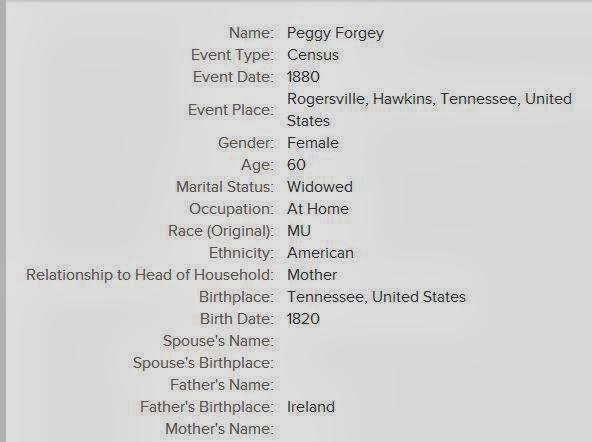
It looks like Joseph Forgey didn't live to see freedom but his wife Peggy did. We find her living in Hawkins County, TN; listed on the 1870 and 1880 Census for Hawkins County, TN. 


We see that Peggy Forgey is listed as a mulatto. Her father's birthplace is given as Ireland. We know her master James Forgey was born in Ireland so it is very possible he is Peggy's father. 
Next we can follow Thomas Forgey from slavery to freedom. James Forgey Sr. names Tom in his 1831 will.


Rachel Forgey died before her mother Margaret Forgey. Rachel willed Tom to her mother Margaret. In 1856 Margaret mentions Tom in her will.


In 1870 and 1880 we find Thomas and wife Fary living in freedom with his family in Hawkins County, TN. He seems to have made a successful transition and was working as a blacksmith.  


We see more Forgey slaves not named in the family wills in the Census. In 1850 James R. Forgey Jr. owns 21 slaves most being children. We do not have most of their names. Here are a few more I found in the Hawkins County, TN Census.
 1870 Census Hawkins County, TN

Lou Forgey 1880 Census Hawkins County, TN

I believe one of these families relocated to Knox County, TN at one point and can be found there in the 1940 Census. After 1900 I no longer find Black Forgeys living in Hawkins County, TN. 

Inhumanity is not confined to a single race or group of people. I've been reading a book about the Scots-Irish. I agree with the author that hard living conditions in lowland Scotland hardened the people which would later settle the south. They did not feel the pain of others. I believe James Forgey in particular was the sort of ruthless business person that really did not feel the pain of others. The business men involved in the slave trade in England, Spain, the Netherlands didn't have a conscience, but they didn't live with the slaves. The way that some families in the south lived with other human beings and didn't have the decency to free them is hard to fathom?

Here is partial list of Forgeys born into slavery
  1. Joseph Forgey (Mulatto)
  2. Peggy Forgey (Mulatto) Born about 1815 she claims her father was born in Ireland in 1880
  3. Malvina Forgey-Harlan (Mulatto) born about 1839
  4. Mary Forgey (Mulatto) born about 1854
  5. Lou Forgey (Mulatto) born about 1845
  6. App. Forgey (Black) born about 1863
  7. Thomas Forgey (Black) Birth Year (Estimated): 1829-1830
  8. Fary F Forgey (Black) Birth Year (Estimated):  1831-1832
  9. Alice Forgey (Black) Birth Year (Estimated): 1852-1853
  10. Martha Forgey (Black) Birth Year (Estimated): 1853-1854
  11. Jinetta Forgey (Black) Birth Year (Estimated): 1855-1856
  12. Dorcas Forgey (Black) Birth Year (Estimated): 1857-1858
  13. Margarett Forgey (Black) Birth Year (Estimated): 1857-1858
  14. Joseph Forgey (Black) Birth Year (Estimated): 1858-1859
  15. Alsy Forgey (Black) Before 1834
  16. Robert Forgey (Black) Before 1834
  17. Sarah 1828