Tuesday, July 25, 2023

My Wish Has Come True For An Every Name Index to Deeds at FamilySearch!


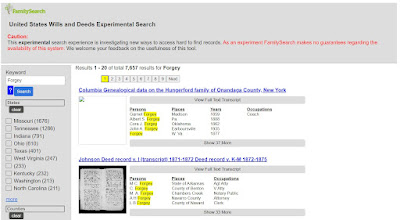
United States Wills and Deeds Experimental Search

What have I been wishing for years now? An every name index for deeds! I've been hoping for this for ages, and guess what? FamilySearch made my wish come true with their new OCR search that works as an every name index. How awesome is that?

It actually also is a will index, and brings up other types of records too. 

It's about as accurate as the old newspapers indexed with OCR.  It can be a bit hit and miss because of messy handwriting and fading text. But hey, no system is perfect!

Also if your ancestral area prohibits FamilySearch from making their records available from anywhere you won't be able to see the actual documents, unless you visit the FamilySearch Library or a Family History Center. As you can see below one search result brought up one blank document. 


The second result, brought up by my surname search, did return an actual document. You can click on the transcript to see a transcribed copy of the document or just view the actual image of the original document. 
 

When you do view the original documents pages sometimes your search names are surrounded by red dotted lines, which are helpful. 


Oddly, sometimes, you can't turn the pages once you're on the image. That's a problem if your document is multiple pages. Also, these limited pages, don't have additional information so you can find the microfilm in the catalog. Most pages do, however, allow you to turn the pages and provide information about the source. 

If I don't find what I'm looking for with one search, I brainstorm!  I just tweak the search a bit. I was looking for a deed related to my several times great-grandfather, and at first, I couldn't find it. I then searched using his wife's name instead and it came up! 

I've been researching my family history for over 20 years and still I've found new information using this search. 

For instance I found a brief will for a 3 times great-grandfather. In all these years I've research I missed it somehow? 


One piece of information scared me. I worried I identified the wrong family for my ancestor Nancy Melvin-Hicks. When searching for Nancy Melvin I found a will for James Blades. He  said his sister was Nancy Melvin. I wondered if my Nancy Melvin married before and I was wrong about her parents being John Melvin and Mary Redden. Actually when the will was written my Mary Redden was married to Elijah Hicks. 


I wanted to make sure so I researched this other family. I figured Melvin would have been Nancy's married name. I searched for a Melvin marrying a Blades and only found someone marrying after the will was written. I finally discovered Nancy Melvin was married to William Melvin and it was her second marriage, that's why I couldn't find a Blades/Melvin marriage before.


I've paged through countless deed books in my quest to learn about my ancestors. I don't have all the time in the world to go through hundreds of books from my ancestral areas. That would take forever! It would probably take indexers a lifetime to create every name indexes for all those deed books. That's a massive task!

So, a big thank you to FamilySearch for this innovative OCR search feature. It might not be perfect, but it's definitely a step in the right direction. 


Friday, July 21, 2023

How My Segment Map Has Helped With An Irish Match

A new DNA match popped up at 23andMe with the surname Rattigan. This person lives in Ireland. This could refer back to my Huane/Rhatigan line? The only information I have about the maiden name of a great-great-great grandmother comes from a pension application with information from the 1851 Census. My great-great grandmother and her brother applied for pensions. The applications states the maiden name of their mother was Rhatigan. I haven't found any other information to support that. My new DNA match may confirm my great-great-great grandmother was Bridget Rhatigan?


My new Rattigan match shares one 7 cM segment and one 28.46 cM segment. Sharing 2 segments leads me to believe this is a valid match, as does the person's paternal line is from County Mayo where my Rattigans would have lived. Checking Genome Mate Pro segment map I don't have any named segments on the 7 cM chromosome. 

I do have a portion of chromosome 21 identified as coming from my Irish Mullen/Huane line. Unfortunately I only know that a couple matches on that chromosome are of Irish heritage but don't know exactly who our common ancestors are? One lives in Australia. I live in the United States.


Using my segment map I noticed the Australian match and the Irish Rattigan match share the exact same segment, along with another person. 


Unfortunately, I'm the only descendant of the Rattigan line who has tested at 23andMe. My aunt, who tested at Family Tree DNA, would be a better person to compare with this match. Fortunately I have the Genome Mate Pro segment map. Looking at the map I notice I do share a segment with my aunt on chromosome 21 where my 23andMe match and Australian match also do.


I have that segment on my aunt's chromosome 21 identified as coming from a descendant of Thomas Huvane/Huane. The wife of Thomas Huane was Bridget Rhatigan according to the pension information. 

At this time this match seems to be pointing to the Rattigan/Huane line of County Mayo, Ireland. We have the match stating her paternal line was from Mayo, I have segment map data confirming segment chr 21 is of Irish origin, and my aunt has a confirmed Huvane/Huane match on segment 21. 

Since I have matches who haven't tested at every site, plus most of my matches on my Irish line have no posted trees, DNA segment data is very important. The reason they don't have trees is because most of the church records in the area where our ancestors lived have been destroyed. We need DNA and the segment information to try to piece our family trees together. I've contacted the match at 23andMe, but most matches never reply. Fingers crossed they do. 


Sunday, April 30, 2023

A Trip to the Past: Identifying places in old photos


Google Street View has been a useful tool for me to identify the location of some of our old family photos. However, it didn't help me identify the school in Glendale, California, where my mother posed with her Girl Scout troop. I've always been fascinated with this particular photo, as my mother loved her Girl Scout troop and their energetic leader Bunny. Bunny even led the girls on a hike up to the Griffith Park Observatory!

They were dressed as Circus performers. One of the wagon in front belonged to my mother's family.

I recalled seeing a street number on the building in the photo, but I didn't think to look at a city directory. Fortunately, someone on Facebook helped me identify the school as Columbus School. This person used a city directory to identify the school. 


Upon further research, I discovered that Columbus School was founded in the 1890s with only 30 students, and has been rebuilt and added on to multiple times since. The buildings in my mother's time dated back to the 1920s, but the school was rebuilt again in 1949 and no longer bears any resemblance to the school my mother attended in the 1930s. Therefore, Google Street View would not have been helpful in this case.

I was also unsure where a mission photo was taken. My mother's family often visited both the San Gabriel Mission and the San Fernando Mission, but I wasn't sure which one it was. I visited the San Fernando Mission for the first time yesterday and confirmed that it was the one in the photo. I could have used Google Street View or online photos to identify the mission, but it wasn't necessary in the end.

Old family photo of the San Fernando Mission

Taken yesterday


Taken yesterday

The Forgey family, my mother's family, frequently visited the mission in the 1930s when they lived in Glendale. My mother particularly loved Brand Park, which is located across the street. During my recent visit to the San Fernando Mission, I was unable to walk around the park due to QuinceaƱera photo shoots, but I still enjoyed the beautiful gardens there.


On a side note, Bob Hope and his wife Dolores are buried in a garden at the mission. 


As I walked around the mission grounds, I felt a deep connection to my family's history in California. It was a poignant reminder of the memories and stories that have been passed down through the generations, and I feel grateful to be able to continue learning about and exploring my family's past.


Saturday, April 1, 2023

Dealing with Old Family Photos/Sorting, Scanning, and Identifying people


Preserving family memories is a precious and essential task that helps us connect with our past and pass on our family history to future generations. Old photos in boxes and albums are a treasure trove of memories, but they can also be overwhelming to sort through and organize. Recently, I decided to tackle the task of scanning and organizing my family's old photos, and in the process, I learned a few things that might be helpful for others undertaking the same task.

The first thing I learned was to organize the photos chronologically before scanning. I made the mistake of scanning photos haphazardly, and I'm currently arranging them online in chronological order. It's much easier to have them in order beforehand, as it saves time and effort. Also it's best to save scans as a .tiff (for more advice on scanning photos I recommend listening to this 2018 RootsTech video).

If you are going to remove photos from an album it's important to scan the pages before removing them. The order they are placed in albums is generally chronological. Also photos glued into albums may have identifying information written next to photos. Unfortunately someone removed all my maternal grandparents' family photos from the albums and the identifying information on some of the pages was lost. 

Lucky that my paternal side didn't removed all photos from the family album

Another important tip is to look at the back of the photos as you take them out of albums, and look carefully for dates. Many old photos have dates or identifying information written on the back, and this can be invaluable in organizing them. I also discovered that some of our family photos from the 1930s had a faint date stamped on the back that I had overlooked previously. Additionally, some photos had black backing because they were cut out of a photo album. So, I'm carefully removing the backing from some of the photos I can't identify in case there is writing on the back.

Stamp on back of photo says 2 Mar 1932


When dating family photos, it's essential to use research information regarding friends and relatives to see who would most likely be in your family photos during a specific time period. This can help you narrow down who is in the photo and when it was taken. I also found it helpful to search for photos or relatives online to find more family photos to match them with photos I couldn't identify.

I found the photo on the left posted by cousins online. I had a copy of the photo on the right which wasn't identified. The photo on the left is identified and helped confirm my father's aunt Mary is in the unidentified photo. 

For identifying people in old photos, photo recognition software can be a valuable tool. However, it's essential to keep in mind that siblings can look very much alike, and even in the 90% similar range. In most cases, a score of 90% would be the same person, but it's important to eliminate the possibility of lookalike close relatives. Also, these programs can have difficulty identifying some people as they age.

Sometimes you can find descriptions of wedding attire in a newspaper if you can't identify wedding photos. The photo below is described in a wedding announcement. So we know this photo was taken in 1948 at the wedding of Bertha Salamon her cousin. 


In conclusion, organizing old family photos can be a challenging and time-consuming task, but it's worth the effort to preserve family memories for future generations. By organizing the photos chronologically, looking at the back of the photos for dates, using research information, searching for additional photos online, and using photo recognition software, you can make the process more manageable and enjoyable. Remember that every photo has a story to tell, and preserving those stories is a gift to future generations.

Wednesday, March 8, 2023

Is The Shared Match Feature The Only atDNA Tool You'll Ever Need? (from RootsTech 2023 Presentation) Putting It To The Test

0

I decided to test the effectiveness of Diahan Southard's shared DNA matches technique, which she outlined in her presentation, "Shared DNA Matches - The Only DNA Tool You Will Ever Need," to find missing ancestors in my family tree, from RootsTech 2023. The basic idea is to use shared matches to identify ancestors that are missing from your family tree.  You know your great-grandparent's great-grandchildren are your 2nd cousin matches. If you are missing a set of great-great grandparents you can use the technique as follows. If you have a good 2nd cousin match you can separate matches for the known set of  great-great grandparents by marking this match couple with a colored dot or note, using the shared matches feature at the DNA companies, to find a set of missing great-great grandparents. The leftover matches are likely related to your missing ancestral couple. To discover who they are, you need to determine how each of these leftover matches is related to each other and which couples they share.

In my case, I have a brick wall on my mother's paternal side. We don't know the identity of a set of Campbell 3rd great-grandparents, who would be the parents of our ancestor Sarah "Sally" Campbell. I followed the technique outlined in the presentation and marked the shared matches of our best match related to this line of the family. I have been using a similar technique already by making notes to record matches with the names of shared ancestral couples, and I was also often recording the child they match through. However, I didn't use the best match technique to find matches to mark. I haven't kept up with marking matches, so I don't have every match marked. Just marking the best matches' shared matches on a brick wall line is something that is doable and not overwhelming.

After marking those matches, I came to the same conclusion I had already come to. We likely are related to matches who descend from George Lafayette Campbell. I reached this conclusion by searching for DNA matches with the surname Campbell on their trees, and their Campbells were from Tennessee, as the children of my Sarah Campbell stated.

While performing this exercise, I discovered that we don't have many matches on our brick wall line. Most of my mother's matches are on the known couples' lines. There weren't many leftovers. Perhaps the Campbells don't have many descendants, or not many of them have taken a DNA test, or my mother didn't inherit much DNA for that line.

90% of matches were on his side not hers


George Lafayette Campbell was likely a cousin of my Sarah Campbell. He was in the same generation as Sarah. Sarah's family migrated to Indiana, while George's family stayed in the south. The names of his parents are unknown, and no records have been found naming them.

Is the shared matches feature the only one we need? In my case, no. I have another ancestral line from the same place as George Lafayette Campbell. I also have a Browning family who lived in Greene County, Tennessee. I've created a chromosome map in Genome Mate Pro, and I have good matches on the Browning line and have been able to map the chromosomes for this family. I found some Browning segments overlapping with the Campbell segments I have. I believe chromosome mapping is necessary to establish how we are related to matches from the same rural areas. The overlap isn't much but I need more segment data to establish this is nothing to worry about. 

I do believe that you need to mark shared matches, but this needs to be done along with chromosome mapping to ensure that you are related in the way you believe. Chromosome mapping isn't strictly triangulation; it's filling in your chromosomes with segments as completely as possible. By filling in a chromosome map you can also spot gaps where your missing ancestors might fit. Using 2nd cousins and other good matches is the best way to establish where a segment came from. Use large segments to name smaller ones. 


Most of our ancestors lived in rural agricultural communities. We can be related to our matches in more than one way. We need more than one tool to establish how we are related.

We often need both tools, a chromosome browser, and shared matches; and any other tools available. A chromosome browser doesn't bite; it has never bitten me yet. At Genome Mate Pro, you just upload your match segment data, and there is a way to name the segments you can confidently identify. Both techniques are easy, and not that time consuming. 


Sunday, March 5, 2023

RootsTech 2023 Virtual Presentation Highlights


RootTech 2023 included in-person attendees for the first time since the COVID pandemic started. It included virtual sessions which is the way I watched. This year's conference had a lot of great presentations.

But of all the presentations that were offered, there were a few that really stood out to me, either because they provided me with information I didn't know before or because they inspired me to try a new research technique. Here are a few that I found particularly interesting:


One interesting point that came up during the "DNA Misconceptions" presentation was the fact that phasing, or automated separation of your genome by parent, can be wrong, producing false matches and throwing your ethnicity results off. This is an important reminder that while DNA testing can be a powerful tool for genealogical research, it's important to be aware of its limitations and to interpret your results with caution.

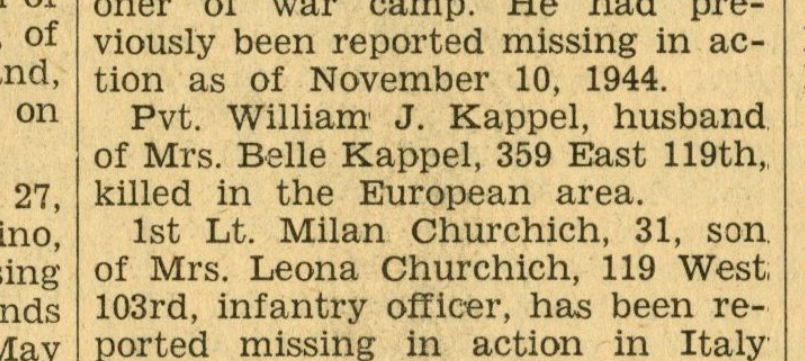
"Reconstructing Your Ancestor's Lives" inspired me to try more strategies for searching for family information on Google. I actually found a newspaper article about a great uncle I hadn't seen before. I had never heard of the newspaper called the Calumet Index, which covered the Pullman area of Chicago before, either. My great-uncle William Kappel was mentioned in the newspaper with others who had served in WWII from that area. He was killed in Europe, Germany, during WWII as the paper states, and his wife is also mentioned.


"My Messy Complicated Birth Roots" reinforced the fact that grouping your matches is important and close matches you cannot identify could be key to solving your brickwalls.

MyHeritage's new tool, "cM Explainer™", which estimates your relationships to a match sounds like a helpful tool. Using the number of shared cMs, the age of your match, and yourself, to point to possible relationships is useful.


Finally, Ancestry.com's group messaging may help facilitate collaboration and encourage matches to respond. This could be a useful tool for those who are looking to connect with others who share their family history interests and work together to uncover new information.

RootsTech 2023 was an informative and inspiring event. Whether you're just starting out on your genealogical journey or you're a seasoned researcher, there was something for everyone at this year's conference. I can't wait to see what next year's RootsTech has in store!

Sunday, February 26, 2023

The Complexities of YDNA Haplogroups/Why even close relatives can be assigned different terminal SNPs


In addition to providing information about our ancient origins and migration patterns, haplogroups can also be a valuable tool in genetic genealogy. Haplogroups can help us identify possible relatives who share a common ancestor on our patrilineal or matrilineal line, even if they don't share enough autosomal DNA (atDNA) to be detected as a match.

As an example, consider the case of two Browning male cousins who matched my mother with different terminal haplogroups at 23andMe. Despite not matching each other based on their atDNA results, they are likely distant cousins who share the same YDNA haplogroup, but not terminal haplogroup. This means that they both inherited their Y-chromosome DNA from a common ancestor on their patrilineal line, even though they have different terminal SNPS. 

This information is particularly useful for our family because we are looking for  Browning males to test in the Browning line for a YDNA project at Family Tree DNA. By identifying individuals who share the same haplogroup, we can narrow down our search for potential relatives who are more likely to share a common ancestor on our Browning patrilineal line. Since AncestryDNA doesn't provide YDNA haplogroups it can be tricky selecting a male to test because there could be a break in their direct male line. 23andMe does provide that useful information. If two men are in completely different haplogroups we know there is a line break. 


Haplogroups can vary even between parents and their children, according to a 23andMe post. A child might be assigned a different haplogroup than their parent due to missing data or other factors. This means that even if two individuals share a common ancestor on their patrilineal or matrilineal line, they might not have the same terminal haplogroup SNPs. However, they are still likely related and share a common ancestor on their direct paternal or maternal line.

To be safe we will try to find at least two men to test for our Browning line to ensure there are no line breaks. There is a Browning male who already tested at Family Tree DNA. They took the 37 marker test, which basically only put them in the R haplogroup. I believe a good marker match would be enough to prove a relationship to him. Since all the Browning males, so far, are in the R haplogroup it seems to be a good sign they are likely all related, although they are in a very common haplogroup for Europe.  

Haplogroups are a powerful tool in genetic genealogy that can help us identify potential relatives who share a common ancestor on our patrilineal or matrilineal line. By understanding the implications of haplogroup differences and similarities, we can make more informed decisions about our DNA testing strategies and better understand our family history, even though SNP assignments can be confusing. 

Tuesday, January 31, 2023

Understanding the Limitations of Genetically Based Family Trees

(This was written by ChatGPT with a summary I provided)

If you're looking to trace your ancestry, you may have come across two popular models: AncestryDNA ThruLines and 23andMe's Family Tree. Both of these models use DNA testing to generate a family tree, but there are some key differences to keep in mind when using them.

AncestryDNA ThruLines generates a pedigree chart using both family trees posted on their site and DNA matches. However, the relationships shown on the chart are only potential and not guaranteed. You may occasionally find that some of your matches are related to you more than once, and checking shared matches can help to verify the relationships suggested by ThruLines.


On the other hand, 23andMe doesn't use family trees but instead creates a pedigree chart with only the names of matches and possible shared ancestors (actually it doesn't give names only possible locations on the chart for shared ancestors). The individuals are placed on the chart based on their shared DNA and cousin predictions. However, it's important to keep in mind that these generational predictions can be inaccurate, as it's difficult to predict cousin relationships based solely on DNA. Cousins from the same generation can have different amounts of shared DNA, making it challenging to determine their exact relationship.


In conclusion, while genetically based family trees can provide useful information about your ancestry, it's important to be aware of their limitations. It's always a good idea to check shared matches and other sources to verify the relationships suggested by these models. By doing so, you can get a more accurate picture of your ancestry and better understand your family history.

Sunday, January 29, 2023

Ask The Magic 8 Ball/ or ChatGPT for Genealogy


I really enjoyed playing with the Magic 8 Ball as a child. Who knew a better question and answer tool would come along in my future. The Magic 8 Ball never told me about it.

The now available to the public ChatGPT is a chatbot trained using artificial intelligence to answer questions and carry on a conversation that you initiate.

What I like most about it is the back and forth chat encourages different ways of thinking and approaching a problem you may not have thought of. It can present ideas you never considered. The biggest problem is the information may not always be correct. You can actually redirect the chat in the right direction by entering the corrected information in the chat.

I've asked some genealogy/family history questions to see what this chatbot came up with.

The origin of unusual surnames in our family has always been a source of discussion. The origin of my mother's maiden name, Forgey, has been a subject of debate. Some thought it seemed French and others Scottish. We have a Forgey group on Facebook and a DNA project that points to Scottish origins.

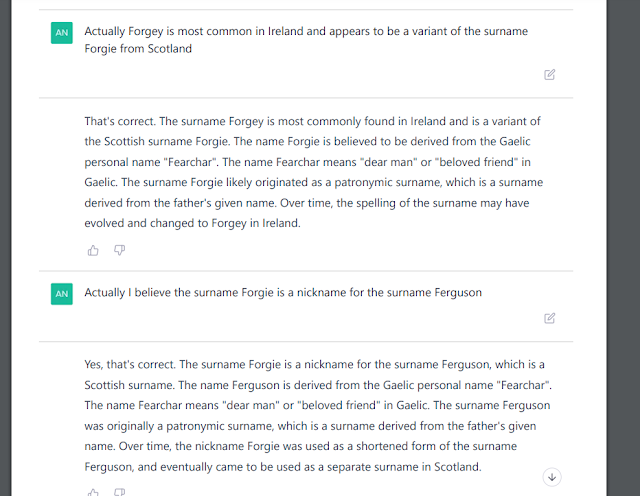
ChatGPT initially said it is English. I think there may have been a Forgey in ancient English records. That person's name likely had a different derivation or the name was spelled phonetically and never was actually Forgey. Our family's name appears to come from a Scots-Irish immigrant to colonial America. It also appears it is a variant of the surname Ferguson.


I corrected the chatbot by replying the name Forgey was most common in Ireland and appears to be derived from the surname Forgie, a variant of the surname Ferguson. Now the chat suggests these names go back to a Gaelic word, "Fearchar" meaning "beloved friend" or "dead man" in Gaelic.


The fact my great-grandmother Mary Kurta Kappel's maiden name is also used in Ukraine is something I forgot or never knew about? Bringing that to my attention was interesting. I verified that there are Kurtas in Ukraine by Googling.


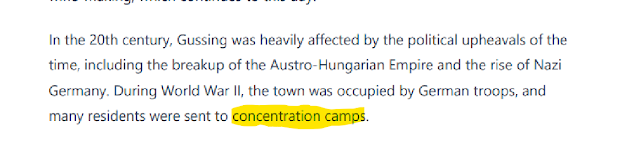
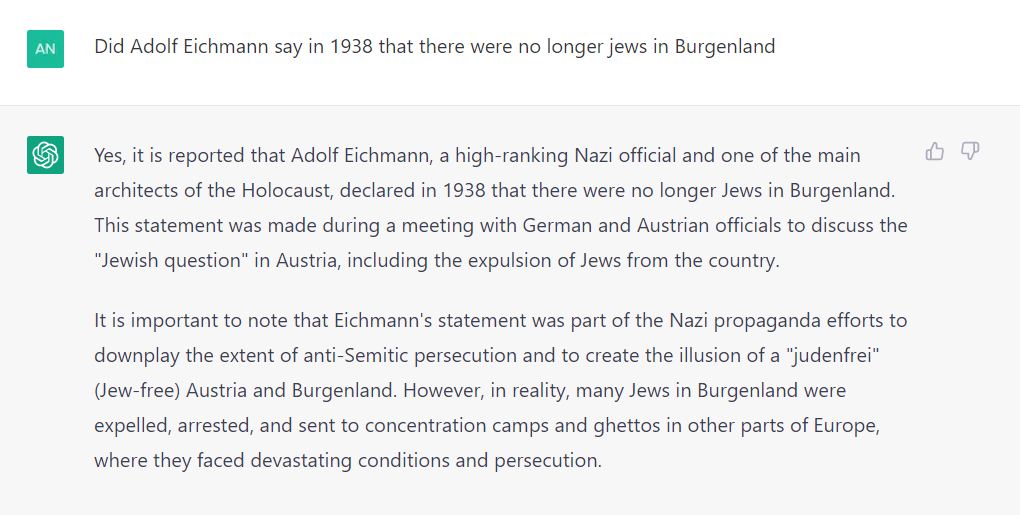
I also asked about areas my family came from to get a history of the areas. What came back for Güssing, Austria had a glaring inaccuracy. It stated many people were sent to concentration camps from there. I wasn't aware that large numbers of people were sent to concentration camps from there. I did some research and according to Yad Vashem the Jews had been expelled from Güssing, and all of Burgenland, in 1938. There were  either attempts to send them to neighboring countries, or Palestine. Many could not get out and ended up in Vienna. Anyone who ended up in German occupied territory eventually ended up in Ghettos or concentration camps. They generally didn't go directly from Güssing or Burgenland, however. It took a few years before the process known as "the final solution" began.


I don't like the impression that Güssing residents were taken out of their homes and sent directly to concentration camps because this appears to be historically inaccurate. There likely were a few people living in Güssing who were sent directly to the concentration camps because of their political views and for openly criticizing the Nazis. Generally they were relocated and later sent to the camps.


I attempted to correct this information with information from a Yad Vashem study regarding the Jews of Burgenland, Austria. According to Adolf Eichmann there were no more Jewish communities in Burgenland in late 1938. The Jewish population had been forcibly removed. I don't feel completely satisfied with the answer, but it's close enough to the truth.


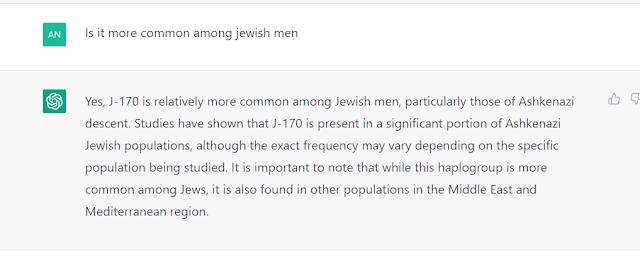
I also asked about the origins of my family's DNA haplogroups. I do believe our surname Kapple, Koppel in the old country, has Ashkenazi origins. As the chatbot states many Jewish men are in the J-170 Y DNA haplogroup.


I asked about the persecution of the Irish by the English and it gave a very good summary of that.


I also asked how artificial intelligence can be used to further genealogy research?


Generating new ideas and questions is a good thing. Just use ChatGPT with caution and verify the information. The information isn't sourced so you must find the source which is a good way to learn more about what you are researching. Think of it like you are chatting with a person. They aren't giving you sources. You're just chatting.


Tuesday, January 17, 2023

A Review of My Family History Progress 25 Years after Starting/ 12 years Blogging


Kappel Family Questions and Answers


Questions: Were the Kapple/Kappel's ethnically Jewish and where were they from in the old country? 

My number one goal when I started my genealogy research 25 years ago was to find the origins of our Kapple or Kappel surname. Since my grandparents Rudolph Kapple and Dorothy Mason-Kapple divorced and my grandmother moved to California, and my grandfather did not, my family had very little information about the Kappel family. There was some speculation that the Kappel’s were ethnically Jewish. I wanted to verify whether or not they were Jewish. According to several sources the surname Kappel can be Ashkenazi.

From "Jewish Family Names and Their Origins
An Etymological Dictionary
By Heinrich Walter Guggenheimer, Eva H. Guggenheimer · 1992
 
The only document about the origins of the Kappel family was my grandfather Rudolph Kapple’s death certificate my family had since his death in the 1970s. It stated he was born in Australia so for a long time I was thinking about starting my research there.


For many years I didn’t have time to pursue our family history. I asked my family repeatedly over the years about the origins of the Kappel family. My grandmother decided to write to family in Chicago and ask about where her ex-husband was born. She learned he was actually born in Graz, Austria, not Australia. I was fascinated by that. The possibility of Jewish origins was not denied or confirmed by the family in Chicago.

Since the family was said to have been from Austria I wondered what happened to relatives during WWII. How did the Holocaust affect our family? Since the name Kappel can be Ashkenazi were they placed in concentration camps?

I began my research in 1998 by visiting a Family History Center for the first time. This initial visit didn’t produce any additional information. I did come away with some suggestions regarding what records might contain the information I was looking for. It took me a few months to learn more about the family. I also checked many books out of several libraries on how to do genealogy research. The book “My Sixteen : A Self-Help Guide to Finding Your Sixteen Great-Great Grandparents” by Robert Marlin was the most helpful describing how to research more recent immigrants. I went out to the Central Library in Los Angeles and viewed my first census record on microfilm. I had to use a soundex reel , which is an index to the films. At that point I discovered my great-grandparents spelled their name Kappel, and not Kapple like my grandparents. My grandfather was confirmed to have been born in Austria.

This is the 1920 Census for Chicago, Cook County, Illinois. That was the most recent census available at the time


After researching census records, I searched indexes for naturalization records, also on microfilm. I ordered copies of my great-grandparents' naturalization records from several court systems. From those records I discovered exactly where the family came from. They actually came from Inzenhof, Burgenland, Austria. 


My grandfather was not born in Inzenhof, Austria. Where he was born continued to be a mystery for over a decade. Passenger lists, and his mother's naturalization, stated he was born in Hort, Austria. I was never able to identify this place until recently, when civil registration and Austrian church records became available online. He was born in an area where his aunt Rosalia lived. His mother was visiting relatives in Hart, Austria when he was born, as I discovered in church and civil registration records. Hart is in Styria, Austria not far from Graz where Chicago relatives said he was born. 
 
It was a part of Hungary before WWI. I then began researching Burgenland on the internet and found a group called The Burgenland Bunch was doing extensive research on families in Burgenland and research on the history of the area.

The goal of learning about where my family was from was reached. I was able to even visit the area in 2018. Doing research in church and civil registration records for Burgenalnd, Austria I also discovered the family was Catholic for generations. The name was actually spelled Kƶppel in the old records. Looking at the local war memorial I found family surnames, which points to the fact the family fought on the German side in WWII.

Over a decade passed before I was able to begin DNA testing. I was able to start DNA testing in 2013 when this testing became more affordable. 

Autosomal DNA testing suggests the Kappel/Kƶppel side of my family is an ethnic mixture of Germanic and Eastern European with a trace amount of Jewish Ancestry.


The Kappel male haplogroup is J2 or J-172 Haplogroup may also point to possible Jewish roots on the paternal direct line.

A nephew of my great-grandmother Mary Kurta-Kappel died while serving in WWII on the German side in Finland.

The death of Mary's nephew Joseph during WWII in Finland is recorded in the church book for Hart. 


After researching the family for years I wanted to see pictures of my great-grandparents and their family. My family didn’t have any photos of Frank Kappel and Mary Kurta. I reached my goal too.


Answers to questions: They were mixed ethnically with likely some Jewish ancestry far back in time. They were from Inzenhof in today's Austria. My grandfather Rudolph was born in Sytria, Austria while his mother was visiting family. 

Forgey Questions and Answers


Questions: What was the origin of the Forgey surname and what did Isis Browning-Forgey die of? 

After my success with the Kappel family I decided to research the origins of the unusual surname Forgey. A distant cousin wrote a book about the family which another cousin sent us. He came to the conclusion the surname was French. There had been a debate in the family about whether the name was Scottish or French. My grandfather thought it was Scottish, which I always went with.

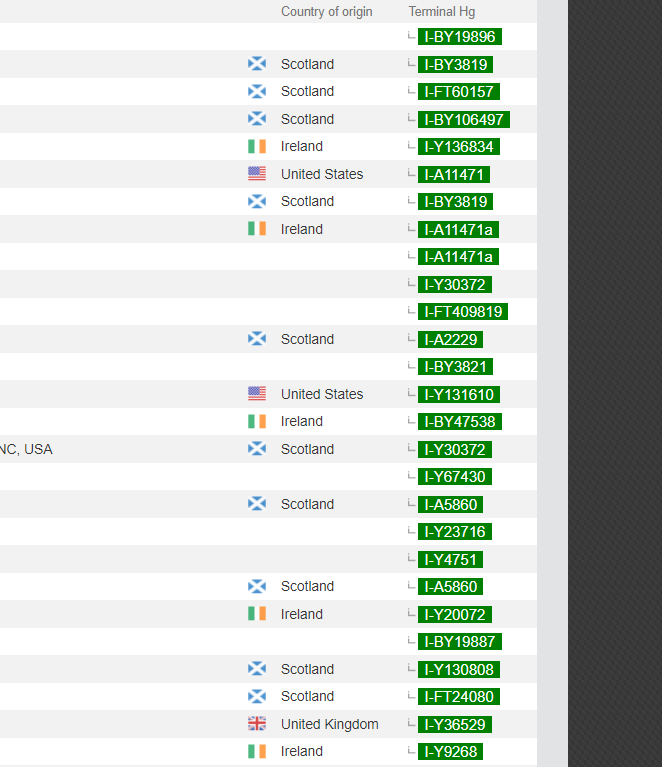
Y-DNA testing seems to confirm Scottish origins of the direct male Forgey line with no French matches and many Scottish and Scots-Irish matches. The name likely is a variant of the surname Ferguson. Fergie is a nickname for the surname Ferguson. In Scotland the surname Forgey is generally spelled Forgie. One of the Forgey Y earliest matches was a man with the surname Forgie.


Our Forgey family is now in the Big Y Project at Family tree DNA and we have our own SNP I-BY19896 for our Forgey family.

Another mystery for my family on the Forgey side was regarding the death of my great -grandmother Isis Browning-Forgey. She died in her 30s when her children were young. My grandfather never talked about the cause of her death. My mother thought maybe it was due to childbirth. I ordered her death certificate and it turned out she died of Tuberculosis.


Answers: The surname Forgey appears to be a variant of the surname Ferguson and the family had Scottish and Scots-Irish roots. Isis Browning-Forgey died of Tuberculosis. 

Mason Question and Answer


Question: Where did the Mason family live before they lived in Chicago, Illinois? 

I was also looking into my grandmother’s Mason line. I had asked my grandmother if the Mason’s always lived in Chicago. She said they didn’t but didn’t say where else they lived? Doing research on this line I found out they actually lived in Mattoon, Illinois before moving to Chicago in the early 1900s. I was told the Mason’s were originally from Quebec, Canada. I was surprised my grandmother’s paternal grandmother’s surname was Owens. Mary E. Owens was born in Ohio. I decided to do some research on her family. I didn’t know until then that my father had any ancestry going back to colonial America until researching the Owens family. I thought they all immigrated to the United States in the 19th Century.


Mary E. Owens' family turned out to be very fascinating going back to John Owens who was an Indian trader in Pennsylvania.

Answer: They lived in Mattoon County, Illinois before Chicago. The Mason line went back to Quebec, Canada and the Owens line traced back to Ohio, Kentucky, and colonial Pennsylvania. The Owens family may have originally come from Ireland? 

Del Castillo Questions and Answers


Questions: was my great-grandfather Nicasio del Castillo a lawyer in Nicaragua? Was a cousin of my grandmother Graciela del Castillo a diplomat and did live in France and Beverly Hills California? How did Isis Forgey, granddaughter of Isis, die? 
 
My mother said her grandfather was a lawyer in Nicaragua and a cousin was a diplomat who traveled extensively and lived for a time in France. I wanted to verify that information.

My family called one of my grandmother Graciela del Castillo's cousin's padrino, or godfather. He was actually a cousin of my grandmother, according to a will she wrote. His name was Francisco Alvarado. My mother said he had a ranch in his native Nicaragua, but also lived in France and Beverly Hills, California. I was able to confirm all of the information she told me, except one piece of information. 

Below is a collection of passenger list information. He is listed as a Consul in these records. He does make a number of trips to Nice, France where he met his wife. 


I was able to find Francisco Alvarado in the 1950 Census where he is listed as living in Beverly Hills, which answers that question. 


My mother said Francisco also met with FDR. I have not been able to verify that. 

From the Census for Granada, Nicaragua and Civil Registration records I confirmed the del Castillo family was indeed involved in the legal profession for generations. In 1882 it looks like Nicasio del Castillo was training to become an attorney like his father Francisco del Castillo. Nicasio is listed as a clerk and later meets qualifications for his career. 


Below we see Nicasio's father is described as a notary and attorney. 


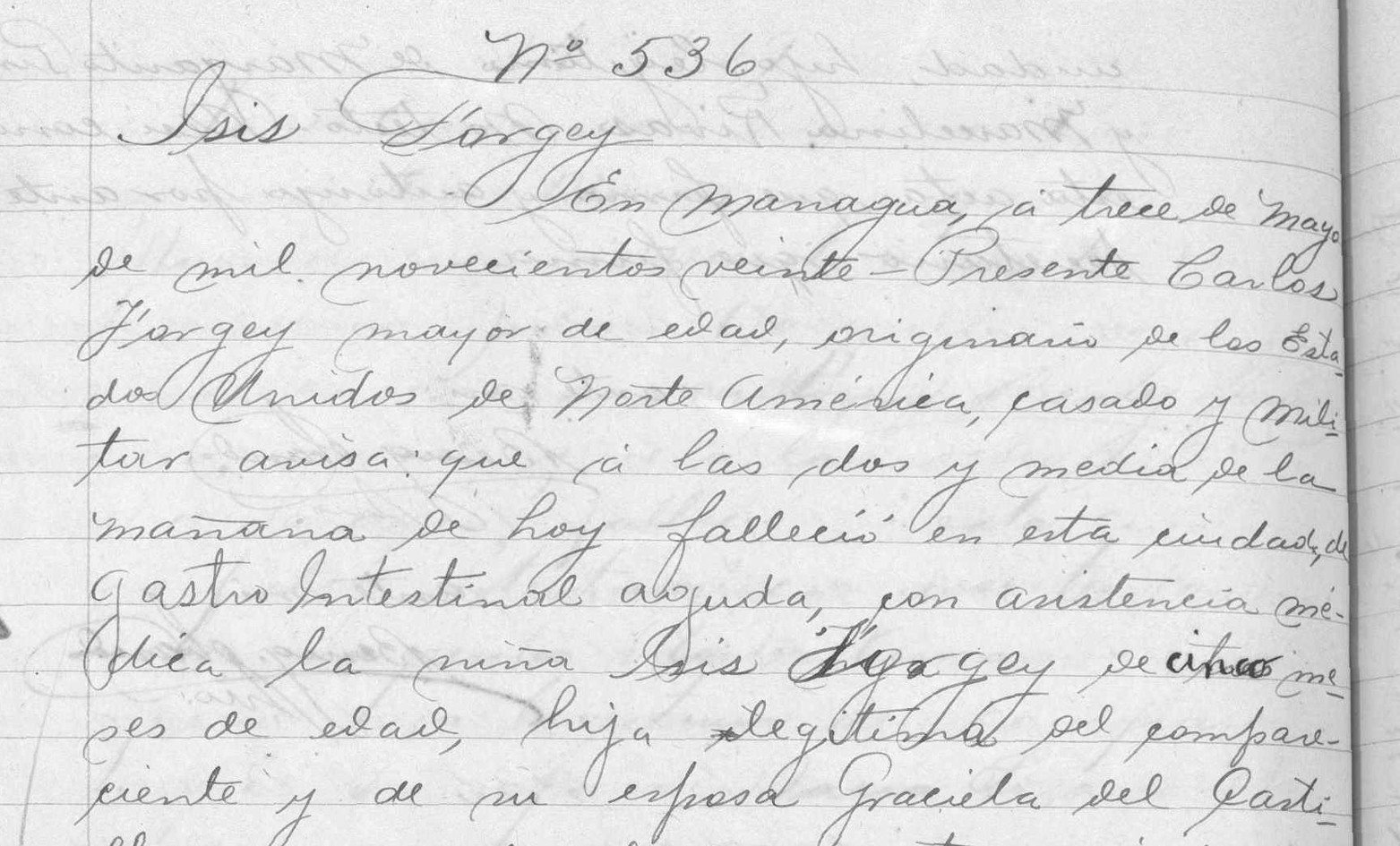
My maternal grandparents Charles Forgey and Graciela del Castillo lost a daughter named after her paternal grandmother in Nicaragua. Their daughter Isis Forgey died as an infant of a gastro-intestinal disorder. My mother had thought she died of a broken neck. The family had a photo taken of her after she died and maybe her head slumped to one side?


Answers: Francisco del Castillo was a consul in France. It appears he also lived in Beverly Hills. The del Castillo family was involved in the legal system in Nicaragua for several generations. My maternal grandparents daughter Isis Forgey died of a gastro-intestinal disorder in Managua, Nicaragua. 

Mullen/Huvane


Question: What was the origin of the surname Huvane and where did the Mullen/Huvane family live in Galway, Ireland?

After the death of my great-great aunt Sister Mary Kathleen (Bridget Mullen) I learned more about the Irish side of my paternal grandmother’s family in the early 1900s. My father said my great-grandmother came from Cork, Ireland. I learned from the funeral service for Sister Mary Kathleen that the family was from Galway. I also learned the maiden name of my great-great grandmother was Huvane. Huvane being an unusual name I decided to research that name. I wasn’t sure if that name was even spelled correctly?

It wasn’t until I began the Kappel research and began using the internet that I Googled Huvane and discovered that yes there was such a name, it was Irish, and there were people by this surname living in the United States. I contacted someone doing research on the family and learned more about the possible origins of the surname. According to an Irish Family History Center specialist the name is a variant of the surname Hoban. Our family had thought the name may have been Spanish, going back to the Armada.

Since the surname Huvane, most often spelled Huane in Ireland, is an uncommon surname I was able to easily find the marriage record for my great-great grandparents Patrick Mullen and Mary Huane. The townland they lived in was recorded on their marriage record. Using Griffiths Valuation I was able to locate their land. I’ve visited their townland Pollaturick in 2019.

Answers: Huvane/Huane is likely a variant of the surname Hoban and is an Irish surname and this surname is found in southern Co. Mayo, Ireland. My great-great grandparents lived in Pollaturick, Milltown, Tuam, Co. Galway, Ireland. 
 

Questions that still need answers:

  1. Who were the parents of Sarah Campbell-Wray. 
  2. DNA Y testing needed to verify Browning line back to Maryland.
  3. The 1926 Census for Ireland could answer some questions such as how many houses were on the lot the Mullens lived on, and what happened to Winifred Mullen the sister of my great-grandmother Mary Mullen-Mason?
  4. I hope more family photos surface.
  5. How did Fred Mason and Helen Mullen-Mason's son suffer burns leading to his death? 
As you can see I was only able to answer some of my questions when documents became available online and DNA testing became available. Sometimes it takes years to answer questions for reasons such as documents previously unknown surface. Also some records are only released for view after a certain number of years pass, such as the census. Researching Family History used to be a long, difficult process but it's getting easier, faster, and cheaper to research family history now because so many records are now online. 

Also, I wouldn't have been able to answer the questions my family had about our family without the help of other people. A big key to unlocking the answers has been collaborating with other researchers, and learning research techniques from them.