Monday, June 22, 2020

A Y-DNA Test Revealed An Unknown Problem then Solved it

The beginning of this journey

This story begins with a book written about our Forgey/Forgy family written in the 1950's called "A Genealogical History of Forgy, Forgey and Forgie in America" . In that book the author Lucille Forgy Wallace speculated whether all of the early families coming to America were related?  In 1958 there was no way to prove this because no documents survive that would prove or disprove a relationship. All of these families came to America in the 18th century. They were ethically Scottish but many of them came from Northern Ireland. Since all of these families were coming from the British empire there are no passenger lists to even trace these families back to a specific place, which might prove a relationship.

From Lucille Forgy Wallace's book

One of the goals of our Forgey/Forgy & Forgie DNA project at Family Tree DNA has been to test the hypothesis that all families carrying these names are related? A distant cousin of mine with the surname Forgey was the first to test for our group. That was back in 2011. His first match with a related surname was a Forgie. This match was a mismatch by 3 markers on 37 markers. Mismatching by this many markers does prove a relation, but that relationship would be quite distant going back to Ulster, Ireland or Scotland?

Initially having only one surname related match I checked the Y-Search and noticed there was another Forgy male in that database but that man had a different haplogroup. My distant cousin's haplogroup was I- M223 and the Forgy at Y-Search was in a different I-M253 haplogroup. I felt like maybe we were seeing proof all Forgey/Forgys weren't related? According to an Irish surname study and Lucille Wallace's book the Forgey/Forgy and Forgie surnames are variants of Ferguson. There are different unrelated Ferguson lines so it's possible all people with the surname Forgey etc. aren't related either.


My Uncle later tested and matched our first tester and distant cousin on 37 markers. They mismatched each other by 1 marker on 37 markers. They are now both in the Big Y project at Family Tree DNA, and they now have their own SNP named I-BY19896 which is hundreds of years younger than our previous SNP prediction. So we are confident that all of the Forgey/Forgys that headed south from Pennsylvania to initially settle Tennessee, along with the border area of Virginia, and North Carolina are all related.

Discovering a different haplogroup and possible different unrelated family line led me to seek out more people descended from that line to confirm there was another haplogroup and not an NPE.

A Surprising Thing Happened

It took me a few years to find another person in that line to test. In 2014 another male in the Robert Forgy DNA line tested. A surprising thing happened when his test results came in. He didn't match his distant cousin, who was a 5th cousin on paper, or anyone in our Forgey group which had now grown larger. Most testers matched the I-M223 haplogroup. This man was in a R haplogroup. Now we had two distant cousins who didn't match anyone? Did both of these lines have NPE's or just one? We needed more testers to find out.


Six years later

Fast forward 6 years later we had someone in another line which had not tested join our group. He was from the Hugh Forgey Revolutionary War veteran line. He turned out to be from the very common R-M269 haplogroup also. He had many pages of matches. One of his 12 marker matches turned out to be our R-M269 match that didn't match his cousin or anyone else. Our previous Robert Forgy descendant was only tested on 12 markers. These two men were perfect matches on 12 markers. With such a common haplogroup this could be a coincidental match? The 12 marker test needed to be upgraded to at least 37 markers, which we did.

Last Friday the upgraded results came in and these two men still match on 37 markers. I'm confident now there is a different haplogroup shared by those with these shared surnames. The I-M253 haplogroup could unfortunately be an NPE?

Our two R-M269 haplogroup matches mismatched by 2 markers on 37 markers. Our more distantly related testers tend to mismatch by two markers on 37 markers. There definitely isn't a close relationship between these two cousins. The relationship could be 300 or more years ago.


Does this prove that all Forgey/Forgys were never related? It certainly could be there was a line break hundreds of years ago resulting in different male haplogroups? Both of the R haplogroup men do match a Ferguson so it is possible that their surname comes from a different Ferguson line. We do now know there were two different male lines going back hundreds of years that aren't related. So it appears that all of the men that originally came to America were not related through the male line.

As more people from different surname lines test we might solve more mysteries and find more haplogroups. We may solve problems and find new problems to solve. DNA is always unpredictable.

All Forgey/Forgy or Forgies who have tested at Family Tree DNA are invited to join our project

Saturday, June 6, 2020

Never Give Up/ A lesson from my Nicaraguan Research


I began my Nicaraguan family history research in 1999. I wasn't sure how to approach it at all before I had access to the internet in the early 2000's. I found a LDS Family History Library outline for Nicaraguan research posted online which laid out the record types and information they provided listed. According to the online church records went back the farthest, but I didn't know which parishes my family may have belonged to? I asked my mother and she said she provided her baptismal information to the parish church she married in here in California. I called that parish and they told me she was baptized at Nuestra Mercedes Church in Granada, Nicaragua, but they didn't have a copy of that document anymore. I was able to find a photo online of the church. After seeing what the old church looked like, and discovering the history of that parish went back to the late 1500's I really wanted to know how long our family belonged to that parish.

The only information on my Grandmother Graciela Del Castillo's family came from her death certificate which stated she was born in Granada, Nicaragua in 1893, and her parents' names were Nicasio Del Castillo and Elena Garcia. My mother had no other information. She said her grandfather Nicasio was a lawyer in Nicaragua. My mother was brought to America at age 3. She couldn't remember much about Nicaragua other than she rode a donkey and monkeys threw twigs at the family as they made there way to a ship that brought them to the United States.

Where My Family Journey Started


My journey to acquire more information from Nicaragua started in earnest in 2002 when I began writing to Nuestra Mercedes church and the civil registration office in Granada, Nicaragua.

I sent $10 for a search of the record books index of Nuestra Mercedes church for the marriage and birth records for the birth of my grandmother Graciela Del Castillo, and marriage of her parents Nicasio Del Castillo and Elena Garcia. I had no idea when my great-grandparents married but my mother said she believed my grandmother was illegitimate. I inferred that maybe they married soon after she was born. I had a date and year for my grandmother's birth. This search produced no results. I thought maybe my grandmother's family belonged to a different parish?


The Priest suggested I contact the archdiocese office, which I also did with no response at all.


I wrote a letter to the Civil Registration office in August of 2003 requesting a search for the marriage record of my great-grandparents Nicasio Del Castillo and Elena Garcia. No response at all either.


Someone also working on Nicaraguan genealogy told me the only way to get searches for certificates would be to go to the office in person. Since I could not do this myself and didn't know of any family still living in Nicaragua I decided to contact the US Embassy in Managua and ask for their help. They told me to fax the civil registration office in Granada and they gave me their fax number and I faxed them in 2004. This produced no results because my friend the Nicaraguan researcher was right. Another person told me that office doesn't respond to mail requests, only in person requests. 


In 2005 I wrote to the parish where my mother Edna Forgey-Kapple was baptized again. According to the church where she was married Nuestra Mercedes was the church she was baptized in. I thought maybe a relative might have been listed on this record which may have furthered my research. This time I received no response at all from them, unlike in 2002. 


I was 0 for 5 when it came to my search requests in Nicaragua. I continued my research off and on through Google searches on my names and searches for records online. I also posted on genealogy message boards for Nicaragua. I received a response from someone who had information on my grandmother Graciela's siblings, their children, and spouses (you can read the response I received here at Boletin de Genealogia) . 

When the Managua, Nicaragua civil registration records came online I was able to find some of my family's documents because my grandfather Charles Forgey was stationed in Managua as a US Marine. This information didn't take me any farther back because my grandmother's family lived in Granada likely for centuries. 

In 2015 a fellow researcher, and DNA match, contacted me and encouraged me to go out to Nicaragua where he said there was an archive that had census records for Granada which would at least take my family back another generation. Many records were lost when American slaveholders from Tennessee overthrew the Nicaraguan government in the 1850's hoping to establish a slave owning country for US slave owners. 

My Nicaraguan fellow researcher said Nicaragua was generally as safe as anywhere in the United States. I decided to take his advice travel there, which I did in December of 2015. I was able to review the Census for Granada, Nicaragua for 1882 when my great-grandfather Nicasio Del Castillo was 16 years old. He was living with both of his parents and siblings in the parish of Nuestra Mercedes or La Merced. I was not only able to add my great-great-grandparents Francisco Del Castillo and Alejandra Granizo, but I also was able to identify my 3 times great-grandfather also named Nicasio Del Castillo. I found the elder Nicasico in the census records and the many other records held by this wonderful archive. The staff was extremely helpful finding references for me. 

I actually visited Nicaragua in December of 2015 and 2016. Unfortunately the civil registration office was closed both years for the Christmas holidays. The church offices were also closed the weeks I was there. 

Someone not long ago contacted me stating they found the death certificate for Elena Garcia which stated she was the illegitimate daughter of Andrea Garcia. The death certificate also implied she never married the father of her children because it listed her as single. It then occurred to me that was why no records of marriage were found. 

FamilySearch Images


Last week I discovered the wonderful Familysearch Images page which seems to have some images not yet in the catalog where I usually access them (it could be they are cataloged in a place I haven't searched?). The Granada, Nicaragua records are also in the catalog where they are easier to search with better descriptions. . 


I had been searching for Granada, Nicaragua church microfilms and digital images for years off and on. This feature, which was new to me, encouraged me to try again. I had immediate success when searching my research area. I found church and civil registers were available. I had no idea these images were now available online. 

Since I have time on my hands while staying at home social distancing for COVID-19 I've been searching these book images nonstop for 2 weeks. It's really paid off. I've found images for all of the records I began asking for in 2002. It's unbelievable because I never thought I would ever see them. I heard local officials were against providing these records online. 

The first record I discovered was my grandmother's baptismal record in the archdiocese book for 1893. I knew she was born on 10 September so I was able to find the record quickly. I found out she was baptized as Lucrecia (her middle name) Garcia confirming she was illegitimate. There are indexes for baptisms making finding these records easy. 


I then was able to find her civil registration record. Her birth was registered by Nicasio Del Castillo which supports his paternity. The civil registration records listed her as Lucrecia Del Carmen Garcia.


My mother's entire family called Francisco Alvarado "Padrino". I had thought that was just a nickname the family used for him. I discovered from this, above, birth record  that Francisco was my grandmother's godfather. I didn't think he would be because he was about 17 when she was born. I've since discovered that anyone at least 16 years of age is eligible to be a godparent. In the will my grandmother Graciela wrote in 1956 she does write Mr. Albarado "mi padrino". 


Obviously since neither record lists a Graciela my requests for her birth information would have produced no results. 

I was able to find my mother's baptismal record and her name was correctly written in both the index and records. I was happy to learn the names of my mother's godparent. 


There are church baptism records going back to 1856. Civil registration records only go back to 1879. 

I was able to find my great-grandfather Nicasio Del Castillo in the baptismal index (which is an individual volume, you have to then find the book for that time period). I knew he was born about 1866 from the census. I searched a book for that time period and oddly he wasn't in that book? Sometimes there are several books for the same time period, which I discovered, he did appear in the second book also covering that time period. 


I was so happy to have a birth record confirming what I found on the census. 

I didn't know when Nicasio Del Castillo died, and there are no indexes for church or civil death records. Finding this record required searching pages of the easier to search church records books which covered the years 1904-1929. I knew he died after 1919 because I was told he wrote a poem for my grandparents' marriage that year. I also figured he probably died before 1925 when my family came to California because something seemed to happen to reverse the family's financial fortunes in Nicaragua? I decided to begin my search after my grandparents' marriage in 1919. After going through a number of pages I did find his death record in 1921. 

The church death record gave the correct approximate age for my great-grandfather Nicasio. Oddly it stated he was married to Elena Garcia which the children's birth records don't support?


I was then able to easily find Nicasio's civil death record in the un-indexed records for 1921. His son Samuel Del Castillo reported the death. Apparently he didn't have much family history information. It appears later someone added Nicasio's parents' names. It does appear that the clerk added this information around the same time judging by the handwriting and ink use. Elena Garcia is named as his wife again although I have been searching the marriage books and can find no marriage. 


Children born to Elena Garcia, registered by Nicasio Del Castillo, are all illegitimate. Rudolfo Del Castillo appears to be the last child born to Nicasio and Elena. He would have been 13 years younger than my grandmother. This child is registered with the local government by Nicasio in 1907. He was said to be the illegitimate child of Elena Garcia according to this record.


My grandmother's older brother Alberto Del Castillo claimed, according to his marriage record, that he was the legitimate child of Nicasio and Elena. My grandmother didn't know she was illegitimate until she was an adult and she asked her godfather, and cousin, Francisco Alvarado to confirm that. 


Reading through the records I'm wondering if there was some impediment which prevented them from marrying? In one of the books recording illegitimate children later recognized by fathers someone said they were not allowed to contract a marriage which prevented them from marrying the mother of their children. I don't know if there were laws regarding race, or laws that prevented cousin marriage? The records sometimes raise new questions.  

I knew from my previous archival research in Granada, Nicaragua that my great-great-great grandfather Nicasio Del Castillo died in 1884. Thankfully I didn't have to page through many pages for that year before finding his death record. The record stated he was a notary, which in Nicaragua is the equivalent of a lawyer in this country. He was said to be the legitimate child of Nicasio Del Castillo and Flora Lacayo. Two names I have added to my tree. 


I had absolutely no idea when my great-great grandfather Francisco Del Castillo died? He would have been born about 1840. No books survive for that time period. The death record would have been my best source for further confirmation of his parentage. When I searched the church records I found that his daughters Adela and Flora both died within a month of one another in 1919. The death records stated both parents were dead. Both parents were alive in 1882 I knew from the census. I did a page by page search for a death record, and any interesting information in the death records books beginning in 1882. Church records produced no information so I had to turn to the more voluminous civil registration records. 

It took me days to search the civil registration. I did find a death record for my great-great grandmother Alejandra Granzio the wife of Francisco. I have still found no death record for him and 3 volumes of death records are missing, and he likely died in a year covered by one of those books.   

According to  my great-great grandmother's death record her father's name was Marcelino Granizo. Her mother's name appears to be Gentas? I couldn't make out her last name. 


I decided next to look for records for the parents of my great-great grandmother Alejandra Granizo. The surname Granizo was very rare in Nicaragua and Spain. I love rare surnames because they don't require as much effort to research. I paged through death records because Alejandra would have been born in the 1840's and no books survive from before 1856. I began with the earliest records looking for all my family names, and for anything interesting. I noticed at the end of every year death statistics were recorded regarding the number of deaths and cause of deaths, which was interesting. 

I found a death record for Alejandra's possible mother, but her name didn't match the name on her death record? A Pia Gutierrez was said to be the widow of Marcelino Granizo according to this death record. She died in 1866 at age 60. I didn't find a death record for Marcelino so I assume he died much earlier. 


I had thought that Pia could have been Alejandra's step-mother. Going through the death records some more I found a death record for a likely brother of Alejandra. Vicente Granizo's death record says he was also the son of a Marcelino Granizo. He died in 1883 at the age of 44. If his age is correct he would have been older than his sister Alejandra. His record states his mother was Pia Fernandez. Did Marcelino marry a Pia Fernandez then a Pia Gutierrez? Possible, but I believe the informants of both deaths didn't remember the exact names of the decedents parents. They had a vague recollection the surname was a name ending in ez. My DNA results point to a relationship with a Gutierrez Nicaraguan family so I'm assuming for now that Alejandra's mother was Pia Gutierrez.   


Reading through all of the records I'm so happy to see that my ancestors were educated people. I'm happy they had an opportunity to learn to read, and write and follow a course of study in the legal profession. Below my great-grandfather Francisco Del Castillo is described as a Lawyer and Notary. 


My mother always said that she was sorry I never met Francisco "Padrino" Alvarado. Since I'm interested in trying to learn languages and love to travel we would have had a lot in common. I'm sorry I never met him also. She said he had a trunk that he traveled with that had stickers from all over the world. I'm sorry I was never able to meet my Del Castillo ancestors too. Their love of music and poetry would be something shared in common with me; and I'm sure we would have had much to talk about. Finally getting to see more of their records and seeing examples of their handwriting has been rewarding. If some photos surfaced of them that would be wonderful. However I'm satisfied for now anyway.


Friday, May 1, 2020

Analyzing the Burgenland Church Records/ Can I trace my lines farther back?


I've been pondering how I could use the newly available online Burgenland church books to trace my family lines farther back. My initial research in these books didn't produce any new ancestors. My research has involved going through the church books for the Ronok parish, which date back to 1789. Before the founding of the Ronok parish,the parish most of my family belonged to, their parish was in Heiligenkruz. Before their records were kept in Heilgenkruz their sacramental records were kept in the parish books for Gussing.

The earliest church to be founded in my ancestral area was Jakobikirche. A Franciscan Monastery and larger church was built in the 17th century in 
Güssing. This parish was founded before 1200. I found these statistics for both churches online: The parishes, which are among the oldest in the country (before 1200), have been published in eight books: from 1690 to 1970 over 7,000 bridal couples, from 1725 to 1970 almost 20,000 funerals, from 1668 to 1970 almost 34,000 baptisms.

I would love to connect my family with the families listed in the earliest books going back to the latter half of the 17th Century as recorded in the 
Güssing books. Sadly the information provided in the earliest Rönök Parish books is very scant. No parents are listed in the marriage records for couples. In the mid 19th century the parish did begin recording parents of couples who were married. This information and the addition of house numbers allows us to confidently trace our lines back to around the late 17th Century.

How can we get our lines back beyond that without the necessary information from the church records? We do have ages from baptismal records of some of our ancestors born before 1789 as recorded in the 
Rönök parish books. Using these ages, however I have been unsuccessful in tracing my lines farther back. Ages didn't match up with any of the records I've found?

I decided to collect all of the information I could find on every family carrying our surnames in the Heiligenkreuz and 
Rönök parish books for the first half of the 19th Century, and back before 1789 in Heiligenkreuz.

My first project when collecting all the information I could find was to collect the names of marriage witnesses and godparents in hopes of making some kind of link between my families in 
Rönök Parish and those in the Heiligenkreuz books.

I have collected Adam Kurta Jr.and Catharina Josts children's godparents names. Several of the children shared the same godparents. A Joanne Jost shows up several times as a godfather but that information hasn't helped me to make any connections. 


Georgius Jost and Margaret Hammerl's children's godparents produced some interesting results with a Georg Jost and Joseph Jost serving as godparents. Unfortunately I have not been able to create a linkage with earlier families with this information.


There are two good couple candidates that could be Georg Jost's parents if our Georg indeed died in 1842 and was born about 1790. There was a Georg Jost born 1790 and another born in 1788, either one could possibly be my Georg Jost. I decided to list two of the best candidate couples as parents of Georg. I can still be wrong because Georg was a popular name among the Josts.


Going through the death records for 
Rönök Parish I believe I found the death entries for my ancestors Adam Kurta and Catharina Jost. The age at death for Catharina matches up well with the marriage entry age for her. According to the marriage entry below Catharina would have been born about 1764.


A Catharina Kurta died in 1819 and was a widow (an Adam Kurta died a little earlier that same year). She was 55 years old which would put her birth at about 1764 also. I believe I have found the correct death entry for her; and the Adam who died a few months previously was likely her husband. Spouses for women were sometimes included in these records, but unfortunately not always as in this case.


Taking the marriage and death information the closest birth entry for a Catharina Kurta is 1766. Either both of these entries are incorrect or Catharina Jost was born in a different parish?

It is also interesting that Catharina had a daughter-in-law by the same name of Catharina Jost. They both shared the same first name and maiden names, so also shared the same married surname. This must have created some confusion when referring to these women by name. This fact means I'm related to the Jost family on at least 3 different lines.

Moving on to Adam Kurta he appears to have died the same year as his wife since I have not found another death record for an Adam. Since Catharina, his wife, died in the parish of 
Rönök as a widow it is more than likely her husband would have died there also. I believe the 1819 death record is his. 


The above death record for Adam Kurta states he was an innkeeper (that tradition seems to continue in Inzenhof where a Kurta Gasthaus still exists). According to this entry Adam was 65 in 1819. That would put his birth at around 1754 which doesn't match up as well with his age recorded in his marriage entry. He was said to have been 24 in 1819 putting his birth around 1758.


Looking at birth records for the 1750's we do find an Adam Kurta born in 1753 in Inzenhof. His godmother was from what is today Kleinmurbisch.


His father was also an Adam and his mother Veronica. Unfortunately the pages that covered the year 1758 are missing which makes it impossible to confirm whether there was another Adam Kurta born in 1758 (baptismal records for 1758 and 1759 are missing. I did find part of 1760 at the end of the death records for 1769 to 1791. It's possible 1758 still exists but was missed during the filming or it's mixed in with another book online?}.

I decided I needed to go through the death entries to see if an Adam Kurta died as a child or young adult? I had not found another Adam Kurta in the death records for 
Rönök Parish. After searching the Rönök death records I began my search in the Heiligenkreuz books beginning my search after the 1753 birth of Adam Kurta. 

Unfortunately the early death records contain scant information. Often these records have no place of residence listed. Kurta being a name that is generally only found around Inzenhof this task wouldn't have been impossible as it would have been for more common surnames like Jost, which is found in many other areas.

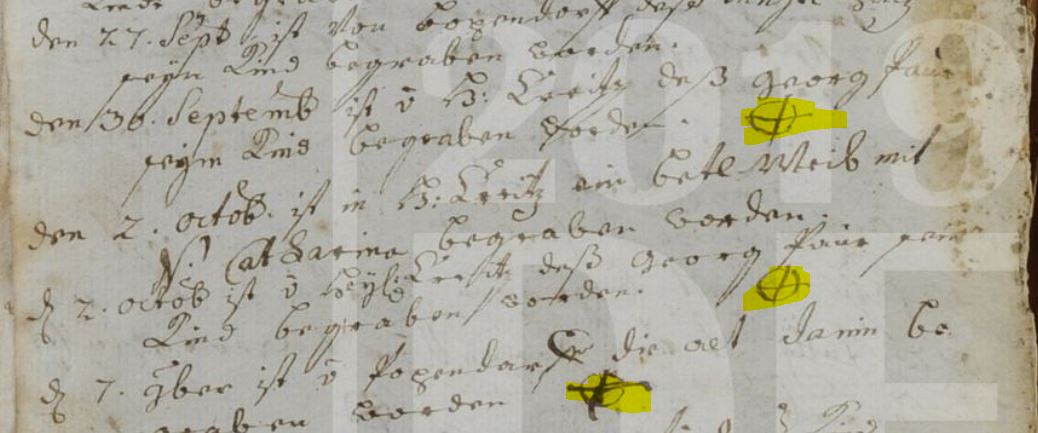
I wasn't even sure I was looking at the correct records when I first began searching these records. In the 1750's the death entries included a circle with a cross inside it. Once I figured out that I knew I was in the right place in the book for the years I was searching.


Sadly deaths don't seem to have been recorded for Inzenhof in the 1750's? I found only one death of Hans Wolf of Inzenhof dying in 1756. It wasn't until around 1760 that deaths seem to begin to be recorded for Inzenhof in larger numbers. When deaths began to be recorded for Inzenhof a decade later only a much older Adam Kurta is listed. The older Adam died in 1778 at the age of 60.


Adam Kurta died 1778 age 60 page 130 

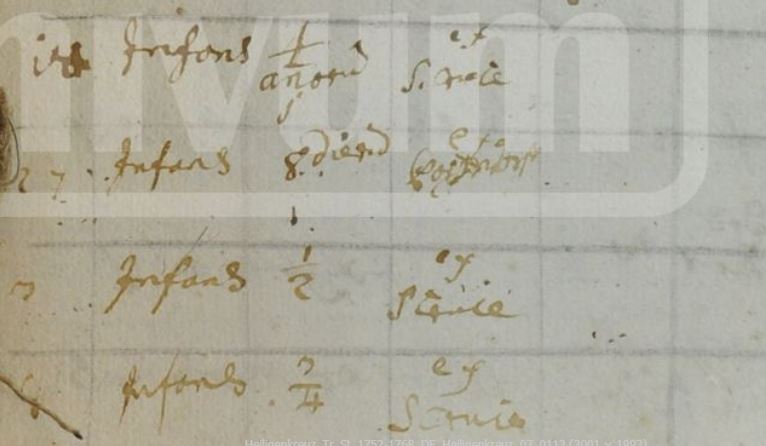
Another problem with the deaths of children and babies in the 1750's is sometimes the names of the children who died were listed as infants without a name. These children were probably never baptized


As time went on more information and full names were provided for infants and children who died, which included parents names.

Combing through the records I did find my Adam Kurta and Catharina Jost lived at house #102.


Adam not being as commonly used as Joanne or Georg, for instance, I think it's very possible that Adam son of Adam Kurta and Veronica is the same man that married Catharina Jost in 1782, and therefore would be my ancestor. I'm adding Adam senior and Veronica to my tree even though I'm not able to verify these relationships. 

There is an Adam Kurta born 1726 who might be Adam Kurta senior? He was the son of a Georg Kurta and Eva. 


Collecting up the names of Adam Kurta Sr. and Veronica's children's godparents they have some Kepl or Kopl godparents which is another one of my lines. Like Adam Kurta the younger these children also have Jost godparents. The name Rottenstrumer indicates a connection with Kleinmurbisch. 


A fun fact I discovered researching these books is a potential ancestor Catharina Kluim had illegitimate children with at least two different men. There may be more if I look more carefully? 


In conclusion 

The details I've found useful in attempting to extend lines back are ages at marriage and death which have been helpful. Place names are helpful when included. Briefly in the latter half of the 17th Century house numbers were included with book entries for Heiligenkreuz. Marital status can also be helpful when it comes to death records. Someone listed as a widow or widower can be a helpful clue. I did find one occupation which can be useful sometimes. Witnesses and godparents can provide clues to relationships also. 
I believe the Parish books for Kleinmurisch will be very helpful in furthering my research. A distant cousin living in Austria said the books for Heiligenbrunn may also contain some entries for our ancestors? I might find some of my new conclusions are wrong if I find ancestors such as Catharina Jost in the Kleinmurisch book in the year 1764 when her marriage and death records indicate she was born. Additional Gussing books would also be helpful too. I'm looking forward to seeing more books online. 


Tuesday, April 7, 2020

New Burgenland Records Research/DNA mapping


Being in lockdown (not in jail, but for COVID-19) has given me time to work on my genealogy. The new Burgenland Church Records  have been very interesting to sort through. My Kappel family came from the village of Inzenhof, Burgenland, Austria. A new set of  Catholic church records has now come online for Burgenland.  Looking at who lived in the family village going back to the late 1600's is very interesting.

Sorting through the records there are gaps which have prevented me from actually tracing my direct lines any farther back. The early church records for Sankt Nikolaus parish, which neighbors Inzenhof, are missing. I believe some of my families were from that parish. Commonly used first names and surnames have also created a problem when it comes to tracing lines back.

Even though record gaps and common names have prevented me from extending my direct lines any further back than the late 1700's I have been able draw some conclusions. For instance the Kurta surname appears in Inzenhof in the late 1600's. The earliest instance I have found the name Kurta is in neighboring Kleinmurbisch (Kissmedves) in 1671, which is a neighboring village of Inzenhof. The first entries for Kurta families living in Inzenhof are in 1687.


Kurtas were likely living there earlier but village names were not always recorded in the books. Since the church books only go back to the mid to late 17th century period  we don't know how much earlier Kurtas settled there? I've been able to reconstruct some of the early Kurta families living in the Inzenhof area, which you see below (you can get a better view of the spreadsheet at Google Sheets).


The earliest records for Inzenhof are recorded under the name Hinzenhoff and can be found in the Gussing parish books. According to The Best of Burgenland site in 1327 the Inzenhof area was controlled by Count Heinz. His subjects were called Hienzen which eventually morphed into the Inzenhof village name.


I've found early entries for my family surnames Wolf and Simitz recorded as being very early residents of Inzenhof. My paternal surname Kapple/Kappel/Koppel is first recorded in 1698 for Inzenhof. I'm not sure if there were Koppels in Inzenhof before that date. There were many Koppel families within a few miles of Inzenhof, however. I do see a number of my other family surnames showing up around 1698 so maybe there was a migration to that area around that time?


I've also attempted to reconstruct Kappel/Koppel family groups using the Catholic Church records (for a better view of the spreadsheet below you can view it at Google Sheets).


Many in my family believed Kappel to be a Ashkenazi surname. I have found the Koppels in Catholic Church records going back to the 1600's. If they were converts to Catholicism it would have occurred before the late 1600's. I did find mixed marriages between Lutherans and Catholics. Those marriages didn't seem uncommon. In 1600's Gussing books I found two baptismal parents described as Judea which I assume meant they were Jewish? I have not found many entries referring to Jewish parents other than the two below.


When I started doing my Burgenland research I was under the impression my family had been brought into the border area depopulated by war when the Ronok parish began keeping records in the late 1700's. Now I know the families were in the area much earlier.

DNA Segment Map

I've also had time to add DNA segments to my segment maps at Genome Mate Pro. When I first started DNA testing I had only one small segment I could trace back to my family in Burgenland. Other family members had several large segments so I wondered am a really a Kappel? A number of 2nd and 3rd cousins, and one 1st cousin once removed have now tested and I'm building a great segment map for my paternal grandparents.

The 1st cousin once removed was anonymous for a time at 23andMe and only recently decided to participate in DNA Relatives. Her grandparents were Frank Kappel and Mary Kurta-Kappel from Burgenland.

The greenish segments (on the chromosome map below) would be the ones I got from my paternal grandfather Rudolph "Boots" Kapple, and the reddish are the ones I got from my paternal grandmother Dorothy Mason-Kapple. If my grandparents were alive I would've tested them and all of my paternal chromosomes would be filled with red and green. Of course we shouldn't see red and green overlapping to any degree unless our grandparents shared common ancestors. I saw a little bit of overlap between two segments, which really means nothing. My grandparents had clearly different ethnic backgrounds. This chart will help me figure out which grandparent a match is related to if I have their segment data but not tree. My mother DNA tested so I can tell which matches are maternal or paternal. I had an aunt and some cousins test to represent my father.


In Conclusion 

I might try to reconstruct a few other surname family groups for my Burgenland family, and I will continue to try to fill my segment map with green and red segments. I figure as long as we need to stay home we might try to make some progress on our genealogy.

Stay Safe Everyone!