Friday, February 21, 2014

DNA Project How To


The most important first step in a DNA project is to set your goals. Randomly test individuals carrying the same surname, for instance, will not produce the targeted results needed if you are trying to answer particular questions about your ancestors.
The goals in our Forgey/ Forgy & Forgie DNA project are as follows:
  1. To identify all of the family branches using branch tags (branch specific marker mutations) or new unrelated lines through the discovery of families from different Haplo groups
  2. To extend our pedigrees by connecting branches 
  3. To find a possible ancestral locations in the Old World
To move towards those ends it's necessary to locate as yet untested family branches, and find a male carrying the name to test for that branch. Since testing is expensive it's important to stay focused on our goals.
I found the colorized group Y DNA charts to be the most useful when analyzing results. The color coding of the mutations tells you how far away from the modal (or common result) that person's marker was, minus is blue; plus is pink. In order to see the color coding you have to set up subgroups on the subgroup page, then place each person in a subgroup. I also found the marker title coloring to be useful. Red background markers are fast moving markers, and change often.
Our project is now in the process of testing 3 men to find out whether they are related to the other testers, and they are all from different branches. All of the first phase testers were related.  
I made the video above so I can remember everything I learned over the last few years. If anyone has any corrections or useful tips please share them.


Monday, February 10, 2014

My Rootstech 2014 Highlights

Something Spencer Wells and I have in common. He said visiting this exhibit influenced his career choice. I was inspired to study Art History in college after visiting this exhibit. This is my actual ticket.

I attended the 2014 Rootstech conference virtually by watching the streaming video. This year's streamed sessions and keynotes were thought provoking. I appreciated the intellectual sophistication of Spencer Wells keynote speech. Lisa Louise Cooke's iPad presentation introduced me to all the possibilities for using one to aid in my genealogy research. The Stephanie Nielson keynote, the final keynote speech of the conference, was very inspiring and a real tear jerker. I recommend watching it if you haven't
I'll share some of the notes I took during the sessions. I recorded many of the key points in Spencer Wells' speech. Introduced as the "Indiana Jones" of DNA, he is the founder of the Genographic DNA Project. He said when he put his idea forward regarding offering DNA tests to the public his colleague didn't think it would take off. The first day 10,000 test kits were sold, which immediately proved his colleague wrong with his prediction that maybe he would sell only few hundred or thousand kits over many years. After one year 100,000 kits were sold. About a decade later 1 million kits had been sold by DNA companies. In the one year period between 2013 and 2014 nearly 1 million more people have taken a DNA test. DNA testing has now become viral. He also explained that all humans share 99.9 percent of the same DNA. This is because mutations in DNA are very rare. We all descend from common ancestors in Africa 200,000 years ago. Migration began 60,000 years ago. Africans have accumulated the most mutations which points to Africa as the place of origin of mankind. As he said copy errors in DNA are rare but do happen at rate of about 100 per generation which represents a smalls fraction of our DNA. These collected errors allow us to identify our DNA cousins who share the same sequences. Spencer Wells wants us to spread the word about our experience with DNA to encourage others to test. I agree, the more testers we have the more we'll learn.
I also enjoyed the streaming session "Introduction to DNA for Genealogists". The overview of all the tests offered and companies offering them was interesting. I have not tested with Ancestry.com, and was I interested in the presenter's results. Ancestry groups matches according to their confidence level. At low confidence level the presenter has around 4000 matches. As he stated the high number of matches are overwhelming to deal with. The solution to this problem would be if everyone who tested posted a tree so it wouldn't be necessary to contact thousands of people to request their information. It really surprised me that with all his matches only about 4 people actually posted trees. This is a problem with all the testing companies. Few people post family trees. He talked about the changing nature of DNA test results, and how your current results may change as the science advances. He felt that the study of SNPs will lead to better matching in the future.
Here are some to the other tips and highlights:
  1. During the "FamilySearch Family Tree: What's New and What's Next"presentation it was announced that there would be hints attached to names on your tree, like the Ancestry.com shaky leaves. Photo uploading will be made easier too.
  2. Puzzilla is an app you can use with your Familysearch tree to see your terminal tree branches. I looked at my tree with this app and discovered that wrong additions were made to some of my lines.
  3. I didn't know that you could dictate with your iPad instead of typing. Lisa Louise Cooke with her "Become an iPad Power User" sold me on an iPad which will likely be my next computer.
  4. During Joshua Taylor's session "Information Overload: Managing Online Searches and Their Results" I was persuaded to try to use the search Yippy engine. It categorizes your searches which can be handy. He also said that when looking for a specific kind of document think about all the possible people or agencies that might have it and search accordingly. 
  5. "5 Ways to Do Genealogy in Your Sleep"session introduced me to some new strategies such as setting up an alert on Ebay for a family bible. One of my names is rare, Forgey, so I can just set up an alert for anything coming up on that name.
  6. The "Getting the Most Out of Ancestry.com" presenter Christa Cowan had some great advice regarding searching that site. She said if your search results don't produce a possible match at the top of the match page continue to narrow your search. I will also start using the general location box in my searches. 
As Christa Cowan's young nephew's observation in a cemetery confirms, we have more dead relatives than living ones, and we need all the help with can get to keep them all straight and discover more. Here is a link to videos of the streamed session :


Puzzilla Tree

Saturday, February 8, 2014

atDNA: What Do Cousin Matches Look Like

The RootsTech 2014 presentation on DNA was very interesting, and I plan on watching it again when the video becomes available. I do think one point that should have been brought up wasn't. The presenter made it sound like all atDNA matches are related within the last 5 generations. This is also the genetic distance which the testing companies use as the cut off point when suggesting relationships. They don't suggest relationships past 5 generations. If you read the full explanation of possible relationships twenty generations is a possibility when looking at distant matches.
I decided to take a look at our atDNA matches that I've confirmed a shared ancestors with to see the patterns of inheritance for each generation.
Most of these charts compare my mother and myself to various confirmed surname matches.
We'll start by comparing myself with my first cousin:

First Cousin Match

The Blue lines represent the DNA we match them on for each chromosome 

I don't have any second cousin matches

Third Cousin Matches

These 3rd cousin matches vary by quite a bit. I share a great deal of DNA in common with my 3rd cousin, but my mother shares less DNA with her 3rd cousin matches. It could be her matches are 3rd cousin once removed?

Fourth Cousin matches

On the left are my mother's fourth cousin matches, on the right are mine. My mother's large block share (the blue) may be a 4th cousin, while the orange match is definitely 4th cousin once removed.

Fifth Cousin Matches

Here we see that a fifth cousin can still share good size blocks of DNA. This first is a comparison between my fifth cousin and I; the second is a comparison between my cousin, and our shared fifth cousin.

Seventh Cousin matches

Here we see at the 7th cousin range we can still inherit blocks of atDNA. My mother has matches here with single IBD blocks ranging 7.93 to 16.15 cm. 

Tenth Cousin Match

This 10th cousin is one of my matches on my father's side. She still shares quite a bit of DNA with me at this distance. She has a long pedigree chart I've compared with and I can't find any other surnames that we have in common.
Add caption
The conclusion I draw from this is that generally if you share large amounts of DNA with someone you are closely related. First cousins are very obvious matches. I don't have second cousin matches so I can't say how large the shares would be? By third cousin we see a greater variations in the amount of DNA shared. It's definitely difficult to differentiate cousin relationships after first cousin. It's still possible to share sizable blocks of DNA up to 10 generations. I have many matches who have large posted trees at Family Tree DNA and we can't find common ancestors leading me to believe that a majority of my matches are beyond the 5 generation cut off. 

Tuesday, January 28, 2014

Dividing People: The Forgey Slaves Hawkins County, TN

James Forgey will "their children may be divided"
Last Thursday I went the NGSQ study group which was in the virtual world of Second Life. We discussed an article we read about tracing the family of a former slaves. It got us talking about slavery and our families connections with it. We said we had curiosity about what happened to the slaves owned by family members after they were freed. Until the mid 1990's I had no idea any of my ancestors could have owned slaves. I had only known them to have lived in the Midwest, and didn't know they had first settled in the south. I remember picking up a book about Tennessee genealogy at our local library and seeing abstracts of family wills mentioning slaves and was blown away.
I've definitely ran across the Forgey former slaves while researching the family in Tennessee since several took the name Forgey after they were freed and did remain in the same area. I've been taking a closer look at these families this week. I had suspected that James Forgey of Hawkins County, TN might have fathered children with some of his slaves because several were described as Mulatto. I did find some evidence that this might be the case a few days ago. 
This is some of the information I've found regarding slavery in my own branch of the Forgey family (James Forgey was the brother of my ancestor. Andrew Forgey was my direct ancestor).
The only mentions of the Forgey slaves I've run across are found in the family wills, and total numbers are found in tax lists.

Above is the first reference to slaves in my branch of the Forgey family. It's the 1809 Taxlist for Hawkins County, TN. We see here rows representing acres of land owned, horses owned and slaves owned. Hugh Forgey and Andrew Forgey Jr. owned no slaves, but Andrew Forgey Sr. owned 1 slave and James Forgey owned 2. 
Later in 1809 we find the name of Andrew Forgey's slave in his will. His name was Bacchus. 


We do find that Andrew Forgey Sr.'s wishes were followed and Bacchus remained in Andrew Forgey Jr.'s family until his death in 1831. Andrew Forgey Jr. wills him to his wife.


I have not found Bacchus on the 1870 Census he may have left the area or most likely was dead by then.
James Forgey Sr. owned 2 slaves in 1809. By his death in 1831 the number had grown. Only a few were identified by name.
A 3 year old was named in James Forgey's 1831 will. Her named was Sarah. She was willed to Matilda Forgey daughter of James. James also names an Alsy and Robert describing them as young in 1831. I have not been able to locate these people after freedom.


We can follow some of the Forgey slaves from enslavement to freedom. 
We'll start with Joseph and wife Margaret (Peggy)
We first see this couple here in Andrew Forgey Sr.'s 1809 will 
The callousness of the James Forgey family can be seen when you read these snippets. They had no qualms about separating children from their parents. 


Here we have James Forgey's wife Margaret also dividing up Joseph and Margaret's family in her 1856 will Hawkins County, TN. 


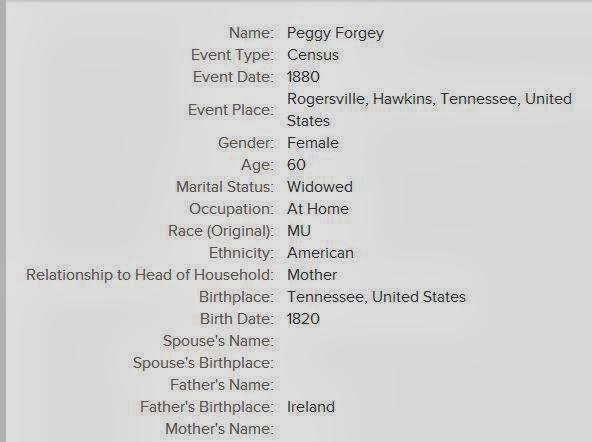
It looks like Joseph Forgey didn't live to see freedom but his wife Peggy did. We find her living in Hawkins County, TN; listed on the 1870 and 1880 Census for Hawkins County, TN. 


We see that Peggy Forgey is listed as a mulatto. Her father's birthplace is given as Ireland. We know her master James Forgey was born in Ireland so it is very possible he is Peggy's father. 
Next we can follow Thomas Forgey from slavery to freedom. James Forgey Sr. names Tom in his 1831 will.


Rachel Forgey died before her mother Margaret Forgey. Rachel willed Tom to her mother Margaret. In 1856 Margaret mentions Tom in her will.


In 1870 and 1880 we find Thomas and wife Fary living in freedom with his family in Hawkins County, TN. He seems to have made a successful transition and was working as a blacksmith.  


We see more Forgey slaves not named in the family wills in the Census. In 1850 James R. Forgey Jr. owns 21 slaves most being children. We do not have most of their names. Here are a few more I found in the Hawkins County, TN Census.
 1870 Census Hawkins County, TN

Lou Forgey 1880 Census Hawkins County, TN

I believe one of these families relocated to Knox County, TN at one point and can be found there in the 1940 Census. After 1900 I no longer find Black Forgeys living in Hawkins County, TN. 

Inhumanity is not confined to a single race or group of people. I've been reading a book about the Scots-Irish. I agree with the author that hard living conditions in lowland Scotland hardened the people which would later settle the south. They did not feel the pain of others. I believe James Forgey in particular was the sort of ruthless business person that really did not feel the pain of others. The business men involved in the slave trade in England, Spain, the Netherlands didn't have a conscience, but they didn't live with the slaves. The way that some families in the south lived with other human beings and didn't have the decency to free them is hard to fathom?

Here is partial list of Forgeys born into slavery
  1. Joseph Forgey (Mulatto)
  2. Peggy Forgey (Mulatto) Born about 1815 she claims her father was born in Ireland in 1880
  3. Malvina Forgey-Harlan (Mulatto) born about 1839
  4. Mary Forgey (Mulatto) born about 1854
  5. Lou Forgey (Mulatto) born about 1845
  6. App. Forgey (Black) born about 1863
  7. Thomas Forgey (Black) Birth Year (Estimated): 1829-1830
  8. Fary F Forgey (Black) Birth Year (Estimated):  1831-1832
  9. Alice Forgey (Black) Birth Year (Estimated): 1852-1853
  10. Martha Forgey (Black) Birth Year (Estimated): 1853-1854
  11. Jinetta Forgey (Black) Birth Year (Estimated): 1855-1856
  12. Dorcas Forgey (Black) Birth Year (Estimated): 1857-1858
  13. Margarett Forgey (Black) Birth Year (Estimated): 1857-1858
  14. Joseph Forgey (Black) Birth Year (Estimated): 1858-1859
  15. Alsy Forgey (Black) Before 1834
  16. Robert Forgey (Black) Before 1834
  17. Sarah 1828

Friday, January 24, 2014

Too Many Sales of One Plot of Land?

Forgey sales deeds Knox County, Tennessee from the County Index book
I've been examing the new databases at Ancestry, the ones resulting from their partnership with Familysearch, for anything new which might solve my brickwalls. I'm waiting for more Virginia databases in hopes of finding out more about Alexander Forgey and his family. I have nothing at all on Alexander's family, so far, other than documentation of a short marriage which evidently produced no children? So far I know Alexander was in Cumberland County, PA  in the early 1770's, and migrated to Washington County, PA in the latter part of that decade.
I have not been able to locate any records for Alexander Forgey after 1807. I have not been able to locate a will or probate for him. I've looked at deeds to 1800, wills, and taxlists to 1804 for Washington County, VA.
I do believe Alexander Forgey of Knox County, TN might be a son of this older Alexander, of Washington County, VA, due to the fact Alexander, the younger of Knox County, TN was said to have been born in Virginia. Losing track of the older Alexander I wondered if he joined his possible son, and nieces and nephews, in Knox County TN?
I've been puzzled by the many land sales of Alexander Forgey, apparently selling the same piece of land on Flat Creek in Knox County, TN. Are we dealing with 2 different Alexander Forgeys selling different plots of 250 acres land or the same plot of land? I'm not seeing any clues that there were 2 different men in Knox County,TN such as references to a Junior and Senior. I never saw 2 Alexanders on the three Knox County, TN taxlists I've searched. The older Alexander would have aged out of the taxlists by 1804 I believe?
In 1802 an Alexander Forgey purchased 250 acres on Flat Creek from James Forgey. The younger Alexander Forgey would have been 23 and unmarried; which, would be a little unusual in my experience. That would have been a young age, for a single man to have had enough money to buy land. Could the elder Alexander have made the original purchase from James? If we had a Census records for 1800 or 1810  this might be cleared up? Unfortunately no Census records for eastern Tennessee survive before 1830.
Here are the Alexander Forgey land tranacations as recorded in the deed index for Knox County, TN (these deeds were not filmed by the Family History Library in Salt Lake City. Hence, it took me a while to locate and get copies of them)
We can see James Forgey's orginial land grant as the first transaction. This land was later split in half and sold to Alexander Forgey and Andrew Forgey (Andrew's relationship to Alexander is unknown).
Flat Creek Knox County, Tennessee
Forgey Land Purchases

Richard Freer to James Forkey
Warrant for 640 acres (actual grant was for 500 acres on Flat Creek)
Date of transacton: 10 July 1788

James Forgey 
Land Grant #305 for 500 acres on Flat Creek
Book C Volume 1 page 49
Date of Deed: 27 Nov 1792

James Forgey to Alexander Forgey
250 acres on Flat Creek
Book L Volume 1 page 4
Date of Deed: 2 Dec 1802

James Forgey to Andrew Forgey
250 acres on Flat Creek
Book L Volume 1 page 16
Date of Deed: 2 Dec 1802


John Smyth to Alexander Forgey
250 acres Flat Creek 
Book M Volume 1
Date of Deed: 1 Oct 1807

Samuel Cox to Alexander Forgey
Tract
Book N Volume 1 page 286
Date of Quit Claim: 9 Aug 1809

Here are all the sales of property by Alexander Forgey as recorded in the county deed books. All of the land transactions consist of 250 acres on Flat Creek in Knox County, TN. We only see one apparent buy back of 250 acres on Flat Creek. Alexander Forgey sold 250 acres to John Smyth in 1803 and buys it back from John Smith in 1807. An Alexander Forgey sells land to John Thompson in 1812. I don't see a deed for a repurchase from John Thompson which I expected because Alexander Forgey sells 250 on Flat Creek again in 1815 to Abner Parr. We know the 250 acres on Flat Creek sold to Abner Parr was from the James Forgey land grant because it's stated on the deed. We don't really know whether the 1803, 1807 or 1812 land transactions involved the original land grant? There is an 1809 Quit Claim deed from Samuel Cox. It doesn't appear to involve the 250 acres of land on Flat Creek? It references a tract of land.

Flat Creek Knox County, Tennessee
Forgey Land Sales

Alexander Forgey to John Smith
250 acres Flat Creek
Book L Volume 1 page 21
Date of Deed: 4 Jan 1803

Alexander Forgey to John Thompson
250 acres Flat Creek
Book O Volume 1 page 315
Date of Deed: 12 May 1812

Alexander Forgey to Abner Parr
50 acres Grant #305 (James Forgey's grant)
Book P Volume 1 page 402
Quit Claim
Date of Deed: 21 Nov 1815

Alexander Forgey to Abner Parr
250 Flat Creek
Book P Volume 1 page 403
Date of Deed: 4 Feb 1815

In conclusion it isn't clear exactly which Alexander Forgey was involved in all these transactions? We only see one purchase of 250 acres of land on Flat Creek (the second purchase looks like a buy back?). Alexander Forgey, the younger, was said to have lived on his father-in-law John Sawyer's property at some point. He may have received land from his father-in-law and never filed a purchase deed. I have not looked at every deed and a reading of everyone of these may provide more information as to how many Alexander Forgeys lived in Knox County, TN in the early 19th Century.
Forgey purchase deeds Knox County, TN. Click to enlarge

Tuesday, January 14, 2014

How long does it take to make a family tree?


A first cousin of mine needed help researching his maternal family tree. He wanted to know whether his grandfather was Native American because he was born on the Pala Mission Indian reservation in San Diego County, CA.
I began researching his tree with only the names of his grandparents, Robert Ridge and Mildred, and place Southern California. No maiden name for Mildred.
So how long did it take to put together the outline of his family tree?
I began at 3:04 pm on Saturday January 11, 2014.
3:04 pm My first stop was the 1940 US Census records since these are the most recent and complete records that would include his grandparents.


3:06 pm I noticed he was born in California.I knew abstracts of birth records for California were online. I checked to see if I could find his birth record but instead found birth records for his children. At 3:06 I had my cousin's grandmother's maiden name.

3:11 pm I had located his grandparents on the 1930 Census. Now I had birthplaces for Robert Ridge's parents which should help me identify his parents in 1920.


3:26 pm It took me a little while to locate Robert with his family on an earlier Census. Once I did locate him in 1910 I also found him with his parents Gertude B. and Mang Ridge. I had never heard of the name Mang before. I wondered if it was Native American? I knew that with an unusual first name it would be simple to identify Mang Ridge on earlier records.


3.48 pm Found the Mang with his father after I took a little break for a snack. I now had his full name Mangrum Ridge and his parents, Robert and Nancy's, names and birthplaces. At this point it looked like they were not Native American. They lived on the Pala Mission Indian reservation in 1880, but were not descended from tribal members.

3:54 pm I decided to check Ancestry.com trees thinking it would be easy to find a Mangrum Ridge if someone had made a tree for the family. I immediately found several trees for him. All of the Census data matched the Mangrum on these trees. These trees included attached records and old photos of  Mangrum and Gertude's family from the early 20th Century. I found more of his ancestors on these trees too. 

I know these tree can contain erroneous information so I needed to read through their attached records. The trees looked accurate after analyzing the information contained in the records. I did wonder about one of his ancestors said to have been killed in the Civil War. When I looked at the attached record it said he was a private in a colored regiment. I don't think this ancestor was African America so I believe this is a wrong connection?
I decided to try to see if I could push his line back farther than the mid 19th Century. I hit the same brickwalls previous researchers did. I was not able to locate the Kohrs family in 1920. I also could not locate the Ridge family in 1860 or before.
5:59 pm. I found my cousin's possible Kohrs great grandparents. This is the closest match I could find in 1910 Colorado. Unfortunately Mildred wasn't born until May 1910, and April was the Census month. It sounds like Mildred's parents names were not included in her 1978 Oregon death certificate? Her social security application would be another source for their names.
I continued to research the family until I went to bed at 11 pm without any more success. 
I did manage to locate the Ridge family on the 1870 Census for El Monte, California and I found Robert Ridge and Nancy Rice's marriage record. 
Without the trees I found at Ancestry.com it would have taken much longer for me to put all this information together. I've put my tree together over many years. It will take this family more time and effort to surmount the 19th brickwalls. It really takes years to assemble and document a family tree. 


Friday, January 10, 2014

Binders vs. Books

Here are the books I've printed seen near an oxygen tank. See the same tank and binders below to get a better idea of compactness the books.


I've been scanning the documents I've collect over the years and filed away in binders. I had them arranged by surnames, and placed the documents in page protectors. The page protectors made the binders very heavy. It's good exercise lugging these around. Since Lulu books are so inexpensive to publish I decided to print my important documents and information into 8 1/2 by 11 paperback books. So far I have 4 books published, and they are pretty comprehensive covering all of the important documents, stories, and data about my ancestors up to the current time.
I'm not going to throw the binders away. They still contain some material not in the books and they contain some original copies, and original documents. I am enjoying these books. I thumb through them from time to time, and love seeing both the documents and family photos without having to lug out heavy binders.


Wednesday, January 1, 2014

Genealogy Resolutions and Year in Review


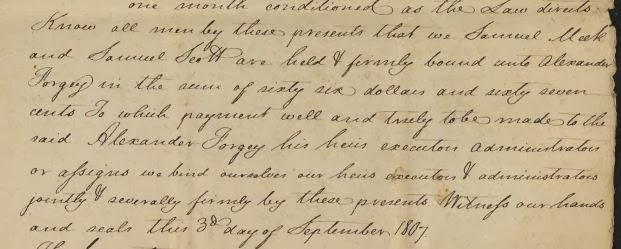
The End of the Alexander Forgey paper trail  is 1807, picking up from here in 2014

Happy New Year 2014! 

It's been such a fruitful year genealogy wise; it's hard to recall every single new find, there were so many.

  1. My mother took the Family Finder autosomal test through MtDNA in August. This has led to finding more distant cousins. The best outcome of this is that she looks like a DNA match to a distant Forgey cousin, further cementing our relationship to the McMinn, Tennessee Forgeys.
  2. My cousin Darryl Kapple took the Y DNA test and we now have a Haplo group of J2b. So we know our family had been in the Mediterranean area at some point.
  3. I took the MtDNA full sequence test and found out I belong to the African Haplo L2a1F. 
  4. Some of my Forgey first cousins took the 23andme DNA test.
  5. A third cousin, Sophia Preston, tested with 23andme and we discovered we share the maximum DNA that a third cousin is likely to share.
  6. The Virginia Memory Chancery court project led to more indepth information about the Lewis Zirkle family, plus great stories! The same database contained a court case naming Benjamin Wray's children and grandchildren, which is conclusive proof we descend from him.
  7. Another big breakthrough came from Ohio court records. Eve Urmey is named as a sister of John Urmey in his Ohio will. This John is son of Jacob Urmey and Susannah Brower. This is satisfactory proof, for me, that Eve is their daughter. 
  8. After adding Brower to the tree I was able to find some great information about this family and their origins in Germany. I've also collected up Urmey and Brower wills this year.
  9. It looks like Edward Browning's wife was Elizabeth Drane.
  10.  This past week I've added another name to the Kapple tree, the name Rottenstummer. I did this with the help of a Kleinmurbisch, Austria cousin. Rottenstummer seems to have originated in the village of Kleinmurbisch.
My to do list for 2014
  1. I think my number one priority this year is going to be trying to find out more about the mysterious Alexander Forgey of Washington County, Virginia. We don't know who his children are, and we don't know where or when he died? We lose all track of him in 1807.
  2. While researching the Brower family I saw Brenneman given as Susannah Brower's mother Eve's maiden name. I can't confirm this. I would like some documentation for this?
  3. I've been doing some Browning family research this year. I would like to find more documentation linking the Tennessee Brownings with Maryland. Also need to find documentation that Elizabeth Drane was Edward's wife.
  4. I still don't have any photos of Frank Kappel and Mary Kurta, my great-grand parents, so I will be continuing to search for those.
  5. Another carry over from previous years is finding the death information for Patrick Mullen and Mary Huvane who died in Ireland.
  6. The partnership of Ancestry.com and Familysearch will produced more records to search, and I plan on using them as soon as they are available. When I don't know?
  7. Another resolution from years past is learning more about my Nicaraguan ancestors. I did look into getting more information about them, but was disappointed to find out that the vital records office for Granada, Nicaragua doesn't respond to mailed in requests. You must request records in person. So finding out more on this line may mean a trip to Granada, Nicaragua?
  8. I'll continue searching War of 1812 records as they come available.
  9. I've upgraded my cousin Darryl Kapple's Y DNA test, and should get the results in a few weeks. We'll see if there as any matches at 37 markers?
In conclusion I've made some great headway, and confirmed the parentage of Eve Urmey and Elias Wray, this year. We've confirmed our paper trails using DNA. We've also added some great stories, so we have more than statistical information. I've compiled much of what we have so far into several books I've printed, through Lulu, this year. This included printing this blog into a book. If next year is as fruitful I will be very grateful!

Welcome Catharina Rottenstummer to our tree!


Monday, December 30, 2013

Coming up to speed with MtDNA


I received my Full Sequence MtDNA results in December. Of course I had no matches at this level, because so few people have tested at this level. I saw a figure of about 18,000 testers at the full sequence level (this number is probably outdated by one year or so). I would need a large number of Nicaraguans testing to find a close match at his level.
I've done a lot of research on the L2a1, and specifically the F subclade. L Haplo is African and about 55,000 years old. I found out that subclade F is anywhere from 2,000 to 10,000 years old. As you can imagine this subclade could travel far and wide throughout Africa over thousands of years. It is widespread in Northern and Central Africa, and made in roads into the Middle East. It is found in Saudi Arabia, and seems to have been spread into Europe by the Jews.
Example 1
We do now have Nicaraguans testing with Family Tree DNA, and I hope to have a close match at some point.
My results mismatched the L2a1f subclade by two mutations, and I have a number of extra mutations. It looks like this will lead to another subclade, which may eventually lead to a more specific location of origin for my ancestors.
Example 2
I've been attending the new series of webinars presented by Family Tree DNA. The MtDNA session was so enlightening! I really had no idea how to read the results page. Example 2 shows the mutations, or differences, I have in my DNA from the Reference model used. These mutations occur among individuals and are disseminated throughout a population through the generations. In earlier eras, when migration was less frequent, these mutations would be limited to individuals living in a small region. Example 2 shows a letter before and after the number. The first letter represents the reference model, and the second represents our own difference from this reference. For example the first position here is A16129G, and we see the first letter is A and the last G . Position 16129 is A in the reference, and is G in my own sequence. These differences are used to place everyone into a Haplo group and subclades. A and G often shift positions, along with C and T.
I found another site besides Mitosearch and Sorenson to upload my full sequence results and compare; namely the MtDNA Community.org. I found one match there. Not an exact match so we probably share an ancestors hundreds or thousands of years ago.
My best hope for a breakthrough with MtDNA would be a perfect match. I also hope we had a mutation in my line fairly recently, because that would mean we share an ancestor in the genealogical time frame.

Tuesday, December 3, 2013

The short life of Isis Forgey

My Aunt Isis lived to be about 5 months old, but her short has always fascinated me. She was born while my Grandfather Charles Lynn Forgey served in the US Marines. My Grandfather married my Grandmother Graciela Del Castillo in Nicaragua on 10 January 1919. Since Isis died in Nicaragua it's been difficult getting any information about her death. I've tried for a decade writing to various record offices in Nicaragua in an effort to get any additional bits of information about my ancestors there. I generally got no response at all. I did get one response from a Catholic Priest stating he could not find any information.
Thankfully the vital records for Managua, Nicaragua were filmed by the Family History Library in Salt Lake City, Utah. These records have been digitized and uploaded to Familysearch and are fully searchable (I am hoping they eventually film the records in Granada).
I've asked my mother and her siblings about their sister Isis, but they didn't know very much about her other than she died very young in Nicaragua. My mother was under the impression Isis had broken her neck? She may have come to this conclusion after looking at a photo of Isis taken after her death. Her rigid position after her death may have made it look like her neck was broken? The family seemed to avoid talking about Isis, probably not wanting to bring back the memory of a painful event. No one knew her date of birth or death.
I've located 3 records mentioning Isis Forgey (she was named after her Grandmother Isis Browning Forgey). I now have her birth record, a 1920 US Census record, and a Death Record.
What I learned from these documents is:

  1. Isis was born on 26 January 1920 in Managua, Nicaragua
  2. Isis died on 3 May 1920 in Managua
  3. Isis died of a Gastro intestinal infection, and not a broken neck


Isis Forgey's birth record says her father Charles L. Forgey was in the Military
Isis Forgey's death record
1920 Census for Marine Legation Managua Nicaragua
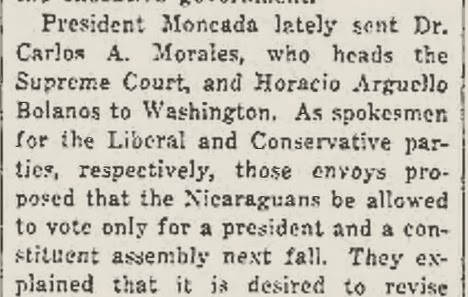
 By April 1921 my Grandmother was back in her home city of Granada where my mother was born. My grandfather was out of the country in Honduras working in a goldmine at the time, he was discharged from the Marines in June 1920. My mother was born in the home of Horatio Arguello Bolanos. I found a newspaper clipping about him below. He may have been a cousin of my Grandmother?


My mother Edna Forgey-Kapple's Birth Certificate 

Sunday, November 24, 2013

Roadwork Books lead to more Brainstorming

Andrew Forgey Knox County, TN Roadwork book 1802
I ordered a microfilm of the Roadwork books for Knox County, Tennessee from the Family History Library. I went to the FHC at the first opportunity when I got the call it came in. I was looking for any mentions of the Forgey, Fisher, and Reynolds families which might provide more information about the family. I had hoped that Archibald Forgey might have done some roadwork creating a connection for him with Knox County, TN. The first item on the microfilm was disappointing with no mentions of any family. The second and third items on the film were for the late 19th Century, which would be well past the time my family lived there.
I finally had a stroke of luck with older books again reappearing towards the middle of the film. After scanning through about 20 pages I finally hit a Forgey entry. This was for Andrew Forgey, a few pages past this I found my ancestor Hugh Forgey. These entries were for the years 1802 to 1804. I never ran across Archibald. It's estimated that he was born in 1790. The family left the Knox County area in 1806. Doing more research on the ages of men who were recruited for roadwork I found the age range of those who were required to perform the work. "Under a legislative act of 1804, counties were authorized to build roads and to require every able-bodied man between the ages of 18 and 50 to work on the roads or to hire a substitute to work in his place." So it is likely Archibald was too young to have been involved in roadwork. 
Deed witnessed by Elen and
 Andrew in Knox Couty, TN
The two Andrew Forgey entries raised the question again about who this Andrew is? We believe he is Andrew Forgey who married Eleanor Randall and later relocated to Maury County, TN. We know this Andrew was associated with Alexander Forgey who married Elizabeth Sawyers (daughter of John Sawyers). We know Alexander and Andrew split a 500 acre land grant which was sold to them by James Forgey. The roadwork book regards the appointment of Andrew Forgey to be overseer of the Road in front of John Sawyers property. This is another in a series of documents linking Andrew of with the Sawyers family. Andrew also witnessed the Will of Hannah Sawyers' wife of James Sawyers, sister-in-law of John. We later find Andrew Forgey of Maury County, TN serving as an administrator of Betsy Sawyers estate in1818, and we find him purchasing most of her estate. This is what led us to believe there was a connection between this Andrew, of Maury County, and the one found earlier in Knox County. I later found a deed witnessed by Andrew and an Elen in Knox County. This would again points to Andrew living in Knox County previously since his wife was sometimes called Elen. 
Hannah Sawyers will Knox County, TN

If we could connect Betsy Sawyers with the Sawyers family in Knox County that would prove with little doubt Andrew of Maury County is related to the family in Knox County. Unfortunately, I can't find a connection. I've found a William Sawyers on a tax list for that area, around Maury County, in 1812. This may be Betsy's husband? I believe Betsy is a relation of Andrew, perhaps a sister or sister-in-law? I've been researching the names of all the Sawyers in Knox County early on. So far I am just finding Colonel John Sawyers Family, and his sister-in-law Hannah and her family. Several males in these families married Elizabeths; but, not this Betsy in Maury County? John Sawyers had a son named William and there are conflicting dates of death given for him ranging from dying at birth to 1867. He is named in his father's 1828 will so we assume he is alive then. This could be Betsy's husband? They may have separated? William married Elizabeth Cassady in 1827. He was born in 1791 which would make an 1827 marriage a late one. William served in the Military during the War of 1812, and could have been in that frontier area in 1812. Sawyers deeds in Maury County,TN may be the only way to establish who Betsy was?  
Here are the names of James Sawyers family:
This is John Sawyers family:
Betsy Sawyers' administrator Andrew Forgey is named here in this Maury County, TN  document


Hugh Forgey serves on roadwork crew in 1804 Knox County, TN