Friday, December 22, 2017

Maryland Browning Research


Now that so many more original documents are online I'm taking the opportunity to collect more information on all my lines. I'm attempting to confirm some of the trees I've found online using these documents.

This week I'm working on confirming the Browning line. Back when FamilySearch went online in May of 1999 the only family I was able to find was the Browning family. According to this patron contributed database information my Browning line went back to Francis Browning and Rachel Marriott who settled in Maryland in the late 1600's.

I have not found any evidence that Francis Browning and Rachel Marriott were the parents of my ancestor Edward Browning. I have been able to prove my line back to Edward Browning and wife Elizabeth who first appears in Montgomery County, Maryland in 1758. Someone stated they found this Edward in the same area in 1736, but I have not found anything confirming that.

Here is what can be pieced together using early Maryland surviving documents. What we know about the first Browning family to settle in Maryland comes from John Browning. He needed to establish a legal claim to his deceased father's property. In 1679 he swore to the fact that he was Thomas Browning's son, and that Thomas Browning  transported 9 people to Maryland and received headright land for that in 1664. Thomas Browning's wife was said to be Hester and she does appear as one transported by him in 1665. Also transported was his son John.

John Browning of Cecil County, Thomas's son,  transported Eliza, George, Thomas, and Hester Browning. John did have a wife named Elizabeth? This Eliza could be John's wife. The other Brownings named could be John's children?


Some think that Thomas and Hester originally settled in Lancaster County, Virginia in the 1650's? There were a number of Browning in Virginia in the early to mid 17th century. A John Browning was a Jamestown settler. It's thought Thomas might descend from him or be related in some way?


Francis Browning is the man my line is said to descend from. There are two Francis Brownings listed in "The New Early Settlers of Maryland" by Dr. Carson Gibb. The one in St. Mary's county was an indentured servant. I'm not sure our Francis was the same person listed as being transported in 1670? Some evidence seems to suggest he isn't. The indentured servant may not be a Browning as his name is sometimes spelled Brown or Browne. He was described as a boy in 1678. If our Francis Browning was born in the 1670's it is unlikely the indentured servant was his father.     


There appears to be a different Francis who is said to have be born in America to Thomas Browning and Hester or their son John? According to the author Richey Tracks of the book "Browning family revision, includes related lines: of Hickman-Lewis-Lloyd-Moore", "Francis  was born about 1672, probably in Cecil County, ... Court Minutes of Cecil County, Maryland, dated November 9, 1698, record a suit by Edward Skidmore against Francis Browning for the settlement of a small debt." Is this really a different Francis Browning? The Thomas Browning and wife Hester's family is fairly well off. They had connections to trade in Jamaica and Barbados.The Francis that settled in Virginia was fairly well off too. One of the Brownings in Maryland mentioned some land he owned in Virginia. John Browning who died in 1741 in Kent County, Maryland said he owned land in Virginia, plus mentioned the name of someone living in Orange County, Virginia. It is possible that we are descended from the indentured servant, or the Thomas Browning and Hester family? The only way to confirm if there is a relationship with this couple is through a Browning Y DNA study.


Some believe Francis Browning returned to England with his mother Hester and siblings. They believe this is the family listed on the 1696 Census for Gloucesterhire England. Someone looked into that and found a Francis Browning who remained in that area years after Francis of Virginia was already in America. Doesn't sound promising. Although some DNA testing may be proving the Gloucestershire roots?


What we know for certain is the Kent County and Cecil County, Maryland Brownings are descended from Thomas Browning and wife Hester.

The Cecil County, Maryland Brownings

What we also know for certain is Browning's Plantation in Baltimore County, Maryland, now Cecil County, was purchased from Abraham Morgan who patented it in 1664, and it was sold in 1672 by John Browning and wife Elizabeth . The land was purchased by Thomas Browning referred to as John's father in this deed.


In 1679 John claimed his father Thomas Browning's headright. Apparently that Thomas was dead by 1679. Here is a portion of the letter granting John his father's land:


In 1690 an inventory is recorded for a John Browning in Cecil County, Maryland.


There is a Thomas Browning married to a wife named Anne who appears in late 17th century Cecil County records. I had thought Hester died and John's father Thomas remarried? It seems more likely that he is another son of Thomas and Hester, or a grandson of theirs through their son John? Thomas had a daughter named Ester. The names Ester and Hester were interchangeable, which suggests this Thomas is descended from Thomas and Hester.

I'm confused by a court record which names Anne Browning as a relict, widow, in February 1695. This record describes Anne as the Administrix of Darby Nolan. In June of 1694 she is referred to and signs a bond along with her husband Thomas regarding the same Darby Nolan estate. In 1696 there is still a Thomas is Cecil County, so I don't believe she was widowed by Thomas yet. She must have been Darby Nolan's widow. This Thomas has a daughter named Ester.


The only thing I'm confident about is the Cecil and Kent County Brownings are related. We know Hester and Thomas are parents of the John who died in 1690 in Cecil County. We know there was a younger Thomas who died in 1721, in Cecil County, and is related, and is likely a descendant or another son of Thomas and Hester. George Browning is transported by John Browning of Cecil County and is definitely related, and could be his son. We don't know if Francis is related? The only way to prove it is through a Y DNA test.

In 1702 George and Mary Browning sell land in Cecil County, Maryland.
In 1702 Thomas buys land in Cecil County from Matthias Smith.
In 1702 John and Thomas sell land in Cecil County together. It appears they weren't married as no wives are mentioned They sold the land to James Watkins. (interesting that much later a Jeremiah Watkin's was involved in a suit over Edward Browning's will).
In 1708 Thomas Browning of Cecil County, Maryland and Ann Browning buy and sell land. Interesting a parcel they sold is situated on Captain John's Creek. I wonder if this is Capt. John Browning?  This Thomas Browning dies in 1721 leaving estate to sons Thomas and William. A daughter Ester (Hester), and possibly a daughter Elizabeth.


The Cecil County, Maryland Brownings were later listed in Kent County, Maryland records. It looks like the family migrated to neighboring Kent County.

Brownings In Kent County, Maryland

George Browning left a will dated 1732 in Kent. Leaving his estate to his siblings, Elizabeth and Mary,
Another George Browning died in 1735. He said his father was also named George Browning. He names no wife or children.
A Thomas Browning dies in Kent in 1739. He leaves his estate to his sons William,  John, his wife Joan, and a Martha Browning.
John Browning of Kent County died in Kent County, Maryland 1741. He mentions Orange County, Virginia in his will. He leaves his estate to eldest son Writson, and sons John, Thomas, George, Nicholas, and daughter Rosamond . He mentions a brother George. Wife was Rachel. He owns land in Virginia called Brownings Choice.

Writson Browning died in 1769. Sons Joshua, John Writson , Joshua, George, and Thomas. Daughters Elizabeth and Cornelia. They owned some very expensive furnishings. He willed a tea set, and silver spoons to a daughter. He also willed some expensive furniture such as beds and a dressing table.
Sary died in Kent County, Maryland in 1775. She sounds like Writson Browning's wife. She has a son named John Writson Browning.  Also son's George, Thomas. Daughters Cornealey and Elizabeth.

Thomas Browning and Mary Ward of Kent County, Maryland married 27 April 1708. Their family is listed in the St. Paul's Church records of Kent County, Maryland. 

St. Paul's Church record

The Montgomery and Frederick County, Maryland Brownings

Moving on to the Edward Browning and Elizabeth family. Edward's children are listed in his 1760's will.


I'm confident with my Browning lineage back to Edward Browning who died in 1788. He may have been born around  1700. There is an Edward Browning who appears in Maryland records beginning in 1706. Could this be Edward's father? It's possible that Thomas Browning and Hester's son John was Edward's father? It's possible the indentured servant Francis, or another Edward Browning was his father?

My confidence in the fact Montgomery County , Maryland family is Roger's family stems from the fact Benjamin Browning, confirmed son of Edward, left his estate to his his eldest son Roger. He followed the English tradition of primogeniture. The fact Roger Browning lived in Tennessee and doesn't state he is from Maryland in any surviving documents may cause us to question this connection? The naming patterns in the Roger Browning family are similar to those of the Edward Browning family. Edward had sons named Benjamin and Nathan, and so did Roger. Also one of Roger's grandchildren, Jesse, knew there was a connection to Maryland even though he were born in Tennessee.  Several of Nathan Browning's children, Roger's grandchildren, stated their father Nathan was born in Virginia, according to the 1880 and 1900 Censuses. My mother has a solid AncestryDNA match to a confirmed Edward Browning descendant, who descends from Eli Browning.

Autosomal DNA testing suggests that our Brownings may be related to the Francis Browning family of Culpepper County, Virginia. My mother has some DNA matches with their Browning descendants. A Caleb Browning descendant is one of her matches.  Also a segment from someone claiming to descend from Francis Browning and Rachel Marriott overlaps a confirmed Browning match, who descends through a Catherine Browning.

 In 1706 an Edward Browning is listed as living in Baltimore's Spes Utiz Hundred.

An Edward Browning was referred to in the 1708 estate papers of John Hunt of Philadelphia. The executor was Richard Bennett of Queen Anne's County, Maryland (some of Edward's children were married in Philadelphia).
Also in 1708 according to the book "Abstracts of the Testamentary Proceedings of the Prerogative", by Skinner, Edward Browning was executor of James Mackneale, "per Mr. Vanderheyen." This was in Kent County, Maryland.

I'm not sure who this early Edward Browning was?
About 1725 is the year Edward's son Jonathan Browning was likely born according the "History of western Maryland : being a history of Frederick, Montgomery, Carroll, Washington, Allegany, and Garrett counties from the earliest period to the present day" printed in 1892.
We first find Edward and sons listed in the land patents records for Frederick County, Maryland. Edward is the first to patent land in 1758 with his sons following suit.
Edward Browning sold land called Friendship Running and Bounding in Frederick County, Maryland in August of 1769 to his son Jeremiah. He gave a tract called Friendship Beginning to his son Benjamin. Edward stated he gave the land to Jeremiah in consideration of "natural love and affection." Parents generally transferred land to children with the consideration being love and affection. 
Edward Browning Jr. bought a parcel of land called Snowden's Manor, from Richard Snowden in 1760 in Frederick county, Maryland. The land was said to be near James Duncaster's land. Edward paid with English sterling. Not sure if that is a hint this family came from England more recently? The fact the Junior Edward purchased land in 1760 would suggest he was over 20 years old. This would mean he was likely born before 1740. Giving us a hint of Edward Sr.'s age.
In 1755 brothers Benjamin and Jonathan Browning along with Jeremiah Prather were charged with "breach of the peace ignoramous."  They forced their way into the plantation of John Davis and assaulted his son Charles Davis according to "This was the Life: Excerpts from the Judgment Records of Frederick County , Maryland 1748-1765."
In 1768 Edward Browning and Samuel Waters are summoned to court in Frederick County "to show cause why they do not account for crops on Plantation." This is regards the estate of Edward Browning's father-in-law Eller Burton, through his second marriage to Drusilla Burton.
In 1784 in Montgomery County, Maryland Edward Browning Sr.'s son Benjamin (my ancestor) sells Friendship to Ashor Laton. Friendship was in Frederick County when Benjamin's father gave the land to him in 1769. Montgomery County wasn't formed until 1776. A problem I spotted with the 1784 deed was Ann was named as Benjamin's wife not Mary (as in Mary Abbott).
In 1783 in Montgomery County, Maryland Edward Browning Jr. sold a 23 year old slave named Doll to Jonathon Nixon for 8000 pounds of Tobacco.
In 1779 Edward and Jeremiah Browning. sold another portion of the parcel Friendship. They sold it to Samuel Phillips of Montgomery County, Maryland. Jeremiah's wife is named  as Cassandria.
The 1778 Tax list for Linganore Hundred Montgomery County. Maryland below.
1778 Tax List Montgomery County, Maryland

Tax list 1783 Montgomery County, Maryland

Archibald Browning. MO Linganore and Sugar Loaf Hundred
Basil Browning. MO Linganore and Sugar Loaf Hundred
Edward Browning. No Name, 30 acres. MO Linganore and Sugar Loaf Hundred
Edward Browning, Sr. MO Linganore and Sugar Loaf Hundred
Edward Browning, Sr. Fancy, 10 acres. MO Linganore and Sugar Loaf Hundred
Edward Browning, Sr. Red Oak Slip, 140 acres. MO Linganore and Sugar Loaf Hundred
Jonathan Browning. Long Looked For, pt, 44 acres. MO Linganore and Sugar Loaf Hundred
Jonathan Browning. Maple Branch, 300 acres. MO Linganore and Sugar Loaf Hundred
Jonathan Browning, Jr. MO Linganore and Sugar Loaf Hundred
Jonathan Browning, Sr. MO Linganore and Sugar Loaf Hundred
Virlinda Browning. MO Linganore and Sugar Loaf Hundred
Virlinda Browning. Timber Neck, pt, 100 acres. MO Linganore and Sugar Loaf Hundred
Virlinda Browning. What You Please, 50 acres. MO Linganore and Sugar Loaf Hundred
Volinda Browning. Hope Improved, pt, 24 acres. MO Linganore and Sugar Loaf Hundred
6 September 1804 is the date of the death of Jonathon Browning son of Edward.

Edward Browning died in 1788.

On 10 June 1788 Elizabeth Sampson of Montgomery County, Maryland appeared in court regarding the destruction of Edward Browning's will. If there are any surviving documents they could help us name many of Edwards descendants.

In closing I have to reiterate we have no documentation regarding the parents of Edward Browning born about 1700 of Frederick and Montgomery Counties, or Francis Browning of Culpepper County, Virginia. We do have some atDNA matches suggesting Edward and Francis might be related.    


Saturday, December 9, 2017

Tax Lists and Provenance


Tax lists are a favorite source of mine. I've found ancestors on the lists who appear nowhere else. If an ancestor never owned property, or was a woman, they may only be found on tax lists. Widows are found on tax lists. From my experience Kentucky has the most surviving Tax Lists. I'm mainly familiar with tax lists in the Midwest and South,  I'm not sure about tax lists in North East States?

Tax lists tell you when males came of age, because that is when they first appear on tax lists. Sometimes they appear on tax lists at 18, and sometimes 21, depending on local laws. They also tell you when males died, or aged off lists, or left an area. Sometimes they state relationships. I did find one case where an ancestor was described as the son of someone.

You can now find many of these lists online at sites such as Ancestry and FamilySearch. The digitization of the Family History Library microfilms is adding to the online Tax lists.

I got back into Tax List research when I learned my immigrant ancestor, who was granted a travel pass in Germany, never appeared in American records. I had assumed he had been found in Colonial American records,  but only was made aware of the fact he didn't appear from a blog post I found about the Brower DNA project. This ancestor's name was Hubert Brower.  He traveled to America with his wife and children. He definitely isn't in deed records or court records. I decided to look for him on Tax lists which tended to cover a larger percentage of the population. Although landless males did appear on tax lists they were sometimes living as paupers so were exempt from taxation, which might be a problem as Hubert Brower and family probably arrived in America with very little.

The ancestor, Hubert Brower, I was looking for most likely would have settled in Pennsylvania where his children lived, and descendants continue to live, from the 18th Century to present. The family lived in Vincent and Coventry Townships, Chester County, Pennsylvania, for many generations. Hubert's travel pass was dated May 1726. There are surviving tax lists covering that time period.

Finding the original tax lists copies required sorting through several digitized films covering that time period. The digital film titled "Tax Transcripts 1715-1900" contains the original tax lists. These lists are sorted by township.

Tax transcripts, 1715-1900
Author:Chester County (Pennsylvania). Board of County Commissioners

There is an index for lists from 1715-1799 here http://www.chesco.org/1729/18th-Century-Tax-Records

The other tax list microfilms for Chester County are just later indexes, basically.

A later index to Tax lists actually misses some Brower phonetic spellings

Another typed copy which lists individuals in alphabetical order
 
The original tax lists are much more helpful because they list people by township, making it easier to find relatives and neighbors living near an ancestor.


 I'm finding that the names, especially German names, were often phonetically spelled and varied with different tax collectors and different years. The indexes weren't helpful in several cases because the names were badly misspelled.

Here we find Christian Brower's name spelled correctly, listed with his stepfather John Road, in Vincent Township, Chester County, Pennsylvania.


His stepfather's name can be found in the records spelled Road, Rode, Rod, and Roth.

Christian's name is badly misspelled on the 1739 list below. I couldn't find this 1739 entry in the indexes for Christian because of the misspelling.

At this point his mother Ann was a widow and appears as Ann Rood on the same 1739 Vincent Township list.


Unfortunately these tax lists aren't complete for every year, and some years are missing altogether. Only a couple lists survive for the year 1726. Hubert Brower never appears on any tax lists. There are a few complete tax lists for years around 1726, and he doesn't show up on any of them. We do know that Hubert's wife Anna remarried in the 1730's. I'm not sure when the 1726 taxes were recorded and paid? The family left Germany around May 1726. Even if Hubert made it to Pennsylvania in 1726 he may not have been there in time to be recorded on a tax list. It looks like he died on the voyage to America or soon after arriving.

While I didn't find Hubert Brower on any of these lists I did learn more about his son, and my own ancestor Christian Brower. Later tax lists, which are available at Ancestry.com also, give additional facts about Christian, including the number of acres of land he owned, his livestock, and the fact the family had one servant.


Without any record of him having lived in America I wondered what the proof was that Hubert Brower, wife Anna and children were the ancestors of the Browers of Chester County, Pennsylvania? According to witnesses the travel pass, letters, and other documents were found in a trunk in Henry Brower's attic. The Brower line is based on the provenance of these documents. There are no documents stating Hubert Brower or Anna were the parents of Christian, Henry. and John.

This is my first line proven based on provenance of documents found in an attic. I'll have to look up a citation for that.

Early Tax lists for Chester County, PA, from 1715 to 1900, are available online at FamilySearch when using computers at the FHC's (find one near you) or a Family History Library. Many Chester County, PA records are available for research at home through FamilySearch, unfortunately the tax lists are not searchable from anywhere.

Pennsylvania Tax lists from 1768 to 1801 are available at Ancestry.

What I've learned with this research is badly misspelled names may not show up where you expect in an index.

I was able to resolve a problem I didn't know existed until this week with the help of Tax lists and a descendant at a Brower family group on Facebook. The descendant had seen the trunk with the documents so could vouch for their provenance and authenticity. The problem is resolved to my satisfaction.

Saturday, December 2, 2017

Isotopic Testing and Genealogy/ Marking DNA Matches at AncestryDNA

Poor Jane was eaten during the starving time


I visited Jamestown Settlement and Historic site last fall. Since many of my ancestors lived at some point in Virginia the history of that state fascinates me. Also it was thought my ancestor Francis Browning may have descended from Jamestown settlers?

I really enjoyed my visit to these Jamestown sites. I wanted to learn more about the Jamestowne Historic site so I'm currently reading "Jamestown the Buried Truth" by William M. Kelso, Jamestowne archaeologist. The similarities between genealogy and archaeology became very apparent to me reading this book. Archaeologists dig down through layers of earth each layer representing a particular time period. The deeper they dig the farther back in time they go. Same with genealogists, our layers being generations. Some new genealogists tend to miss the layering and connect the wrong generations.


Two of my goals have been to find the place of origin in Europe of my ancestors, and find out when some of these earliest families arrived in America. I have not been able to actually pinpoint an exact place of origin for any British Isles/Irish ancestors, except possibly the Forgeys in Co. Louth, Ireland? All of my British Isles ancestors appear to have come to this country before the American revolution.

 
Here is a chart with the earliest dates in America of my British Isles/Irish ancestors. Many appear to have Scottish or Scots/Irish roots based on their settlement on the frontiers, and their Presbyterian religion. Campbell is definitely a Scottish surname.
I have no idea when these particular ancestors arrived and from where?


The Thurmond relatives here are just speculative

My dead end regarding the origins of these families sparked my interest in the information found in teeth and bone analysis at Jamestown. How can teeth and bone help pinpoint where in the British Isles an ancestor came from? An explanation from Jamestown scientists,"Oxygen isotopes are stored in our teeth in childhood and can be used with other information to determine where a person grew up." This test gives an approximate locations such as Wales, as a place where someone lived as a child.

A test on bones can tell us about the diet of the deceased. If a persons diet had been corn for a time period before their death that can be detected using the chemical composition testing. Skeletons with a corn based diet either were Europeans who had been in America for some time or Native Americans. Those with wheat based diets, according to these tests, died soon after arriving in America.

It is exciting to know that if the remains of our early American ancestors are still available that we can learn more about their origins through teeth and bones. Unfortunately for me and other genealogists finding and unearthing remains is generally impossible. But who knows maybe an archeologist will unearth some of their remains at some point? If you are related to those skeletons found at Jamestown you could be in luck. You could find yourself related to the Bartholomew Gosnold who has had an mtDNA test performed on his remains.

Marking My Ancestry DNA matches

I decided to mark every DNA match at AncestryDNA I could identify a relationship with. Marking them with notes and stars. I basically identify them based on our most recent shared ancestral couple or a single ancestor. With couples I record the husband's surname first, a slash mark, then the wife's surname. If I know which of the couples children we relate through I record their first name. The second match, first column left, below, descends from Andrew Forgey and Margaret Reynolds through their son John. The estimate of 5th through 8th cousins would be correct. They would be 6th cousins, or 5th cousins once removed.


The names with questions marks generally mean this match doesn't have a tree, and I'm basing their relationship on shared matches. I only base relationships on shared matches if they share more than one common match with us. Sharing one common match is often a coincidence.

By catching up on marking identifiable matches searching by surnames I can separate them from my brickwall lines. If I search Campbell, for instance, and find a new match on that surname, and they have a very small tree I can might be able to eliminate them as descending from my Campbells using notes and shared matches. If this Campbell shares 5 Roller matches I can fairly confidently eliminate them as matching through Campbell. If they share one Roller match I wouldn't eliminate that possibility.

Out of around 11,000 matches for my late mother I was able, to some degree, identify the possible common ancestors for around 200 matches. Most of these are on well documented lines. The more surviving documentation, the longer the family has been in America, the number of trees online all seems to correlate with a high number of identified atDNA descendants and matches.

I don't think I was clear in my last blog post regarding finding the origin of atDNA segments. I'm not looking for the ultimate origin of segments, I'm actually looking for more recent origins at around the limit for the effective use of atDNA for genealogy; at round 5 or 6 generations.

By the way I downloaded the 11,000 matches with the chromosome browser extension AncestryDNA Helper. It would be great if we could download our matches and notes right from Ancestry. Using a browser extension, or downloading other applications, can be risky and infect your computer with malware or a virus. I have not had a problem with AncestryDNA Helper so it appears to be safe.

Since I can't dig up the ancestors I will return my focus to documents and DNA in 2018.


Friday, November 17, 2017

Nailing Down The Origin of atDNA Segments

Nailing down exactly which ancestors passed down our DNA segments is challenging for those of us with early America ancestry. It's not that our trees always collapse, mine never has, instead we share an ancestor, or an ancestral couple, or several ancestral couples. To overcome this hurdle it's important to collect as many 2nd and 3rd cousins' segments as possible. These segments are most likely to be IBD, identical by descent.

This week I was able to add a third cousin to chromosome 20 on my mother's chart. This segment can now be named Forgey/Roller after the most recent ancestral couple they share, i.e. Andrew Forgey and Anna Roller.


Marking my well documented known lines helps to eliminate these chromosome regions as areas associated with my brickwall lines.

Right now I'm examining segments on chromosome 5 and 18 as possibly relating to my Campbell family brickwall. I'm looking for the names of the parents of Sarah Campbell, who married Anderson Wray 1833 Indiana, and her place of birth in Tennessee.

I've found the common ancestors for many of our predicted high quality matches at AncestryDNA. My mother and I have had a high quality match for years at Ancestry that I can't place. The fact this match has Campbell ancestors from Tennessee is a possible promising lead for my Sarah Campbell's family. Since this person recently uploaded their raw data to Family Tree DNA I've been able to compare her with others sharing segments on chromosome 5 and 18.

I've examined the trees of matches on Chromsome 5 and 18. I've determined that segments running up to the promising Campbell matches' segments on Chromosome 18 are most likely Wray family cousins. Several also share the Campbell surname, but several don't. Since they don't overlap these segments could come from different ancestors.


 I've found more Campbell descendants who share segments on both Chromosome 5 and 18.


Chromosome 5
Chromosome 18


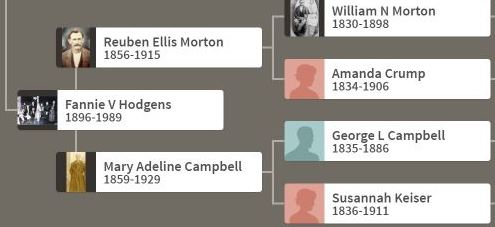
I have found trees posted for some of these matches, and I researched matches myself to build trees out as far as I could. Everyone sharing overlapping segments on ch. 5 and 18 shares the same ancestral couple. They are descendants of  Reuben Ellis Morton 1856-1915, and his wife Mary A. Campbell 1859-1929, of Greene County, Tennessee. These matches are all 2nd or 3rd cousins to one another. I can't find another surname on these trees that would match with the names on my tree.

Paper trails and DNA don't always match up because there can be unknown adoptions, and affairs that no one is aware of. I have a Browning line that also traces back to Greene County, Tennessee. There would have to be some sort of unknown Browning blood relationship at the Reuben Morton and Mary Campbell generation, or before, for these segments to be Browning.


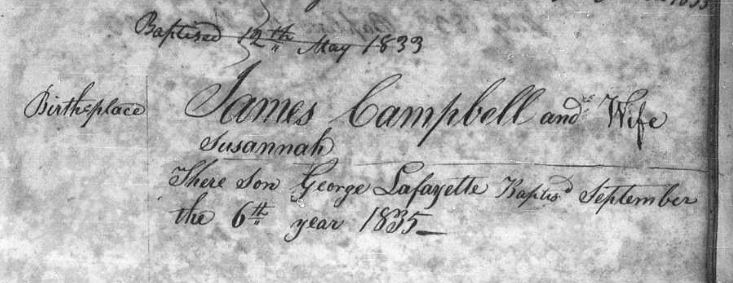
I'm doing some research in Greene County, Tennessee records to see if I can make a connection with the Campbell's in Indiana. There was a disagreement about who George Lafayette Campbell's parents are? I was able to find the documentation for his parents being James M. Campbell and Susannah. George Lafayette Campbell was baptized in the Sinking Springs Lutheran Church in Greene County, Tennessee.

 
George Lafayette Campbell would be in the age range to be Sarah Campbell-Wray's nephew. Could his father James be her brother? Not likely since I believe she may have had a brother named James T. Campbell? Unlikely they would name two children James? It's possible James could be Sarah's cousin?

Not being completely confident that these Campbell matches actually do match us through the surname Campbell I need to find more information to confirm or eliminate this line as contributing to this DNA. If more descendants of James Campbell and Susannah match us DNA wise that would strongly suggest Sarah Campbell-Wray's family originally came from Greene County, Tennessee. William M. Campbell is thought to be James' father.  He settled in Greene County, Tennessee very early. It would be helpful if matches other than one particular line matched us. So far I can't find any other matches with trees tracing back to this family, but I will continue to check for anyone posting such a tree, or testing in the future.

I plan on continuing to search records and check DNA matches, especially on chromosomes 5 and 18, in hopes of finally solving this Campbell mystery.

Saturday, November 11, 2017

These Are The Good Old Days of Genetic Genealogy/ And A Segment Puzzle Mystery?


As I'm going through Genome Mate Pro adding named segments to my segment map this week the differences in the size of the segments between my mother and I were so apparent. Many of the segments I share with matches are less than 20 cM's. My mother has many more segments over 20 cM's, and many over 30 cM's. She was born in 1921, whereas I was born in 1963. As the generations pass our genetic links to our immigrant and early American ancestors will not be visible in our DNA. Definitely test all older relatives first.

I've been mapping my segments in Genome Mate Pro. My main focus right now is on the segments shared on chromosomes 5 and 18 which relate to possible Campbell family matches. Since the only thing I know about Campbell is I have an ancestor named Sarah Campbell who married Anderson Wray in Jackson County, Indiana, possibly born in Tennessee, that's everything I know. I updated the GEDmatch data with new matches. I've been going through these segments and naming them if I can determine the ancestors they came from. This process involves using Ancestry trees. Also Googling names and email addresses to see if there is a family website.

Gedmatch is estimating the length of the segments as longer than AncestryDNA. I've filled in more of chromosome 18 adding matches besides the Campbell match. Two tested with Ancestry and overlap each other, but neither appear as shared matches. According to AncestryDNA one of these matches shares one 14.4 cM segment. GEDmatch estimates the segment is 22.4 cMs. The other match is said to share 1 segment of 12.7 cM's.  According to GEDmatch the segment length is more than twice that length at 28.3 cM's. Since Ancestry doesn't share segment data there is no way to know whether their segments overlap, according to their calculations. They do overlap according to GEDmatch.

Examining the family trees of theses matches I find that the two matches segments I've added to chromosome 18 might share more than one set of ancestors with me. These two added matches share the surnames Campbell and Wray with us. My ancestors Anderson Wray and Sarah Campbell married in 1833. On first examination it could be that these matches are also their descendants, but they aren't. Instead they are descendants of Anderson Wray's grandfather Benjamin Wray and his second wife Patsy Goode. The Campbells they descend from didn't live in Franklin County, Virginia where the Wray family lived.

 
A third match also shares DNA on chromosome 18. This match overlaps substantially with one of the other matches. Since one of them tested at Family Tree DNA and the other at AncestryDNA, and only one uploaded to GEDmatch, there is no way to tell if they match each other?

What is particularly interesting about the match at Family Tree DNA is they have ancestors who lived in Iola, Kansas. Iola is a very small town. Anderson Wray migrated with some of his children to that town. He died there. According to this match she doesn't have any relationship to the Wray family? Either this is a coincidence or there was a non paternity event? If this segment on chromosome 18 came down from Benjamin Wray then an NPE is likely. On the other hand if the match relates on the Campbell line then her tree is correct.

Last week I discovered one particularly interesting Campbell matches ancestors were from Greene County, Tennessee. Sarah Campbell-Wray was said to have been born in Tennessee. The recently added matches, who tested at AncestryDNA, have Campbell ancestors from Lee County, Virginia and Hawkins County, Tennessee. All of these places are close together in Northeast Tennessee and Southwest Virginia. My tendency is to think these segments are related to Wray and not Campbell because both share Wray ancestors?

Looking at chromosome 18 at Genome Mate Pro, after marking all of these segments, it's impossible to see where segments begin and end.


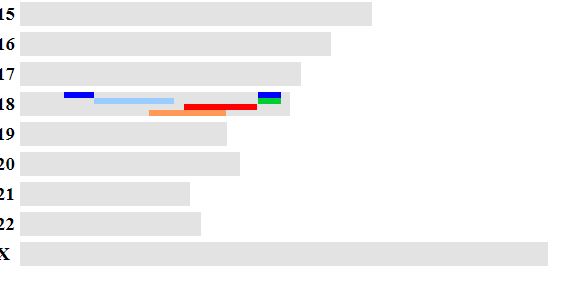
Charting the segments with Kitty's Segment Mapper we see exactly how they fit together (chart below). Not sure why there is an overlap of the blue at Genome Mate Pro? This view is very helpful. We see the Campbell match I am most interested in with segments bookending the others. I found another match who shares one of the exact segments with her. This matches has a very small tree containing no Campbell's or Wray's.

Based on this view my mother either inherited one long segment of DNA from her Great-Great Grandfather Anderson Wray, or chromosome 18 is mix from both Anderson Wray and Sarah Campbell? The book ending may suggest there is a mix of Wray and Campbell DNA on chr. 18? The Campbell match of special interest at AncestryDNA, the booking ending match, has a fairly complete tree out to around 6 and 7 generations with no Wray's on it?


The shared matches feature at Ancestry didn't give me a clue that 3 matches had something in common, facts important to me were hidden. It would have been helpful to know they share either overlapping segments, or segments that are close together. None of these matches appear to match each other even though two descend from Benjamin Wray and Patsy Goode, and both tested at AncestryDNA? They don't show up as shared matches? They do match at GEDmatch.

Doing this analysis required quite a bit of time. No one site has everything needed to effectively analyze and compare matches. I had to go back and forth between Ancestry, Family Tree DNA, 23andMe, GEDmatch, Genome Mate Pro, and Kitty's Segment Mapper. 23andMe has to best tools, but no trees. If they would add a tree feature I would recommend everyone test there.

I will continue to work with the matches on chromosome 18. I do have many more matches I need to evaluate. This kind of analysis is only possible if you have segment data. This analysis is necessary if you are comparing with distant cousins.


Saturday, November 4, 2017

Brickwalls DNA and Privacy

AncestryDNA Changes

Sorry to hear that AncestryDNA plans on making changes which could hamper our ability to workout how we are related to someone. A match can now choose not to show up in results, and testers will be given the option to keep shared matches private. This is a positive development for those testing for ethnicity results who don't want to hear from matches, not so positive for the rest of us..

23andMe has managed to preserve privacy while providing needed tools like the chromosome browser and shared matches.

It's sad Ancestry has chosen to focus on ethnicity results rather than helping us to resolve our brickwalls. They've chosen to focus on the least accurate portion of the DNA results. Not providing the ability to map segments means the power of this tool will never be fully realized for their customers.

The only thing the ethnicity results can tell you with any accuracy is whether you are European, African, Middle Eastern, Native American or Asian. It can only give you vague estimates about anything more specific which actually may turn out to be completely wrong.

Working on Brickwall using DNA

After writing last week's blog post I downloaded my DNA matches from Family Tree DNA into Genome Mate Pro. Someone asked me about the DNA segment chart I included in that blog post. I was thinking it's been a couple months since I updated that database, so I needed to do that. The Family Tree DNA database has grown so slowly that updating every few months has been enough.

After completing the update to Genome Mate Pro I noticed that the Campbell match I was referring to at AncestryDNA has now transferred to Family Tree DNA. Great for me! She has a very complete tree going back about 6 generations at Ancestry. She has no tree or surnames at FTDNA so when I've been searching by the surname Campbell her name didn't come up. She transferred her kit recently.

Why is this such good news? The only information those of us researching Sarah Campbell-Wray have is that she married Anderson Wray in 1833, in Jackson County, Indiana and died there in 1848. We have a list of her children. All but two died before the 1880 US Census, when they would have stated where they thought she was born. Polly Thurman Wray-Hall stated her mother was born in Tennessee, but my ancestor Elizabeth Wray-Forgey didn't know where she was born?

With so little information, and the fact matches would be 4th cousins to my mother, probably removed by one or two generations, the segment data is crucial to making connections with DNA. I need to have a segment map which is as complete as possible in order to eliminate the possibility that we are related on another line. I have to rely on segments to give me clues. With these clues I can do further research in the actual surviving records.

Let's examine the exact segments shared with this match. Both my mother and I share the same segments and same and number of cM's with this match.

Chromosome 5, 28.05 cM's , SNP's 6100

Chromosome 18, 5.69 cM's , SNP's 1700

Chromosome 18, 22.27 cM's , SNP's 2443

We share a total of 56.01 cM's according to Family Tree DNA on 3 chromosomes. According to AncestryDNA we share 43 cM's on 3 segments.

Comparing these segments to others in the same places on the chromosomes it's looking promising that these segments do indeed relate to Campbell. They don't match up with any known Roller matches. They don't match up with any other surname segments.


Doing further comparison with shared matches at Family Tree DNA more good news! Half a dozen shared matches also have the surname Campbell listed in the surnames. As I stated before Sarah Campbell was said to have been born in Tennessee. Several of those who have Campbell listed have Georgia/Alabama ancestors. We know that there was migration heavy migration from Tennessee farther south. I was blown away when I saw two of these matches had Campbell ancestors who were from Greene County, Tennessee, which matches the place of origin of our AncestryDNA match. There was some migration from Greene County, Tennessee to Lawrence and Jackson County, Indiana. My Browning family migrated to these counties from Greene County, Tennessee.

Greene County sounds like a promising place of birth for Sarah Campbell? I will comb those records for any connections.

What I'm getting out of the DNA testing is confirmation of already well documented lines. DNA is matching the paper trail meaning there were no unknown adoptions etc. When it comes to my brickwalls more work is required. All of my brickwalls are at or beyond the 4th generation. The chances of matching a 4th cousin and beyond is far less likely. You have a 90% chance of sharing DNA with a 3rd cousin, but that drops to 50% with a 4th cousin and only 10% with a 5th cousin. Building a segment map using 2nd and 3rd cousins is the most effective way to workout those more distant matches. These large segments are more likely to be IBD, giving a firm foundation for those smaller segments.

I'm going to focus on building my segment map in hopes of narrowing down who is related on my brickwall Campbell line.


Sunday, October 29, 2017

Resolving A Brickwall with Maps/ Why DNA Segment Data is Important


Resolving A Brickwall with Maps

Last week I blogged about my efforts to identify the family of Sarah Campbell-Wray b. about 1812 in Tennessee, according to one of her daughter's Polly Thurman Wray-Hall.  Sarah Campbell married Anderson Wray in Jackson County, Indiana in 1833. There were no Campbells living around Anderson and Sarah, or least not within 20 or more miles.

This week I did page by page research in court orders and probate records, but no additional Campbells have surfaced. So far James T. Campbell still seems the best candidate to be a relative of Sarah Campbell. He is a  possible brother or cousin, based on his age on the Census, if he is the same person listed on the 1840 US Census for Indiana? I first discovered he lived near some of my ancestors in Jackson County, IN a week ago. This James did live within 10 miles of Sarah Campbell's mother-in-law. Sarah's husband Anderson Wray's Uncle, William Harrison, purchased land from James T. Campbell.

I mapped the land grants for the township, range, and section using the BLM search for James T. Campbell, and neighbors . From the landing page clicking on related documents I was able to find descriptions of land purchased by neighbors living in and around township 5, where James T. Campbell lived.


I paid $5 to map all of these land purchases at Earthpoint, which produces a map at Google Earth Pro. Clicking on the purple dot displays the section number. Dividing the sections into 16 squares with a drawing tool allowed me to add the names using the directions, NW of NE quarter for instance.

Looking the map, below, it does prove James T. Campbell was a neighbor of several Wray family relatives. Villorous Wray, Sarah's brother-in-law owned land in township 5 also. The land was indeed close to where Sarah Campbell's mother-in-law was buried, at the yellow pinpoint on the map. Several other Wray and Forgey family in-laws also lived in the same area. The interrelated web of relationships proves that individuals usually married neighbors during this time period. The more distant Campbell families are less likely to have been related to Sarah.

Sections 23 and 24 of Township 5


Why DNA Segment Data is Important

I would like to resolve the Sarah Campbell b. 1812 Tennessee brickwall with DNA. 5 years after first taking an autosomal DNA test,  DNA hasn't resolved this particular brickwall. I've tested with all three major companies. Family Tree DNA does provide segment data, but I see no matches who are good candidates to be distant cousins through Campbell. Same with 23andMe. 23andMe lacks tree information and most testers have no surnames posted. There could be a good match at 23andMe, but I would never be able to identify it without surname information.

AncestryDNA has a possible Campbell related match? This match is a close match of my mother. This match shares 43 cM's on 3 segments. She doesn't match through a Campbell family in Indiana, but does relate to one in Tennessee. Unfortunately one of her shared matches relates through another line of our family. Only one out of a dozen, however, which could be a coincidence? Roller is the line shared by one of her matches. I have a good DNA map for the surname Roller. If I could see the segments we share with the Campbell match I, most likely, could confirm or rule out a relationship based on Roller.


If this match didn't share segments with known Roller matches I could go through matches at Family Tree DNA , 23andMe, and GEDmatch looking for matches on the same segments we share only with this Campbell match. Since my grandmother on that line was Nicarguan it would be easy to establish whether a match was likely a Campbell and I could contact that match. Even if they had little information I could establish whether they, or their ancestors, lived in Tennessee or Indiana.

Without the segment info there is no way for me to work with this high quality Campbell match at AncestryDNA. I've contacted them, but haven't received an answer. I've contacted them twice in the past 3 years. If AncestryDNA would offer an opt in segment sharing option that could help me, and many others solve some brickwalls. 23andMe's opt in segment sharing is fabulous! I haven't bought an AncestryDNA kit in years. I would consider buying more if they had a segment sharing option. If our Campbell match had decided to opt in when she first tested I might have been able to make some progress using DNA for this match?

AncestryDNA may hold the key to at least identifying a potential place in Tennessee where Sarah Campbell's family originated, and a possible shared Campbell ancestor. It could also provide me with more matches on the same segment related to us through our Indiana family.

I will continue to look for potential Campbell related cousins at these DNA companies. Hopefully a match with an Indiana Campbell family will surface.

Saturday, October 21, 2017

Sarah Campbell-Wray: Searching A Place For Everyone Who Shares A Surname

My ancestor Elizabeth Wray-Forgey she was the Daughter of Sarah Campbell-Wray

I've hit a brickwall with my ancestor Sarah Campbell-Wray of Jackson County, Indiana. Researching women is challenging because they were named in few records. My male ancestors names can be found in deed records. When buying land for the family home or farm only the male head of household's name appeared on the deed. Women's names didn't appear on census records until 1850, unless the woman was the head of the household because she was widowed, for instance. My ancestor Sarah Campbell-Wray died in 1847 as a wife and mother, at age of 37. Her early death and the young ages of her children has lead to a brickwall regarding her origins, and the names of her parents. On top of this there were only two identified Campbell males contemporary with her recorded on censuses for Jackson County, Indiana. These men weren't old enough to be her father.

Since there wasn't a Campbell family in Indiana that Sarah Campbell-Wray fitted into I searched neighboring counties. I thought I found her family in Lawrence County, Indiana. William and Mary Gilles did have a daughter named Sarah and they were old enough to be her parents. Unfortunately their daughter Sarah wasn't my Sarah. She married a Dougherty the same year my Sarah married Anderson Wray. This led me to return to Jackson County, Indiana records to see if there were Campbells missed by the censuses.

A major set of records containing women's names in the 19th century, and before, are marriage records. Indiana marriage records are online at Ancestry and Family Search. There is a quick index search at the Indiana State Library site. This index is perfect for my search. It's an index to marriages to 1850. To find every Campbell who married you have to enter the surname in the spouses search. The first surname search field only brings up husbands names. Here we see more names than those represented on the early censuses. Possible siblings of Sarah? I looked up information on those listed, but have not been able to find a connection?


Probate records are another source listing many names not appearing on early census records. This record collection hasn't produced any results regarding Sarah Campbell.

Tax records are another source for names between censuses, but not available for the time period I need online.

Another source containing names missed in the censuses, or who lived in the area between censuses, is deeds. The Family Search microfilm digitizing project has completed digitizing the deed films for Jackson County, Indiana. Unfortunately you have to view the online digitized deed books at a Family History Center or Family History Library to unlock them (there is a little lock beside records that need to be viewed at an FHC or FHL, or you just need to sign in to see). These records are not indexed yet, but many books contain indexes, and there is often also a general index that has been digitized. Oddly the general indexes for Jackson County deeds are at the bottom of the list of digitized films, so some people might miss them.

Indiana sales deeds include the wives names because the wife has a dower interest her husband's property, and therefore had to sign the deed. When land was sold wives were interviewed, as Sarah Campbell-Wray was, to insure she wasn't coerced into signing the deed by her husband.


Looking through the Jackson County Deeds I did find several Campbell men who didn't appear on any of the other records. These men included a James T. Campbell, a Joseph B. Campbell, and a William P. Campbell. Of these 3 men one stood out. James T. Campbell had a land transaction with Sarah's husband, Anderson Wray's, Uncle William Harrison. The fact a relative was named with a Campbell is a breakthrough,


I have not been able to find anything stating James T. Campbell is related to Sarah. The deed I found states his full name is James Trigg Campbell. I searched censuses looking for him. I could not find him on the censuses for Jackson County. I did find a James T. Campbell in neighboring Washington County. This James T. Campbell would be too young to be my Sarah's father, but in the right age range to be her brother. He was born in Tennessee in about 1809. He has a Charlotte Campbell in his household in 1850. My Sarah also has a daughter named Charlotte. Tennessee matches the birthplace for my ancestor Sarah according to her daughter Polly T. Wray-Hall. My ancestor Elizabeth Wray-Forgey's 1880 Census entry gives Indiana as the birthplace for her parents which isn't correct.

Polly Thurman Wray-Hall, Sarah's daughter, gave Tennessee as her mother's birthplace on the 1900, 1910, and 1920 censuses. On the 1880 her mother's birth location was given as Virginia. Her husband may have provided that information? She was a widow and most likely provided the information on the later censuses.


James T. Campbell is a good candidate for a brother or possible cousin of Sarah Campbell-Wray. Some of the information for him is hard to reconcile and might suggest he came to Indiana from Tennessee later than Sarah? The Charlotte in his household was born in Tennessee in the late 1830's and my Sarah married in Indiana in 1833. This Charlotte is said to be James T.'s sister in the 1880 Census. There is a 30 year age gap between them. Not sure if that relationship is a correct? An Elizabeth Campbell appears to be a relation living close to James T. and family in 1850. She has a 4 year old daughter born in Tennessee in 1846. It appears relatives of James joined him in Indiana many years after he settled there according to later censuses.


Charlotte died in 1903. Her parents weren't named, but East Tennessee was listed as her birthplace narrowing the place of origin for these Campbells.


BLM land grants is another collection of records listing individuals not always found in other records. There is a Robert Campbell listed that I hadn't seen on other records for the area.


In 1860 Sarah Campbell-Wray's daughter Elizabeth Wray-Forgey had a Jane Campbell in her household. That Census doesn't give relationships so there is no way of knowing if she was a relative or friend visiting the household?  I mention this because a Jane Campbell is listed in the BLM index for Jackson County. This widow would have been too old to be the Jane in the 1860 Forgey household. The BLM Jane was likely too old to have been born in the mid 1830's. The Jane in the Forgey household was born in the 1830's. The BLM Jane's husband was a soldier in the War of 1812.

One of James T. Campbell's neighbors in 1850 appears to be a Campbell relative of his. Eliza Campbell born in Tennessee has a Jane in her household. She was born in the 1830's. It's possible she is the Jane appearing in the Forgey 1860 household, her age is closer to the same.


Not finding Sarah's parents in Jackson County, Indiana I turned to Washington County where the James T. Campbell and his relatives families from Tennessee settled. I found an interesting woman named Elizabeth Campbell who could be old enough to be my Sarah's mother. She purchased land in 1829 and sold it in 1840. Since Sarah had a daughter named Elizabeth this person might be worth looking into, if she can be found on any other records giving her origins?


I have found more Campbells in Jackson County, Indiana than were listed on the early censuses. There could be others who happened to die shortly after migrating to the area without leaving any traces behind? Sarah Campbell-Wray is still a mystery. I'm hoping these newly found families lead to a breakthrough. James T. Campbell seems particularly promising, although no one has a tree with his parents names either? I'll continue looking at the available records and do some page by page searching in court orders, probates, and deeds. Indexes can miss people and not all names are indexed.

When trying to find parents of ancestors it is important to find everyone carrying their surnames living in the same area. Researching all of those with the same name for clues. Relying on census records alone causes us to miss everyone in an area between censuses, as I've discovered.