I love Black Sheep ancestors and relatives because they show up in the records more often. Before researching my Grandmother Dorothy Mason-Kapple's family I didn't know anything about the origins of the paternal side of her family? I began tracing the Mason family from scratch a little over 20 years ago.
I didn't even know what the name of my Grandmother Dorothy's father was? When I located a marriage record for her parents I then discovered his first name was Fred. From there I was able to locate Census records for his parents' household going back to the 1870's.
I found two children I couldn't place in his widowed Mother Mary Owens-Mason's household in 1900 and 1910. A female name Vera Mason and male named Claude Mason were listed in 1900 as children of Mary E. Mason. I didn't believe that to be correct because of their ages. In 1910 they were listed as Grandchildren which seemed to be more realistic. I couldn't identify whose children they were however. I had thought maybe they were illegitimate children of a daughter because sometimes families covered up illegitimate children by claiming they were the children of their Grandparents.
It was only last year that I discovered Vera and Claude were half siblings of my Grandmother Dorothy. I didn't know my Grandmother's father had been married before. His first wife died young. In 1900 Fred lived in his mother's household with his children. By 1910 he had married my Great-Grandmother Helen Mullen. His children with his first wife didn't live with this second family.
My Great-Great Uncle Claude Sylvester Mason turned out to be a black sheep often recorded in newspapers and legal system records. The only family member he seemed to stay in touch with throughout his life was his sister Vera.
Below is Claude Sylvester Mason's baptismal record from 1898. Oddly his first name Claude was not recorded on it?
Vera continued to live with her grandmother. Claude was listed with his Grandmother in 1910 but actually lived in the Chicago Parental School, which was a Reform School for truants and incorrigible children.
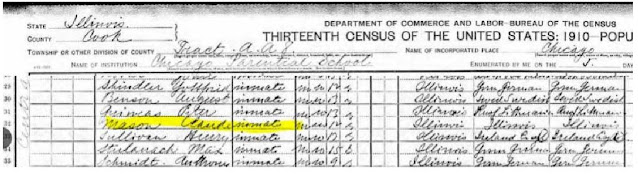
One positive thing you can say about this Reform School is it was probably the only integrated school in Chicago at the time. The kids farmed around the facility. The school was run like a military school with children wearing military uniforms and marching around the school grounds. I don't know how long Claude spent in Reform School in Chicago? He spent time there at the age of 11 according to the Census.
Did Reform School reform Claude Mason? No. I can understand, however, why Claude would have strayed from the straight and narrow. His father basically abandoned him. His grandmother Mary struggled financially after her husband died. I'm sure she would have had a difficult time working and managing young children at the same time. Claude probably roamed the notoriously crime ridden streets of some of the poverty stricken South Chicago neighborhoods and picked up bad habits.
He probably learned more bad habits from fellow inmates at the Reform School. As a Chicago Superintendent of the time Superintendent MacQueary said truants: "Frequenting cheap theaters, associating with bad companions, smoking, drinking, swearing, drifting
into the habits of indolence--he is on the broad highway to
crime." Bringing children with bad habits together and removing them from families didn't work when it came to reform either. As the Superintendent also said, "They are the children of the street, and as such are a menace in their possibilities for evil." Most eventually returned to the school after being paroled.
A year after Claude was recorded at the Parental School his grandmother Mary Owens-Mason died in 1911. I'm not sure who he lived with after that? He was only 12 years old at the time of her death. He returned to Mattoon, Illinois, a previous place the family lived, with his Aunts Ida and Ada for his Grandmother's funeral. His sister Vera also returned with them, but not their father Fred Mason?

Claude's next brush with the legal system is when he kited checks as a teenager. According to newspaper accounts Claude Mason and accomplice were arrested in Ohio for kiting checks on a crime spree from Chicago to Ohio. Claude had a Great-Uncle who spent some time at a soldier's home in Ohio. Not sure if he went to Ohio to see him? According to newspaper accounts Claude was 19 years old. Actually he was only 17 years old. One article stated his father was a paint dealer which was somewhat accurate. Actually Fred Mason was a painter. According to Claude the boys couldn't afford to live "the high life" in Chicago and that's what prompted the crime spree. He was sentenced to a year in the Ohio State Reformatory where he may have picked up the vocation of Electrician. In 1918 when he registered for the draft his occupation was Electrician.


After spending a year in the Ohio State Reformatory Claude was in trouble again with the law in 1918. A reformatory didn't reform him this time either. He was arrested for robbery at the National Tea company where he was working. A letter from his sister Vera was intercepted by the Police who were then able to track him down and arrest him.
A few years later Claude is in trouble again. This time he and two others robbed a man on " Lovers' Lane" in Chicago in October of 1921. They were nicknamed the "Lovers' Lane Bandits".
After the 1921 arrest Claude did some hard time at the notorious Joliet Prison. He served a 4 year sentence at Joliet.
After his release in 1925 I haven't been able to find any evidence of any trouble with the law until the 1940's. In 1941 Claude was jailed for 60 days in Chicago. He actually relocated to Los Angeles around 1935 where his half siblings Mary, Dorothy, Frank, and Edwin also relocated to after WWII. Apparently he got into some trouble on a visit to Chicago in 1941.
Unfortunately Claude commits another robbery in Los Angeles and does more hard time at the notorious San Quentin Prison in California. He got 5 years to life.
Claude was scheduled to be paroled in 1948 but was released early in 1945.

According to a description from the San Quentin records Claude had abdominal scars from operations.
I was happy to find a mug-shot of him with his San Quentin records at Ancestry.com. Although I was saddened to see what a broken man he appeared to be.
Claude died in 1946, at age 47, soon after his parole from San Quentin. He died in Los Angeles County General Hospital which was a public hospital mainly serving the poor. Patients were generally housed in overcrowded wards.
He died due to Rheumatic Heart disease. He probably had Rheumatic fever as a child. His early death and life of crime are results of his difficult life. His mother died when he was a baby. His father abandoned him. His grandmother Mary Owens-Mason was his guardian. She worked as a washerwoman after the death of her husband Peter Mason and probably didn't have much energy to devote to raising Claude and his sister Vera. Living in poverty in a crime ridden area of Chicago it would have taken a strong person with family support to resist the street gang mentality of South Chicago (street gangs formed around ethnic groups and neighborhoods). If Claude Mason's life had turned out better it would have been a miracle.


