Wednesday, May 11, 2022

Problems With The Browning Lineage/New Information has Surfaced

 My research on my great-grandmother Isis Browning-Forgey's line began in May of 1999 when FamilySearch.org first went online. When that site first went online I tried searching all of my family names but the only line I got a hit on was for Isis Browning's family. I didn't know at the time this information wasn't verified and there weren't any source citations. It didn't occur to me that someone would post information that hadn't been thoroughly researched with documented sources. I had just begun researching my family in 1998 and didn't know that some people drew conclusions without proof. 

Actually the Browning lineage I found posted turned out to be mostly correct. I copied the family group sheets for the Browning family as far back as the links would take me. Below is the group sheet for Edward Browning's family. I copied this sheet on June 8th, 1999. 


The information on the sheets turned out to be very good going back to Edward Browning. When we go back a generation to his parents that's where we run into problems. According to this sheet Francis Browning and Rachel Marriot were the parents of Edward Browning. 


In 1999 there weren't many original documents online. If I wanted to verify the Browning lineage myself I would have to travel to Maryland to view the original documents or write the repositories asking for them to mail me copies, or order microfilms from the Family History Library in Salt Lake City. 

Doing some research online I was able to eventually find the reasoning and sources behind the information provided in the group sheets.. Someone had written a book about the Browning family and this information was copied from the book. Wills, land records, and census records were the bulk of the sources used. Looking at the sources used I felt confident the Browning researchers had done a good job and I didn't need to do anything else except collect the original sources either online or by ordering microfilms from my local Family History Center.

The reasoning behind the parentage attribution for Edward Browning was based on the fact Francis Browning, of Virginia, named an Edmund in his will. The names look similar when handwritten; it was thought someone mistook the name Edward for Edmund. I thought that could be a possibility and found no proof it wasn't. On the other hand Edward doesn't appear to have any sons named Francis or daughter's named Rachel. He lived in Maryland and Francis lived in Virginia. 

Where Edward is the man mistakenly identified as Edmund completely falls apart is there was a man named Edmund who was the son of Francis and Rachel. Edmund Browning can be found in several 18th Century records for Culpeper County, Virginia, the same area Francis and Rachel settled. Below is a power of attorney given to Edmund in 1770 from his brother John witnessed by brother Caleb Browning. These are all children of Francis and Rachel Browning. 


I had thought that atDNA test results at Ancestry supported a link between the Browning family of Culpeper County, Virginia and our Maryland Browning family. Looking at Ancestry's Thrulines a Nicholas Browning is shown as a son of Edward. He didn't have a son named Nicholas, but Francis Browning and Rachel Marriot did. 


I assumed this was pointing to a relationship with the Virginia family even though someone had an error in their tree. Doing some more research I discovered this family didn't descend from Nicholas or the Virginia Brownings, They also descended from the Maryland Brownings. 

It appears that as in the case of Edmund becoming Edward, Edward's son Nathan became Nicholas. Maybe because they both start with N? Looking at the names in the tree of the supposed Nicholas I spotted the name Verlinda. That was the name of Nathan's wife. Also this Nicholas was said to have died and been married in Maryland. 

Doing more research on the ancestors of these matches I discovered not only was the name Verlinda passed down in the family Elias was the son of Nathan Browning and Verlinda. My DNA connection to the Culpeper County, Virginia Browning family had now disappeared. 


Edward Browning origins mystery

The Edward Browning, of Maryland, origins mystery continued until someone commented on a blog post with information from a book he wrote.

George Arthur Trail IV, author of the book "David's Industry" discovered some new information about Edward Browning while researching original documents at the Maryland State Archives. He found Edward Browning named in a court case. He had been convicted for stealing a cow. The court case occurred in 1722, in Prince George's County, Maryland. Edward Browning is described as a former servant of John Rothery in the entry below from the book K page 484 of Prince George's County, Maryland court records. 


It's a little difficult to read the old faded record but we can make out that Edward Browning was sold by the court to Richard Isaac for a term of 3 and a half years. 

I believe this Edward Browning is more likely than not our Edward Browning. Part of Prince George's County, Maryland later became Montgomery County, Maryland where Edward's will was filed. He was also the right age to have been the father of children born in the 1720s when many of our Edward's children were born. 

Maryland was settled by many indentured servants who couldn't afford the cost of transporting themselves to America. They instead entered into service contracts with masters for a certain number of years to pay for their passage to this country. I believe Edward Browning could have been serving a set number of years as an indentured servant. Apparently John Rothery no longer wanted his service or the court thought that arrangement wasn't in the best interest of the parties because he was sold to someone else by the court. Three and a half years could be the remainder of his contract with Rothery? 

Another scenario that George Trail believes is the case is a ship captain named William Browning is the father of Edward Browning. This man was captain of the "Chester Merchant". Naval logs name a Potomac River captain by the name of William Browning. The entries in the logs were in 1689 and 1690. Our Edward Browning's eldest son's name was William. It's also likely that Edward Browning was born in the 1690s. Edward could have been a free man sold by the court for stealing the cow? Instead of a newly arrived indentured servant. 

There was an Edward Browning who is listed as living in Baltimore's Spes Utiz Hundred in 1706. This could point to our Edward's family being in Maryland well before the 1720s. Edward could haven been a name passed down in the family. 

Maybe more information will surface to establish whether Edward came to America as an indentured servant or he was born in America? 

Roger Browning of Tennessee loose ends
My line goes back to Isis Browning-Forgey of Indiana. Her father Richard Washington Browning was the son of another Nathan Browning and Obedience McPike of Greene County, Tennessee. Our connection to the Browning family of Maryland hinges on a deed naming a Roger Browning as the son of Benjamin Browning who in turn was the son of Edward Browning whose story I presented above. 

Benjamin was named in Edward's Montgomery County, Maryland will. Roger was named in a deed after Benjamin's death as the eldest son of Benjamin in a Frederick County, Maryland deed. The Brownings lived in both Montgomery County, Maryland and neighboring Frederick County. 

We don't have anything specifically stating that Roger Browning of Greene County, Tennessee and Roger of Maryland are the same person. We don't have any documents stating where he was born. We do have census records for a couple of his children. One child states his father was born in Virginia, while another states he was born in Maryland. Roger had a son named Benjamin who may have been named after his father. Nathan could have been named after an uncle? 

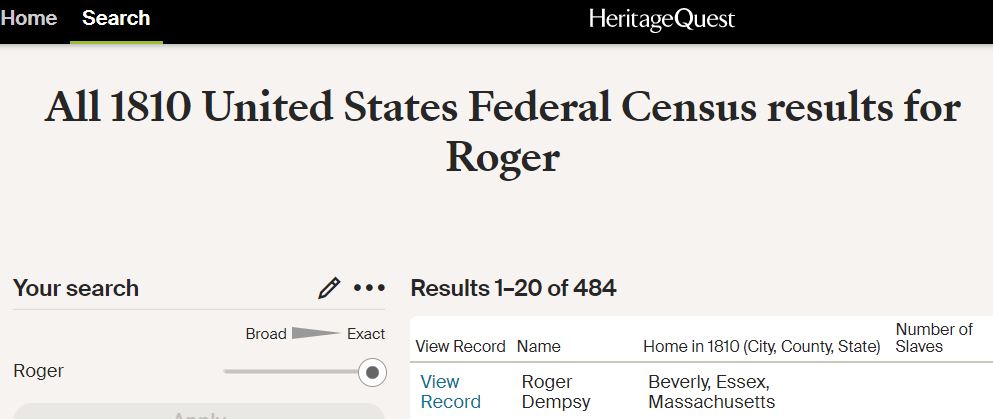
How common was the first name Roger in 18th Century America? Comparing the incidence of Roger to John in the 1810 US Census we see Roger is much less common than the name John. There were 87,284 Johns and 484 Rogers. This would support the fact the name Roger Browning wouldn't be very common. I have not found any other Roger Brownings on census records contemporary with our Roger. Doing a general search on Ancestry.com and FamilySearch.org I haven't found any either. 


Looking at Thrulines, at AncestryDNA we do have matches with descendants of confirmed children of both Edward Browning and his son Benjamin. 

One of these lines had to be dismissed, however, because we also share another German related line with this family. Nancy Browning descendants are disregarded because of our relationship on two different lines. If I could see the segments in a chromosome browser I might be able to determine which side they came from? Since only one segment is shared with Nancy's matches, looking at common matches it looks like this segment comes from our shared Zirkle Roller line. 

This leaves us with 3 matches related to the possible brother of our Roger. We have 3 matches with descendants of Benjamin Sr.'s son Benjamin. We have 36 matches with descendants of our ancestor Roger. Our connection to Roger is firmly established, not only with all of these DNA matches, but also with Roger's will and census records. 

Where we run into some conflicting information trying to prove our ties to the Maryland family has to do with a Roger Browning that is listed with a Maryland Browning family member named Basil in Pennsylvania. Basil is listed on records with the family in Maryland and then relocates to Pennsylvania. There is disagreement regarding who his father was. 

We first find Roger Browning on a muster roll in 1781 in Bedford County, Pennsylvania. 


Since the name Roger is generally uncommon this Pennsylvania man may be Roger Browning from Pennsylvania? A William Browning and an Ephraim Browning are also named as living in Bedford County, Pennsylvania around the time Roger lived there. 

There is other evidence, however. There may have been more than one man named Roger Browning living in Pennsylvania. Descendants of the other Browning lines in Pennsylvania believe that their ancestors were originally from Maryland. The name Roger looks to be more common in the area of Maryland where the Brownings lived than in other areas. The name Basil, who Roger is associated with, is also used in that area. So there could have been more Roger Browning cousins living in Pennsylvania. 

In 1783 Roger Brownen was listed on a Bedford County, Pennsylvania tax list. There are 6 people in his household. He has one cabin. 


In 1785 we see a Roger Brownen listed as a single freeman non-resident runaway. Sounds like a different man than the one named above. The name Roger may have been used by other branches of the Maryland Browning family? 


If this Pennsylvania Roger is the son of Benjamin Browning he makes a trip back to Frederick County, Maryland after the death of his father in 1787. His father died intestate and the only child mentioned was Roger who inherited the land because he was the eldest son. A likely brother did appear on Benjamin's inventory. Roger sold the land he inherited to Jeremiah Browning. He could have been a brother, a cousin. or his uncle. 

After selling the land he apparently would have returned to Pennsylvania joining Basil in Huntingdon County, Pennsylvania. 

In 1788 we find Basil and Roger on a militia list for Huntingdon County, Pennsylvania. 


They both appear on a 1788 tax list for Huntingdon, PA. Roger drops off the Pennsylvania tax lists in 1789 when he either dies or most likely moved to Tennessee. 

In 1789 our Roger Browning bought land in Sullivan County, Tennessee.. An Amsy Browning was serving in the militia in Tennessee in the 1790s, and is believed to be related to Roger due to the fact the name Amzi was used by Roger's descendants. It's possible he was another brother of Roger or his son?


There is a Browning DNA project with two descendants of the Maryland Brownings in it. The best way for our family to confirm our relationship with the Maryland Brownings would be for a male descendant of Roger Browning to take a Y-DNA test to compare with the Maryland Brownings. More research in Pennsylvania and Maryland court records would also help. 

Wednesday, April 20, 2022

AncestryDNA SideView/New at Ancestry.com


I've been interested in seeing how accurate our ethnicity results become as the technology advances. It's difficult to gage accuracy without separating the results by parent. 23andMe has been separating the results by parent if at least one parent has tested with them. 

Since 23andMe phases your results with an actual parent, or parents, their ethnicity results are more accurate. Separating the results by parent is called phasing. 

Ancestry.com phases results by guessing the phase based on strings of letters that make up our DNA code, A (adenine), G (guanine), C (cytosine), and T (thymine). These appear in base pairs, such as A-T, one letter for each parent. In order to separate the base pairs according to parent strings of letters are separated by parent using your matches in their database. It's an accurate process but errors can occur. A phase can turn out to be wrong, which will cause your ethnicity to be incorrectly estimated.

(For a better explanation by a professional genetic genealogist read: "AncestryDNA SideView | Ethnicity Inheritance | What is Phasing?" by Diahan Southard.")

How accurate is SlideView for my mother and me? 

Looking at my mother Edna Forgey-Kapple's SideView gives us a good idea regarding how accurate Ancestry.com's phased results are. My mother's father's ancestry is 100% Colonial American. His ancestors originally settled in the mid-Atlantic and Southern part of the United States. there is no New England ancestry I have been able to find. Settlers of those areas were heavily Scots-Irish and German. Those two ethnicities make up the bulk of his ancestry. There is also likely some English and Welsh ancestry. 

My mother's mother, Graciela (Lucresia) Del Castillo, was Nicaraguan. Nicaraguans are a mix of Spanish, Indian, and African. My grandmother lived in Granada, Nicaragua in an area that was a segregated area where people who were primarily of Spanish/European ancestry lived. Granada had a line drawn in the city separating the indigenous population from those who looked more European. However, all Nicaraguans are a mix of the 3 ethnicities because there was never a large migration of Europeans into Nicaragua.

Now let's look at the split between my mother's parents in her results.

Looking at parent 1 and parent 2 on the parent chart, and the ethnicity breakdown, I can easily tell which parent is which. The breakdown looks fairly accurate. If a person's parents were both from the same places, they wouldn't be able to identify which parent is 1, and which 2. We see parent 1, Graciela Del Castillo, has much more color in her chart representing the fact she isn't 100% European, and she has more trace regions. 


Maternal Parent 1 Graciela Del Castillo-Forgey

It's definitely obvious Graciela is parent 1. 

Below you see African admixtures represented in the chart as coming from the Graciela Del Castillo side. Tracing my grandfather's ancestry, I haven't found any African ancestry. Our mtDNA is L, which is African, and would support this result. Europeans in the United States generally married other Europeans. 


Now looking at the indigenous Indian admixture we see that share is larger than the African representing the fact they were more numerous being native to the area. 


Ancestry estimates that my mother received a 25% admixture share of Spanish from her mother Graciela. 


Below we see Basque, and Portugal represented which would make sense because they reflect the Iberian Peninsula ancestry. The surname Lacayo on my grandmother's side is Basque. 


Some French is showing up on Graciela's side. This could be French Basque or it could be a phasing error? 


Below we see a sliver of Irish on Graciela's side. I don't believe she had any Irish and believe this is a phasing error. 


90% of this so far looks accurate for Graciela Del Castillo. She said she had some German ancestry which is not showing up in my mother's results. 

Maternal Parent 2 Charles Forgey


As I said Charles Forgey had American Colonial ancestry which was a mix of British Isles and German. 

Since many of his ancestors were Scots-Irish we would expect to see this reflected on his side. We do see Irish, and Scottish, represented in the parent chart below. 


England and Northwest Europe below helps fill this Colonial American admixture. Obviously this portion of DNA isn't pointing to anything more specific. 


I would say Charles Forgey was about 1/4 German on paper. According to his breakdown my mother received 8% Germanic admixture from him. 


My mother is said to have received 2% Sweden and Denmark admixture which I believe isn't accurate. That is probably Germanic. 


This again, is very accurate. I think it's accurate because my mother's parents were from such different ethnicities, and their ancestors married people from the same ethnic groups for generations. 

My parents


On my father's side I'm 1/4 Austo-Hungarian, 1/8 Irish, 1/16 French Canadian, and the remainder of my 50% share from my father would be a Colonial American mix which would mainly be a British Isles mixture. On my mother's side I'm 1/4 Nicaraguan and 1/4 Colonial American British Isles, and German mix. On paper that is. That doesn't mean I inherited these amounts of DNA admixture.

Parent 1 Edna Forgey-Kapple

I can identify my mother Edna immediately by clicking on all of the ethnicities associated with Nicaragua. She is definitely parent 1 as we see below with the Iberian and Indigenous. Those ethnicities cover about a quarter of the chart as expected. 


The ethnicities I would associate with my mother's father's side, my grandfather, looks to be over represented. Maybe I did receive more DNA from my grandfather's side? 


I found what is apparently a phasing error. My breakdown shows Welsh and Norwegian admixture on my mother's side. My mother doesn't have those ethnicities in her results? If she doesn't have it she couldn't give those to me. 


Since I'm more Heinz57 than Ivory soap pure my results aren't as accurate. As families spend more time in America they mix with other ethnicities jumbling the letters in our DNA up. 

Parent 2 Robert Kapple

Since my Kapple grandfather Rudolph was Austro-Hungarian and my grandmother Dorothy Maon-Kapple Colonial American, Irish, and French Canadian it's again fairly easy to figure out which quarter share of parent 2 represents each grandparent. 

Paternal Grandfather

The Germanic and Eastern European on the parent 2 side represents my Kapple Austro-Hungarian grandfather. When I first tested 8 years ago I didn't see him represented in my ethnicity results. It's nice to see him represented. These admixtures don't cover a 1/4 of the chart but are getting closer to correct. 


Paternal Grandmother

My grandmother Dorothy Mason-Kapple was a mixture of Irish, French Canadian, and Colonial American is showing up correctly on parent 2 my father's side.

Clearly, we see my great-grandmother Helen Mullen-Mason's Irish showing up. She was born in Ireland in 1880. According to this breakdown I received 23% of my Irish from her. The Scottish could have come from early American Scottish ancestors? 


What's missing from my maternal grandmother's side is French. My grandmother was 1/4 French Canadian. I have many French-Canadian DNA matches so I believe I have some of that admixture. 

I would say the breakdown by parent for me isn't as accurate as it was for my mother. I believe it's because I'm more ethnically mixed and it's confusing their algorithms. Some of my ethnic groups are underrepresented in the database which also makes identifying my ethnicities difficult. The closer someone is to a particular ethnic group the better the results, meaning your family has been in one place for centuries and haven't mixed much recently with other ethnic groups. 

I know where my ancestors lived in the past few hundred years, so the ethnicity results are less important to me (although ethnicity results can help sort our DNA matches). If someone doesn't know where their ancestors are from the accuracy of these results are important to them. 

So how accurate is the Ancestry.com SideView for us? I would say it's in the 90'% range for my mother and about 80% accurate for me. So, I would infer the ethnicity results overall accuracy are in those ranges. 


Saturday, April 2, 2022

My Experience With the 1950 Census/ How I've found hard to find people

 I live in Southern California so when the 1950 Census became available on April 1st just after midnight eastern time it was only 9pm  in California. I was able to search the census while still reasonably lucid. It was still a learning process. Searching by name often didn't bring up the correct person. The machine generated index does a fairly good job but you have to play with it sometimes. You can get thousands of possible matches when searching the index, or the right one may appear on top or on page 1.

How to search while waiting for the better indexes

Until a better index is ready, basically going through the 1950 Census and manually indexing it, the machine generated index is all that is available if you don't want to patiently wait.  

The NARA site recommends using a place and name of the head of household to search their index for the best results. That didn't always work for me. It didn't work for my Forgey family or my Kapple family in California. I did find my grandfather Kapple that way. 

Below you can see my grandfather Rudolph Kapple's first name isn't spelled correctly, but the last name was indexed correctly. His 2nd wife's last name is indexed as Kappu. 


I found out that if you use both the enumeration district and a name the search results can be much better.

For me anyway I've found the best technique for searching is to find the Enumeration District, or ED, using Ancestry.com's ED finder. This works well if you have the exact address for the family in 1950. 

My Forgey family didn't come up in the search results, or not in the first few pages, not by just searching on my grandfather's name, and place. Using the enumeration district it did appear at the top. 

Going through the ED district page by page I discovered no one was at home when the census taker came to the Forgey family door. 


Going to sheet 75 line 23, as noted, I did find my mother Edna and her family listed.


I didn't have the exact address of my great-great uncle Thomas Mullin who lived in Phoenix, Arizona in 1950. Searching on his name brought up the wrong Thomas Mullin. It brought up a man who was born in California and my Thomas was born in Ireland. I had his obituary and I used his place of death address to find an ED District. He died in a nursing home, but I figured he probably didn't live far away. I used the Steve Morse 1950 ED finder to look for the ED districts around the address. I tried 3 or 4 with the name Mullin in the search box, and eventually his name popped up at the top of the page. 

If nothing works just search the ED districts page by page. 

What did I find on the Census of Interest? 

I found the occupations the most interesting. I knew some of my family's occupations. I didn't know my great-uncle Edwin Mason worked in shipping for the railroad. Great Aunt Mary worked at a window manufacturing company. My aunt Dorothy June worked as a file clerk at an auto insurance company, and aunt Gloria was a typist at a life insurance company. 


My grandfather Rudolph Kapple was still working a Pullman, as his father before him did. 


It was sad to see Belle Kappel and her son Ronald living without William Kappel, Belle's husband and Ronald's father. William was killed in WWII Germany. A reminder of the war that was over only 5 years before the Census. 


Information that will lead to more research

My Kapple grandparents, Dorothy Mason and Rudolph Kapple, divorced in the 1940s. After the divorce my grandmother Dorothy decided to move to California with her 7 children. Her brother Frank already lived in California. Their brother Edwin also made the move along with their sister Mary Mason-Greene. Some members of the family flew out to California and other family members took the train. My father Robert J. Kapple came out to California by train with his aunt Mary. He loved the train ride out to California with the interesting views from the train. 

I used a postcard from 1948, sent by my aunt Diane (Daine in the census lol), to get the address of the family in Los Angeles. Apparently in mid 1948 only part of the family had arrived at their new home in California, but Diane said the family was coming soon in her message postcard. 

My grandmother made out the address and my young aunt wrote the message. 

I assumed those family members would include my great-grandmother Helen Mullen-Mason. When I didn't see her with the rest of the family on the 1950 Census I assumed she was visiting family or friends. 

I was very surprised to find Helen living in the basement of the former family home in Chicago. She had not come out to California in 1948 with the family. 


I thought my grandparents sold the house after they divorced? Did they continue to own it and rent out the upstairs and downstairs? Or did the new owners rent the basement to my great-grandmother? Francis Regan and his family lived downstairs, and Rosina Feehan and her children lived upstairs, in 1950. 

My Helen had family and friends living in Chicago and probably would have preferred to stay there. 

The basement had windows, thankfully, but the current windows don't seem to open. Hopefully they did open when my great-great grandmother lived there. Helen may have lived in a basement before? When she came to Chicago in 1899 she worked as a servant, possibly living in a basement? Living in the basement with water and electricity was likely better than living in the rural village in Ireland she was raised in. In 1950 her Irish relatives still had no electricity. 

The house as it currently looks with glass blocks as basement windows. 

I plan on doing some research on the house to find out when it was sold by my grandparents. I might have to visit Chicago to do that? 

Since my moneysaving great-great grandmother remained in Chicago a little longer, my family could keep the light bulb in the refrigerator a little longer and turn the heat up when it was cold. She definitely ruled the house when she lived with the family. 

Here we see my great-great grandmother is finally out of the basement and in California


The 1950 Census research was more interesting than I expected. 


Wednesday, March 16, 2022

Help from Facebook Group Member & 1851 Census Ireland Breakthrough/Ordnance Survey Map dates


Breakthrough

A few years ago I discovered the 1841/1851 Census extracts for Ireland. These extracts were created for the purpose of verifying the ages of applicants for a state sponsored pension. In order to receive a pension a person had to prove they were 70 or older. 

I learned the names of my 3rd great-grandparents which I found on 1851 extracts. Actually, in the case of  Michael Mullen, he was not born yet and couldn't be found on the 1851 Census. But even when the  person was found to be ineligible for a pension the documents are still very useful. There was another Michael born previously who died in 1848. My 3rd great-grandparents decided to name this later son, who applied for a pension, Michael. Perhaps Michael thought he could get away with posing as the brother born earlier or he was visiting another family on census day? 

The 1851 census asked for the year of marriage for couples. 


Using that information I tried to find the marriage records for the ancestors named on these extracts. I assumed my 3rd great-grandparents were married in the parish my Mullen family lived in. I was not able to find a marriage record in that parish and didn't pursue it again until recently.

When I brought this up in the Facebook group "East Galway Genealogy & DNA", someone suggested I try the Tuam marriage records. Tuam is the nearest larger town near the townland Pollaturick where my Mullen family lived. Since I had the year from the census I started with the year 1837. I quickly found a marriage record for Patrick Mullen and Eleanor Qualter in 1837. 

The name of the bride on the 1837 marriage record was Eleanor, not Ellen as likely reported by Michael, or Nelly as found on the census. I assumed that was the correct record because the name Qualter isn't very common. Also there were no Qualter families living near the Mullen family townland.  A sponsor was named Ruane. Ruane is a surname associated with the Mullen family which was another clue this was the correct marriage entry. 


I then assumed the couple married in the bride's parish as is common. I found a birth record for a Nelly Qualter in Tuam in 1812. This matches the name of Patrick's wife recorded in the 1851 Census extract. Her father's name was Michael, she had a son named Michael. Her father being named Michael is probably why she named another son by that name after the first Michael died. Her mother's name was Mary Finigan. Now I have the names of my 4th great-grandparents.


I then decided to look for her death record to see what name was recorded on that. I found her death record and she is recorded as Eleanor, which supports the marriage record. 


The online civil registration death records don't go back into the 1760s when Eleanor died. I used the site RootsIreland to see a transcript of the death record to make sure I was ordering the correct record. The townland recorded in the transcript confirmed which one would be the right one to order a copy of. 

When I looked at the transcript for the birth record of Eleanor/Nelly her name was recorded as Helen even though the church birth record clearly states her name is Nelly. I believe someone thought they were being helpful by replacing the nickname with a formal name. They guessed wrong at the given name however. 


Unfortunately I wasn't able to trace the family back any farther because the Mullen parish in Milltown has many missing church records. 


The Ordnance Survey of Ireland

Maps based on the 1830s and 1840s Ordnance survey were produced until new surveys were undertaken. Maps based on those coordinates were produced for the valuations of property for tax purposes, such as the first one, Griffith's Valuation. Periodic revaluations were done and maps were made for notations of changes of ownership or property lines. These notations were handwritten by valuation office workers. The location of the buildings, however, would be from the 1830s to the 1840s. Some areas were resurveyed sooner as I will explain later. 

I'm interested in knowing when changes in the structures on my Mullen family property occurred. For that reason I wanted to nail down when resurveys were made. A resurvey of our family's property and structures didn't occur until the 1890s, with another survey around 1913. 

The circa 1839 map is a mystery. I'm curious about whether there were two houses on the property at the time the 1839 survey was made. There is a structure marked with a lowercase "b", which would indicate a house. There is no corresponding "a" structure, and the building near the current house isn't marked with a letter at all. Was the structure near the present house actually an outbuilding? I don't think so because it would be far from the structure marked like a house. Usually farm buildings were close to the house. The structure marked "b" has a fence around the front. I could use another map of the early structures to clear this up. 


The map below is the 1913 survey map. The structure marked "b" is gone. There are more structures near the present house.


This is the property today with only the house and cart house still standing. 


A list of resurvey dates can be found on this pdf from Trinity College Dublin titled "The Six Inch Ordnance Maps of Ireland (1:10,560)."

The original survey began in Northern Ireland. A decision was made soon after the start of the survey to include field lines in the survey maps. The surveyors had to resurvey some areas to include the field lines. For that reason some areas have two early maps. 

The first ordnance maps in Northern Ireland were made as early as 1832. These maps have no field lines. The resurvey with field lines took place a number of years later and as late as 1862. Below you can see examples of the early and later maps. The maps below show some changes in the structures and landscapes in the decades between the first and second surveys. I'm sorry that my family's area in Galway didn't need to be resurveyed a decade or two after the original survey. It would answer some of my questions. 


There were many ordnance survey maps produced for different purposes and also for sale to the general public. Salesmen were sent around the country selling the maps. By 1857 200,000 maps were reported to have been sold. The resurvey maps produced in the 1890s were advertised for sale in local newspapers. 


The second major survey of the 1880s and 1890s took place in order to establish landownership as a shift in ownership took place due to land reform. Before the reforms a majority of the population of Ireland were tenants, after reform a majority of the population owned their land. 

What I've learned by studying these maps is structures on farms were frequently replaced. The old stone cottages fell out of favor because they were associated with poverty. When visiting Ireland today you do see old stone houses, but many have been torn down to make way for more modern structures. Most people today do appreciate the old cottages and are restoring them.

I'm hoping more of these maps will eventually appear online. 

A Little Something From RootsTech

A new feature at MyHeritage was announced at RootsTech 2022. It's called Live Story. This feature animates photos of people. The animated photos of your ancestors tell their story based on information in your tree or you can change the story and write your own. The animated photos have a number of voices to choose from. 


In honor of St. Patrick's Day here is the animated story of my great-grandmother Helen Mullen-Mason. 

Happy St. Patrick's Day!