Tuesday, March 9, 2021

Follow up to DNA Case Study/ Can I at least Confidently name the segments?

I've been continuing to research the Campbell family in Greene County, Tennessee based on the obituary for Eleanor Campbell. She might have been a niece of my brickwall ancestor Sarah "Sally" Campbell born about 1811 likely somewhere in Tennessee according to her daughter. I've been searching at Ancestry.com, and researching the digitized deed books and probate records at FamilySearch. So far I haven't been able to find anything linking my Sarah to Greene County, TN, or Eleanor for that matter. Maybe eventually a bible record may surface or there are courthouse records that haven't been digitized? In the meantime I wonder if I can at least confidently mark the DNA segments from our Greene County, TN matches as coming from Campbell on my Genome Mate Pro segment map? I do have segments I can confidently attribute to lines such as my Browning line. 

In order to have confidence in which ancestors these segments can be attributed to I first needed to make sure these matches didn't match my Mother on more than one line. Since my Mother is closer generation wise to Sarah Campbell-Wray I'm using her match results to establish who these segments came from?

Since AncestryDNA, 23andMe, MyHeritage, and FTDNA all predicted with some confidence that the Greene County, TN Campbell matches descended from George Lafayette Campbell, were 4th cousins to my mother I feel I only need to establish the segments came from ancestors going back to her 3rd or 4th Great-Grandparents on her Campbell line. 

I began to suspect Benjamin Browning, a brother of our ancestor Nathan Browning, may have fathered George Lafayette Campbell? He remained in Greene County, Tennessee whereas my Nathan Browning was already in Indiana when George was born. This would make most of George's descendants 4th cousins once removed of my Mother. Sarah Campbell was my mother's 2nd Great-Grandmother. Her parents would have been 3rd Great-Grandparents making any matches through them her 4th cousins.. 

I have a number of Browning segments confidently marked at Genome Mate Pro and none are shared with the Greene County, TN Campbells. To try to eliminate a possible relationship through the Browning family I marked all my mother's matches through Browning at Ancestry, then went back and looked at shared matches with the Campbell matches just to make sure none were shared? 


I was surprised at how consistently correct matches in the 4th cousin range at Ancestry were. They were right over 90% of the time. Since there are removals some of these cousins can end up as distant 5th to 7th cousins.

Going through the relevant matches, and looking at shared matches, I haven't found any related to the Browning family. Since I haven't worked on grouping matches, other than the Brownings, you don't see any groups listed with the Campbell matches below. 


What I did discover is one of these Greene County, TN matches shares Sarah Campbell-Wray as an ancestor through her daughter Charlotte Temple Wray. This match doesn't share any of the other Campbell matches with my mother even though they are all descended from George L. Campbell? I assume that's because they are distant cousins and share different segments with my Mother, and no longer share enough DNA with each other to match. (I'm also assuming that matches that are shared consistently between these families share the same segments. It would certainly help to know which chromosome the segments are on to verify that.)


Another way to establish which line these segments came from would be to compare the segments with other descendants of Sarah Campbell and her husband Anderson Wray. That way you can eliminate other routes of inheritance. Unfortunately their son William died in the Civil War and a couple of their daughters died young also. Other than my Mother's Great-Grandmother Elizabeth Wray-Forgey only two other daughters lived long enough to leave children. 

The easiest way to find matches who share Anderson Wray and Sarah Campbell as ancestors is to look at Thrulines at AncestryDNA. Since Sarah died young Anderson remarried and had more children with his 2nd wife. Looking at matches listed with Anderson Wray I have to be careful that they descend from Sarah. The only descendants I could confirm are descendants of Charlotte Temple Wray-Estep, one of Sarah's daughters. 


I then looked for these Thruline matches, and their shared  matches, at all of the other companies that share segment information. I was able to find a match at MyHeritage descended through another daughter of Sarah's name Polly Thurman Wray-Hall. She had a segment on chromosome 18 like the Greene County, TN Campbell matches. The segments didn't overlap however. This segment appears to come from the Wray side of the family. 


I had marked segments on chromosome 18 as likely from the Wray line and not the Campbell line on my Genome Mate Pro segment map. This worried me because the segments were close together. Our Wray family crossed paths with the Campbells just like the Brownings did. The Wrays, like some say the Campbells also, originally settled in Virginia. 

I decided to collect up more matches with segments on chromosome 18 since that one related to the problem I'm working on. The tip end of chromosome 18 seemed to relate to the Greene County, TN  Campbell family while the rest appear to be related to the Wray line. There is some overlapping which made me think of the possibility all of 18 related to the Wray family?

A positive factor in favor of chromosome 18 being split between Wray and Campbell is the fact matches on 18 don't always match each other. The matches on the tip end all descend from George Lafayette Campbell of Greene County, TN, whereas the longer segment matches to the left all match each other and share only Wray ancestors. So some of this overlapping may include false positive areas? My Mother's parents came from completely different ethnic backgrounds so I don't have the problem of separating matches from the same places. My maternal Grandmother was Nicaraguan. I don't believe overlapping is related to a segment misattributed to my Mother's father's line.   

Generally most of the Greene County, TN Campbell matches line up as expected on the far right tip, example below. 


This example below shows one small orange colored segment belonging to a Campbell match fitting like a puzzle piece next to larger Wray line matching segments. 


I can confidently name the segments to the left of the Campbell segments as coming from our Wray family line. 

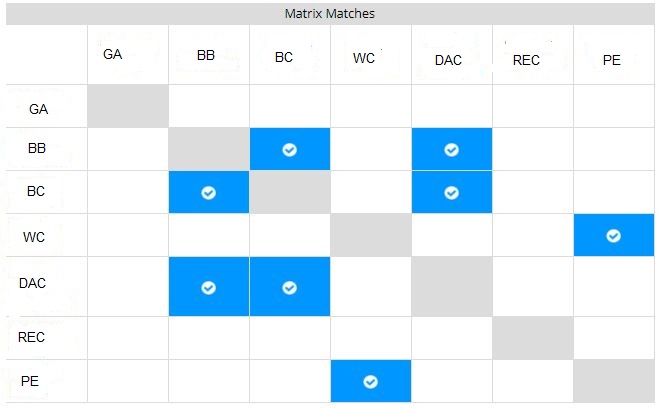
I decided to confirm that the Wray family and Campbell family matches didn't match each other. Since some of these matches had a kit at FTDNA I was able to use the Matrix tool. Below you see a Wray match on Chromosome 18, GA, compared to George Lafayette Campbell descendants. All of the Campbell descendants match each other as expected, but don't match the Wray descendants who all share segments on chromosome 18. 

With more than a dozen matches now shared with Greene County, TN Campbells I have not found these matches associated with any other families of ours. Some share small segments on chromosome 18 but others also share larger overlapping segments on chromosomes 8, 5, and 12. The latter segments have not presented a problem with any other matches' segments overlapping with them. The segments on chromosome 18 are all shared by the descendants of two of George Lafayette Campbell's daughters. That would be about half a dozen matches. I'm leaning towards believing these segments are Campbell, and came from our ancestor Sarah Campbell. 

I'll keep collecting matches on these segments. I believe I'm on the right track, at least I haven't been proven wrong yet? I'm definitely open to any information that surfaces even if I'm proven wrong. 

Final thoughts 

Comparing with matches who tested at 4 different companies is challenging. All of the companies have different tools and some are better than others. I wish there was one company with good tools, trees, and a large database of matches to compare with. At this point we have to jump around between companies because, for instance, Ancestry has better trees and Thrulines, while other companies offer segment information. 23andMe and MyHeritage give you predictions regarding how shared matches are related to each other. Knowing how matches are related to each other helps to group them with families. From a list of shared matches this match below is a 3rd cousin to my mother and the father of this match. 


Sometimes close relatives, even siblings, test with different companies and in that case their relationship isn't apparent unless you can compare them at GEDmatch. We have to somehow pull all of the information from all of these sources together which is time consuming. As things stand now genetic genealogy is mainly for those with time to devote to learning about all of the different tools and navigating between companies. If you're looking to test with one company in order to solve a brickwall out past a 2nd Great-Grandparent's generation you are unlikely to do that at one company. 


Tuesday, March 2, 2021

A DNA Case Study/ Plus Would Sharing the Chromosome Number be Possible?

I've been working on trying to break down a brickwall by using atDNA match chart. I got that idea from the RootsTech session by that called "Organize Your DNA Matches in a Diagram". 

A couple weeks ago I found important information that might help lead me to a resolution of the Campbell brickwall. My only confirmed Campbell ancestor is Sarah "Sally" Campbell. She was born about 1811 (according to a daughter Polly Wray Hall her mother was born in Tennessee). She was married to Anderson Wray in Jackson County, Indiana. 

A James T. Campbell lived near the family in Indiana. I believe, based on his age, he might be Sarah Campbell-Wray's brother. I've been researching James and his family. I did discover that the family came from East Tennessee based on a death certificate but I hadn't found any other information on him. The recent find regarding this family was an obituary for an Eleanor Campbell referred to as a sister on a census and daughter by descendants. I don't know which is correct? I do know they are related because James is always recorded as being born in Tennessee on census records and they share the same last name. James T. Campbell was in Indiana by the mid 1830s whereas Eleanor said she came to Indiana in 1846. 

Eleanor F. Campbell's obituary gives her birth place as Greene County, Tennessee. 

Ottawa_County_Democrat_Fri__May_8__1908_

Even before finding this information I was leaning towards believing my Sarah might be from there. My mother has a number of atDNA matches descended from a George Lafayette Campbell of Greene County, Tennessee. I have not been able to find any other surnames in common or places in common with these matches. The families of these matches migrated from Greene County, TN to Alabama and Texas. All of my Mother's paternal ancestors had arrived in Indiana prior to 1840 and remained in the Midwest.

A problem I have is that I have other ancestors from Greene County, Tennessee. My ancestor Roger Browning migrated to that area in the 1790's. His second wife Elizabeth's maiden name isn't known so it's possible these matches match us through her family?

I knew my mother had a number of matches who descended from George Lafayette Campbell but didn't know exactly how many or how they were related to each other until I created the chart below. 


Charting each match descended from George Lafayette Campbell and Susannah Kaiser provided some very helpful information which has allowed me to find even more matches through this couple. I used the additional surnames of descendants to find matches that may not have their tree traced back far enough. I was then able to collect up segments for those who tested with companies who offer a chromosome browser. 

These matches shared DNA on chromosome 5, 12, and 18. Some of my mother's matches share a very large segment on chromosomes 8 & 12. There are false positive regions on both of these chromosomes  according to Genome Mate Pro. I believe that is why they predict these cousins are more closely related? 

Ancestry and 23andMe are pretty insistent that several of these cousins are 3rd or 4th cousins of my Mother. I believe they are at least 5th cousins probably with removals? George Lafayette Campbell's father was James M. Campbell born about 1800. The man I think might be my Sarah Campbell-Wray's brother is also named James and he was born about 1811. I doubt they would have been brothers with the same first name. They would most likely have been cousins. If they were cousins then my Mother would be at least a 5th cousin with removals. If the relationship is instead through Roger Browning's wife they would still be in the 5th cousin range possibly with removals?

Below you see AncestryDNA predicts chances are only 2% that one of these Campbell matches is a 5th cousin. 


When I clicked on the question mark next to the same matches name at MyHeritage a chart with the predicted possible relationship comes up. They don't give a percentage of the likelihood for each possible relationship. I believe the chart should have extended to 6th cousin or 5th cousin once removed? More research may prove I'm wrong about the relationship? 


A chart predicting the relationship of another match from the same family at 23andMe. They are predicting the match is a 4th cousin, and not extending the possibility the match is a 5th cousin. 


I noticed while making the chart two Campbell sisters married two Morton brothers. The growing list of matches with descendants from this one family all seem to come from the same 3 siblings Nancy Elvira Campbell, Mary Adeline Campbell, and James Wallace Campbell. 

Looking at the chart it's also interesting to see all of the matches are separated from George Lafayette and his wife Susannah by the same number of generations, except for one.

Going through matches on the same chromosomes I've found other families with the surname Campbell matching on the same segments as George Lafayette Campbell and Susannah's children. I'm not sure if that is a coincidence or these segments have been passed down in Campbell families for generations?


I believe it looks promising that these matches are related through the Campbell line. I need more documentation to prove it however. 

Would Sharing the Chromosome Number be Possible? 

Mapping the chromosomes of our Campbell brickwall matches has been very helpful. It has helped me confirm that segments have been passed down through this family because they are overlapping. It's also helped me find more matches through the same couple. 

I know AncestryDNA will never have a chromosome browser but I had heard they might share which chromosomes segments are shared on? Knowing the chromosomes segments are shared on would be helpful to me and others I'm sure. If I have distant cousins sharing DNA on the same chromosome that would suggest the segment could have come from the same source. 

The trees attached to DNA matches at AncestryDNA are very useful but without segment information the results aren't very useful when trying to connect with distant cousins. Many people share more than one couple with a match. The location of the segments is the only way to tell which couple a segment or segments came from. 

I may be mistaken about AncestryDNA planning on adding the segment chromosome numbers? It would be extremely helpful if they could do that though. The trees have helped identify my Campbell matches ancestors but there was no way to tell if the shared matches' segments came from the same ancestor? Additional segment information at AncestryDNA would help.   

Sunday, February 28, 2021

Celebrating 10 Year Blogiversary/ The Best of RootsTech 2021


I began this blog on March 1, 2011 so this is the 10th Anniversary of this blog. During the past 10 years I've shared the agony of waiting for DNA test results, and long waits for something in the mail. I've also shared the thrill of the ancestor chase and the satisfaction that came with breaking down brickwalls. 

What have I accomplished and shared over this decade? First of all I've added some branches to my tree. 

Below you can see just a few of the ancestors I've added since 2011 highlighted (couldn't get them all on a 6 generation chart):


With such a mixed heritage my genealogy research has led me to many different places through this decade. 

Some accomplishments and sources I've blogged about in the past decade include:

  1. Photos of my Kappel/Kurta Great-Grandparents were shared with me in 2019, I had never seen photos of them. Had no idea what they looked like before 2019.
  2. Owens family brickwall came down in 2015 with a lawsuit and resulting deed documents surfacing.
  3. Granada Nicaragua Church and Civil Registration digitized records became available online at Familysearch allowing me to extend by Nicaraguan lines and collect family documents.
  4. Irish land records became available online such as the revision books for County Galway which extended my knowledge of my Irish families.
  5. Irish Civil Registration records online is another online source I've blogged about.
  6. Styria, Austria and Burgenland, Austria Church records have come online in the past few years helping me extend more family lines.
  7. Civil Registration records for Burgenland helped fill in blanks in my family history 
  8. 1851Census Search Forms came online for Ireland allowing me to add mothers of my Irish great-great grandparents to my tree. 
  9. In the past decade Findmypast Ireland has allowed me to extend my Irish families to include new dog family members using the dog license records. Court records have added new stories for my family history. 
  10. Newspapers online have helped me confirm family lines and added new stories. A newspaper article provided me with the only photo I have of a great-uncle who was killed by a sniper in Germany at the end of WWII.
  11. Deed books coming online at Familysearch and other sites have helped add names to my family tree in the past decade. The James Trigg Campbell deed I located in Jackson County, Indiana may eventually break down my Campbell brickwall? 
  12. We confirmed many lines through DNA testing. I started a Forgey family DNA project and a Kappel family project at FTDNA. 
  13. IDing photos unmarked photos has also been a project I've been working on often using photo recognition websites. 
  14. Naturalization certificate files with photos helped ID photos. 
  15. I've blogged about information I've found on death certificates available online at sites such as Ancestry.com where old death certificates are available to view for free. Indiana death certificates are available online at Ancestry for instance. Other vital records now online have also been helpful.
  16. Virginia Memory Chancery records online has also been an invaluable resource which I've blogged about.
  17. I visited a courthouse in person for the first time in 2018 where I found documents not available online. I shared this experience in my blog. 
  18. Luckily I was able to get to all of my ancestral related countries and states in the past few years before COVID shut travel down. I've shared those experiences in this blog. 
Blogging about my family history has helped me focus my research and writing down my findings has helped me formulate proof arguments. I often refer back to old blog posts to review previous findings. 

Rootstech 2021

I always enjoy watching streamed RootsTech  sessions. This year all of the sessions are being streamed because of the COVID-19 pandemic. Videos of the sessions will be available to watch even after the event is over so if you missed them during the event you can watch later. 

I found the animation of photos at MyHeritage one of the most interesting announcements this year. At the bottom of the page you can see one of the best animations produced for my photos which was of my Great-Grandmother Mary Kurta-Kappel. 

Connecting with cousins through the "Relatives at RootsTech" app was also fun.  The app used Familysearch trees to match up cousins who were also streaming the sessions. Since the shared trees at Familysearch contain errors these matches weren't always correct. I did find that 4th cousins and closer were generally correct. 


From "When Your Tree Is a Banyan: Untangling Endogamy" I learned about different sites where you can upload your family tree or have your DNA results analyzed so you can evaluate how much endogamy you might have. I have a little bit of endogamy as you can see in my French Canadian lines as demonstrated by the sideways sweep of lines. Endogamy makes figuring out how you relate to DNA matches difficult. 


Also I learned some tips for getting more out of MyHeritage DNA. 

Clicking on the question mark near the predicted DNA relationship brings up a chart showing how you might be related to a match. Below you can see it correctly outlines my relationship to my mother. 


Ancestry has a similar feature if you click on the shared DNA link. Below you see AncestryDNA is nearly 100% positive this match is my first cousin and she definitely is. I like the chart format however because I like charts for easy visualization. 


Another tip presented was if you click on your communities at MyHeritage DNA more information about the location is brought up which includes the number of people in the community, and first and last names common to families in a particular community. Also there is an animation of migrations through time you can play.


 Aside from the DNA information a session on new features at Familysearch and another on tips for using the site were presented. I watched the sessions "Demo: Getting the Most from FamilySearch Search" and "What's New On FamilySearch"

I heard about the hints at the Familysearch tree before but didn't know how to see them. After the presentation I  played with the tree features and discovered you can't see the hints in the fan chart view when I changed views I could see them. 

Ancestor pages at Familysearch have been updated to include more features and a different layout. This is the page for my Grandfather Rudolph Kapple. 


The session "Hidden Treasures: Discovering Local Sources in Your Irish Research" pointed out a website that led me to a family history society I hadn't heard of called the "Western Family History Association" which I will join. 

Other sessions I found interesting:

Many of the sessions are short so it doesn't take a long investment of time to watch them. I've enjoyed watching the sessions over the last few days and learned some new things. Right now I'm working on my Sarah Campbell Jackson County, Indiana brickwall. I've selected sessions based on this particular brickwall. I'll use some of the tips I've learned to continue trying to breakdown this wall down.  


Monday, February 1, 2021

Comparing the new 23andMe Ethnicity/ A New 2nd Cousin Match


In October 2020 new ethnicity estimates were provided to people who tested at 23andMe with the V5 chip. At the time some thought you could only get the update if you tested with the newer V5 chip. My family tested with the V4 chip and we didn't get the update when it first came out. Checking my ethnicity results at 23andMe recently I discovered updated results. 

A previous update to my results, the one before the current estimates, was disappointing. 23andMe appeared to provide the most accurate estimates for my family before that update. The new update seems to correct some of the issues I had with the previous estimates. I believe the estimates around 2018 were the best.

Comparing my estimates 2015 to the present 2021 


My European ethnicity estimate has been pretty consistent in the 90% range over the years. I was surprised when it dropped to 88% with the previous update, but it's back up to 90%. 

My British and Irish started out at 29.5%, went up to 32.6% with an update, went down to 30% with another update. The current update sent that estimate way up to 44.4%. I believe the previous estimates are more accurate. 

French and German estimates started out at 5.6%. It went way up to 13.9% with an update. It likely went way up after my Mother tested and her results were phased with mine. 23andMe phases ethnicity results if parents test which often changes estimates. Another update estimated I had 14.3% French German ethnicity. The current estimate has taken my French German down to 6.3%, which would appear to be too low because one of my Grandfathers was born in Austria and I have French Canadian roots. 

Iberian estimate started out very low at 6.0%. I believe that was way too low considering one of my Grandmother's was Nicaraguan. When my mother tested and her results were phased with mine the Iberian estimate went way up to 18.4%. It went up again with another update to 19.9%. The current estimate is 12.3%. 

Eastern European started out very low at 1.7% and went up to 4.9% after my results were phased with my Mother's. It went down slightly with the last update to 4.4%. It's gone up to 7.4% with the current. That estimate should be higher since paternal Grandfather's family was from an area on the Austrian Hungarian border. 

Native American estimates haven't seen any wild swings. The first estimate was 6.7%, an update raised that to 7.3%. The last update took that estimate down to 6.9%. The current estimate took it back up a tiny bit to 7.1%, 

Sub-Saharan African from 2015 to the present this estimate has never changed and stayed at 1.3%. 

Ashkenazi has been added to my estimates with the current estimate at a trace amount of 0.1%. 


My Mother's European estimate changed quite a bit from 75.6% European to 81.8% European. I believe around 80% is fairly accurate. 


Conclusions

For some reason the previous update seemed to underestimate European admixture? It's now returned to the previous level. The current update raised my British and Irish from around 30% to 44% which is a substantial difference. My French and German estimates seemed to change for the worse while my Eastern European changed for the better. Looking at the updates from 2015 to the present they have become much more specific as you can see in the growing list of places. Personally I know where most my ancestors came from so the ethnicity results are not that important to me. Many Americans don't know where their ancestors came from so accurate results are important to them. 

Update: When I added up my known British and Irish heritage it came out to 38%. 

A new 2nd cousin match


Reviewing my 23andMe matches I also recently found a new 2nd cousin match. I was able to narrow down which line this match came from by looking at shared matches. The match is on my paternal Grandmother's side. Only one of her full siblings had children and I assumed this person was his descendant. Recently I had discovered my paternal Grandmother also had two half siblings, but I assumed they would have shared less DNA with me. 

I contacted this match and she was nice enough to respond to my message. She indeed is a Granddaughter of my Grand-Uncle Frank Mason. 

I've added the new segments to my Genome Mate Pro chromosome chart. Many of the segments overlapped with previous Mason cousins, but a few were new. One segment was extended as you can see looking at the red segments in the charts below. The one on the left shows all my collected segments before the new ones were added, and one on the right shows the Mason segments after I added the new segments. 


I only met Frank once when I was a child and only remembered him mentioning one daughter. With this new match and two other 2nd cousin matches descended from Frank Mason I realized he had more than one daughter. 

Doing research to find out exactly how many children he had I discovered a passenger list for Uncle Frank Mason and his first wife and daughter. According to this passenger list they were being deported from Cuba in 1939. I knew Frank spent time in Cuba, but hadn't heard he was deported from there. I have no idea why he was deported, but thought it was an interesting fact I never knew before. 


Frank had been in Cuba even earlier than that visit. He returned from Cuba in 1934 at the age of 20. Evidently he used his birth certificate to prove he was a citizen. 


I'm not sure why Grand-Uncle Frank spent time in Cuba? Maybe some of our Mullen cousins relocated there during prohibition? Or he was working as a painter there? He must have stayed long enough to learn to speak Spanish because my mother said his Spanish was very good. 

Frank Mason in Cuba

January was a productive month. Hoping some new genetic genealogy tools are unveiled at the end of this month during RootsTech


Sunday, January 3, 2021

My Year In Genealogy/ More time at home online

More time at home because of the COVID-19 pandemic meant more hours online researching my family history. Spending more time researching produced some great results. Information I've been looking for for years surfaced online. I discovered that Granada, Nicaragua church and civil registration records were now online; something I never expected would happen. I visited Granada, Nicaragua and wasn't able to get access to the records. I've written to my family's parish church and  civil registration offices requesting copies of documents but never received anything back. Seeing the records myself I understand why my family couldn't be identified, the surnames and sometimes first names were different because of illegitimacy and the use of middle names. Accessing these records was a highlight of my year. Another highlight was seeing more family photos online and some given to me by family. Newspapers added stories to go with names I've collected. Being able to search Irish Deeds online was another highlight. 

My month by month progress in 2020:

January: I began the year by reviewing the past decade genealogy wise in a blog post.

February I spent time reviewing Burgenland, Austria church records. I was able to add a few names to add to my Burgenland family lines. I also watched the live streams from Rootstech.

March was spent researching record groups I learned about at Rootstech. I also took a look at the 23andMe DNA family tree I learned more about from a Rootstech presentation.


I also learned about the new photo colorization feature from a Rootstech presentation. As the lockdown began here in California photo colorizing provided me with something to do during this period in March. 


With so much time at home I was able to catch up on some genealogy videos I had missed. Listening to the 2019 Rootstech London presentation  "A Strategic Approach to Irish Genealogy" , by Maurice Gleason I discovered that Irish deed books were online at Familysearch. I was really excited about the ability to search these online and get copies of my family deeds. 


April: I continued my Burgenland church books research. I was also able to build an expanded DNA segment map by comparing segments with a first cousin once removed. Her segments greatly expanded by DNA map for my Grandfather Rudolph Kapple's line. Below is a map of segments I received from my Paternal grandparents. I was very happy to make some progress this year filling in this map. 


 May: Still staying home I continued to read through the Burgenland, Austria church books:


June: I'm the administrator of the Forgey/Forgy & Forgie DNA project. One goal of this group was to confirm whether everyone carrying this uncommon name was related. In June we learned that all Forgeys are at least not closely related within the last few hundred years. A new Y tester matched another Forgy outside our most common Y DNA haplogroup. The most common haplogroup among the early testers was I-M223. A male with the surname Forgy later tested in the R-M269 haplogroup. It was impossible to say whether there was a recent break in this man's line or there was a second unrelated Forgy line? Another Forgey joined our group this year and match the man who previously tested. They appear to be distantly related confirming a different line came to this country and may have come by the surname Forgey/Forgy by a different route. It was very nice to make some progress in this group. 


Another huge breakthrough in June, and for the year that matter, was discovering the Granada, Nicaragua church and civil registration records were online at FamilySearch.org. I was able to find copies of my Grandmother Graciela Del Castillo's church and civil registration records. Records for her parents, Grandparents, Great-grandparents and siblings. I also found a diary written by a friend of my Del Castillo family in Nicaragua. I compiled all of the information into a book I posted on Archive.org.


July: In July I received a copy of a Certificate File I ordered. I've ordered a couple of these files in the past 2 years. I've been ordering them for the photos on the certificate. Sometimes you can find these photos free online with naturalization documents. Unfortunately the online records for my family didn't contain a photo. Someone shared a number of unmarked photos with me and these certificate photos have helped with my photo identification. I received the file for my Great-Aunt in July and was able to compare her with unidentified photos. I was able to ID her in a couple photos using photo comparison software. 


I was able to find photos of distant relatives on naturalization documents online. 


August: A photo of a Great-Uncle surfaced in August. When I signed into my Familysearch account a photo suggestion came up. It was supposed to be of my Great-Uncle William Kappel who was killed in Germany during WWII. He was killed pursuing a sniper at the end of the war. I had never seen a photo of him. The source of the photo wasn't listed but it looked like it came from a Newspaper. I was eventually able to track it down to a Chicago paper. There was a small obituary included. That was a great find this year! 


I found the newspaper at the online site Newspapers.com. I hadn't searched there in a few years and didn't realize the Mattoon, Illinois newspapers were now available there. This led to many mentions of my family in the local Mattoon papers. These bits of information have provided me with stories and other information supporting the Mason/Owens lineage. I can't stress enough how enormously helpful the newspaper information was.  


More information from the newspapers led to more photo finds at Ancestry.com. With time on my hands I was able to add more family photos to my own tree. 


September: I ordered a copy of my Great-Great Aunt Bridget "Sister Mary Kathleen" Mullen's Alien file. I was curious whether she ever became a US citizen? She had been in the United States for decades before she registered as an alien in the 1940's. I was also wondering if she mentioned any other siblings on one of the alien forms. I knew my Great-Grandmother came to America of course. I didn't know if any other siblings did? I had noticed according to a WWI draft registration card a Thomas Mullen gave the name and address of my Great-Grandmother. I thought this might be her brother but couldn't confirm it because the card didn't state their relationship? The alien card did answer the question as to whether Sister Mary Kathleen became a citizen. She became a citizen in the 1950's. It didn't list any other relatives, however, other than her parents. 


An Aunt also sent me family photos in September of my Mother Edna Forgey-Kapple's family. I loved seeing photos of my mother as a young woman and child. It's also nice to see more photos of my grandparents, and my mother's siblings. There seems to be much more photo sharing due to the lockdowns because people have time to digitize the photos and upload them. 


October: I continued researching Newspapers for any family information. I found a story about a Great-Great Aunt Julia Kurta-Deutsch who was nearly murdered by her husband. That was a shocking find. I shared this information in my Halloween blog post. 


November: I decided to push to confirm my Great-Grandmother Helen Mullen's brother also came to America. I knew he was living in Chicago, Illinois when he registered for the draft during WWI. I lost track of him after that. I did see someone matching his description in Arizona in US Census records. Newspapers came to the rescue again. I found an obituary for the Thomas Mullen I was interested in. It mentioned my Great-Uncle Edwin Mason who lived in El Monte at the time of his Uncle's death, and his sister Sr. Mary Kathleen Mullen. That was a great find. 


December: I upgraded a paternal Aunt's DNA test to include mtDNA at Family Tree DNA. Her maternal line is Irish. I was quite surprised when her haplogroup, U5a1a2, turned out to be most common in Finland. Researching the haplogroup its origins appear to have been in the area which is now Ukraine and it spread across Europe during the bronze age. It appears that these bronze age migrants contributed substantially to the genetics of the people of the British Isles and Ireland. So surprisingly the Irish may not be substantially Celtic as once believed.  

I've collected up the Y and mtDNA haplogroups for my ancestors and used DNA Painter to record them on a pedigree chart. 


This year I discovered my paternal grandmother had a half-brother I never heard about. Sadly he had run-ins with the law. I discovered mug-books online at Ancestry.com and was able to get his mug-shot so now I know what this black sheep looked like. 

December was also the month when MyHeritage rolled out a new DNA feature called Genetic Groups. The areas included are accurate for me, but Ireland isn't included in my groups. 


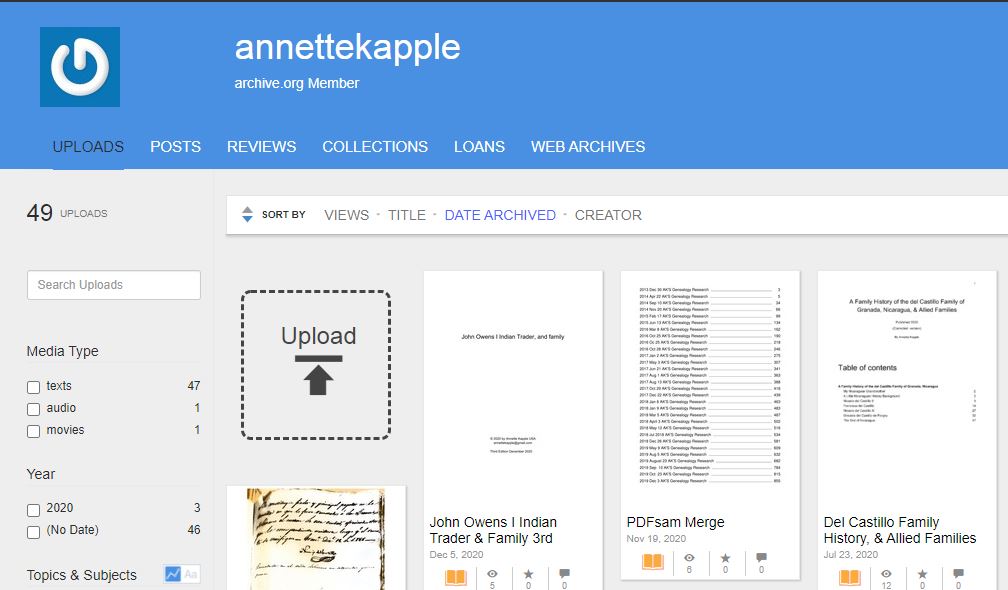
As I stated before I uploaded my Del Castillo family history to Archive.org. I also made some corrections to my Owens Family history and uploaded the book again. I copied blog pages as pdfs and merged them into a single pdf and uploaded it to the same site. 


My goals for 2021

  1. I'm carrying over a goal I've had for years now which entails finding a Browning male in my line to DNA test. 
  2. Breaking down my Campbell brickwall is something I've been working on for years now. I'm thinking mtDNA testing may help if I can find the right person. 
  3. I would like deed records for my Burgenland ancestors. 
  4. I'm always looking for more photos. As you can see below there are still photos I lack. 

Staying home had some positive aspects. Putting even more hours than usual into researching my family paid off. The results of my research have been rewarding. The old photos, that are new to me, and the stories I've unearthed have enriched my life. 

Wishing everyone a Happy New Year and success in finding what you're looking for in 2021!