Friday, March 13, 2020

Irish Deed Records Online/ and how to use them


I didn't know that Irish Deed books were online until I watched "A Strategic Approach to Irish Genealogy", which is a free video from RootsTech 2019 London. Maurice Gleason was the presenter at this excellent session.

These digitized microfilms are free to use at FamilySearch. The title of  this series of films is "Transcripts of memorials of deeds, conveyances and wills, 1708-1929." Unlike in the United States land records were recorded by the national government in Dublin, instead of by county or town.

A little history of landownership is necessary when it comes to researching land records in Ireland. According to the encyclopedia Britannica in 1641 Irish Catholics owned 59% of the land (although Protestants already owned much of the land in Ulster).  With the ascendance of Protestants to the British throne after the Glorious Revolution restrictions on landownership by Catholics resulted in a decrease in ownership with Catholics owning only 22% of the land. By 1703 they owned only 14% of the land in the country. Protestant's made up 10% of the population, but owned most of the land in Ireland.

Landownership by Catholics didn't increase significantly until the Irish National Land League was formed in Co. Mayo, where some of my own ancestors lived. A motto was "The Land of Ireland for the people of Ireland." Most of the Irish were tenant farmers who paid rent to English and Scottish landowners. The league used various means to achieve the reforms they wanted including rent strikes. My own ancestor Patrick Mullen was granted ownership of his land due to an 1891 land reform.

I've found many land entries for landowners who lived in Dublin or London. Landlords were generally absentee. One document listed individuals with an interest in land in Ireland living in Auckland, New Zealand, France, and London.


The deeds books have two sets of indexes one set up by the name of the grantor. The grantor indexes are often arranged by decade. Sometimes there are several individual books covering a decade.


My favorite index is by townland. These books are called land index books. The townland being the smallest jurisdiction this is the easiest way to find land records for ancestors with common surnames, like my Mullen family. For some not living in Ireland finding ancestors townland names can be a challenge. Sometimes ancestors didn't give the townland as their place of residence, but instead named the nearest town. I was able to find my ancestors' townlands through marriage records in Ireland. If you can find your ancestors on Griffith's Valuation and the 1901 and 1911 Censuses you will also find their townlands listed there.


The first step in the process of researching the indexes is to decide which years you are interested in looking at because they are first organized by years. Each county/townland book generally represents around half a decade. As I said before each grantors index represents generally a full decade.

The index gives the year, book number, and page number for the deed that was copied into the ledger book (early books also give a deed number). There are also page numbers for entries in Day Books, which are not online


How to search the books


Let's use Thomas Kirrane as an example. Say we knew he lived in the townland of Pollaturick in Co. Galway, and we are interested in the time period between 1900 and 1904. The first check would be for the index book covering the County of Galway for that period. Since we know the county and townland he lived in it's faster to use land indexes. And using the townland index will allow you to see all deeds filed for that place at around the same time.


Now that we are in the right place in the index we will now look for the townland. To find the townland quickly we need to know which barony our townland was located in. By Googling the townland we can generally find the barony. There is often a barony index in these index books which makes the quick location of the townlands easy.


Pollaturick in in the barony of Dunmore. This barony begins on page 257. We then go to the page with the P at the top for Pollaturick since the townlands are in alphabetical order.


Thomas Kirrane is at the top of the page. Next we need to go to the actual deed books. The books are first arranged by year, then by volume. We need the year 1900 volume 45. As we see below volume 45 is the second volume in the digitized microfilm.


We scroll down to the second book which is book number 45.


In the earliest books the page numbers will match the numbered pages in the book. This format changed in later books when the page number actually is more of a document number. The early books also contain a deed number you can use to verify you have the correct entry.

In 1900 the page number refers to a specific document because the pages are not numbered.

When I locate the correct year and document for Thomas Kirrane, document 264 I run into a problem this deed is for someone else? A Michael Nally of Killerneen.


When we turn the page we find Thomas Kirrane listed under No. 267. So if you can't find someone keep paging through. Looking back at the index the clerk who recorded the deed formed his 7's in such a way it looked like a 4 to me.


This deed gives very exact information on when this did was registered. It was registered 9 July 1900 at 37 minutes after 10.

My ancestor Patrick Mullen's entry directed to the correct deed which was filed in 1901. His page is number 9 on the index which matches the document number on the page. In 1901 the clerk probably was a different person than in 1900. I can clearly make out his 7's.
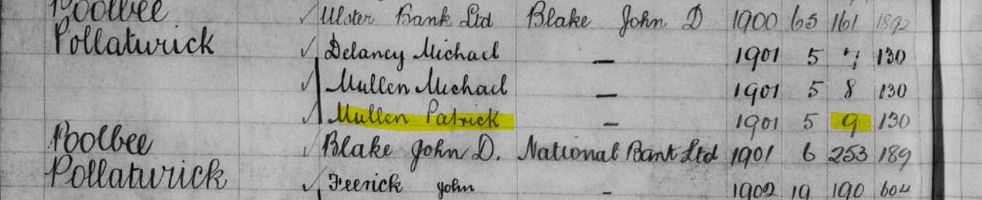


Patrick also received his land as a result of the 1891 Registration of title act. Both Thomas Kirrane and Patrick Mullen were both tenant farmers before they received title to their lands.

I knew Patrick Mullen's landlord was Courtney Clarke, from Griffith's Valuation, so I searched the deeds for him in hopes of finding some information on his tenants. Unfortunately my Patrick Mullen was never mentioned.

I did find a marriage related document which gave more information on Clarke himself. According to the document he was a Lieutenant in her Majesty's Regiment of Fusiliers. Also according to the document he married Arbella Charles Walsh in 1878.
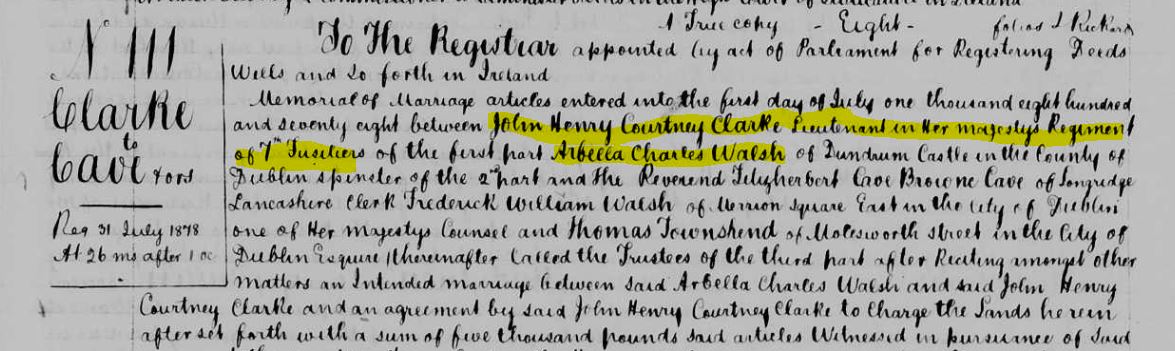

I've run across many documents relating to marriages of large scale landowners who were also landlords.

The document below gives some information on a Peter Daly who had some interest in land in Pollaturick townland Galway. The Daly family is related to my Mullen family so I decided to take a look at this document. The land index is helpful because it shows all land transactions for a townland and you can find family deeds clustered together. Some interesting information provided here is that a Peter Daly was  a Catholic Priest who lived in the city of Galway. You never know what sort of information might be recorded. Often occupations are recorded.


Other documents I've seen are powers of attorney, and wills. Wills were also sometimes recorded in the deed books. Before the land reforms in the late 19th Century you'll generally find mostly middle class and aristocratic families listed in the deed books. Beginning around 1880 you will see ownership beginning to change as tenants receive title to their land.

You will also sometimes find interesting markings in these books directing you to the next page or directing you to look up.


Here is an example of an early index to the deed books. We see Liber, or book number, page number, and a document number. Sometimes many books are listed together in a single paragraph like below. You just have to keep looking for libers to find all individual the books.


I'm very happy to have collect a few family deeds. I'm a little disappointed that my Huane/Huvane family did not file any deeds before 1930. Filing a deed with the registry office in Dublin wasn't mandatory.

The Registry Office in Henrietta Street in Dublin also keeps original copies of deeds. I'm thinking of trying to get original copies because they may potentially provide additional information.

I generally find more information about my family around St.Patrick's Day and this year is no exception. I guess it must have something to do with the luck of the Irish?

Have a Happy St. Patrick's Day!  


Tuesday, March 3, 2020

My Takeaways from RootsTech 2020


I didn't attend RootsTech 2020, but instead streamed the sessions from home during their free live-streams. This year the RootsTech conference celebrated their 10th anniversary. I've watched the live-streams at home from the very beginning.

Some very interesting new tools, and some not yet available, were introduced and demonstrations were given on how to use them.

I've spent a good deal of time, as you know if you've seen some recent posts, identifying people in old family photos. A new tool I learned about from watching a live-stream fits into my recent photo projects. MyHeritage now has a tool which allows you to colorize black and white photos. I colorized a photo of my mother with some Navy friends, which came out really nicely. This tool doesn't work as well on some of my much older photos though. It does help the details to pop a little more though, which may help us to see facial features a little better, Seeing features more clearly could assist in photo identification. The painting on the wall, in the photo below, is by my grandfather Charles Lynn Forgey. Nice to see the painting in color.


A live-stream session that was particularly interesting for me, and also directly relates what I''m currently working on, was "German Research for the Everyday American". I've been working on my Austrian family line and dealing with the difficult to read German script lately. I've been going through the newly released Burgenland, Austria Catholic church books. Karynne Moses did a wonderful job covering techniques for researching German ancestors. She briefly went over German pronunciation and showed a useful slide with the German script alphabet. Her slide of the alphabet was better than an example of the writing I've been using.

Karynne Moses also introduced me to a site with Protestant religious records in Germany. It's called Archion. There is a fee to use the site. I have German ancestors who immigrated to Colonial America, and  so I will likely give the site a try at some point. She also discussed the records available for Germany at Familysearch, which also includes church records, and Matricula an Austrian site for church records. Of course I'm familiar with Matricula because of my obsession with the Kappel/Kurta families.

What Are the Odds? (WATO) was another very interesting live-streamed session. During this session Leah Larkin explained how the WATO tool from DNA Painter works. This is an autosomal DNA tool. WATO stands for what are the odds. This is a question that everyone working with atDNA is always wanting an answer to. DNA testing is all about determining our relationships to matches using the number of shared cM's as a way to estimate when we share a common ancestor. This WATO tool helps to confirm, or disprove, hypothesizes we've formed regarding our relationships to matches.

Another interesting session on DNA was presented by Angie Bush called "Adding Branches to Your Family Tree Using DNA" . I learned about the beta DNA based family tree at 23andMe from this session. This is similar to Thrulines at Ancestry.com, and the Theory of Relativity at MyHeritage, which she also explained. The 23andMe tree groups matches who likely descend from a common ancestral couple in a tree format. The trees created for my mother and I correctly group matches according to family lines. Matches are definitely correctly sorted according to whether they are maternal or paternal line matches. I was busy in October 2019 when this tool was introduced so I appreciated learning about it now.


I wasn't able to watch all of the sessions live so I'm watching the archived videos as I have time. Every year I pick up new tips for research, and learn how to use new tools, this year was no exception. I look forward to what we might learn to further our research in 2021! 


Wednesday, February 5, 2020

Naturalization Certificate File/ And Burgenland, Austria Church Record Books

Certificate File or C-File

When I began my research on my Kappel family line I didn't even know where the family came from? My grandmother Dorothy Mason-Kapple did some research and found out her late husband's family was from Austria. The family told her they were from Graz, Styria, Austria. I continued the research on the family beginning in 1998. I didn't order naturalization documents until the year 2000.

When I researched what I might find in the naturalization documents I was excited to discover that my great-grandmother Mary Kurta-Kappel's 1939 petition for naturalization would likely include a photo. Sadly when I received a copy of the petition from National Archives Great Lakes Region, Chicago there was no photo on it. It said no photo required. Since our family had no photo of her I was disappointed by the lack of one. These records did contain valuable information so I wasn't completely disappointed.

An Example of a Naturalization Petition with a photo

I assumed this was the end of the trail for photos from this governmental source. I was wrong. Interestingly in the year 2019 when two people came forward with long awaited photos I would discover there was a government record with my ancestor's photo. The certificate for naturalization contains a photo of the immigrant. It's contained in a certificate file (C-File) kept by US Citizenship and Naturalization Services. The National Archives office I originally wrote to for information didn't have a copy of the certificate in their files.

Doing some research in 2019 I discovered I could get a copy of USCIS file. I was able to order a copy of the certificate file online, which I did in October. I didn't get copies from the file until January. The agency making the copies has to go through the documents and make redactions which I assume can result in a longer than expected wait time. Oddly you can get unredacted documents from the courts and National Archives. Many Naturalization records are unredacted and available online now at Familysearch.org.


When I received a copy of my ancestor Mary Kurta-Kappel's naturalization certificate it was nearly exactly 80 years to the day that my great-grandmother became US Citizen. I was able to celebrate her naturalization anniversary with another photo and a copy of her certificate. So happy to get this copy!


I received a copy of my great-grandmother's petition, and certificate for naturalization, January 2, 2020. My understanding was I would only get a digital copy by logging into the website when my documents were ready. I found the website complicated to use. I did figure out how to sign up and receive the digital copies, which is the way I originally retrieved them. A few days later I also received copies in the mail.

In 2000 I paid the National Archives $10 for a copy of my great-grandmother's petition and certificate of arrival. In 2019 I paid $65 for her naturalization petition and certificate of naturalization. Each file had different documents. To get all information about an ancestor I would look for information held by each government organization. The certificate file can contain even more information than my ancestor's did if you're lucky. An Enemy Alien Exception might be contained in the C-File, for instance. Below a record for someone naturalizing and stating they are a conscientious objectors.


There has been talk about raising the cost of a C-File from $65 to $385. I would probably not order the file at that price.

Burgenland, Austria Catholic Church Records

Burgeland, Austria Church records belonging to the Catholic Church diocese in Eisenstadt, Austria and Gyor, Hungary have now been digitized and uploaded to the internet. You can view them for free until March 31, 2020. The fee schedule after that is as follows: the following fees will apply: EUR 10/15 days, EUR 20/3 months and EUR 50/1 year."

These books are being restored by the Institute for Paper Restoration in Schönbrunn Palace, Vienna, Austria. I was at the palace not long ago and had no idea they were restoring these books. My ancestors never dreamed they would end up in Schonbrunn Palace, or at least their personal records. 

I'm finding going through the books and getting back to the place I left off is very difficult based on the way this site is set up. Each page doesn't have an individual web page address. I love the way Familysearch.org is set up. At that site I can copy a link to each image. 

There are already Burgenland church records online at Familysearch.org, but they only go back to 1789 for my family area. The records for my family village of Inzenhof/Borosgodor are now available back to 1710 in the parish books for Heiligenkreuz. The parish changed over to Felosronok in 1789 and those church books are at Familysearch.org. 

The problem tracing the family back to 1710 is that in the early 1800's the marriage entries don't list the parents names. Without parents names or house numbers families are hard to trace. There are a few first names consistently used over and over again. Joanne, Stephen, and Michael were common names for boys. Maria, Veronica, Barbara, and Catharina were favorites for girls. Every family used these names so there would often be more than one Maria Kurta, for instance, born around the same time in the same village. 

What I've decided to do is imitate the PRDH that has been put together for Quebec, Canada for my family names. So basically what I'm doing is reconstructing all families carrying my names in hopes that there is a naming pattern or common godparents that might lead me to make a connection with specific families?  

This is how I'm reconstructing the families:


First I snip records with the snipping tool.


   Then I'm recording the information in a document by surname and decade.

I then look for family units. Then create a page for couples and their children.


I try to decipher names the best I can. Some are impossible to read.

What I'm finding doesn't seem to make sense? I'm finding couples with very few or no children? Either they don't baptize all of their children, or they live in another area part of the year?

Another interesting discovery is mixed Lutheran and Catholic marriages.


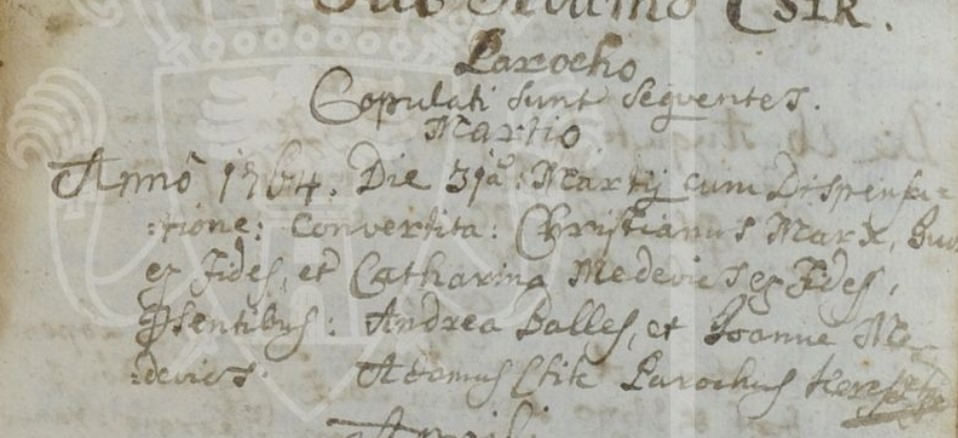
I also found a Marx who likely converted  from the Lutheran religion to Catholicism based on the previous record. When I first found the record saying convertita (below) I didn't know what it meant until I found the record above.


The Gussing Catholic Church records go back to 1666. The Kopls were in the area as early as 1690.

Even if I cannot make any definite connections with my own family all of the people in Inzenhof were closely related (which is why they all looked so much alike). I'm enjoying reviewing the old records even if some of them are very hard to read. Looking at the records has added to my appreciation of my Kappel/Kurta ancestors.

Wednesday, January 1, 2020

Reviewing A Decade In Genealogy Research & Heritage Travel


As we leave another year behind, and a decade which included 9 years blogging about my genealogy research, I review some highlights of the past decade in genealogy.

All of us involved in the genealogy community have enjoyed the heritage programming offered on TV. Shows including "Finding Your Roots", "Who Do You Think You Are", and "Genealogy Roadshow".


Streaming webinars such as those offered by Legacy, Youtube videos, and podcasts have helped has become more skilled researchers. Streaming conferences such as Rootstech and Jamboree has been fun and informative too.

The past decade has seen a rise in the number of conferences and family history events. To keep track a tool was developed during the past decade called Conference Keeper which is a calendar of conferences and events.

Participating in the genealogy community in the virtual world of Second Life has also been very rewarding. I highly recommend joining Second Life Virtual Genealogy Society (SLVGS) and participating in the presentations offered there. It's a nice way to connect with others interested in genealogy research.

The genealogy groups at Facebook have also been very helpful with many new groups popping up over the past decade. Groups I've helped form at Facebook include the Forgey/Forgy & Forgie group,  We're descendant's of John Owens Indian Trader a group which helped me break through a brickwall, and put together a book about our Owens family. I also started the group Irish Genealogy Links.

Familyseach.org digitizing films and making them available for free online has led me to make so many breakthroughs. These films have also added interesting details to my family history. Seeing original records at Family Search is an incredibly rewarding experience.

With so much coming online over the past decade sites like Linkpendium and Cyndi's List have helped us wade through it all.

Bloggers have also helped us discover new products and sites for family history, and explained how to use them.

My wish when I started this blog in 2011 was to use DNA to push my family lines back further in time, and determine the origins of some of my family surnames. My DNA journey began in September 2011 when our Forgey Y Project began at Family Tree DNA. A year later in 2012 I took the atDNA test at Family Tree DNA. I then tested at AncestryDNA, and 23andMe. I tested my late mother at all of those companies too. I also tested other relatives. All of this testing helped to confirm our ancestry. I transferred my my results to MyHeritage and GEDmatch where I was able to make even more connections. So far I haven't found any breaks in my own family lines.

The Forgey DNA project has confirmed that this surname is a variant of the surname Ferguson. It also confirmed what my grandfather thought; we are indeed Scottish on the Forgey line. So far all Forgeys in the United States appear to be related.

The most rewarding outcome of my DNA testing has been the surfacing of photos of my Kappel great-grandparents. I had never seen photos of my Kappel great-grandparents until this year when a DNA match living in Austria contacted me and told me his family had photos of them. My great-grandmother Mary Kurta-Kappel sent photos to her sister living in Austria. I was also contacted by another cousin at Ancestry this year who also had a photo of Mary Kurta-Kappel. I was nearly ready to give up on finding photos of them. This year two different distant cousins came forward with some.

When this decade began DNA testing for genealogy was in its infancy. We've seen many improvements in our results over this past decade. The ethnicity results are definitely much improved from when I tested in 2012. The last decade has been a period of development of new DNA tools such as Chromosome Painter that help us to analyze our DNA results to get more out of them.

In 2015 I began doing Heritage Travel. Travel and genealogy being my favorite pastimes because of that this has been extremely rewarding.

Nicaragua 2015

The first heritage country I visited in 2015 was my mother Edna and Grandmother Graciela Del Castillo-Forgey's birthplace Nicaragua. My grandmother was Nicaraguan and she married my US Marine grandfather Charles Forgey. Nicaragua is at the top of my list of favorite places with beautiful scenery and weather.


I extended my Nicaraguan family back a couple generations doing research in Granada Nicaragua's archives. I also was able to see some documents that my ancestors wrote. The archives has many of Nicasio Del Castillo's handwritten documents. I loved seeing his signature.


England and Scotland 2016

Scotland was the 2nd heritage location I visited. Many of my earliest American ancestors had Scottish and Scots-Irish roots. Another absolutely beautiful place I was sorry I had to leave.


I also visited England which I loved so much I've visited twice. I know I have some English ancestors but I have not been able to trace these early American ancestors to a place in England. Some of my possibly English surnames are  Browning, Thurman, Morris, Hicks, Watkins, Abbot, Marriott, and Adams. I'm also missing some of the surnames of wives. I don't know the surnames of some of the Owens wives?


East Tennessee 2016

In 2016 I also made my first Trip to the Forgey area of East Tennessee. I attended the Tennessee First  Families Reunion during that trip, which included seminars on Tennessee genealogy, and a tour of historical places in East Tennessee. I also met a distant Forgey cousin Kenneth Edmondson after years of collaboration via email and Facebook.


I also applied to become a member of First Families of Tennessee in 2016. I was accepted based on my ancestor Roger Browning.


Historical Highlights Tour of East Coast 2016

In 2016 I also took a Historical Highlights tour of the East Coast with Trafalgar Tours. This tour covered my ancestral areas of Virginia, Maryland, and Pennsylvania. We also visited the area in Virginia where my German ancestors lived in the Shenandoah Valley. I was able to visit the Christ Church in Philadelphia where my Browning ancestors married.


Nicaragua again Christmas 2016

I returned to Nicaragua again at the end of 2016 to do a little more sightseeing. I was able to see more of Nicaragua on this trip.


France and a 2nd Trip to England 2017

In 2017 I visited France where my French Canadian ancestors originated. Some of my ancestors were from Paris where I spent a week. I loved visiting some of the churches my family was associated with. One of my favorite things to do was sit and look at the Seine River, and the passing boats. One of my ancestral families lived on a bridge spanning the Seine. Happy to have ancestors from this beautiful place.


A 2nd Trip to East Tennessee Summer 2017

I visited Tennessee again in 2017 to do a little research in the McPike's Washington County. I stayed in the lovely little town of Jonesborough. I highly recommend visiting that cute town if you are visiting East Tennessee. I was able to visit the house of the man who made land entries for the county, and the room where he would have recorded the William McPike's land entries.


New York City July 2017

From Tennessee I headed for  New York for my first visit there in early July. I was so excited to visit  the Statue of Liberty and Ellis Island. My Kappel/Kurta family arrived in America through Ellis Island as did my Irish Mullen/Huvane family.


Indiana Spring 2018

In 2018 I visited Indiana where my grandfather Charles Lynn Forgey was born, for the first time. I stayed in Jackson County where my grandfather and generations of his family lived back to the early 19th Century. I loved Jackson County with it's beautiful farms, and countryside. I felt very much at home there. I was able to meet my Forgey/Roller double cousin Nan Harvey on this trip after years of communicating at Facebook.

Visiting my ancestors graves was very moving.


I did my very first courthouse research at the Jackson County Courthouse in Brownstown on this trip.


Chicago, Illinois September 2017

I visited my father and paternal grandmother's birthplace of Chicago for the first time in 2017. I had been wanting to visit Chicago for so long. It was a thrill to finally visit there. The weather was perfect too! I could definitely move to Chicago, but this California girl may not tolerate the cold winter weather.


Germany, Austrian, & Hungary 2018

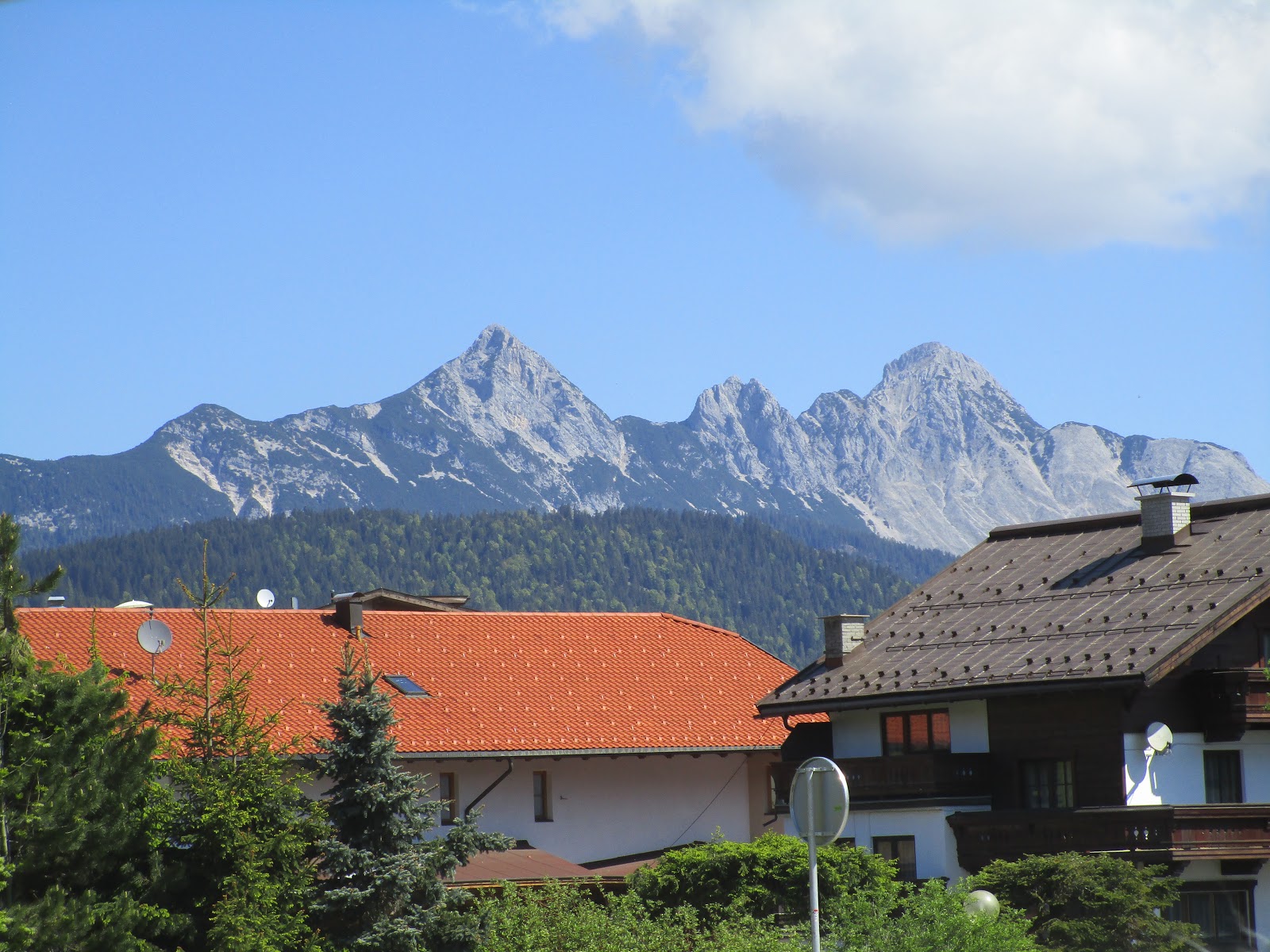
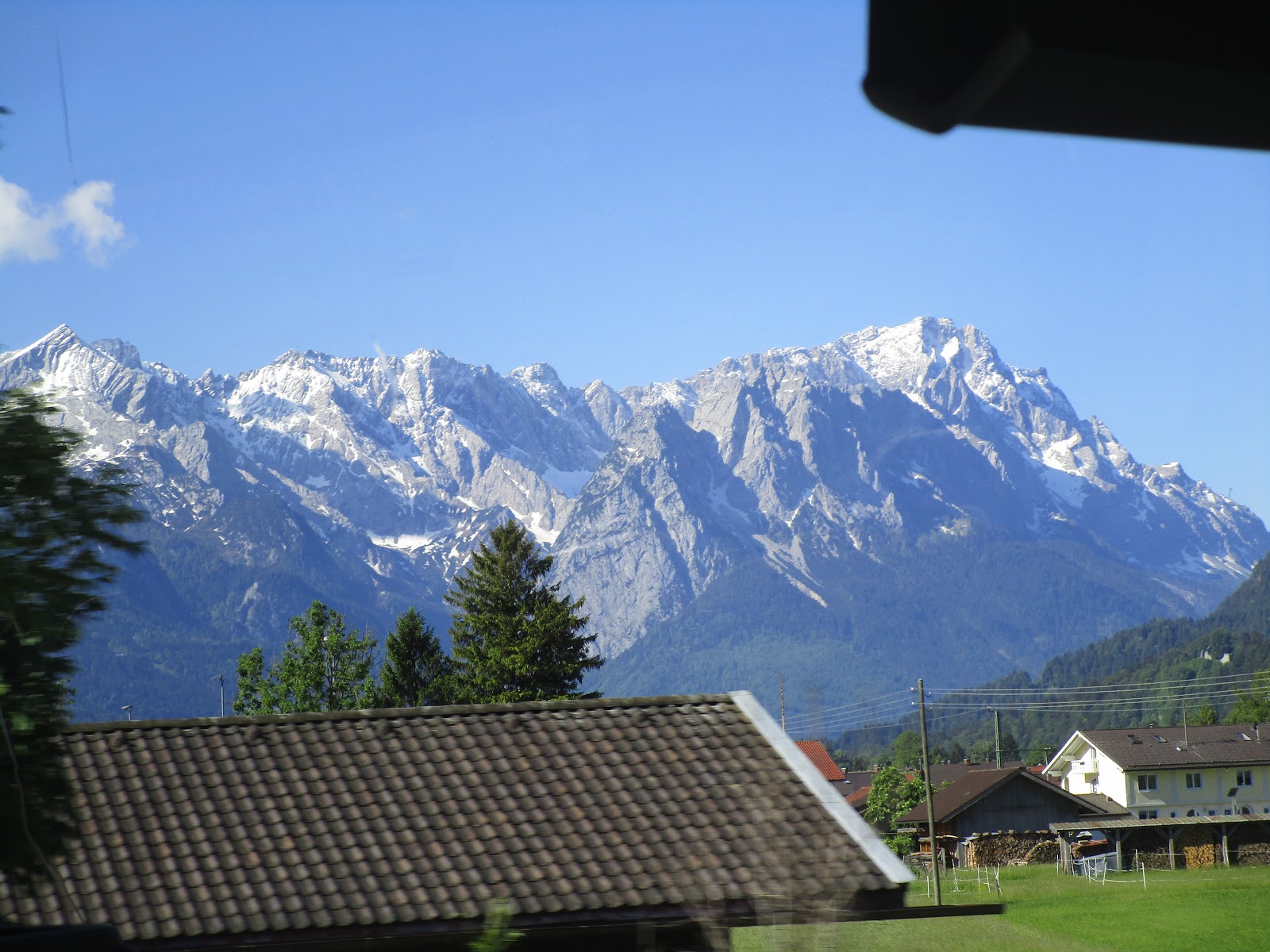
I visited ancestral countries of Germany, Austria, and Hungary for the first time in 2018. All of these countries are beautiful. I was saying ooh aah constantly, especially in the mountainous areas of Germany and Austria.


Visiting Burgenland, Austria for the first time in 2018 was so exciting. When I discovered my family was from there in 1999 I was dying to visit someday, and that someday came in 2018.


Visiting Graz was also something I've wanted to do since learning that my grandfather Rudolph Kappel was born on the outskirts of that city. It's a lovely city was an exotic feel.

Ireland May 2019

In 2019 I continued my heritage travels visiting Ireland in May. My great-grandmother mother Helen Mullen-Mason was born in Galway, Ireland. I wondered if I would like Ireland as much as England? I found that I liked it just as much as England. I think Ireland is even a little more interesting than England because of the pub entertainment. Also Ireland has a cozy feel that makes you feel at home. Plus being surround by so much history everywhere is wonderful.


Happily I was able to visit my Mullen family's townland of Pollaturick. Thanks to my cousin Darryl I was able to locate and visit the Mullen family home.


I also visited family cemetery. 


Spain June 2019

From Ireland I flew to Spain for a week. This was also my first trip to Spain. I wondered if I would like Spain as much as Italy? Spain is definitely as history filled and beautiful as Italy. Spain is also special because I have some Spanish heritage. According to research done by another researcher my Del Castillo family came from the Sevilla area. I loved Sevilla and nearby Granada. Spain is amazing!


Quebec, Canada August 2019

My final heritage trip of the year was to Quebec last August, and I fell in love with it just like all of the other places I've been. My ancestor Pierre Masson/Peter Mason was a native of Quebec.


Now I can cross out finding photos of my Kappel great-grandparents from my genealogy to do list.
  1. I think my number one priority this year is going to be trying to find out more about the mysterious Alexander Forgey of Washington County, Virginia. We don't know who his children are, and we don't know where or when he died? We lose all track of him in 1807. Still looking
  2. While researching the Brower family I saw Brenneman given as Susannah Brower's mother Eve's maiden name. I can't confirm this. I would like some documentation for this? Still looking
  3. I've been doing some Browning family research this year. I would like to find more documentation linking the Tennessee Brownings with Maryland. Also need to find documentation that Elizabeth Drane was Edward's wife. I visited Greene County, TN. I've collected up more deeds for the Browning Family in TennesseeStill only have circumstantial evidence for the Maryland connection
  4. I still don't have any photos of Frank Kappel and Mary Kurta, my great-grand parents, so I will be continuing to search for those. Still no photos
  5. Another carry over from previous years is finding the death information for Patrick Mullen and Mary Huvane who died in Ireland. I was able to find the death information for both Patrick Mullen. He died 13 Aug 1930 in Pollaturick Co. Galway Ireland. I even found the name of his mother, a detail I never even thought was possible. I was also able to identify the breed of dogs my family owned in Ireland, and what color they were, by using the Dog License register at Findmypast. 
  6. This year I would like to focus on my Browning line and maybe find a male to take the Y DNA test for our line.
  7. I would like to work on filling in my photo tree also which is at the top of this blog post. I need someone to come forward with these remaining photos. 
This has been a busy decade. I need to rest a bit before beginning some new adventures in family history.

Happy New Year and New Decade!