I am using this blog to record my genealogy research progress. My research at this point is concentrated in Tennessee, Virginia, Kentucky and Pennsylvania records. Since many of my ancestors ended up in the Midwest and West my research sometimes takes me in that direction. I also research Irish records.
I have spent years searching for the birth record of my grandfather Rudolph Kapple. I began searching in 1998. I had assumed he was born in or near the village of Inzenhof where his parents were born and raised. Actually before I even knew of Inzenhof my grandmother Dorothy Mason, first wife of Rudolph, had written to his surviving family in Chicago to ask where he was born. Most likely she wrote to one or more of his siblings, at least a couple were still alive around 20 years ago. They told her Rudolph was born in Graz, Austria. After discovering the family came from Inzenhof I discounted this as wrong believing they just named the nearest large metropolitan area as his place of birth, and it was not his actual place of birth. I assumed that also because the Irish generally provided the name of the nearest market town as their place of origin instead of the smaller townland they actually lived in.
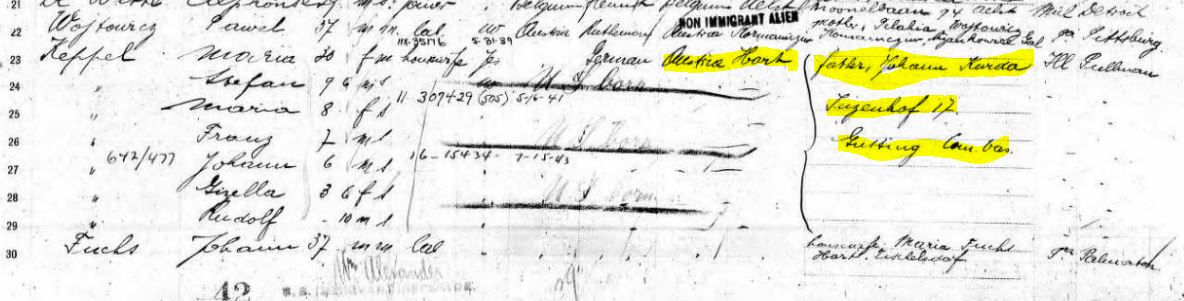
After obtaining a copy of Rudolph's mother Maria's naturalization document, and passenger list, he was listed with a different birthplace I never had heard of. A place called Hort was named as Rudolph's birthplace.
I used this information looking for places named Hort. I found one place by that name in Hungary. I was unable to find his birth record in the LDS Family History Library civil registration film for Hort, Heves, Hungary. I then believed the spelling could be wrong and it might instead be Hart? There are several places in Austria called Hart. With few microfilms for Austria, and none for a birth in 1909, I had to give up on the search for my grandfather in places called Hart.
I also believed he could have been born in Inzenhof, and the passenger list was wrong. Since the passenger list surame misspelling had to be used on documents for naturalization I assumed a place name error may also have had to be repeated even if it was wrong. I assumed it was possible Maria told the immigration clerk, when asked, that Rudolph was born in Ort, a word meaning place. I thought this may have been a misunderstanding brought about by a language barrier?
I had looked through the Civil registration microfilms for the area the family was from when they became available. I did not find Rudolph's 1909 birth record. When a distant cousin suggested looking through them online, I decided to try again.
I went through two different civil registration digitized films at FamilySearch, one for Rábafüzes and one for Németujvár. Civil registrations for Inzenhof were recorded at various times in both districts. I didn't find his birth record and decided to see if I could find his siblings records. Some of his siblings were said to have been born in America, and two in Inzenhof/Borosgodor (Borosgodor is the Hungarian name for Inzenhof). I noticed something I hadn't noticed before, births could be recorded a year, or years, after the fact, I needed to extend my search beyond the date of birth, for maybe years beyond that date.
I began my search with Maria's 1900 birth. I saw an interesting record which seemed to relate to my family. I didn't think the father's name was correct and kept looking. Then it occurred to me the father's name was written in Hungarian, instead of German or Latin as in the Catholic Church books. His name was recorded as Francis in Catholic records, but the name is Ferenc in Hungarian, meaning Frank which is the name he used in America. I went back to that record and sure enough the father's name was correct just written in Hungarian. The name of the child was listed at the bottom of the record, which also threw me off. I can't speak or read Hungarian which made searching these records very difficult.
Maria's birth date was the same as on her mother's naturalization record so I knew this was the correct record. Her birth was recorded in the Rábafüzes civil registration district.
Maria was living at number 21 Borogodor/Inzenhof when daughter Maria was born. I didn't know that when I visited Inzenhof. I checked my pictures to see if I had a picture of that house. Yes I did get a picture of 21. This house is across the street from number 24, which is where cousins of my family lived and still live.
Maria's grandparents Johann Kurta and Anna Joszt were witnesses on the birth record. This is another confirmation that Maria Kurta's Catholic Church birth entry is in error. Her mother is not an Anna Scharl, but instead Anna Jost. I figured that because her siblings birth records stated their mother was Anna Jost, plus there is no record of an Anna Scharl marrying a Johann Kurta. There is a record for the marriage of Johann Kurta and Anna Jost before Maria was born, and the address was the same as Maria's birth record.
Johann and Anna were still living at house 17 in 1900. House 17 is behind the village school in the picture below.
I then searched for John's birth record and also found it. He was born in 1904, and his birth was recorded in the Rábafüzes civil registration district. His grandparents also witnessed his birth record like that of Maria. An old address of number 3, which was where his mother Maria was born, was given?
I then decided to go through the books searching for my grandfather's birth record, this time looking for names spelled in Hungarian. Looking through the Rábafüzes book for births in 1909 I noticed that it appeared Borosgodor/Inzenhof births were not longer registered in that district. As I was researching the Németujvár digitized microfilms at FamilySearch I noticed there were zero births listed for Borosgodor (Hungarian name for the Village of Inzenhof). I then had to figure out where these births were now being registered?
Looking more closely I then discovered there were actually two books on the digitized film I was searching in. There are two books for district of Németujvár. One was for the larger towns, and the other for villages or rural areas. As you see the book below is for Németujvár Videke. Videke means rural. Rudolph's family lived in Inzenhof, which is a rural area not far from Gussing/Németujvár. There is a set of films for Németujvár which have these books on separate microfilms. I accidentally came upon the one with the combined books, which led to my confusion.
The best way to search the FamilySearch microfilms is by using the links provided by the Burgenland Bunch website. Then you won't run into the confusion caused by two books on one film.
Now that I finally had the correct book I searched page by page from Rudolph's birth in April 1909 until I finally found his birth record. His birth was recorded nearly a year later. I was surprised to find Hart named as his birthplace. It stated he was born in Hart, Styria, Austria. His name is also written in Hungarian, which didn't look like Rudolph Christian to me. I did figure it out more quickly knowing to look for different looking names, but the correct parents and date of birth.
Someone at the Facebook Burgenland Bunch group helped me find my great-grandfather's baptismal record. Graz diocese records are now online.
Now I have confirmed that Rudolph Christian Kapple/Koppel was indeed born in Hart, Styria, Austria. He wasn't born in Graz, but instead in the diocese of Graz. He was baptized in Pischelsdorf, Styria, Austria.
It looks like births and deaths for Inzenhof/Borogodor were registered in Rábafüzes between 1895 and 1906. Between 1907 and 1920 they appear to be registered in Németujvár/Gussing.
I found house #42 in Hart on Google Maps.
Looking at the passenger list my grandfather Rudolph appears on, in 1910, Maria states her last address was Hart, Austria. I missed that before.
I have not idea why Maria was living at number 42 in Hart? Her husband Frank's grandfather, Joseph Bierbauer, was from Frösaugraben, Styria, Austria, which isn't far away from Hart, just around 9 miles away. Maria may have joined cousins of Frank living in that area?
I found another entry in a civil registry book for for Pischelsdorf so apparently there was some connection between these two areas?
Inzenhof is about 35 miles away from Hart.
I've got more research to do to discover why Maria was living in Hart? I may also find birth information for her children in America in these civil registration records. The births of many Inzenhof emigrants are recorded in these books. It's a page by page search through many years so it will take me a long time to complete. My prime goal at this time is to find photos of Frank Kappel and his wife Maria Kurta since I have never seen any photos of them.
The Travelers
Maria, and apparently not her husband Frank, made 3 trips back to the old country. Often she was accompanied by at least some of her children. Frank moved the family around Pennsylvania according to where he could find work. He finally migrated to Chicago where the family joined him after returning from Austria for the last time in 1910. Below is a video showing the movements of Maria to and from Austro/Hungary, and the family's movements within America.
From top left to bottom: me, and my father Robert Kapple, my great-aunt Bertha Kappel-Solomon, my grandfather Rudolph Kapple
I began my genealogy research to find out more about my grandfather Rudolph Kapple's roots. I had never met him because he died in Chicago when I was 7 years old. My father's parents divorced and my grandmother moved with her children to California where I was born, and raised. As a matter of fact my first trip to Chicago was last year. I've always regretted never meeting this grandfather, and asked family about him. Even though my father sided with his mother in the divorce he still loved his father. When he heard of his death he was very broken up I remember. I remember him telling me about a tour of a steel mill he took with his father, which was a fond memory for him. That whetted my appetite for more.
I was always told Kapple, or Kappel as some of our family spell it, was a Jewish surname. That's the only thing I knew about the family. I didn't know where the family came from? My Grandfather's death certificate said he was born in Australia. I had thought to start searching there, but my grandmother had some research done which pointed to Austria, and not Australia, as his place of birth. I read the book "My Sixteen" which has instructions on researching immigrant ancestors. I ordered the documents suggested, and looked at census records which were on microfilm at that time, and not yet on the internet. Once I found the name of their village I looked the village name up on the internet, which took me to the Burgenland Bunch. This group led me to church records. The spelling of the name in the old country turned out to be Köppel. I was surprised to find the Köppel's in the Catholic Church records going back to 1785. The surname Köppel seemed even more Ashkenazi related. I figured maybe they converted to Catholicism?
I had a Kapple male first cousin take the Y-DNA test; his result turned out to be in the J-172 haplogroup. Many people of Jewish ethnicity tend to be in that haplogroup, so I thought this was further confirmation that we were indeed Ashkenazi on our Kapple line. I looked up the surname Kurta on a Holocaust database site, and Kurta came up. I thought maybe the Kurta surname origins were also Ashkenazi?
I thought I had it all figured out. We were substantially Ashkenazi Catholic converts? I was in for a big surprise when my autosomal ethnicity results came in. Zero Ashkenazi. I had an aunt and first cousin tested to confirm these autosomal results. My cousin came out with a trace amount of Ashkenazi, and my aunt zero. FTDNA predicted my aunt to be around 30% Southeast European, and 6% Eastern European. That would seem to account for part of the 50% of DNA she would have inherited from her Burgenland born father.
My own ethnicity predictions are around 4%-6% Eastern European on most of the tests. AncestryDNA gives me a range of 0-12% Middle Eastern, which could point to some possible Ashkenazi ancestry? My Aunt has 1.1% Ashkenazi ethnicity at MyHeritage.
It seems like much of my grandfather Kapple's ethnicity is missing from these tests, everyone in my family who has tested seems have a chunk of missing ethnicity from the Kapple side. British Isles and Western Europe seem to be over estimated.
What really intrigues me is the Slovak ethnicity prediction. I do see surnames such as Muik and Kurta listed in the Slovakian church books. Both 23andMe and DNA.land point to the possibility of Slovakian ancestry for me and my aunt.
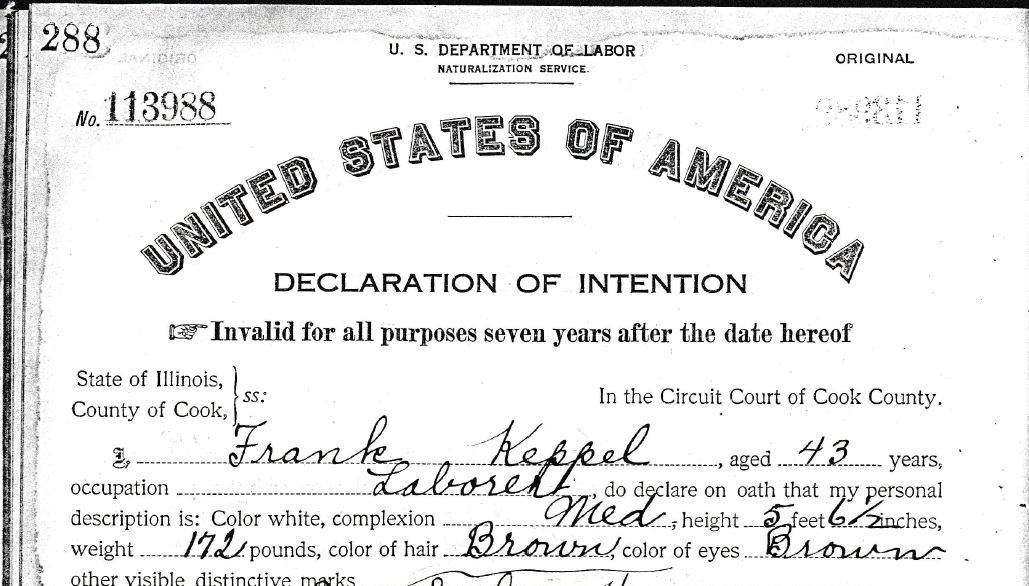
After visiting Austria, Bratislava, and the western portion of Hungary I had not noticed many people with the dark eyes, and dark hair similar to my Kapple family, or other similar features? Even the Kurta cousins living in Burgenland tend to have lighter features. I thought that was a little odd? Looking at us your first guess as to our ethnicity probably wouldn't be Germanic. I don't have any pictures of my Inzenhof great-grandparents. I only have physical descriptions from documents. My great-grandmother Mary Kurta was 5 feet tall with dark hair and brown eyes. My great-grandfather Frank Kappel was 5 feet 6, with dark hair and brown eyes, as you can see in the description on his Declaration of Intention below. My father looked much like his father and had black hair, and brown eyes. His mother had light colored eyes
Interesting that I did see a few more people in Slovakia that looked like us, with darker features. Our tour guide in Bratislava, Slovakia had darker features, more like our Kapple side of the family. I was beginning to think the Slovakian estimate was correct.
I've since looked at a list from 1720 and there was a Kurta already in Borogodor at that time. 23andMe states that I probably have ties to Slovakia within the past 200 years. Looks like it would be more than 200 years ago, more like 300 years or more, since a Kurta was in the Borosgodor area in 1720. If Muik is the source of the admixture it's possible they migrated to Borosgodor at a later time?
23andMe Predicts I have Slovakian ancestry within the past 200 years?
1720 Census Borosgodor
Slovakia is mixed ethnically because it was part of the multi-ethnic Hapsburg Empire. There are signs in 3 languages on the old pharmacy in Bratislava, photo below. Instead of my family being from Slovakia it may be that the mixed Hungarian ethnicity of the people of that country is throwing our ethnicity prediction off? It could also be that some of the people who settled in Inzenhof were from Slovakia?
An old Apothecary shop in Bratislava with signs in 3 languages
Kurta indeed appears to be a Hungarian surname. I marked all of our Kappel side surnames according to there likely ethnic origins. Nearly all of the others appear to be Germanic.
Surnames can be adopted for various reasons and don't always reflect a persons ethnicity. I do think the surname Kurta is a clue that line is an ethnic mixture of Germanic and Hungarian.
Looking at all the information provided by the DNA companies I would say the origins of matches, especially close matches, is more informative than the ethnicity results alone. The fact my aunt and I have Austrian matches seems significant since my mother, who has no Austrian ancestry, doesn't have any is a clue to our origins. My aunt has 17 matches with Austrian ancestry. If I didn't know families origins at all I would look more closely at the origins of matches.
I absolutely loved Bratislava and would love to find an ancestral connection to Slovakia. It could be we just share a common Hungarian ancestry? I may never know for sure? At this point I would say my Burgenland family is a mixture of Eastern European and Germanic ethnicity.
Now that I've visited the village of Inzenhof, Austria where my grandfather Rudolph Kapple, and many of our ancestors had lived, I am more curious about their living situation. How close were the houses where my ancestral couples lived before they married? The early houses were all fairly close together, but some were a block or two away from the others. Below you can see the village of Inzenhof from an aerial view. All of the early homes were mainly clustered near the present Kurta Gasthaus, Fire Department, and School.
I would think everyone in such a small village would have known one another, but there were about 600 people living there when my ancestors lived there. Even with a smaller population, now around 300, not everyone knows each other as I discovered on my visit. I was thinking proximity probably played a role when it came to the marriages of my ancestors? Were they neighbors?
I had no way to plot out the addresses of my ancestors until Werner at the Official Facebook Burgenland Group provided me with some links to GEO Data sites. I used the GEO Daten Burgeland site to plot the addresses of my ancestors, and their neighbors in Inzenhof: https://geodaten.bgld.gv.at/de/home.html
How close did the couples live to marriage partners?
They were not next door neighbors as I was thinking. Here you see Christian Koppel and Marie Bierbauer who married in 1876; they lived a block or two away from each other.
My great-grandparents Frank Kappel and Maria Kurta married in 1898 in Pennsylvania. They both were from Inzenhof, but weren't next door neighbors either.
Maria Kurta-Kappel's parents lived about the same distance apart as the other couples, not next door neighbors either.
Even though the couples didn't live next door they did live in the same village. Interesting that they tended to marry within the same village even though other villages were close by. Maybe it's because each village had its own church? Since the principle gathering place was the church for events and masses that is likely where people got to know more distant neighbors, and these couples met. Also I am thinking if I traced the extended families I would find a web of relationships with neighbors I'm not familiar with. These relationships probably also led to matches with more distant neighbors. I'm not sure about how much schooling my family had? They likely would also have met contemporaries at school if they attended?
I also used the GEO Data site to mark some of the Inzenhof houses. I mainly used the village list at the Burgenland Bunch website. It's been interesting getting to know the village better.
Mid 19th Century Inzenhof Village Tenants
The Geo Data map shows house numbers in blue, and what seem to be tract numbers for the land in white. I added the names from the village list dating from around 1859.
It's interesting to compare the names of villagers in 1720 with these later descendants. You can view the 1720 Census list for Borosgodor here.
After years of research I finally made it to Inzenhof, Burgenland, Austria. This was the finale to my goal of visiting the places where my grandparents were born. I first traveled to Granada, Nicaragua, in 2015, where my maternal grandmother Graciela Del Castillo was born. A couple years later I made it to Chicago where my grandmother Dorothy Mason was born in 1909. A few months ago I visited Brownstown, Indiana where my grandfather Charles Forgey was born in 1898. I finally made it to Inzenhof where my Grandfather Rudolph Kapple was born in 1909. He was born during a visit back by my great-grandmother Maria Kurta . She was visiting her father Johann Kurta and family. She had been living in Pennsylvania. When she returned to America, with her children in 1910, she joined her husband Frank Kappel (Köppel) who had migrated to Chicago. His father, Christian Köppel, and Maria's father, Johann Kurta, had both made trips to America, but appear to be among the 22% of immigrants who returned to Burgenland after spending time working in America.
I put off the visit to Inzenhof, and the Güssing area, because traveling there is more of a challenge. Not only is it there a 12 hour flight from Los Angeles, California but it's also at least a few hours, by public transportation, from the nearest airport. There is limited public transportation to the area. Taking public transportation to the nearest larger hub town involves taking trains to buses, which don't run frequently and require several transfers.
I've always wanted to visit Salzburg and Vienna, Austria. I decided to add the trip to southern Burgenland to that itinerary. Since getting to Burgenland from Vienna was a bit complicated for a first time visitor I decided to begin the trip with a structured 10 day Trafalgar bus tour, which would take care of all the trip details, leaving me to navigate my way through Burgenland on my own more rested. This tour began in Munich for a couple nights, moved on to Oberammergau for another two nights, continued to Salzburg for another two nights, then ended in Vienna. I stayed a few additional days in Vienna before moving on to my hotel in Güssing, Burgenland. Güssing is the closest area to Inzenhof with hotel accommodations.
The Trip to Güssing and Inzenhof from Vienna
I took 3 trains from Vienna to Alsoronok in Hungary, which is only 9 miles from Güssing. There are several routes and trains that stop within easy taxi distance from Güssing. It costs around 35 euros to travel from Alsoronok to Güssing by taxi.
Below you can see the route my trains took to Alsoronok. Depending on the route the Trains take and the time the connections meet it can take 3 and a half, to 4 hours, to to travel from Vienna to Inzenhof (the fastest way to get anywhere in Burgenland would be to rent a car in Vienna or Graz). Unless you're lucky enough to have a train stop near your Burgenland ancestral area it can be time consuming to make the journey from the airports to the area. The tricky part when it comes to visiting Burgenland is transportation and lack of accommodations in sparsely populated areas.
Google maps has simplified visiting Burgenland by providing train and bus schedules. Just enter where you are traveling from and where you're going , click the public transportation icon and travel options will be presented. Austrian rail OBB also provides schedules at their website, and the ability to buy tickets online.
Schedule and train numbers for trip to Alsoronok
All of the trains are modern, comfortable, clean, and have WC's (restrooms). All trains have mounted screens providing stop information and train arrival times.
Traveling through Northern Burgenland before crossing into Hungary
Crossing into Hungary, from northern Burgenland, Austria, Austrian border guards patrol outside the train, but do not board. Passport checks aren't required when traveling through EU countries.
Traveling through western Hungary
We traveled through some beautiful Hungarian countryside on our way to Alsoronok. I saw a beautiful stork in flight too.
Taxi Roni picked me up at the train station in Alsoronok. Taxi driver Ronald Vajda can speak English so I would recommend using his taxi service if you don't speak German. He is also reliable so even if you do speak German, I would still recommend him.
The taxi took me to Güssing through the back road leading past our family church St. Emmerich. This little known route is shorter.
Crossing the Border from Hungary into Austria
Here we are at the border with signs with the Hungarian flag on one side and the Austrian flag on the other
Arrival in Güssing
Once I got to Güssing everything was simple. I stayed at the Aktivpark hotel, which is part of a sports and fitness complex. I was happy with this hotel which provided a free breakfast, wifi, and had a restaurant and bar. The accommodations were modern and clean.
Within easy walking distance to the town center the location of the hotel was very convenient for me since I didn't have a car. I was able to explore the area, which has some nice restaurants, cafes, a theater and grocery stores along with historic buildings. Burg Güssing dominates the hill which the town is built around.
After dumping my stuff at the hotel I took a leisurely stroll around Güssing.
I then stopped at a grocery store and bought a drink, and a snack (jelly filled cookies). Nice grocery store with many yummy options.
The taxi driver, Ronald's, English was very good but I did encounter a language barrier more frequently here than in Vienna where more people could speak English.
The next morning I woke up to the sound of church bells. It was for Corpus Christi a Catholic feast day, and Austrian National holiday. You can watch the procession I videoed below.
First Official Visit to Inzenhof
After the morning Corpus Christi festivities I headed to Inzenhof, about 4 miles away, with Taxi Roni, to look up the house numbers I collected from the Felsoronok church records. This was much more complex than I expected because the house numbers are in random order. Apparently they were numbered as they were built, so house number 5 can be next door to house number 111. Not the tract numbering system I'm used to.
Taxi driver Ronald spotted a man walking his dog. He asked about the house numbers and this man turned out to be the man we needed. This man delivered newspapers to the area and knew how to find the houses I was looking for. I really appreciated his helpfulness.
Below is house number 3. My Kurta ancestors lived for a time at number 3. Kurtas still live in the house. I'm not certain if this is an old house? This may either be the renovated house my ancestor Johann Kurta and wife raised their children in, or a newer house? I believe it probably does sit on the land the original house sat on, if it doesn't contain any parts of the original house?
My ancestor Christian Köppel's family home/property is more difficult to establish. Our local guide asked the current residents of house number 25 if Köppel's lived in that house? They said a Christian Köppel lived in another house. Because of the language barrier I was not able to understand if they were talking about another Christian Köppel? They stated Christian married a woman in the United States. My Christian did go to the US, but seemed to return to Austria? I really don't know what happened to him? His son, my ancestor Frank, stayed in the US, but I didn't see his father with him, or around him, in Census records? I'm not sure when Christian's wife, my ancestor, Maria Bierbauer died, it's possible he could have remarried in the US?
They seemed to be saying that someone named Köppel was living in Vienna now?
I'm not sure when the current residents of 25 moved into that house? I should have asked. I believe the fact Christian's family lived in the house so long ago the locals no longer have any knowledge of the Köppel's ownership of the house or land?
Like house number 3 the house may have be a renovated older home, or a much newer build.
Christian Köppel later took over his Bierbauer in-laws property at number 111. The Bierbauers relocated to Inzenhof in the mid 19th century and likely built a house then, which is why the number is so much higher than Johann Kurta at number 3.
A Köppel is currently living at house number 24, which the residents at house number 25 pointed out. Apparently this is a longtime Köppel household. It's associated with a Christian Köppel, which I believe is a younger man than my Christian? I do think they are related to my family.
Since we no longer spell our name Köppel I had no idea how the name should be pronounced. We now spell and pronounce the name Kapple. Our original surname should be pronounced K-Opal, as the local residents explained. They didn't recognize Kapple, as a local family. Once they understood what my surnames were they stated there were many Köppel's and Kurtas in the area historically, and currently there still are a number of Kurtas.
One of the residents of number 25 called a Köppel to ask her how my family fit into to the local area. My family having left so long ago little is known of them. The residents of the area were aware of the fact some of the Köppels went America, but weren't sure exactly where they lived or how they connected with current residents?
The house at 111 is definitely a newer home. It isn't built in the traditional local style. Unfortunately the owner wasn't home because his wife died recently.
After searching for family properties. I asked Ronald to drop me at the family church St. Emmerich. This church was located in no man's land during the Cold War. Because of its location on the Iron Curtain the church and cemetery fell into disrepair. Once the Cold War ended it took a great deal of restoration work to bring the church back to what we see today. The church is now very isolated in a wooded area, miles from the populated areas.
The road from Inzenhof to the church has signs pointing out this road is part of the Iron Curtain Trail.
I hiked around the location of the old abandoned cemetery. I was only able to read one headstone. The others are too worn. I believe more headstones are likely buried. Since the border area was heavily mined during the Cold War digging around the old cemetery may not be the kind of blast we'd like?
I examined photos posted around the grounds of this church.
I was also fascinated by the signs. The painted markings on the trees seem to represent Austria and Hungary. One sign stated a camera was surveilling the area, but I didn't see one?
Back to Güssing
After heading out of the woods back to Güssing I took a wonderful tour of Burg Gussing. When I told the person selling tickets at the Burg that my family was from Inzenhof and I was visiting from California, and my family names, she recognized a name like Bierbauer, she said Bierbaumer. I'm not sure if later members of this family changed the name? Could be a different family too?
If you buy a 7 euro ticket to the Burg Güssing you will get a discount on tickets to the other Burgs in Burgenland.
I thought touring the Burg Castle/Museum would only take a short time. I was there for hours. After walking so much the past couple weeks I was happy there is a lift up to the Burg, which helped preserve my energy for the vast collections of the museum, and large Burg complex.
Our previous landlords the Batthyany family are still prominent in Gussing. You can see pictures of the current family members at the Burg museum.
Closing Service For Corpus Christi
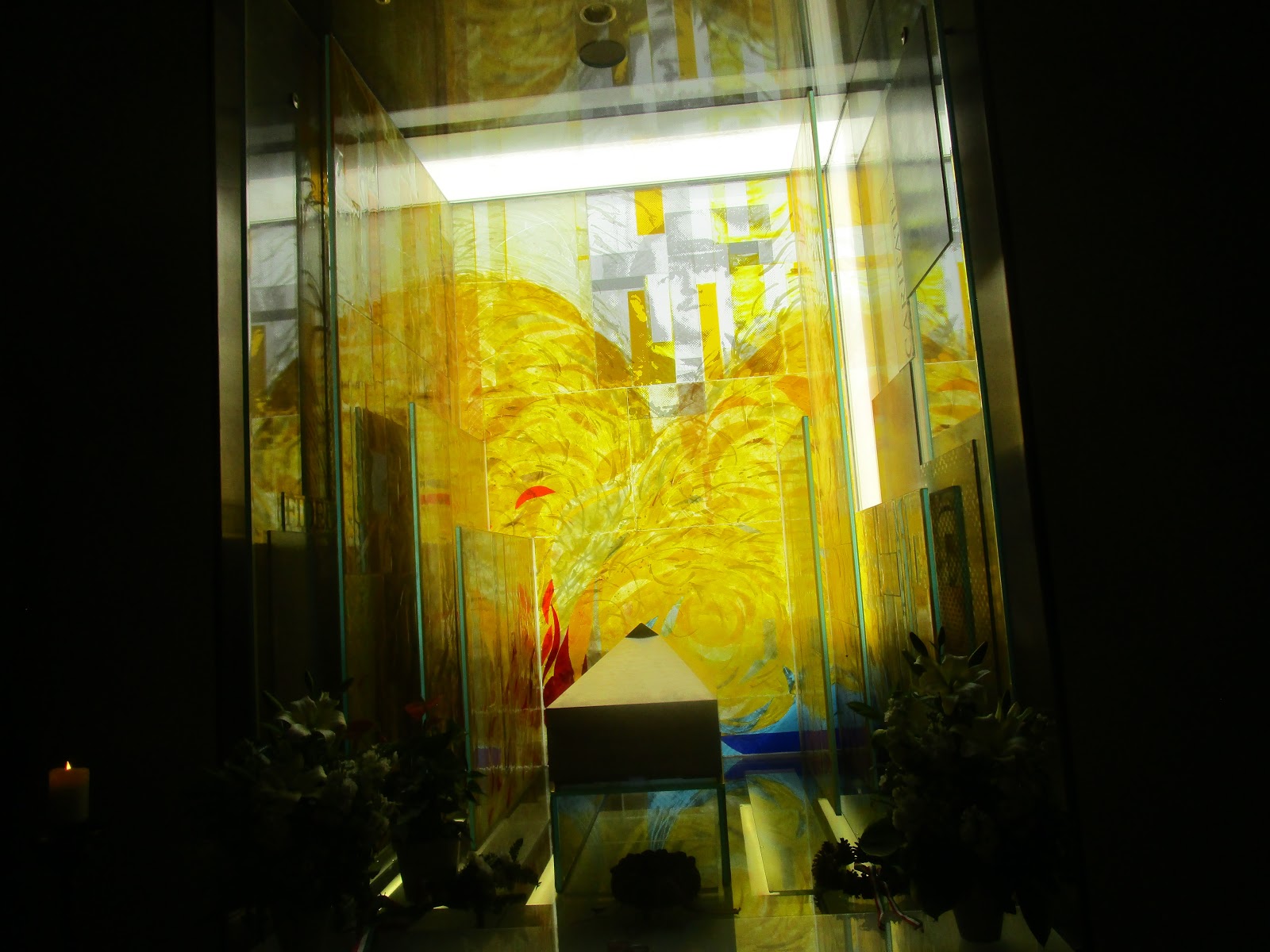
After the Burg tour I attended the closing service for Corpus Christi at the Catholic Church. This was a beautiful ceremony. This service was primarily sung. The German dialect in this area is very interesting to listen to. Listening to this softer German accent was very soothing.
Other Religious Groups in Güssing
Most Burgenlanders are Catholic, but Protestantism did penetrate the area early on. One of the Batthyany overlords converted and became Protestant adding acceptance of that form of Christianity. Below you can see a Protestant church building in Güssing.
This church was built in the 1980's, but the congregation was established in 1783.
There is also a Kingdom Hall located on the same street in Güssing. The Jehovah's witnesses have apparently made converts here.
A Return to Inzenhof Day 3
I returned to Inzenhof the next day again via taxi. I asked about buses at the Rathaus. There was a bus to Inzenhof that day, but no bus returning to Güssing. The only bus headed to Inzenhof left around 1 pm. Lucky I could take a taxi and start my journey earlier because a thunder storm rolled through late in the day, after I left.
What caught my eye in the center of the Village of Inzenhof was the Gasthaus Kurta, since my great-grandmother was Maria Kurta. I'm actually related to the Kurta family at least twice. If I could trace the family back farther it may be more?
The Gasthaus Kurta is a place where local villagers can socialize.
The sky was mostly clear when I arrived in Inzenhof, but there were clouds off in the distance. I enjoyed the beautiful morning weather walking through the entire village. Looking at the surviving houses and farm structures some appeared to be newer and some could be quite old based on the state of deterioration. It is difficult to date buildings by eye because the same building techniques were used until fairly recently. Most structures were made of brick with a coating over it, which looks like plaster. The earliest roofs were thatched, later replaced by red tile. The newer buildings appear to be made of concrete blocks.
Soviet occupation of Burgenland after WWII led to stagnation of the economy. Poverty likely preserved some of the pre- WWII structures, and led to continued use of old building techniques, and preservation of old ways of life. A definite change to more modern styles can be seen immediately after the Soviet occupation ends.
I was surprised to find a newer war memorial in Inzenhof. Not the one I had a picture of?
The house behind house number 55 is very interesting. It appears to be fairly old and has a rusted manual water pump. Next to the old pump is modern water spigot. Many people continue to use the old manual pumps to water their gardens, but this particular pump is likely older than some of the others. I'm wondering if the current house number 55 is a replacement for the older house behind it?
House number 55 and its older neighbor are built in the traditional Hungarian style common to what used to be Western Hungary. The houses were long, not compact like the Northern Austrian Alpine style houses. Recently Swiss chalet architecture seems to be becoming popular in the area. Also western style homes with attached garages can be seen here.
I spotted a couple of what I thought were old outhouses.
I thought a bread trunk was going through to village the day I was there. No it's actually a meat truck, for those who may not go into Güssing very often to buy groceries.
Inzenhof residents still erect the traditional Maypole. I'm glad I arrived the end of May and the first couple days of June so I could see the Maypole.
Burgenland has fully integrated into Austria culturally. They may retain some traditional customs, but the culture is now predominately western and Austrian. American music can be heard playing all around the area, even though few Americans visit here. The family ties of the area to America are strong, maybe that's the reason why American popular culture is found here? The Austrian bicycle culture has found a home here too. Sadly cigarette smoking is common in Austria where cigarette machines can still be found.
Back to Güssing
I was pleased to find a phone booth in the town of Güssing. I think phone booths are a good thing. Not having them forces people to spend money on cellular phones, like it or not. I've forgotten my phone, and can't always find a place to charge the phone. Phone booths are handy if you are caught without a phone in a emergency.
There is a great deal of signage around Burgenland so getting around isn't that difficult.
Sign of pride for a local woman made good at the Winter Olympic games
"They will not replace us," isn't a chant ever heard in Burgenland or Inzenhof. The man showing us around the village was from Germany. Some distant cousins still live in Inzenhof, but many village residents fled poverty in the late 19th and early 20th centuries relocating to America, Canada and wherever they could find work and were allowed to settle. My own ancestors were brought to that area to replace the population decimated by the Ottoman Turks invasions. The local aristocracy, the Batthyany relocated peasants from other areas to inhabit this land and pay rent to them as tenants.
The residents of Inzenhof weren't always struggling to the point of leaving the area, and not everyone was driven to flee the area during economic downturns. Many Inzenhof residents did migrate to America. In 1910 ninety-eight of the 673 residents of Inzenhof were residing in Copley, Pennsylvania. This depletion of the population continued through population losses due to war, and the decline of farming as viable occupation. Residents also relocated to Vienna and Graz.
The current population of Inzenhof is now around 338 people. The smaller population reflects the early out migrations, and the fact small farms are no longer as sustainable in Austria as in the past. Smaller family size is also a factor, my Kappel great-grandparents had 11 children, which is practically unheard of today. Many new surnames can now be found as people from other areas of Austria, and the European Union, have made their homes in Inzenof. The new residents have likely been drawn to the area because of its quiet charm, and lower cost of housing.
Time to say goodbye for now
I was in Burgenland from Wednesday to Saturday. I left for Graz Saturday afternoon where I continued sightseeing until my flight back on Monday.
I took taxi Roni to the train station in Fehring which is about 24 miles away from Güssing. From Fehring one train takes you to Graz, unlike the 3 trains to Alsoronok from Vienna. It costs more for a taxi to Fehring, but the trip by train is faster, only requiring one train. I would probably fly into Graz when returning to the area, and take the train from there.
My fondest memories of Burgenland. Austria:
The cute villages with their mostly one story Hungarian style houses with the church steeple dominating the view
The church bells echoing through the villages and hills
The beautiful woods
The firewood stacked everywhere
The rolling hills
The flowers everywhere. Both garden flowers and wildflowers. I love flowers and people who love flowers
The lace curtains popular in the area
The charming old Burg and other historic old structures
The cafes in the town of Gussing and the great gelato
The sound of the farm animals, and thunder, echoing through the isolated valley of Inzenof
The beautifully maintained Village cemeteries
The swallows. I've been to San Juan Capistrano where the celebrated swallows are said to return every year. I've never seen one swallow in Capistrano. I saw hundreds here
I saw one stork which was quite beautiful! That is one large bird. I bet they can deliver 10 lb babies. I also saw stork nests
Seeing my uncommon family names such as Kurta, Hamerl, Muik, on signs around the area was a big highlight. I'm happy to see these families still flourishing in the area providing gardening supplies, photography, and a gasthaus to the local area; these families have been able to make a living and remain in the area.
I'll will always have fond memories of my visit to Burgenland. I really hated to leave, but I do hope to return.
If you'd like to see a slideshow of my Trip to Inzenhof at youtube I've provided it below (under that one is a slideshow of my nearly 3 week trip through southern Germany and Austria ending in Graz):