Friday, July 26, 2013

Locating Our Families Old World Origins with DNA

I've been buried deep in Haplogroup research since my cousin's DNA results came in last Friday. Eupedia has been the best resource for finding maps and explanations of the origins of Haplogroups. I've also been looking for test results posted by distant cousins of some of my other lines using the Family Tree DNA surname projects. I found a number of surname groups for family surnames at Family Tree DNA. I had forgotten how to see the results at first. I then remembered you have to use the menu in the bar near the top of the page. I also Googled to find more family surname projects. I managed to find a few outside Family Tree DNA.
I was able to locate DNA Y results for several family lines including Melvin, Owens (which I already had), and Callahan. There were also groups for the Browning surname and Wray surname.
R1B and L21 Maps
All of the Haplos I located were for the most common Haplogroup R1b. My Callahan distant cousin had some deep clade results, meaning many SNPs were tested to narrow the families place of origin. His terminal SNP was L21. It's difficult to narrow R1b results without extensive SNP testing. If more SNPs are found then the area may be able to be narrowed further. It does look like this SNP L21 is highly concentrated in Ireland, and constitutes about 90% of  the male population in parts of Ireland. Some call it a Celtic clade?
We were lucky on our Forgey side because the I2 M284 L126 Haplo is far less common. I2 is found throughout Europe. The sub clade M284 is most common in the British Isles and probably originated there 3,000 years ago according the Eupedia. The terminal Haplo L126 is centered in Scotland and Ireland, and probably originated in Scotland according to some sources.
Depending on the rarity of a Haplogroup and related SNP's it is possible to narrow down an old world ancestral location.
Forgey Family Ancestral Haplos

Wednesday, July 24, 2013

DNA Testing Companies Database Sizes: How many people in their databases?

The Genographic project has a counter on their homepage 

I've have been curious about the total number of people who have tested with the major genealogy testing companies. It's difficult to find these numbers at most of the company sites. The numbers are important because they will affect the number of matches you'll get, and your predicted Haplogroup. Here are some of the numbers thrown out by the major testing companies:

  1. Family Tree DNA has sold 300,000 kits as of Saturday July 20, 2013
  2. As of May 2013 23 and Me sold about a 250,000 tests (their goal is 1 million by year's end)
  3. The National Genographic Project has 600,000 DNA samples as of June 2012
  4. DNA Tribes makes reference to comparing your results with 560,0000 people but doesn't say whether all these people purchased kits through their company?
  5. Haven't found any numbers for Ancestry.com
After researching all of these DNA companies I've come to the conclusion that the The Genographic Project offers the best most accurate DNA testing, which tests Y, MT, and Autosomal DNA for $200. You get much more for less money testing here. You get your deep clade at no additional cost. Deep Clade testing helps narrow down your ancestral ethnicity. Since the Genographic Project is affiliated with Family Tree DNA you can transfer your results to Family Tree DNA for free. With the size of the database and their advanced testing the Genographic project is the most reliable test available. 
I wish all of the testing companies would provide the numbers of people who have taken each of the tests they offer, so we can get a better idea of the size of the comparison pool. 

Saturday, July 20, 2013

Hurray! I confirmed I'm a member of a persecuted minority!

The passenger list for the SS Vaderland which sailed out of Antwerp to the Port of New York in 1909.
My Grandfather Rudolph is 10 months old and is returning with his mother Maria and siblings from a trip to their Grandfather Kurta's house.

For years some family members have been in denial over possible Jewish origins. I was told by my Grandmother Kapple not to worry, she looked it up and we weren't Jewish (but she also told me to get married and get rid of the "Jewish" surname). I guess there is good reason to worry about possible Jewish ancestry considering still present anti Semitism, and centuries of persecution. I really have wanted to know for certain whether our family had been Jewish at some point despite the burden of having connections to a persecuted minority. 
My Aunts with my Grandfather Rudoph Kapple
My first step in trying to find our Kapple family ethnic roots was taken after reading the book 

My Sixteen: 

A Self-Help Guide to Locating Your Sixteen Great-Great Grandparents, by Robert W. Marlin . After reading that I got a clear idea of how to proceed with my research. Using Naturalization records for my Great-Grandparents I found out the name of the village they came from. Searching the Internet I found the Burgenland Austria, Burgenland Bunch, genealogy website. My ancestors' village was in the groups area of specialization. Their website gave helpful tips on researching in that area.  They pointed me to microfilm available through the LDS Family History Library. I ordered Catholic Church records and Jewish Records. I didn't find my family in the Jewish records like I expected. They did appear in Catholic Church records for 100 years. This really puzzled me. Many of the names I found in the Catholic Church records for Ronok Parish, where my family attended church, contained surnames associated Ashkenazi Jews. I figured that my family likely converted to Catholicism, and many of my collateral  families likely did too. 
So I was stuck for a dozen without any proof regarding the true ethnic origin of my family. I got involved with a DNA project for my Forgey family a couple years ago at Family Tree DNA (by the way, congrats on selling their 300,000 test kit today!). I hesitated testing my Kapple side because I was afraid the results might be inconclusive. A few weeks ago I finally bit the bullet and asked my cousin Darryl Kapple to test and he happily agreed. We just got the results yesterday and it's obvious the family does have Jewish origins (at least tracing strait down the Kapple male line). My cousin tested as Haplo group J2 M178. This is a fairly common Haplo group among the Jewish population (although some non Jewish groups in the Mediterranean also carry it). This along with other clues would point to a 99.9% probability of Jewish ancestry.
An as yet unanswered question is whether the family was Ashkenazi or Sephardic? My cousin had one match of Portuguese origin, another of Spainish origin, another of Italian origin, and the fourth was Swedish. These were all perfect matches at 12 markers. I will need to upgrade to find out if they remain close with more markers.
So at this point the 12% middle eastern in my Autosomal results looks like it's Jewish. I'm waiting for MtDNA results which will hopefully come back next week.
All of this is a very appropriate way to mark what would have been my late father Robert Kapple's 80th birthday today, July 20, 2013.

Thursday, July 11, 2013

Hanging Out the Zirkle Dirty Laundry


Witness List Zirkle Case
The Zirkle Family Home
Like many families the Zirkles had their share of dirty laundry which was aired in court in early 19th Century Shenandoah Valley, Virginia. A full accounting of this court case can be found at Virginia Memory. It is comprised of 57 pages, which include 4 wills made by Lewis Zirkle, and the testimony of friends and neighbors. Some members of the Zirkle family came away better off than others in his last will. Changes in his wishes at the end of his life were construed by some as resulting from coercion by those living with him in his household.
My own ancestor Mary Eva Roller, Lewis Zirkle's daughter, seemed to make out better in his first wills. She would get less than 50% of the money she would have received in his first wills in his final will. You can see her declining fortunes here:

  1. Exhibit A. Will dated May 21, 1806 Will Mary Eva Zirkle/Roller received 130 pounds current money
  2. Exhibit B. Undated Will  the same Mary Eva receives 130 pounds current money
  3. Exhibit C. Will dated 1812 Mary Eva's fortunes are somewhat on the decline she now receives 110 pounds
  4. Exhibit D Will dated 10 July 1814 Mary Eva now receives only 24 pounds?


Many of her other siblings saw a similar decline in their inheritance. This spurred them to file the court case to  "break the will". Lewis and Daniel Zirkle were given the bulk of Lewis Zirkle Sr.'s property along with their mother. They lived with him before his death and may have exercised undue influence over him?
To "break the Will" the family would need to prove that Lewis Zirkle Sr. was incompetent to execute a will when the 1814 will was written. Both sides called witnesses supporting their side of the story (see image at the top of the page).
At the outset of the case the family didn't want to injure Lewis Zirkle's reputation (or their own)
so the original complaint stated he was incompetent due to illness. Later it came out that he often drank Whiskey and was sometimes drunk. Here is some of the testimony:

All of those testifying agreed that Lewis Zirkle was "fond of drink".  But they also agreed he stayed away from transacting  business when he was drinking. 

According to this Lewis Zirkle was in advanced old age when he died. He was debilitated in mind and body.
This man thought he witnessed a possible "fit" which would point to ill health.
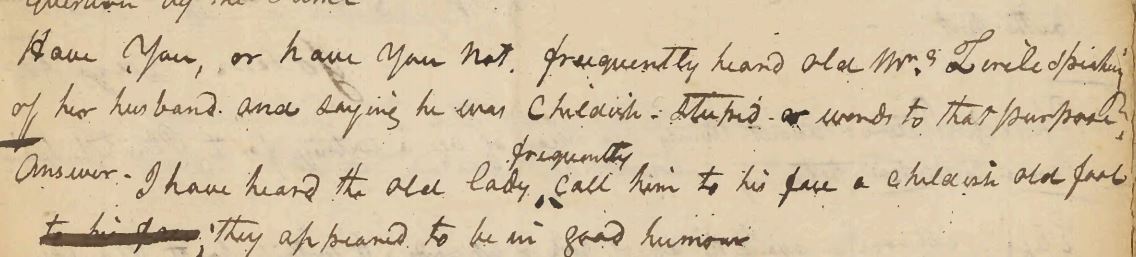
This testimony seems to speak to the issue of bullying. Son Daniel refuses to help his father Lewis, and calls him a childish fool
This testimony states Lewis' wife Mary Magdalene also called her husband Childish and Stupid, but in a playful way
More testimony by a defense witness that the Mrs. Zirkle would tease her husband in a "romancing way".
Here is prosecution testimony demonstrating that Lewis Zirkle could be bullied by his wife. This person had to screen him from her.
According to this Mr. Zirkle was worried about his will being broken before his death.
This witness said he offered a donation of $50 to break the will because it was an "unjust will".
According to this testimony Mr. Zirkle was a kind father but his children did not altogether obey.
According to Mr. Zirkle's Reverend he seemed to be sensible right up to the time of his death
According to this testimony Mrs. Zirkle ruled over Mr. Zirkle.
According to this witness Mr. Zirkle would give in to his family to avoid trouble.

Some of the witnesses may have had conflicts of interest. At least one purchased land from Daniel Zirkle from the estate, and might have to return it if the will was broken. It's tough to know who to believe without Lewis Zirkle Sr.'s testimony?


Wednesday, July 10, 2013

Don't White Wash the Past


Somewhat to Lewis Zirkle's credit he did free one of his slaves, George, and gave him some land in one of his wills
I have found that relatives have wanted to distance some of our families from the institution of Slavery. I was quite surprised when I first found my Forgey family's name linked to Slavery. I found Forgey wills in Tennessee naming slaves as part of the family property. My family had been in the Midwest for so many generations that our family didn't have any memory of slave ownership in our family.
Here Lewis leaves a Mulatto boy to his wife
My cousin Nan Harvey found more family related documents at Virginia Memory for our Zirkle family. This Palatinate German family settled in the Shenandoah Valley of Virginia in the 18th Century. The documents Nan found relate to a court case to set aside the will of Lewis Zirkle (husband of Mary Magdalene Roush).  Lewis had made 4 wills during his lifetime. Several references to slaves can be found in these documents. Only 3 slaves are named but he seems to allude to even more? It's interesting that Roush family historians stated Johann Roush, Mary Magdalene's father, was anti slavery. I've found no written evidence that he was against slavery, and felt that this was wishful thinking on the Family Historian's part. The fact that his daughter was a slave owner makes me tend to think her family wasn't actually against slavery. I had thought myself that German Lutherans might steer away from owning slaves so I was surprised to find they did in fact own slaves. Slave ownership was much more widespread than many would like to believe. Even those who didn't own them would sometimes lease them.
Closing our eyes to slave ownership in our families is a shame. I think looking at this terrible episode in our family history can make us more sympathetic to plight of oppressed peoples, and should make us more humanitarian. I personally try to vote for those who support equal treatment for all.


Here Lewis leaves his slave Margaret to his wife

Alluding to Slaves not named

Monday, July 1, 2013

Old Search at Ancestry Better for Slow Internet Connections

One reason why I liked Ancestry.com's old search is because you could get to a scrolling menu when you clicked the record catagory in the browse records side bar. Scrolling through the records is quicker than clicking through pages of lists. If you have a slow connection you don't have to wait for the pages to load. Sometimes I have a quick internet connection and sometimes it's slow ( very slow lol).
It's not that big a deal but it was nice! It's still easier than microfilm lol.


Scrolling Menu

With New Search you need to click View in Card Catalog, and you need to click through  a number of pages to see all records


Wednesday, June 26, 2013

A 2006 Letter from Ireland I Cherish!


The anticipation that comes from waiting for DNA results can be overwhelming LOL. I am currently waiting for results from a Y DNA test and a MtDNA test. I'm also waiting for the Gedmatch site to catch up with their backlog so we can do more comparing of results. In the mean time I am doing more scanning. Below is a cherished letter from a resident of my Great-grandmother's  townland, Pollaturick, in Ireland. I appreciate this person taking the time to write this and help me to confirm what I found in other records. The elderly are our greatest sources for information, as this letter affirms. The family of a distant cousin of mine had visited this relative, so they wrote her a letter for me asking about my family. This is in regards to my Mullen/Huvane  family. Some of the Huvane's use the alternate spelling Huane, as used in this letter.


Wednesday, June 12, 2013

Concrete Proof of Relationship

Jane Sharp/Rawlins statement on paper (somewhere?) naming her relations got me to thinking about our documentation for the Forgey family. What documents do we have for the early Forgeys directly naming parents, children or other relations?
The earliest mentions of the Forgeys in America would be on Tax Lists. The tax man (as today) seldom missed anyone. Land was cheap in early times so we find them in the deed records. Native American Warfare was a constant in early days so every male generally served in the Militia at some point so we find them in those records. Many of the 1790 Census records have been lost and Eastern Tennessee doesn't have Census records until 1830.
The above records were 99 percent male. Females would be taxed if there were no males over 21 in the household, and they were head of the household. The same held true for the Census.They could appear in Dower releases on deeds so they were better represented here. They were not allowed in the Military so never mentioned there.
The place where we find entire families listed are first and foremost wills and adminstrations. Second would be bible records. The third would be church records, and then County Histories.
Here is some of what we have:
Andrew Forgey of Hawkins County, TN names his family members
\

James Forgey of Hawkins County gives us info about his parents in his bible and names his children

Hugh Forgey Crawford names his Forgey Uncles and their children in a Journal he kept


Samuel Forgey of Rowan County, North Carolina's Children (James is also mentioned in the will)

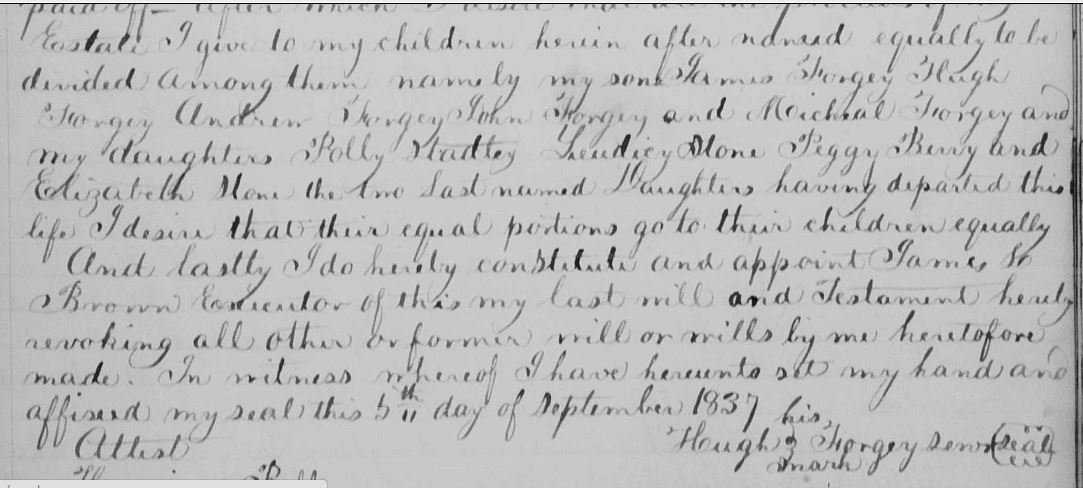
Hugh Forgey of Bourbon County, KY's  children in Will

This father son relationship is not clearly stated but assumed since they are together on this 1780  Cumberland County, PA Tax List

In 1785 we no longer see John Forgy we now instead see Widow Forgy

Here we have Robert Forgy of Mifflin and Mary Forgy of Washington County, PA. I assume they are  mother/ or stepmother and son

The John Forgey Family of Clark County, Ohio. I am no longer certain this is  Robert Forgy of Mifflin County, PA's brother?

Church Record naming Andrew Forgey and Elenor Randall's Children

Andrew Forgey's inventory contains his childrens names and wife's name

Alexander Forgey of Indiana Bible record

Andrew Forgey and Anna Roller Family as recorded in a Family bible


Monday, June 10, 2013

Analysis of a Family Tree Gone Wrong

A tear in Samuel Forgey's will is symbolic of the missing pieces we need to reconstruct  in the family history in general

Seems like when ever Nan has an autosomal DNA match we find a problem with the old version of the Family Tree. The old verison I'm talking about, mainly, is  the one that appears in Lucille Wallace's Forgy, Forgey in America. The book written in the 1950's contains a few errors due to the fact so much of the information about these families was not as easily accessible as now. So much is being digitized and easily searchable now old trees are undergoing massive revisions. The authors of the old family histories didn't want to upset families with short lineages and tried to make connections, where no proof existed, with older longer lines. You can see them trying to fit people, without proof of parentage, into existing lines. This is sort of inferential genealogy without enough foundation for a conclusion.
Nan had a low level Autosomal DNA match with a descendant of Elizabeth Forgy. When I took a look at her line I noticed some problems. Several trees posted online have Samuel Forgy and Sarah of Rowan County, North Carolina as her parents. A researcher named Bert Rawlins did extensive research on Jane Sharp/ Rawlins family (she was Elizabeth's daughter) and came to a different conclusion (this is a link to a PDF with some of Bert's research http://www.rawlins.org/bert.rawlins/frost.research.2007.pdf.
Our problem is who to believe?
  1. We have some believing that Samuel and Sarah of Rowan, North Carolina are Elizabeth Forgy/Sharp's parents.
  2. We have a statement on GenForum that Jane Sharp recorded the names of Elizabeth's parents in 1844 as John and Rachel Forgy
  3. At the same time in 1844 she recorded the names of two uncles John Forgy and Adam McPherson and two aunts, Jane McPherson and Rachel Forgy.
  4. The researcher Bert Rawlins came upon a GenForum post regarding a John Forgy and Rachel White. He recognized the fact that Jane's uncle Adam McPherson was married to a Jane White (a maybe sister of Rachel?)
  5. Elizabeth Forgy was married to Robert Sharp who appears with Adam McPherson in Washington County, PA in the late 1700's, and is found with him later in Bourbon County, Kentucky. This may link  Elizabeth's family with the family of Hugh Forgey and Sally Evermen who were also residents of Bourbon County, KY
  6. We then see an Adam McPherson with a John Forgy in Clarke County, Ohio in the early 1800's. They both belong to the same Presbyterian Honey Creek Congregation in New Carlisle.
  7. On the flip side, in support of Samuel and Sarah as parents, a Sharp was named in Samuel Forgey's will
  8. Samuel and Sarah did have a daughter named Elizabeth as recorded in Samuel's will.
  9. Elizabeth named a daughter Melinda. A named used in Samuel Forgy's family
  10. After Samuel's death his family did migrate from North Carolina to Kentucky
If John Forgy is Elizabeth's father we find several in Pennsylvania who could be candidates. There is a John Forgy on the 1773 Penny Tax list for Lancaster County, PA. We know that the White and McPherson familes came from there. Hugh Forgey of Bourbon County, KY also originally settled there. We have a John Forgey who was naturalized on Westmoreland County, PA in the late 1790's according to an  Ancestry.com database. We also have a John who was a bondsman for Mary Forgey in 1800 Mason County, KY. We have another John Forgey who seemed to be a long time resident of Westmoreland County, PA. He first appears there in the early 1780's on Tax Lists and Militia lists (not sure whether this was the same man who was naturalized?). The John in Mason County may be the same as either the long time resident of Westmoreland or the one who was Naturalized in the late 1790's or a different person all together? Mary Forgy (probably widow of John Forgy of Mifflin County, PA) died in the early 1800's in Washington County, PA. I assumed that she may have went there with one of her children, and assumed it could have been a John? 
The marriage bond for Mary Forgey was for a marriage to John Everman. This would point to a connection with Hugh Forgey who was married to Sally Everman. Hugh did have a daughter Elizabeth. Could she have been named after his sister Elizabeth Forgy/Sharp?
We really need a copy of the 1844 document with the names of Jane Sharp/Rawlins relations.


Elizabeth named as a daughter of Samuel

A William Sharp is mentioned in Samuel's Will

Could this Elizabeth named as a daughter in Hugh's will be a namesake of Elizabeth Forgy/Sharp?