Monday, July 30, 2012

Book Sale Bible Update


Whittier Public library book sale


Uinta Chieftan November 3, 1883, page 3


Glad to have heard from a person related to this family. So glad to get to additional info on this family from them. After picking this bible up at a used book sale at Whittier Public Library's store I had wondered who the family was? There are no surnames listed in the bible. I was only able to find the surname after the US Census was posted on the Internet. 
Wyoming Territory sounded so isolated I wondered if this family had much support when their first child died only a few weeks after his birth? It was nice to see later children survived infancy. The Uinta Chieftan obituary did mention the support of friends. Evanston was not as isolated in 1883 as I was thought. His father Victor Engstrum was born in Sweden and  was a Jeweler and involved in the cattle business. 
If you would like to know more about this family Find-A-Grave has more info. Godfrey's Tombstone and info http://www.findagrave.com/cgi-bin/fg.cgi?page=gr&GRid=40221242
Father Victor's Tombstone and info http://www.findagrave.com/cgi-bin/fg.cgi?page=gr&GSln=engstrum&GSfn=victor&GSiman=1&GScid=225471&GRid=40221244&


Below is the entire family record as recorded in the bible.
Presented by Mother to Victor in 1880


Thursday, July 26, 2012

How Much Space Do I have left in the Free Cloud?


After two days of syncing space in the free cloud it's filling fast. I would like to save space for the future so I am going to start slowing down syncing. I have been syncing the most import things first. Personal pictures are the most important and hard to replace so they are uploaded first. Hard to replace documents second, and so on. I have to figure out which videos to save first because they take up lots of space. My videos alone take up a little over 5 GB.
I am using 73% of my Drop Box space and 53% of my Google Drive space without the videos. It looks like I can't save videos to Skydrive. So I will have to divide them between Drop Box and Google Drive.
I am finding the syncing is going slowly and it's best to upload one file folder at a time. It would cost $9.99 a month for me to buy additional space at Drop Box, which I don't want to do.
I started moving things to Drop Box a year ago. I should have been updating it as I got documents I wanted saved to the cloud. It becomes confusing if you wait and later forget which files you already uploaded. I started fresh with Google Drive which is now the most complete backup. Moving everything on your computer to the cloud can be time consuming but worth it when you think of the time it would take to replace everything or losing things which can't be replaced.


Wednesday, July 25, 2012

What to keep and what to toss? My cluttered Cloud


I tend to like to hold on to things. My father used be the tosser/organizer in our household. He would sometimes get carried away and toss important stuff. I on the other hand would keep too much stuff and the important stuff would get lost in it all. I am trying to find a happy medium between these two extreme styles. I've quickly filled up my free cloud storage at Google Drive and Drop Box (I am now going to open a Skydrive account at Microsoft for additional storage). I don't want to pay for cloud storage I would rather put that money towards other things. Over the years even a small cost adds up.

I've been catching up on my backups to the cloud. Doing this I've noticed how bad my computer filing has been and how inconsistent I have been when it comes to putting things in the right folder. So I am cleaning up  sweeping out and reorganizing as I go along. What I am discovering as I go along is:

  1. I should try to limit the number of folders I have because that it over complicating my filing.
  2. I should toss duplicates because I am backing up to several places anyway.
  3. I need to keep the collateral information separate I have some merged with my own line.
  4. When it comes to backing up first save what can't easily be replaced ie stuff that's not already stored in digital form on a reliable site like Ancestry.com or Family Search where I can access again.
  5. All my important documents linking generations need backing up no matter how easy I can replace them.
  6. Name my files appropriately so they will come up in my searches. I sometimes download and don't name something or give the file an obscure and can't find it again.
  7. I should backup any new document or photo I get immediately, otherwise, I will forget later whether it had been backed up or not. I don't have enough space to back up everything over and over.
The advice given on "The Hoarders" show regarding keeping and tossing can also apply to my digital files. Can this info be easily accessed again? Is it irreplaceable? Do I really need to keep everything I've collected over the years? I am finding that some things can certainly go without compromising my research. The Free storage offered by most cloud services is actually more than enough to keep my important stuff. It's just going to take me some time sorting out the important stuff. I feel like one of the Hoarders not wanting to part with anything and wrestling with every file I have. I am starting to let go slowly.
Thinning the volume out is going to help me focus and find what is most important. I won't get a headache every time I open my genealogy folder.

Friday, July 20, 2012

DNA Progress Report Update


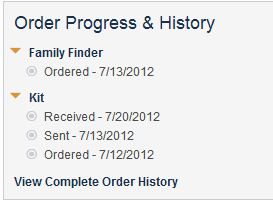
Checked Family Tree DNA and found out my kit was received today! I think this is interesting because today would have been my father's 79th Birthday.  I mailed it from California on Monday. Hopefully being checked in on my father's birthday will be a good omen!


Beginning My Autosomal DNA Journey

Kappel Cousins

I took advantage of the recent sale at Family Tree DNA to order an autosomal DNA test. This test generally does not track as far back generation wise as the Y and Mt DNA tests.  It can, however, on occasion capture a distant relationship. The reason for this is Autosomal DNA is non sex linked DNA which is divided into smaller and smaller segments as it is passed down in the family. Everyone inherits half of their parents DNA. This half can be scrambled in any way. So siblings would inherit different segments. We all have small fragments passed down from previous generations. As DNA is passed from generation to generation many segments are lost. So traces of our earliest ancestors can no long be found in our DNA. This test is very accurate going back 3 generations, and occasionally there is a small fragment which can lead us back to 5 generations and little beyond.
Forgey Cousins
I received my test kit in the mail a few days after ordering it. I was so excited about it that I tested the very day I got it. I was a little surprised that the scrapper was so abrasive on my check that it caused irritation and bleeding. You have to suffer for your family history sometimes. It was very easy all in all. I did have some difficulty ejecting the scrapper into the vial. It took a few pushes to finally get it in. Everything else was easy because an addressed envelope is provided with the kit.
Now it's just a waiting game. I went into the site and provided them with all the info I know about my ancestors in the form of a gedcom file. They also wanted to know the name of my earliest male ancestor on my father's side and the earliest female on my mother's side. They are Andreas Koppel b. 1780 and Elena Gracia who I have no additional info on.
The fact I don't have any stats for my Great-Grandmother Elena points up the problem with several lines. Loss of records and the inability to gain access to records in Nicaragua has created a brickwall nearly impossible to breakdown. I also have a difficult brickwall for my Great-Grandmother Helen Mullen-Mason in Ireland due to record losses. DNA may be the only way to scale these brickwalls.
Another problem on my father's Kappel side is loss of contact with most of his uncles, aunts and cousins. This has left a serious gap in my knowledge of that family which has been a complete mystery to me since childhood. I had heard many stories about my mother's family, but few about the Kappel family in Chicago. I had wondered whether the family was Jewish? I had heard this talked about at my childhood at family gatherings. We were Catholic so the Jewish side was mysterious to me and I wanted to know more about them. There seemed to be a complete backing away from this side of the family due to possible Jewish origins. The sad history of the Jewish people causes many to turn their backs on Jewish heritage in their family. It's too painful for some to deal with. I didn't want to turn my back on this possibility. I wanted to know how the Holocaust may have affected our family in Austria? I was not able to get any answers until recently. I am hoping my DNA test will lead me to a greater understanding of the origins of this side of my family. I have no pictures of my Kappel Great-Grandparents and would like to make contact with a cousin who might have some? Above is a chart showing my current knowledge regarding cousins in this line. As you can see there were 11 children and I only have data for a few. Contrast that with my Forgey family where my knowledge is complete. Even more striking is the nearly complete lack of any knowledge for my grandmother's family owing to the near impossibility of getting anything from Nicaragua, and my young when my grandmother died.
So this DNA test has the potential to expand my family history in many ways. My ethnic breakdown will be as interesting as finding new cousins.


Wednesday, July 18, 2012

Euros For Ireland & "The 1766 Religious Census"


The 1766 Religious Census is an important source for Irish research. It actually covered a very small segment of the population, but because of heavy record loses in Ireland is important to consult.  It looks like my ancestors were part of the lucky few recorded on it. Only a transcription is available at ancestry.com. The original is housed at the National Archives in Dublin. Many of the original pages are missing. I lucked out again in the fact that Creggan Parish lists survive.
I decided it would be best to have a copy of the original. It is always important to use the best source which would be the original. When I tracked down the location of the original at the National Library I sent an email  to them requesting instructions on how to order a copy and the cost. The cost was reasonable $3.30 or 2.60 Euros. I forgot to ask about what form of payment would be acceptable to them. Since it takes a while to receive an email reply I used some credits at Google Voice to call them. Had a little trouble getting the call to go through. I found out you have to leave out the city code in the number. I was told a bank draft in the form of Euros or an international postal money order would be acceptable. I was also directed back to their website where there were similar instructions ( I could not find this page when I looked the first time).
These instructions seemed reasonable and doable. I immediately consulted the US Postal service website to find out how to go about getting an international money order. I soon found out that these money orders could only be cashed in a few mainly third world countries. I Ireland was not on the list of countries which accepted these. So I then turned to my bank asking if I could get a Euro Bank draft. The Chase customer service person was very confused by my request. After waiting on hold a few minutes I was told that a cashiers check would be the same thing. No actually it would not. The Archives wanted payment in Euros and the cashiers check would be made out in Dollars. I contacted and visited several local banks asking about how I might be able to get Euros to Ireland at a reasonable price. I had been told about electronic transfers which were expensive, over $40. I was not willing to pay over $10 to get a record which cost $3.00 or 2.60 Euros. No one had any idea how to do that. One person did think that a regular money order could be easily cashed in Ireland, and should not present a problem for them.
This was not as easy as I hoped it would be. I did want to comply with their instructions and get some Euros over to them. I thought maybe I could just send the Euros in cash which I could buy at the bank. I didn't realize that anything under 5 euros would only be available in coins not paper money. I could have sent 5 Euros but they may feel obligated to return my change, or just not accept it at all and return it to my. The fact that the cost was so small was actually presenting problems at this point.
I did finally discover that Well Fargo had an international division. I found out that it would cost $30 to get a Euro draft from them and I would have to open an account with them. I would loved to leave Chase bank, which I hate, but $30 was out of the question.
I decided to go the the recommendation just to send a regular money order. If they accepted it that would be great, if not there was nothing else I could do.
Happily they accepted the payment and I received a large envelope from them yesterday. I got much more than I expected. I was just requesting one page, but got 7 legal size pages for all of Creggan Parish.
What immediately jumped out at me is the fact I had the County wrong. Most of those listed were in Armagh. I thought my family was in Armagh. The Forgey and Reynolds families both were located in Louth. They were among only 33 Protestants residing in Co. Louth. The other nearly 1000 people were residents of Armagh. They have these 33 people misidentified as living in Armagh at Ancestry.com.
Sadly the exact townland they lived in is not recorded. They lived in an area described as Five Towns. No one is certain which towns were being referred to? They could be any of the 10 townlands in Creggan Parish Co. Louth.
I also don't see any other Forgeys or Reynolds amongst the nearly 1000 people on these lists. So we have a James and Andrew Forgy and Hugh Reynolds. I might deduce that the Forgy family came from Co. Down where the name was more common, and only fairly recently to 1766 migrated to that area.
Reynolds family researchers found marriage documents for their family in Dundalk Co. Louth. These families likely lived near Dundalk. Lease records may provided more info on these families.


Monday, July 16, 2012

Good Excuses for Not Indexing the 1940


If you need a reason not to index the 1940 Census anymore here are some deemed acceptable:

  • Actually I have been diligently Indexing but my Cat or Dog keeps hitting keys on the computer and deleting all that I have done.
  • My internet has been down.
  • My computer isn't working.
  • My cat or dog sleeps on the keyboard and I can't use it.
  • I can't find my keyboard because of the stacks of genealogy paperwork on my desk.
  • My family hogs the only computer we have.
  • My family wasn't in this country in 1940.
  • This project is full of idiots who can't read even the best handwriting and I don't hang out with idiots.
  • The arbitrators are unfair and I am on strike. 
  • Low scores on my indexing has hurt my self esteem I am seeking therapy.
  • This whole project has gone on longer than I expected and my attention span is short.
  • The handwriting is too difficult to read.
  • I have actually been working at a paying job to feed and shelter my family (I can't miss Phineas and Ferb during my off hours either)!! 
  • I don't do anything for FREE.
  • I've found my family so I'm OUT.
  • Doing my own genealogy research is more fun.
  • This Indexing thing isn't working out for me (sorry can't be more specific).
  • This Indexing stuff looks and feels like real work! I am allergic to real work and break out in hives.
  • Just plain BURNED OUT!! I've indexed over 50,000 records and I am ready to snap! (this is the most acceptable excuse)

Saturday, July 14, 2012

Early Transcribers Preserved Records Later Lost

The Irish religious Census and Quebec Tanguay records are examples of how early transcription preserved the contents of records later lost. Anyone with ancestors in Quebec or Ireland should be grateful to these 19th century genealogists who transcribed  records in these areas. 
Father Cyprien Tanguay was a Priest and Genealogist. He was born in 1819 and died 1902. He was appointed to the Dominian Statistics Department because of his interest in the records kept there. He spent many hours consulting these records and compiled  "Dictionnaire généalogique des familles canadiennes françaises depuis les origines de la colonie jusqu'à nos jours" a set books containing detailed family trees for every early settler. I am lucky he transcribed the records for St-Augustin Quebec because many of the pages are now missing from the church records. Sometime between the late 19th and recently someone removed whole sections from the church registers. When Ancestry.com offered free access to Canadian records a couple of weeks ago I took that opportunity to collect some family records. That is when I found out the St-Augustin book was butchered. Most of my family pages were missing. When I laid out everything I had as far as connecting generations in the Martin family I recognized how indebted we should be to Fr. Tanguay. His transcription is the only way we can bridge the gap between records. I've posted all of my relationship proof records here https://sites.google.com/site/forgeyfamilies/mason-to-martin-1624 You can see where the missing records are and Fr. Tanguay records fill the gap.
Another person I am indebted to is Tenison Groves. He copied many records which were later destroyed in the Four Courts Building fire during the Irish Civil in 1921. He was a professional genealogists whose reports now form a very important record source in Ireland. He transcribed the 1766 Religious Census of Ireland (see right) We believe that Andrew Forgey and Hugh Reynolds are our ancestors? Few original pages still survive making this an important document collection. It's one of the few surviving sources of family info during that time period; and the only source for some areas.
We are also indebted to an unknown family member who was doing Mason Family research in the early to mid twentieth century. I believe it's a she? The distant cousin who provided me with the copy of the handwritten family history didn't know who actually wrote it or when? A small example of the writing is right. Who ever wrote this did a wonderful job. Everything I've looked up is correct. This is very unusual because most of the family histories passed on to me have contained major errors. Ida Mason daughter, of Peter and Mary Mason, may have made this out but we can't be sure? We would have had a very difficult time locating the family in Quebec if this information had not been recorded. The person who put this together had first hand knowledge of the family location in Quebec.
The really Herculean efforts of these pre-computer age genealogists have provided us with valuable records, and family traditions which otherwise would have been lost.


Thursday, July 12, 2012

MyGenShare.com Beta Test Experience


I've really enjoyed the privilege of being allowed to use MyGenshare site during beta testing . I've just scratched the surface in the past few days. I have spent many hours looking over a wealth of genealogy information shared here. This is certainly a very important site for beginners. It will provide them with a great reference library and how-to articles. I've been researching many years, and I've pretty much read every genealogy book available at the many libraries in my area. I still consider myself at an intermediate level, and continue to pursue further education. I have picked up many great tips this week at MyGenShare. It's been a very fruitful experience. The books and many referenced articles contain helpful advice on every aspect of research. They also contain inspirational articles. The genealogy humor book series "Collecting Dead Relatives" and "Further Undertakings of a Dead Relatives Collector" are at the site. I've read those books so many times and never get tired of them. There is also a genealogy search engine, and link directory which is very extensive.
Some of the notes I made while using the site:
  1. Found a query placed by a Forgey cousin of mine in the 1960's in Everton's Genealogy Helper.
  2. Discovered that Scots-Irish was seen as a derogatory term. Ulster Scot was the term preferred by Scots who settled in Northern Ireland.
  3. When my Ulster Scot ancestors came to America the ship likely only had an approximate date of departure, so they would sometimes spend an extended time living and working in the port town. Liverpool was sometimes a departure port for the Ulster Scots.
  4. Ulster Scots often came over in groups led by a local preacher (you can also sometimes determine a place of origin if you know the date of emigration based on emigration patterns).
  5. Local histories are also a great source for Ireland.
  6. A majority of the felons transported to Virginia were non violent criminals. The transportation of  criminals to the American South during the Colonial period gave the area a bad reputation. These people often served their sentences as slave labor on tobacco plantations.
  7. I found an article about someone with a similar background who had European ancestors who settled in Nicaragua. I believe some of my ancestors were Germans who settled in Nicaragua. I found the research as difficult as the person sharing their story in this article. Did get some good tips. I will try to get a baptismal certificate for my grandmother, if it has survived all the disasters? 
  8. I also was reminded that deeds can be filed well after a person in the deed's death. Someone found one filed 110 years later.
  9. In order to own a piece of property you had to be over 18 years old.
  10. A lease record my be the only way to find out more about the Forgey's in Ireland. These records can contain a significant amount of genealogy. More people leased land than owned land.
  11. Landlords' personal records are a great source for Irish research.
  12.  Talk to members of the local historical society where my ancestors lived. They are the most knowledgeable about local families.
  13.  Between 1922 and about 1940 a woman could lose her citizenship for marrying an alien.

Friday, July 6, 2012

Free Microsoft Expression Software a Great Family History Tool!


I found a new toy! It's Microsoft's Expression Software. You can record your computer screen with it which allows you to make videos you can post on Youtube. You can make instructional videos showing your screen only, or combine it with other tools such as drawing and Movie Maker to make a creative Family History video.  Expression Encoder offers a free version which only captures your screen in 10 minute increments. You can work around this and make longer videos by combining 10 minute segments in Microsoft Movie Maker.
Here is a tutorial on how to use Expressions: http://youtu.be/gYhSo7U_CCg
This wonderful video at Vimeo is a great example of what you can create:  http://vimeo.com/30868456

I made this video combining a Google My Map with Movie Maker . http://youtu.be/glplJD6ujhA


Made this second one using Open Office drawing where I inserted the picture of the map and and picture of a little boat. I then added pictures at Movie Maker. I got the music from Youtube enhancements audio. I figure it's best to use their own selection. which is copyright safe. http://youtu.be/k1NrjhcG6nE

Saturday, June 30, 2012

Metes and Bounds Troubles


I finally have most of my metes and bounds deeds platted. I wondered whether the free Deed Platter actually gave a correct representation of my ancestors properties? Some turned out looking quite odd. Many did not close correctly, and some lines ran too long. In these cases I wondered whether they were measuring all the way to the central marker? Another possibility is they weren't taking into account the degree angles and just adding up the pole numbers?
I decided to use Open Office drawing to verify the plats I made from the free site. I found trying to reproduce these plats in drawing a little tricky. It takes a little manipulation to get the numbers exact. The degrees can only be estimated to the nearest degree, since only increments of 5 can be selected. This isn't really a big deal since the differences are fractionally small. I was able to reproduce them, and they looked the same. I entered one of Jacob Roller's deeds at the Deed Platter site last night. It actually closed perfectly! This also verifies that the site does accurate renderings of the deeds. If a deed does not render in a plausible way then the deed likely has errors.
I made a video for Youtube demonstrating some of what I've learned. I plan on ordering more deeds to get a better idea of where Hugh Forgey lived.

Tuesday, June 26, 2012

Plotting to find your Ancestors


 Plotting or platting your ancestor's land isn't as easy as it may seem. I had previously used Google Earth to locate my ancestors land grants in the Midwest. This does not work with the older metes and bounds surveys. The deed surveys I have for my early ancestors all contain measurements in poles. I found a free online tool to draw these plat maps for me. The site has some basic instructions. I did not realize that some of the coordinate numbers on the surveys were degrees and not poles. I eventually realized some the numbers referred to degrees when some of the deeds did start stating this fact. Here is an example:

 The example above demonstrates that degrees were sometimes not included as a part of the land description. You can infer degrees when see the coordinates phrased like the example above. They seem to always state it when they are referring to poles. So a direction with a number, another direction, and number of poles would mean we are dealing with poles and degrees. So the above would refer to a line running southeast at a forty degree angle 100 poles. You could draw this with a protractor or you could draw it with a drawing program which will calculate the angle for you. The easiest way is to use a program designed to do all this for you, when you enter the coordinates.

I looked all over the internet for answers to questions regarding metes and bounds deeds. I did find some great instructions at About.com. Unfortunately, it didn't answer every question such as that above. I looked at some videos at Youtube, and FamilySearch Wiki. I would like see a course at FamilySearch Learning demonstrating every step in the process of platting. I couldn't even find many platted deeds and descriptions posted anywhere. A video showing someone platting a deed on paper would be great too.

My primary purpose in platting these deeds was to find the approximate location of Hugh Forgey's property in Knox County, TN. I have a deed for his property and a couple of neighboring properties. One is a deed for a large 4000 acre tract which Hugh shares a line with. After platting this deed I now think Hugh's property could be a little south of Emory Road near Little Flat Creek. I was thinking it was North of Emory.  I need to examine this deeds further to be certain of this. I've found this project to be very rewarding. Seeing the online of ancestors' land brings you closer to them. It's interesting to reconstruct the area your ancestors lived in using neighboring surveys. The descriptions can be very vivid regarding the landscape too. You really get a better feel and appreciate for their surroundings when you do a project such as this.
Options for platting:

  1. Hand draw it with a protractor and compass
  2. Use a computer drawing software program  
  3. Use the free tool on the internet at  Deed Plat
  4. Buy a more powerful program such as Deed Mapper
You'll find more About.com Metes and bounds articles at FamilySearch Wiki.


Tuesday, June 19, 2012

Two brickwalls exploded today!


The Virginia Memory project and Nan's careful reading of these many page difficult to read documents is responsible! Thanks Nan!
I searched plaintiff and defendant names in the search boxes and forgot to do a general name search yesterday, and walked away thinking there was nothing else here.
This document confirms the inferred brother relationship between Andrew Forgey and Archibald Forgey. I also confirms that Ann (Anna) was the daughter of Jacob Roller. We had inferred that because one of Anna's sons was named Jacob Roller Forgey. I was never able to find a baptismal record to confirm this. Earlier I had posted that I was searching for Lutheran Church records in Rockingham and Shenandoah Counties Virginia. Now I can continue to trace the Jacob Roller and Eva Zirkle line with confidence.
This document also contains a great story about my Andrew and Anna family. According to document Andrew and Anna Forgey migrated to Indiana which is correct. This narrative then takes a wrong turn and describes them as migrating beyond the Rocky Mountains where they are murdered by hostile Indians? I am afraid not. The true story is they settled in Indiana. When Anna dies a decade after migrating to the area. Andrew then migrates to the Davenport, Iowa area where he remarries and dies of a stroke in old age. Andrew lived a very quiet life of farming. The Rollers should have been able to reach Hugh Forgey by letter because he continued to live in Indiana?
This is now definitely one of my most cherished documents!


Monday, June 18, 2012

Alex Forgey Found? A twenty year court battle


I wrote in my last post that Alexander Forgey went missing several times in his life. I wondered whether anything else would surface for this elusive man. Wonder no more because a great find has been made! Nan continues to follow the roll-out of new records at Virginia Memory. She found a case referring to Alexander Forgey as defendant in a recently added Augusta County, VA Chancery Court collection. This digitized record contains an 8 page summary of his case. It likely stems from the sale of Alexander Forgey's wife's dowry back to her father Samuel Meek. I guess there was continued haggling over who owned what? In this case Alexander states he was coerced into turning over property which had actually belonged to him. All this led to a twenty year quarrel over property in dispute.
Thankfully, this twenty year feud led to the creation of records for this elusive man. What we've now gleaned is that Alexander Forgey lived at least until the early 1800's. I had lost track of him after 1796. Court records confirm he was in court in 1803, and probably was also in court in 1807. Alexander had sold his property in January 1796. He no longer appears on tax lists after that date. I don't know if he actually continued to live there and was exempt from paying taxes at that point? He may also have migrated to Tennessee where he had family. The 1810 Census for Tennessee is missing; so he could have lived there and not been recorded on any records. Hawkins County suffered serious early record losses, which could be why nothing has surfaced there for him? Another possibility is that the Knox County, Tennessee property purchased by Alexender Forgey was actually purchased by the Senior Alexander?
There are concrete facts in the documents from which inferences can be drawn. Here is a summary:
  1. It seems like a forgone conclusion, after reading through this, that Alexander Forgey lived into at least the early 19th century.
  2. Jacob Anderson is said to have provided security for Alexander. Don't know if he is a relation?
  3. Alexander Forgey was awarded a judgement against Samuel Meek for $66.67 (a lot of money then).
  4. Samuel Forgey planned to appeal the judgement against him to the Staunton District Court in Augusta County, VA.
It looks like the court papers being digitized for Augusta County Chancery Court Staunton District are loose case files. I don't think they are digitizing the order books? So I am thinking that anyone interested in Alexander Forgey and his line might want to order the court order microfilms available for borrowing through the LDS Family History Centers. There are order books for both Augusta District and Staunton District. Here is a very interesting blog post regarding these records http://www.virginiamemory.com/blogs/out_of_the_box/2012/06/18/augusta-co-chancery-reveals-pioneer-stories-of-western-virginia/
If Alexander Forgey did not live to collect his judgement his heirs may have collected. So the court orders may contain the names of his heirs?


Saturday, June 16, 2012

WANTED!!! A. Forgey between 1775 & 1779


Alexander Forgey is one of the most elusive people I've researched. I have no idea where he was between the time he disappeared from Cumberland County, PA in 1774 and 1779 when he seemed to have settled in Washington County, VA. Also, I lose trace of him after 1796? If we could find his locations in these time periods we might be able to find a brickwall breaking record? We are trying to verify that the above children are his.
I believe he would have been married at least a couple of times based on his age. He seemed to have a short duration marriage in 1786 which is the only marriage I've found for him. Any earlier marriage would seem to have taken place possibly in Ireland or 1760's South Carolina or Pennsylvania? With very few records to go on it is difficult establish whether Alexander Forgey had children or not. 
I've searched all the records available through the Family History Library for the areas I know he lived in. I feel like any breakthrough will come in a different location unknown to us at this time? I would recommend that anyone with possible connections to this line try to locate Alexander's locations in the time periods he is missing.
It will be a major earthshaking breakthrough to find any additional info on him!
Here is a timeline and what we've found already.
  • Lucille Wallace felt that an Alexander Forgie/Forgy who arrived in Charleston South Carolina in 1768 was the same Alexander as above. If true we might infer that Alexander was born sometime before 1746. Tax lists would point to him being at least 21 in 1772.
  • 13 February 1768 he receives a warrant for Land in Granville or Craven County Carolina for 100 acres
  • I don't find him again until 1772 when appears on a Taxlist with Andrew Forgey in Cumberland County PA
  • His last appearance in Cumberland County, PA was on a Tax list in 1774
  • We don't see him on any records again until 1781 when he appears on a tax list in Washington County, Virginia (we know Andrew Forgey was in Washington County, VA in 1779 when he is involved in a court case).
  • He purchases land in Washington County, VA in 11 October 1782
  • He marries Agnes Meek in 1786
  • 1787 there was a white male in his household between 17 and 21 years of age
  • His marriage to Agnes ends in 1788
  • He witnesses a deed in Washington County, VA in 1792
  • In 1794 there are 3 white males over 16  in the household according to taxlist
  • In January 1796 he sells his Washington County, VA property and I lose track of him completely


Tuesday, June 12, 2012

Lessons From Jamboree 2012


This past weekend's Genealogy Jamboree live stream proved very helpful to me! All of the sessions from the first, dealing with placing your ancestors in historical context; to the last, finding Diaries and Journals were very thought provoking. Being at home in front of the computer already I was able to put some of their suggestions into practice immediately. I went to google books and found some of the books that were recommended plus additional related books.
The NARA Military records talk helped me locate the ship info for my twin Uncles who were in the Navy. Some of which I've posted here.
Curt Witcher addressed the problem we sometimes run into when we don't have focused goals. We then aimlessly search for nothing in particular, and spend fruitless hours searching the internet. I feel like participating in Second Life, and all the educational activities I've participated in the last couple years, has helped me to focus my research and actually find solutions to family mysteries. Blogging helps me focus too, and analyze what I find more accurately.
Here is a link to the Syllabi for these sessions  https://www.dropbox.com/sh/ra3yvqceqmb40ng/3l8nVnVdzu/Stream%20Video%20Syllabi.pdf


I picked up interesting tips from all the speakers.

 Here are some of the sites mentioned which I got my attention:
  1. Mentioned by Lisa Louise Cooke for creating photo collages www.ShapeCollage.com
  2. My Genshare, not available yet, is going to be a very important Genealogy website with links, genealogy ebooks, periodicals, and maps http://mygenshare.com/mgs/coming_soon
  3. I don't recall hearing about this genealogy look-up service before. Genlighten sounds like a great resource for long distance research http://www.genlighten.com 


Sunday, June 10, 2012

A Look at My Lulu Family History Book


I received my "Our Forgey Family History" in the mail from Lulu yesterday (it took 4 days from the time they shipped it). I thought it came out AWESOME (video above isn't very clear, but give an idea of how it turned out)! Never having published anything I worried about whether text might get cut off because I didn't lay it out correctly. Everything printed; even some of the text I had previously questioned was not in fact cut off. The charts appear uncut.
The quality of the book is as good as any text book you might find in a college bookstore. The paper very white and silky smooth. All of the colors printed very well, and the text is a good font size. I should have printed chapter headings at the top. Otherwise, it's a more than satisfactory first experience with publishing! I hear the black and white copies, which are much cheaper, are also good quality. I will be ordering black and white to give to relatives.
I do want to continue publishing even more stories, and research results. Looking through it in printed form jogged my memory, and I now have a list of more subjects to research.
No one would believe all the time and spent on this little 102 page book. Not only my time and money, but that of many others too. It represents many years of research. Like Joshua Taylor said in his session, yesterday at Jamboree, Family History is a life long pursuit. It's not something you do in a weekend. Someone contacted me once about putting together a family history as a Christmas present. He thought if he started in August he would have enough time to put one together one for Christmas that same year. When you are just beginning your research that is not enough time; unless, you are luckier than me!

Saturday, June 2, 2012

How Many People does it Take to Write a Family History?


It takes a village It literally does take a village to write a good family history book. I have seen very few good family history books. Even some of the good ones have factual errors. Professionals with the best resources at their finger tips can produce an error ridden product. A family history book, American Tapestry, recently put together for Michelle Obama contains some erroneous connections. I've tried my best to provide the most accurate info in my book. As more records are found I may find that I will have to revise my book at a later time.
The problem which arises most often, writing these family histories, is when an author becomes overly ambitious and tries to include too many lines in one book. A book which attempts to provide info about hundreds or thousands of people makes it virtually impossible for a single average writer to do all the necessary research to verify every piece of info, and generally is just a compilation of family trees found on the internet. The one exception would be the genealogist who has personally documented every detail on every person over a number of years doing research. Most of those who write these books rely on others to provide vital statistics on each person.  Lucille Wallace is an example. When she wrote her Forgey family history in the 1950's she wrote to Forgey families asking them to provide the info they had on their own line. She did do some research on each line, but it was very limited. The book was good by Family History book standards. It did contain many wrong connections, because the research wasn't thorough enough. The author's own line was the most accurate, as usually the case.
I have written a more limited family history for a single immigrant family (instead of everyone with the surname) and their descendants to about the 5th generation. In doing this I have included about 600 names. I have basically done the same thing as Lucille Wallace, and used info provided by others on most collateral lines. I just don't have the time to track down info on 600 people. Unlike Lucille I have been able to use records posted online to verify what I can (I have verified nearly every relationship to the point where I am highly confident, but some exact dates could be wrong?). What I can't verify online I have had to rely on others to provide. I have done extensive research on my own line which should hold up to scrutiny by other researchers. Most of the info I have not been able to personally verify has been provided by skilled researchers- unlike Lucille Wallace who relied heavily on the family traditions of those she wrote to. Some of those who provided her with info transmitted stories which were passed down verbally from generation to generation, which is helpful but needs verification using documents.
The technical formatting of my family history has been a challenging learning experience. I am going with Lulu to self publish my book. I noticed I haven't made my page margins equal on the left and right hand sides in portions of my manuscript. I'll have to see how this looks. As I understand the left and right page margin should be set to 0.8 to give enough space for binding. I've ordered a copy to see if my layout is alright. I'll be reviewing this copy for picture print quality too. I might have to adjust to clarity of some of  pictures?
My advice to those interested in writing a family history is only take on as much as you can handle so you can produce the highest quality book. If you want to produce a more comprehensive family history it does take the active participation of several people helping with research and proof reading. A family history is full of facts which need checking. I have been reading a wonderful family history which would have been perfect with more focus on fact checking. This person did not know when  the Civil War started, which  led them to incorrectly date a family letter. I have noticed some family had been left out of this 300 page book. I think scope of the book was just too wide ranging which made editing extremely difficult.
I think it is extremely important to record yourself reading your manuscript to get a feel for how it reads. Use spell check several times and read it over as many times as possible for grammar errors. Order a black and white copy of your book to check to see if the layout is correct and use that copy to edit further. A black and white copy is only $5 to $10. I have noticed several people have ordered $100 in copies, or even more, of their book only to discover it wasn't laid out correctly or they didn't catch all of their typos. You do need to order a proof copy before making the book available to others (Lulu occasionally offers one free to authors) . I will post images of my book when I get  it in a few days.

Friday, May 25, 2012

Designing Your Own Genealogy Charts


Really working hard trying to put my family history book together. I tried to make a pedigree chart using my gedcom file and saved it as a PDF. When I tried to upload it at Lulu the file wasn't accepted. I then turned to designing my own chart. Since my focus in the book is the Forgey line designing my own chart really is the best solution anyway. I decided to make a basic hierarchical chart beginning with my grandparents in two rectangular boxes, with my great-grandparents boxes going down the page. Not sure about how colors and fancy formatting would translate as far as publishing at Lulu, so I decided to just go very basic. Hopefully, Lulu will accept this PDF. Lulu does not accept PDF's without embedded fonts.
Looking at several videos at the Microsoft Charts page I see you can really create some interesting personalized charts. With time and creativity you can produce a work of art. I like the idea of making unconventional charts that will display well in a book format, or on an 8x11 piece of paper.
You can see my entire chart here https://docs.google.com/open?id=0BwF6-JJ2FtA1Vm52QUZuY3U5T2s
In other news I received an email from someone descended from the Forgy family of Pennsylvania and Ohio. He took the FT DNA Family Finder test. This family did not match my line as far as the Y test goes. This may have been due to a non paternity event in one branch of that family. I am curious as to whether this person's Family Finder results may show a relationship to our family? Since this is an autosomal test it may not pick up a relationship that far back in time?