Tuesday, January 31, 2012

Publishing Your Family History or Making Your own Reference books


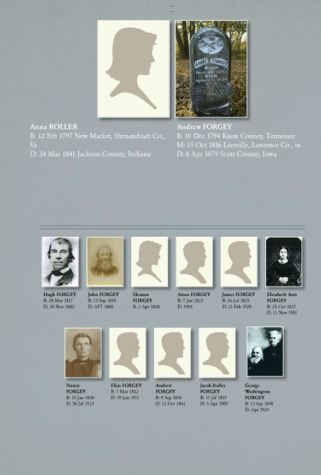
I've put together a brief narrative and descendant report using my Genealogy Software program, and Microsoft Word. I then saved it as a PDF, which is the format needed to produce a book at most publishing websites. Blurb requires you use a specific PDF format, PDF/X-3.
It can be tricky when it comes to laying out your book correctly. You have to be sure that your fonts are embedded in your PDF; and you should not use unusual fonts. You should use commonly supported fonts. You need to follow instructions for margins carefully; otherwise, you may find some of your text is missing. The Amazon publisher (Create Space) and Blurb give you a list of problems which it detects on your PDF. I got a message stating my image resolution was too low so the pictures may not come out clear. Lulu does not provide these suggestions.
The best place to publish an ebook you want to share with your family for free is at Internet Archive which allows readers to read it using many different format options:  www.archive.org


You can make books to share with your family, or just as reference books for yourself. I think putting together  documents, maps, pictures, progress reports etc., in a published book would be a great way to access them easily. Even if you just print your important source material and three hole punch it and put it in a report cover it would be a very helpful resource. I've used binders in the past, but they are bulky and heavy, a light weight report cover is more compact too. I have quite a few documents etc. in digital format, but find I get tired of looking at the computer screen too long. I like a printed format sometimes. It can be quicker to access a book.
I plan on ordering a copy of my book at LuLu. This is definitely an amateur production. I've never tried anything like this before. I haven't used any professional advisers for the layout; so I am not sure how it will come out? We'll see what the results are? I do plan on adding an index to the book and making additions this summer, so it's a work in progress. This copy is my test run: http://blog2print.sharedbook.com/blogworld/printmyblog/index.html

Here is my test copy at Internet Archive: http://www.archive.org/details/AndrewForgeyMargaretReynoldsAScotsIrishFamilyInAmerica13112

Since I am using this blog as a research log I plan on publishing it using Blog to Print.

Some publishing websites

Monday, January 30, 2012

When fact and speculation become confused


Often researchers have speculated about events which they did not have direct evidence for. Sometimes these specualtions become more than that, and are later represented as fact by others. This often involves a misreading of notes left by previous researchers failing to notice qualifying statements, such as approximately or circa. I've been researching the Archibald Fisher family. As I search the internet I am finding the year 1767 as the year of their immigration to this county. This was copied from a book. Whoever copied it missed the fact that it actually says immigrated before 1767. It's easy to miss that, but important to read through these entries in books etc. to make sure there are no qualifications. I had to go back to the book to verify what it said. I was getting confused and thinking maybe they did immigrate in 1767. Looking at some of the other records for Augusta County, VA it seems that a lawsuit involving Archibald Fisher and his wife Susanna Shaddon was filed in 1766. So it seems Archibald may have been in Augusta County in 1766?
We do not know where his children were born and most may have been born in the US (speculation)? I am also speculating that it is possible that Catherine Fisher may be a daughter of  Archibald and Susanna? I base this on the fact that it's likely Catherine's husband, Hugh Forgey, was born in around 1766. We don't know how many times Archibald was married. According to a Randolph County History Archibald came from Scotland and first settled in South Carolina?

 Here is what we know for certain about Archibald Fisher.

  1. We know he married Susannah Shaddon sometime after November 1765 when she was appointed administratrix for her late husband ( it looks like Archibald and Susanna were married before 9 August 1766 when they filed a suit together?)
  2. We know he purchased land in Augusta County, VA on 5 March 1767 
  3. Sells his land in Augusta County on 9 Dec 1777
  4. We know he was in Sullivan County, TN in 1777 when he signed Holston Men Petition.
  5. We know he received a patent for land in Sullivan County, TN (later part of Hawkins County) on 10 November 1784 
  6. We know he sold his Hawkins County land on 27 May 1789
  7. We know he married Elizabeth Sharp on 11 December 1797 in Knox County, Tennessee
  8. He died 1 May 1805 in Ellis Grove, Randolph County, Illinois
We also know the names of his children because they are named in his will.
    What we don't know is when he came to America? Did he settle in South Carolina first? Where was his property in Knox County, TN? When did he sell it? Most importantly, what was Catherine's mother's name?

    Thursday, January 26, 2012

    Can you spot the problems?

    The following family group was compiled by a researcher who used the Scottish Church records at Family Search. The last child, Mary Fisher, does not appear in these records, but the researcher assumed she belonged in this family anyway.

    Archibald Fisher b. 17 April 1734 in Glasgow, Lanark, Scotland. Father: Patrick Fisher b.1701
    married Isobel McDougal
    Children of Archibald and Isabel

    1. Janet Fisher b.  16 July 1742 in Alloa, Clackmannan, Scotland
    2. John Fisher b. 19 September 1746  Alloa, Clackmannan, Scotland
    3. Archibald Fisher b. 24 December 1749  Alloa, Clackmannan, Scotland
    4. Isabel Fisher b. 5 July 1751  Alloa, Clackmannan, Scotland
    5. Catharine Fisher b. 5 August 1754  Alloa, Clackmannan, Scotland
    6. Janet Fisher b. 9 September 1757  Alloa, Clackmannan, Scotland
    7. Mary Fisher b. 18 January 1758 (from tombstone)   Scotland


    The first contradictory fact that stands out is that Archibald Fisher was born in 1734 and his first child was born in 1742. So he would have been 8 yrs. old when his first child was born? He probably married at 6 yrs. old. Not likely! 
    A second problem is Janet and Mary were born 4 months apart. Not likely either!
    There were also two Janets, so apparently, the first one died. 
    Archibald Fisher came to America in 1767; without his wife who probably died in Scotland? We have not located the name of his spouse on any records in this country. A Fisher researcher assumed that because Archibald had a daughter named Catherine she was the same one born to Archibald and Isabel in Scotland. There were several Archibald Fishers in Scotland at the time. To verify they found the correct one they should have looked at all the birth records for this couple. If they had they would have discovered these contradictory facts. The easiest way to find the other children born to this couple is by using the batch number along with a surname search. All of the records for the same Church were batched together (this same method is also helpful when searching any other record extractions in the IGI).
    The same researcher also states that Archibald's second wife was Nancy Agnes Firney ( seems close to Forgey?) I've seen this same info copied several times by different people. No one has any source for this. I have not found her in the IGI for Scotland either. It seems a little unusual that a person born that early would have a middle name? 
    Someone else has an Ann McNaughton as his wife. This is another improbability. This particular family was still in Scotland in 1768, when a child appears in the Church records. I've seen about half a dozen different women recorded as Archibald wives. He may have actually been married about 3 times?  
    These are the verified children of Archibald Fisher (none of which appear in the IGI Scottish Church Records)
    1. Catherine Fisher b.?
    2. Mary Fisher b.1757
    3. John Fisher b.1762
    4. William Fisher b.1766
    5. Eleanor Fisher b.1765
    6. Nancy Fisher b.c.1767

    Monday, January 23, 2012

    The Mysterious John Beaird


    Nan Harvey just found a marriage record for Eleanor/ Elinor Fisher and John Beaird. I suspected they had married in the late 1780's or early 1790's in Tennessee. I was surprised to find out that they had married in 1799 in Pulaski County, Ky. I had understood that at least one of their children, John Beaird Jr., was of age by 1809 when  his father John Sr. died.
    My relationship to the Beaird family is through my ancestor Catherine Fisher who was the sister of John's wife Eleanor. I've only found a couple of references to Catherine Fisher/Forgey in records. I've never been able to find anything giving her age. I found an estimated year of birth for her sister Eleanor of 1765. Another sister Mary Fisher/Steele was born 18 January 1758.
     John Beaird's family being more prominent he does appear in several local histories. I am hoping to find more info about my own family by following these collateral lines.
    The newest discovery of  a marriage record for John and Eleanor does raise some questions. Was Eleanor John's first wife? I had suspected that John and Eleanor were neighbors of  my ancestors' Hugh and Catherine in Knox County, Tennessee, but now it looks like they were not married when they lived in Tennessee. It does look like they may have had a common law marriage before the official marriage in 1799, because it is suspected that their daughter Harriet was born to them in Tennessee.
    I also found out that John Beaird sold his Flat Creek Knox County, TN property in 1797; when he was living in Lincoln County, KY. This was unexpected too. According to family tradition the family left Tennessee in 1801 for Randolph County, Illinois. The story also states the Fisher in-laws accompanied the Beairds in 1801? Did they really travel together or meet up later? Evidence does seem to point to a relationship between them in Tennessee. Maybe there was a common law marriage, and out of wedlock births?  I've found references to John Beaird living in Wayne County Ky, Lincoln County, Ky, and Pulaski County, Ky.  Apparently this is because the area he was living in was Lincoln County when his first settled there in 1797. This same area became Pulaski County, Ky in 1798 , and in 1800 it became part of the newly formed Wayne County, KY.  So lots of jurisdictional changes occurred in a short time. It does appear they left Kentucky for Illinois in 1801. I don't know whether the Fishers did the same?
    I was also a little confused about where the Beairds and Fishers settled in Illinois. It appears the Fishers settled in Randolph County, and the Beairds in neighboring St. Clair, Illinois.  John Reynolds described the place the Beairds settled as 4 mile northeast of Kaskaskia, Illinois. The Fishers lived in the Ellis Grove area a few miles away. Now I am getting a better picture of where the families lived and when. It might be helpful to do some research in these new jurisdictions, which might produce more Fisher family documents.

    Tuesday, January 17, 2012

    Breast Complaint a Misdiagnosis?


    Now I am wondering whether "Breast Compliant" was a misdiagnosis? I am sure an accurate diagnosis would be hard to come by in early America and rural Tennessee especially. The James Forgey and Margaret Caldwell family may have been completely decimated by Tuberculosis which was commonly known as "Breast Compliant" in early America. Or could it have been breast cancer? Four Forgey sisters all are described as dying of  "Breast Compliant".  TB sometimes spreads to the ducts and nodes of the breasts causing lesions. Could breast cancer lesions be mistaken for TB lesions? I would think that could be a possibility. Did the women have a cough? No one gave the details of their symptoms so it's impossible to say.
    I wondered how common it would have been for that many members of one family to die of TB? My great-grandmother Isis Browning-Forgey died of TB and remained at home with her children until her death. None of her children caught TB from her. I found this about the famous literary family the Brontes: "Anne and Emily Brontë and other members of the Brontë family of writers, poets and painters were struck by TB. Anne, their brother Branwell, and Emily all died of it within 2 years of each other.Charlotte Brontë's death in 1855 was stated at the time as having been due to TB, but there is some controversy over this today." It is possible the Forgeys contracted TB from one another. Their only brother James Reynolds Forgey died at age 44 of unknown causes. It appears that no one lived until the age of 50.
    A fifth daughter may have died of the same thing. Here are the dates for all the Forgey daughters (except Sally, I don't have any death info for her)

    1. Margaret Forgey (1794-1817) died age 23 (don't know her cause of death?)
    2. Mary Forgey (1796-1833) died age 37 of  "Breast Complaint"
    3. Ellen Forgey (1798-1837) died age 39 of  "Breast Complaint"
    4. Betsy Forgey (1805-1837) died age 32 of  "Breast Complaint"
    5. Rachel Forgey (1812-1837) died age 25 of  "Breast Complaint"
    6. Matilda Miller (1802-1839) died age 37  (don't have her cause of death?)
    Looking at the years of death I see 3 in 1837, which would point to a contagious disease, like TB. All who died of  "Breast Complaint" died in the 1830's. It's difficult to say if they were diagnosed correctly? They may have died of something hereditary, such as breast cancer; or, may have been TB after all? It's very troubling when you think about the short life expectancy of this family line. My own Forgey line tended to live into old age.

    Monday, January 16, 2012

    What was "Breast Complaint"?


    Early medical terminology can be confusing. I've been looking for definitions of some of the diseases my early family had. Some of the names they used could be misleading. For years I was thinking breast complaint must be breast cancer. Four women in the same family died of this, i.e, Polly Forgey, Ellen Forgey, Betsy Forgey, and Rachel Forgey. I was thinking it was hereditary breast cancer. When I googled "died of Breast Complaint" I found several references to tuberculosis. I found a google book called, "Language of Mormon Pioneers." Here is their definition of breast complaint:

    According to the Crawford family letters (written in the mid-nineteenth century) a number of Forgey family members suffered from "ague". I had no idea what that referred to? I found out it most likely referred to malaria. It could also have been a fever with symptoms similar to malaria. I remember reading about how diseases I thought were tropical were present in early America. Malaria and Yellow Fever epidemics were common in early America.
    Apoplexy also perplexed me. Apoplexy would be referred to as a stroke today.
    Before clinical tests were developed the cause of death or disease could only be surmised from previous experience or autopsy, and may not have been accurate. Scholars still debate the causes of some early epidemics.

    Thursday, January 12, 2012

    West Fork of Flat Creek Found?

    Field Stone marking Boston Grave's burial site on Little Flat Creek

    I've been continuing to trace the land of Hugh Forgey's neighbors in order to find the location of  his Flat Creek property.  It seems like Little Flat Creek was not identified as such until the mid nineteenth century; which leaves me with the question was the West Fork later identified as Little Flat Creek? Early deeds never seem to refer to it. I've found a number of transcriptions for Flat Creek deeds on the internet. Flat Creek, and the West Fork of Flat Creek were common names used on deeds for the area. 
    John Beaird  (brother-in-law of Hugh) owned 400 acres at the Headwaters of the West Fork of Flat Creek. I figured if I could find his land I would then answer my question. I had searched for Boston Graves earlier (knowing he was a neighbor of Hugh). I had found out that John Beaird had sold land to Boston and his son. Boston was said to have lived on Little Flat Creek according to a descendant. I wasn't sure if that Little Flat Creek land was previously owned by John Beaird? I did find references to the sale of this property by John Beaird to Levi Hinds as follows:


    Levi Hinds sold the Beaird property to Boston. This still didn't connect Little Flat Creek and the West Fork. I later found this about Boston's burial which does make the connection:

    I was able to establish the connection using all of these facts and going to Find-a-Grave and looking for Boston's burial place. Luckily he was listed there, and the address of the Graves Cemetery was given. I looked it up at google maps and found out it was located on Little Flat Creek. I now have some evidence that the West Fork of  Flat Creek and Little Flat Creek are the same. Along with previous statements by family researchers, everything is pointing to  Hugh Forgey's property being located on Little Flat Creek.
    I found Hugh Forgey mentioned on other West Fork deeds. Some of the men sharing property lines were: William Beaird (John's brother?), Absalom Hankins, and a Reynolds no first name ( may be his cousin John?) Mynatt's and Gibbs also lived close. Hopefully, I will be able to find the exact location of the property eventually!
    Boston Graves Burial site location at A pinpoint located on Jim Wolfe Road


    Tuesday, January 10, 2012

    Where oh where is the West Fork of Flat Creek?


    Where is the West Fork?  Being a Larry Hagman fan I know where South Fork is. Now I just need to find out where the West Fork of Flat Creek is in Knox County, TN. This Flat Creek area is a mystery to many. Lucille Wallace the author of the 1950's version of the Forgey Family History was unclear about it's exact location. She seemed to place it in Hawkins County, not realizing that area later became a part of Knox County, TN. This threw me and others off. When I began searching for Flat Creek I looked at maps for Hawkins County and couldn't find it. When I posted a query at a message board I was told it was in Knox County; I then located the general area.
    When I received photocopies of the deeds I noted that Hugh Forgey sold his Flat Creek property to Christian Shell. I found a Shell Lane and Cemetery on a map for the area; I assumed the land was in that area. The land was not literally on Flat Creek. I had read that sometimes the nearest creek was mentioned on these early deeds, and did not mean the property was located on the creek.
    Now that I am trying to put together a narrative family history I decided I wanted to include a map of the area where the family lived. I decided I should try to do some fact checking. I got the deeds out and read the location descriptions. Glad I did that because the deeds do say the family properties were located on Flat Creek. Here is what they say:
    • James Forgey's grant states the location "Beginning on the North side of the Holston River on a Branch of Flat Creek"
    • Alexander Forgey's deed states the land was "on the waters of Flat Creek"
    • Andrew Forgey's deeds state "on the waters of Flat Creek"
    • Hugh Forgey's deeds state his land was "on the west Fork of Flat Creek"
    Armed with these descriptions I am now trying to locate the exact location. My ancestor Hugh's property description is the most descriptive "West Fork." I have not been able to locate a map with that particular location. I did find a query posted by someone also looking for that location. I also found out Hugh's brother-in-law John Beaird lived on the West Fork of Flat Creek. I checked the taxlist I have for Hugh Forgey when he lived on Flat Creek. I google searched some of the names plus Flat Creek. When I searched Bostian Graves I found a website where I found this info "The writer has no knowledge as to the original grantees to tracts of land on the head waters of Little Flat Creek. Most of them had served in the Continental Armies of North Carolina or Virginia during the Revolutionary War. Daniel Graves and his father Boston (Sebastian ) Graves (Graff) were in the area May 23, 1797.it is believed they came to Tennessee from Montgomery County, Virginia. They had earlier lived in Orange County, North Carolina. Since this recorder (Scharmal Veronica Triesch Conley) is a descendant of both Daniel and Boston Graves much of this compilation will relate to them and their descendants. On May 23, 1797, Daniel Graves bought 200 acres of land from John Beard. The land was located in the head waters area of Little Flat Creek, first known as Gravesville and later Graveston. The land is recorded in Book C-1, pg. 131, Knox County, Tennessee. "  
    I remembered that Lucille's book, and the earlier Forgey Family History did state James Forgey's land was on Little Flat Creek. I will have to order copies of the rest of the Flat Creek deeds to see whether any of the later ones offer a more detailed description of the location? None of the deeds I've seen say anything about Little Flat Creek. There was a Little Flat Creek and a Big Flat (a Forgey relation John Sawyer's lived on Big Flat Creek). Since I did find a couple of references to Little Flat Creek when I googled the names appearing on the Taxlists it is possible the Forgey properties were located on that creek? 
    I will contact the Knox County archives regarding the West Fork of Flat Creek. In early times Little Flat Creek may have been known as the West Fork of Flat Creek? If so the Forgey properties may be located near present day Emory Road and the Little Flat Creek Baptist Church. It was thought Washington Pike Presbyterian Church was located on Forgey land, but Flat Creek is several miles from there; not likely.

    Sunday, January 8, 2012

    National Register of Historic Places Registration Form/ Genealogy Source


    The National Register of Historic Places Registration Form I found this form to be a great resource for local history and family history. This Knox County, TN form is packed with information about the early history of  Tennessee and Knox County http://pdfhost.focus.nps.gov/docs/NRHP/Text/64500608.pdf. It mentions many of the early residents too. I did find a factual error. The person who built the fort at Harbison Crossroads was actually James Reynolds not John. This application involved multiple sites and buildings and contains more info than an average form. Even a shorter form can contain some very interesting historical info about a building or location, and family. Below you can see an example of the kinds of details that were recorded.

    Below is an example of the kinds of info you may find about an individual.
    I am now looking for more of these forms by searching google and including the name of a site or area. They are generally posted as PDF's. I think the information provided is very interesting to include in a Family History, and some of the info may lead  to more resources and help breakdown a brickwall.


    Monday, January 2, 2012

    To do list for New Year


    Last year was very productive genealogy wise. I joined Second Life last January which helped introduce me to the genealogy community on the internet. As a result I began attending Webinars. I started this blog last March after attending a Dear Myrtle blogging Webinar. I began listening to Genea Bloggers radio even before starting my blog. All of this activity led to a more focused approach to my research which has paid off. I plan on maintaining this approach this year. I am going to work on improving citations and locating sources. This is my target list for this year:
    1. I still have not found the purchase deed for Hugh Forgey's property in Flat Creek, Knox County, TN. He probably purchased the land in the 1780's or 1790's? Will attempt to find the deed.
    2. I would like to collect more maps of the areas where my ancestors lived. I especially would like to get a better map of the Possum Creek area of Hawkins County and Flat Creek area of Knox County, TN.
    3. I will keep googling my family names in hopes of someone posting transcriptions of letters or diaries. I've pretty much exhausted currently available records at the government level so private sources could be best in the future.
    4. I plan on ordering a copy of the Deeds Index for Maury County, TN. I've looked some court records for that area but didn't find anything useful (someone reminded I can order the film online.
    5. I need to keep checking the Newspaper project for Tennessee which still has not been completed. I am hoping the early Knoxville Gazette will be available online soon. This should be a great source for the early history of the area.
    6. I need to fix some gedcom problems.
    7. I plan on continuing to work on my family history book/report.
    8. I will move over to Clermont, Ohio and do some more research on Nancy Melvin-Hicks. I would love to find an obituary for her.
    9. I still have not found the death years for Patrick Mullen and Mary Huvane in Ireland (my great great-grandparents).
    10. I have a long genealogy book reading list I hope to get through this year.
    11. More Forgey/Forgety DNA testers would be nice!

    Sunday, January 1, 2012

    My Family and the Rose Parade


    My mother's family, the Forgeys, settled in Southern California in 1925. My Nicaraguan grandmother, Graciela Del Castillo-Forgey was able to integrate into American culture very quickly. The Hispanic heritage of California was familiar to her too. She loved American holidays which she celebrated heartily.
    In the late twenties my Forgey Grandparents moved to Glendale, California close to the Rose Parade city of Pasadena. My grandmother became acquainted with a float designer for the City of Glendale. My grandmother loved attending the parade. During the Depression the Parade was great free entertainment. My grandmother's husband and children didn't always share her enthusiasm for the parade. Even way back then the traffic around the parade route was bad. My grandfather drove there once, but was very annoyed by the traffic and would not go again. You have to get there early or camp out to get a good view. It can be very cold and uncomfortable waiting for the parade. My mother didn't enjoy all of these inconveniences either, but often accompanied her mother like a dutiful daughter. My mother did enjoy the 1939 parade when she saw Shirley Temple in person. Shirley Temple shares my mother's birthday.
    My Kapple family came to California after WII. My father Robert Kapple would send a copy of the Rose Parade program to his Great Aunt Sister Mary Kathleen (Bridget) Mullen who worked at a Catholic Girls boarding School in Chicago, Illinois. She would look at it with the students who enjoyed a great deal as I hear.
    I collected the souvenir programs as a teenager. My family would often take a ride on New Year's Eve along the parade route. We would only move at about a snails pace along Colorado so I could purchase a program while waiting for the traffic to move. I enjoyed seeing the crowds camping out and celebrating. Our car would get pelted with dried marshmallows which sounded like hail hitting the car, and silly string. On the way home we sometimes caught a glimpse of the floats be moved to the parade site.
    We did attend the parade once. It was fun but pretty exhausting. We generally would just go to see the floats  when they were parked. It used to be free. You would have to pay to park close. We always parked on someones front lawn across the street. That was a big money making opportunity for local residents; having people park on their property for $5 or $10. It usually took about an hour in traffic to get to the  float viewing area. Heading home it would look like a tornado hit Colorado Blvd. with old couches (used by parade viewers) and trash everywhere.
    It was fun though and they are even more beautiful in person.

    Saturday, December 31, 2011

    Nothing but Good News to end the Year with!


    It's been a really good year for genealogy :)! I've had several major breakthroughs. I received the final DNA test results for my Uncle Charles Forgey. At 37 markers he mismatched Roger Forgey by only one marker. That is described by FT DNA as a "Tight Match". They say very few people achieve that close a match. My family and Roger share a common ancestor back in 1732 when our shared ancestor Andrew Forgey was born. I only had circumstantial evidence of this before. Now the DNA backs this up. Really very satisfying! I had no idea they would match that close considering two other testers confirmed to share a common ancestor in the 1720's mismatched by 4 markers at 37 markers. If that had happened in our case it would have led to second thoughts about our relationship. 
    The one mismatch with Roger was a mutation occurring in our line. It was not shared by our other testers either. The single mutation made a big difference as far as the number of matches my Uncle got versus Roger. My Uncle got sixteen matches and he got 30 matches. That one mutation cut the matches by half.

    These are our results to date.

    I made a happy discovery in my ancestry messages. I don't check that message box very often. I didn't notice a message had been there since September about a Joshua Hicks book. It's available at Lulu and Amazon http://www.lulu.com/product/ebook/descendants-of-joshua-hicks/17440597 . I purchased the digital copy a few day ago. It's really excellent. I was thrilled to find a picture of a many times great grandmother Nancy Melvin-Hicks. I have been researching her family extensively, so seeing a picture was a wonderful treat!  I believe she is the earliest ancestor I have a picture of. She was born in 1806. I do plan on doing more research on her in the New Year!

    Friday, December 30, 2011

    My Canvas a Boring, Expensive Family History Book?


    I have been trying out the My Canvas family history book creator at Ancestry.com. You can view my own project here View Annette's project.
    You can use any family tree you have uploaded to Ancestry to create your book. You can also use any documents and photos you have stored there too. Using their book designer is a little tricky. Creating a book is very time consuming. You can only add 4 generations initially. You can then continue adding new pages with more generations.
    It definitely could be more user friendly. For instance you have the option to upload 3 or 4 generations at a time. There should be an option for fewer, because you may end up with many more pages than you actually want. You may end up with to many time lines especially. I think I would only want a time line for key people. I can't imagine wanting a time line for every individual. So you have to go in and delete the pages you don't want. Very time consuming. More options for adding pages, and deleting several at a time would be helpful.
    Adding text is a pain too. This is designed to be more of a picture book than a real Family History.
    I've uploaded a few examples of the pages I created here. The family group sheet is above. The first two below are examples of individual time lines. Too bad you can't insert more events and years. You are stuck with their default events. There isn't a military confederate background either. Don't know if confederates would want Lincoln on their time line?
    If you are creative and have time on your hands you can get a very nice final product. Otherwise the basic book is not worth the expense.


    Tuesday, December 27, 2011

    A Software Generated Family History

    I've been comparing software generated modified descendant registers for creating a Family History. You can generate a book using this report. Once you've produced your report you can upload it to Internet Archive and share it with family.
    I started out by using my own Rootsmagic program. I used the modified register report and added more photos for family members. It produced a nice layout, with lots of detail included in the family group layout. It also produced an index which is so helpful.

    Rootsmagic Modified Descendant Register

    I also downloaded a free trial of The Family Historian software. I created another modified register here. It produced a slightly different layout. I believe that company is based in the UK where they have a different protocol for the arrangement of the data. Rootsmagic provided more details for individuals at the family group level, whereas, Family Historian only gave date ranges, and no spouse info at this level. I could not manipulate the pictures in the Rootsmagic program, but could with Family Historian. I was able to make the pictures small, medium and large. I could also move them. I later found out I could change the size of the pictures at Rootsmagic by going into settings then options, and resizing them. I don't think you can move them in Rootsmagic?
    Family Historian.


    I like the uncluttered, neater, layout Family Historian produced. It's easier for family members to read. Here is the copy I contributed to Internet Archive: http://ia600800.us.archive.org/23/items/DescendantsOfAndrewForgeyAndMargaretReynolds/DescendantsOfAndrewForgeyFinal.pdf . Genealogists would probably prefer a more detail oriented layout like Rootsmagic.
    I also tried Ancestral Quest's Modified Register which produced this layout:
    Ancestral Quest
    This report did not include spouses at the family group level. It's interesting that it did give info about sex. It's not as attractive as the other reports but readable. The default picture size is small.

    Ancestral Quest  Index
    Ancestral Quest like Rootsmagic generates an index. The index is even more detailed than Rootsmagic giving the ID number of each individual in addition to the page number and dates.
    Legacy seems to generate a report similar to Ancestral Quest. It does have a more attractive layout with a larger default picture size.
    Legacy

    It appears that the Legacy modified register doesn't have an index either.
    Here is a sample of the same sort of report produced by The Master Genealogist:
    The Master Genealogist Descendant Narrative

    This report provides a substantial amount of info about individuals. It reads more like a word processor style document; the layout is basic no frills. 
    I like the Rootsmagic and Family Historian layouts the best. I think the Rootsmagic version is excellent. The Family Historian layout is good to give to family members not that familiar with genealogy. They can quickly scan the info which is very simply layed out. Too much info, too cluttered may put off those not familiar with genealogy. 
    I found out that I could add biographical info using comments. Without the biographical info these reports can be about as interesting as reading a phone book. I also found it may be necessary to remove some of the facts and events you may have in your database. These can result in very odd sentences. You may also get a sentence that reads "undefined sentence." That means you need to remove a bit of information connected to that person. It's best to use notes/comments to give info about Military Service etc. Sources may come out jumbled also. It's probably best not to activate sources for reports for those not familiar with genealogy. You can include some important sources in notes.
    It is good to print and read a narrative report like this. I found many mistakes on my gedcom. It's difficult to spot mistakes unless you create a narrative. 


    Sunday, December 25, 2011

    Santa and my Grandfather had the same Handwriting


    In 1936 my mother received this dictionary from Santa Claus :D with the inscription "From Santa Claus Dec. 25- 1936

    Hope everyone has a very Merry Christmas!

    Monday, December 19, 2011

    A Forgey Slept with Abraham Lincoln's....


    Cousin! Or so the story goes? It all hinges on a 15 year old WIDOW who married a 50 year old man, and an Indian Prince?  I found this juicy family story at findagrave. This is what it says: "Mary Ann Hanks was the daughter of John & Elizabeth Hanks. She was born October 05, 1827 in McMinn County, Tennessee. Family legends has it that Mary Ann was married for a brief time to and Indian prince by the name of Forgey? but that has never been confirmed and they had no children. Mary Ann was then married to William T. McCallie of Chattanooga,Tennessee on September 18, 1842, This was a strange union because William T. 50 at the time and Mary Ann was only 15." I immediately performed a logic, credibility test on this interesting yarn. It didn't seem to pass the test :). I know the Forgeys of McMinn, TN were not Native American. John Forgey's, progenitor of this McMinn Clan, descendant Roger has been DNA tested and is of Scots-Irish heritage. His wife, Nancy Armstrong, was born in Prince Edward County, VA and her family wasn't Native American either. I have not run across a fifteen year old widow in my family research either? A connection was also made between Mary Ann Hanks and Abraham Lincoln's mother Nancy Hanks. All of this smacked of someone trying to establish a connection to Abraham Lincoln's family, and hence all these unlikely facts.
    Well I may have given up the research there, if not for fellow genealogy researcher Karen De Groote. She was able to find more about the Hanks family which adds credibility to this incredible story. She found a reference to John Hanks Will, which did mention a daughter Mary. He also mentioned a wife Elizabeth in the will. John Hanks does says he was born in North Carolina on the 1860 US Census. I was able to find the supposed to connection in this family and Abraham Lincoln in this tree at Rootsweb http://wc.rootsweb.ancestry.com/cgi-bin/igm.cgi?op=REG&db=ldkingsley&id=I003134
    So my personal connection to the Hanks family would be that my ancestor Hugh Forgey would have been the Uncle of  the Forgey male who married Mary Ann Hanks. Mary Ann would have been a several  times great-grand daughter of  William Hanks born 1654, and the several times great-granddaughter of Nancy Hanks-Lincoln. So the cousin relationship would not be very close between Abraham Lincoln and Mary Ann, being that they shared a common ancestor in 1654, in North Farnham, Richmond Co., VA.  
    My connection is tenuous at best, lol, to the Hanks Family and Abraham Lincoln.. I will take any possible connection to Lincoln, however. I have not been able to find a marriage so far between a Mary Hanks and a Forgey so far. John Forgey and Nancy Armstrong do have some unidentified sons, per the 1820 and 1830 Census's. So can I add Abraham Lincoln to our family tree. NOT Yet lol.

    Friday, December 16, 2011

    More DNA results plus Serendipity


    Both Roger and Darren have now tested positive for Isles Scottish Clade I2b1a1 M284 L126.  M284 probably originated in the British Isles around 2000 years ago. The L126 SNP is most frequent in South West Scotland and probably originated there over one thousand years ago.
    These tests also confirm the Forgey/ Forgys were originally Ferguson. The name Ferguson in Gaelic, and not Norman, so I had always figured the family was not Norman.
    My uncles, Charles Linn Forgey's, 25 markers have also come back. I was thrilled yesterday to find out that he matched Roger with no mismatches. Exact match so far!
    Serendipity It was seven years ago this month ( December 23, 2004 to be exact) when Roger Forgey first contacted me by email.  This is what he wrote:
    "Annette, I am beginning the search to figure out my Forgey line and go back as far as I can. My name is Roger Forgey ..... There are several of our family members in Cleveland, Tennessee and Harrison Tennessee. These are about 70 south of Knoxville Tennessee. My father's name was John Milburn Forgey and grandfather's name was John Melborne Forgey and his father was Dave Forgey. I don't have a lot of information but am trying to start. I would appreciate all the advice you might give me...
    I am so glad he decided to contact me :)! That was a stroke of good luck for me. I was not able to answer his question right away, and it actually took me several years to figure out which line he belonged to. I worked out which line he belonged to in 2010. I was going through Carla Rotmans's pedigrees online and noticed John Milburn Forgey, and the fact the family lived in McMinn, TN  (apparently Lucille Wallace had them as descendants of James Forgey and Fidelia Alderson, which can be disproven using the 1850 Census.). So I began doing some research on the Forgeys of McMinn, TN. I found a Nancy Forgey, daughter of an Armstrong, in some online McMinn County, TN records. There were references to Hawkins County, TN. Apparently her father died there and she was from there. 
    So bingo; we now had a connection to the Forgey family of Hawkins County, TN. From there I took a brief detour, and put the family in the wrong line. I found an Andrew Forgey listed on some of the 1829+ taxlists. I also found a John listed later. So I thought Andrew son of Margaret Reynolds migrated there with his son John. Later I discovered my error when I found out Andrew died in Hawkins County, TN and John was still in Hawkins County, TN in 1840. So I eliminated that possibility.  
    From "Tennessee Cousins" Book


    I went back to the drawing board. I could not figure out the connection immediately. I did remember something about Nancy Forgey I photo copied years before. I could never place her with a particular Forgey male, and all the marriage records had been lost for that time period. By 2010 I had been able to find the wives of all the Forgey males in eastern TN except John Forgey (uncle of the John I mentioned previously). So he became my focus. I believed John Forgey, or Forga as listed on the 1820 Census for Maury County, TN, was the same man I was looking for. He did not appear on any Census's after 1820. Apparently he died after the 1820 Census. I did later find Nancy Forgey with her children living near Armstrong siblings in McMinn, TN. When I compared the number of children in John and Nancy's households they seemed to match very well. With that plus the fact that the name John was used in the family for generations I felt I was on the right track. I then remembered a letter that Hugh Crawford had written in the 1830's about John Forgey's son Andrew dying; this clinched the likelihood I had the right person. An Andrew Forgey was on  taxlists in 1829+ in McMinn, TN and did not appear after 1834 when Hugh Crawford said he had died. I feel the circumstantial case is very good. Now we also have DNA on that line backing up our assumptions.
    By collaborating we have been able to further all our lines, and become acquainted with some new cousins. It's been a very rewarding in so many ways :)!

    Wednesday, December 14, 2011

    Timeline Helps Clarify Alexander and Andrew lines

    What I've learned from the timeline Going over everything yet again I found still more facts I missed before. In the process of verifying dates I discovered my error regarding James Forgey's year of birth. I was thinking it was 1766, but it was 1764. This bolsters my belief that he was the one who purchased the land warrant in 1788, for the 500 acres on Flat Creek in Knox County, TN. I had some misgivings about such a young man making such a large purchase. Now that I know he was a couple years older I feel more confident.
    James Forgey's father Andrew Forgey also owned land on Flat Creek, Knox County, TN. His brother, Hugh, did also. His sister Margaret Roberts lived on Flat Creek too. James was an elder in the Presbyterian Church and may have donated land for Washington Pike Church.
    Another thing that came to light was the fact that Alexander Forgey sold his 250 acre share of the 500 acre grant one month after purchasing it. That was in January of 1803. In 1807 he bought it back. He then sold it once and for all in 1815 but continued to live in Knox County until the 1830's.
    If my transcription of the 1806 Tax list for Knox County, TN is correct then Alexander and Andrew Forgey were sharing a 321 acre tract on Flat Creek? They were both taxed for the same tract.
    It still looks like most of the Forgeys in East Tennessee, early on, were descendants of Andrew Forgey and Margaret Reynolds, with Andrew and Alexander set apart with an unknown relationship to the others.
    This should be a good cheat sheet because I could never remember exactly what happened when.
    Below you can see my Timeline. You can click on each one to enlarge. Andrew Forgey husband of Margaret Reynolds is 1. Andrew. Andrew Forgey of Maury County is 2. Andrew. 1. Alexander is the older one of Washington County, VA. 2. Alexander is the one who settled in Tippecanoe, IN.

    Monday, December 12, 2011

    Was their father James, John or Alexander?

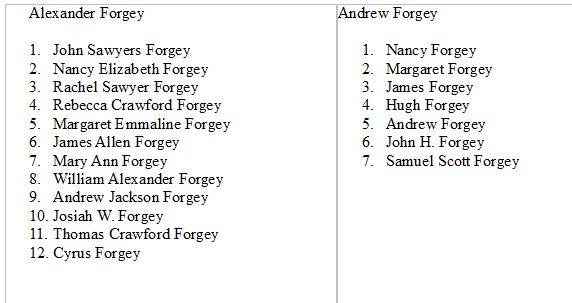
    Children of Andrew and Alexander Forgey
    As I stated in my previous post we have not proven who Andrew and Alexander Forgey's father was? Both men show up out of the blue in Knox County, TN records in 1802; with Alexander making his first appearance in March of 1802 when he serves on a Jury. Andrew makes his first appearance in the records in December 1802 with his land purchase. Several of Andrew's children are thought to have been born in Knox County. One child as early as 1795. So if that is true we know Andrew arrived there before we find him in any records.
    The ages of Alexander and Andrew are important to keep in mind when looking at the records I cite below. Alexander's year of birth is given as 1779 in a family bible. Andrew's year of birth can only be estimated. In 1820 he was said to be over 45, according to the census of that year. Taking in to consideration the fact his oldest child was born about 1795, this would put his year of birth somewhere between 1770 and 1774.
    I've reexamined the deeds regarding the 500 acre land grant. The authors of the Sawyers Harris family history found this land grant for James Forgey and assumed that since he was older he was the father of the younger men found in the local records. James later sells the land to Andrew and Alexander, in 1802. The way it's divided 50/50 sounds like a possibility of father deeding to sons. The problems that tend to lead a person in another direction is the statement James Forgey of Hawkins County grants to Andrew and Alexander of Knox County, TN. There is also no hint as to what the relationship the seller is to the buyers. Alexander pays $100 dollars for 250 acres which would be equivalent to about $1700 today. That would be quite a bit of money to pay your father for land which you would likely inherit after his death? I read Andrew's deed over again also. His is more puzzling, and does not give a dollar amount just says for "valuable consideration".
    We have a father to son deed for Andrew of Hawkins County to his son Andrew Forgey Jr.. I've copied that one and Alexander's deed below to show the stark difference in tone.


    They are a little difficult to read, but basically state Andrew received the land from his father for "love and parental affection." Whereas the deeds given to Alexander and Andrew do not contain that kind of wording? Another blow to the case for father deeding to sons.
    1794 Taxlist Washington County, Va, 3 men in household
    Who else is confirmed to be in the area at the time, in the age range, to be their father? My feeling has been that Alexander Forgey of Washington County, VA would be the best candidate. Alexander said he was born in Virginia and his name being Alexander means he could have been a Junior? This would make Alexander and Andrew first cousins of the other Forgeys in the area. Of course there are always discrepancies. We do not find either Alexander or Andrew on any of the tax lists for Washington County. VA? From the time Alexander, the older, purchases his property, until the time it was sold we only see young men in the household twice. Alexander sells his property and leaves the area in 1796. So Alexander would be too young to be included in the tax lists to 1796. But Andrew should appear if he lived in the area at that point, because I believe he would have been old enough? An explanation for this would be that Andrew Forgey left home and the area at a very young age? Can't locate a Will for Alexander Forgey, the older. Another fact which might point away from this possible connection is the fact Andrew did not have a son named Alexander. Although he may have a one and he died as a young child?
    Another possible candidate would be a John Forgey who died in the early 1790's either in Hawkins County, or Knox County, TN. James Forgey filed a probate for him in Hawkins County in 1793. He also sued a Joseph Beard on behalf of the estate in Knox County, TN in 1793. The fact he brought suit against someone in Knox County leads me to believe John may have lived there at some point? So could John have been a son of Alexander Forgey, the older and father to Andrew and Alexander?  We know he is not Andrew Forgey and Margaret Reynolds's son because they had a son who lived at least until the 1820s. We do not find a John Forgey with Andrew and Alexander in their early years in this country. So we are left to assume this could be a son of Alexander who came of age at a later date. We do not find him on the 1774 Taxlist for Cumberland County, PA like we find Andrew and the older Alexander. So we assume he was too young in that year. We do not find John on taxlists for Washington County, VA either in the 1780's which we might expect. He could have been in Tennessee by that point? We do not find him purchasing land in Tennessee, or in any of the records until he is listed as deceased. Not having any further info regarding him it's hard to say whether he is their father or brother? He looks more like a possible brother however.
    Arguments can be made for and against all of these men as fathers for Andrew and Alexander. It could be that they came to this Country without their parents at all? More research needs to be done. Going over everything again I noticed that both Alexander and Hugh Forgey sued Absalom Hankins. Hugh was involved in a suit with him in Knox County in January of 1801, and Alexander sued him in April 1802. Anyone interested in these lines may want to get more info on Alexander's lawsuits in Knox County. I have not looked at all of the sales deeds for Alexander Forgey, they might be useful too? More research in Maury County may be helpful too.
    Andrew and wife Elen witnessed deed in Knox County, TN 1806

    Friday, December 9, 2011

    Alexander G. Forgey, Do We Have the Best Sources?


    Is this proven I've written about Alexander G. Forgey in this blog before. I said I believed that he and Andrew Forgey of Maury County were likely brothers and could be sons of Alexander Forgey of Virginia. The Sawyers Harris Family history purports to document his family history. It was written in 1913 by Madison Monroe Harris and William Randolph Carter (I've embedded a copy below) .
    I've been going through the info in this book regarding his early history. According to the book he is the son of a James Forgey who entered 500 acres on Flat Creek, in Knox County, TN and lived on that land from 1792. It is odd that I have not been able to find a James Forgey in Knox County, TN court records if he lived there from this early date? This is very unusual since every male at some point served on a Jury.
    I immediately find more holes in this family history. As you can read above, James was said to have had four sons. Alexander, Hugh, Andrew and James. We know for a fact that Alexander and Andrew are closely associated. We find them witnessing documents, buying land next to each other on Flat Creek. There is never a James involved with any of them other than one described as living in Hawkins County, TN. There is never any evidence of a James Forgey living in Knox County, TN.  The authors conclusion that Alexander had a brother James came from the fact that a James Forgy family had also settled in Northern Indiana, like Alexander G. later did. There was no basis in fact for this. As it turns out this James Forgey family did not come from Tennessee at all. It was just a coincidence they settled in the same area. Lucille Wallace also came to the conclusion that the James mentioned by the Sawyers Harris author, as the son of James brother to Alexander, was not.
    Another misidentification occurred regarding Hugh Forgey. Hugh Forgey was not Alexander G.'s brother at all. The Hugh Forgey living on Flat Creek was the son of Andrew Forgey and Margaret Reynolds. Hugh Crawford, grandson of Andrew and Margaret and born 1806 Knox County, TN, wrote in his Journal that his Uncle Hugh Forgey lived in Knox County, TN. 
    At the face of it you would think the authors had a good sources for the family history. They tell us that James Forgey migrated early from Virginia to the Flat Creek area. Sounds like they knew what they were talking about? Actually since Alexander was said to have been born in Virginia this was likely the basis for that statement . It was just another assumption.
    In 1802 James Forgey sold two equal portions of his 500 acre grant to Alexander G. and Andrew. This deed does not say anything about relationships. The land was sold to these men not given away to them. The price could not be called hugely discounted either. These deeds damage the circumstantial case that James was likely their father. The deed portion I copied above states that James Forgey of Hawkins County, TN is selling to Alexander Forgey of Knox County, TN. Well James Forgey of Hawkins County, TN brings to mind only one person that is James son of Andrew and Margaret. Not Alexander G.'s father at all. James was known to have purchased large land grants which he did not live on. He appears to have bought them for speculation. James being in Alexander G.'s age range seems to point to a cousin relationship.
    The only source for the James Forgey as Alexander's father appears to be the Sawyers Harris book which Lucille Wallace later quotes. I have seen nothing else. The only source mentioned in the Sawyers Harris Family History is the 500 acre land grant on Flat Creek. More than this is definitely needed.
    I can see where a circumstantial case might be built around the land grant, but this is not supported by the sales deeds. A family history is not a good source since they can be notoriously wrong when it comes to  early generations. Building a good foundation for a family history requires several primary sources. One deed just isn't enough. We need some proof that there were two James Forgeys living in the Eastern Tennessee area at the same time, and nothing points to this so far. However we do know that James Forgey of Hawkins County, TN uncle Alexander Forgey sold his property in Washington County, VA in 1796 and disappears? So does Alexander Forgey relocate to Knox County with two sons?
    So has anyone proven who Alexander G.'s father is? No. Should we continue to search? Yes.