Friday, August 30, 2013

The Bizarre Life of John Urmey

Chancery Case Montgomery County, Ohio the Executors of John Urmey

John's esteemed friend Elizabeth (he did like the ladies) 1846
John Urmey the brother of my ancestor Eve helped me breakdown a brickwall. His wife and illegitimate son contested his will. When this happened the case generally went to Chancery Court where the names of all living heirs, and their relationship to the deceased is documented. I've found even more documents relating to the John Urmey case which I've found very entertaining.
The Urmey family is quite interesting. They appear to have been religious refugees, Anabaptist Mennonites, who first were forced to flee Switzerland due to persecution and later migrated to America. You wouldn't expect that a grandchild in this line would lead a less than admirable life. I don't know what the circumstances he faced were, so perhaps I shouldn't be too harsh.
John Urmey had no legitimate children, but did have one illegitimate son named John Q. Urmey. John Q. was born in 1827. John Sr. was 62 when he died in 1846. Sounds like he married his "esteemed friend", Elizabeth Hipple, as he calls her in his will just before his death, but after he made his will. Since he mentioned her father she must have been quite a bit younger than him.
John's illegitimate son enters into a lawsuit along with Elizabeth Hipple who now expects to receive a greater portion of his estate. The overseers of the Poor in Montgomery County, Ohio also sued for their share. Actually any remaining money after the heirs got their shares was to go to the support of the poor and "fatherless" of Montgomery County, Ohio. That was a nice bequest so he must not have been all that bad. After many year of litigation nothing was left for the poor and fatherless. Much of the money was eaten up by court and lawyers fees.
His behavior however doesn't seem to be in line with the Mennonite teachings of the time. It sounds like John lived off and on with the mother of John Q. for many years and never married her. He divorced his first wife Catherine Passinger in 1828. Probably because she found out about his affair with Sarah Kinsey.

John Q. Urmey called infamed an illegitimate 1848

Wednesday, August 28, 2013

One Brickwall Leads to Another


I did finally solve one brickwall regarding the parents and siblings of my ancestor Eve Urmey. A number of years ago I ordered a partial War of 1812 Pension file, for her husband Jesse Callahan, which consisted of the Pension application and a land warrant. This provided some important information such as Eve's maiden name. The name was spelled Urma. The closest match to that name in Indiana that I could find was Urmey, which was also the maiden name of a sister-in-law of  her husband Jesse Callahan. I searched for any information I could find in the records for southern Indiana; where they lived. There was only one family unit in the area at that time with that name, that of Jacob Urmey and his wife Susannah Brower, and their children. According to Jacob's will he didn't have a daughter named Eve. I assumed at that point she might have been a niece of Jacob, or her maiden name was Urma after all?  When the War of 1812 project at Fold3 reached the letter C I immediately looked up Jesse Callahan's file, which was quite large due to the fact Eve had to provide affidavits proving her marriage. This file was a gold mine of information. These affidavits pointed to Jacob and Susannah once again being the most likely parents of Eve. Their daughter Catherine Urmey-Miller attended Eve's wedding. The Urmey's son Jacob was described as Eve's brother. This was pretty convincing proof to me that she belonged in that family. This proof was strong, but not conclusive because I wasn't certain if there was only one Jacob in the area at the time.
This week I found a court record which leaves no doubt that Eve was the daughter of Jacob Urmey and Susannah Brower. Eve was named as a sister of John Urmey in a court case regarding his estate. All of the other children of Jacob and Susannah were named, and are the exact names found on Jacob's, his father's, will. Here is what it says:
"After making will, John URMEY married Elizabeth HIPPLE named in will a
dower set off. She is now widow of Levi Wooden. John Q. URMEY had no
other children other than illigimate son, John Q. URMEY. He left four
brothers; Abraham URMEY of Mont. Co. Ohio, Christian URMEY of Tipp Co.
Indiana, Jacob URMEY, residence unknown, and Jonathon URMEY, died before
testate, also four sisters, Catharine, wife of Jacob MILLER, Eve, wife of
Mr. CALLAHAN, Esther, wife of Mr. CALLAHAN of Washington Co. Indiana, and
Susannah, wife of Robert Scott, both dec'd and residence unk. Exe.
court who gave balance of estate and court awarded it to widow as legal
Will of his Father Jacob Urmey
heir." Dayton, Montgomery County, Ohio. - 15 December 1848
Dayton Court Record: Samuel LANDIS & Jacob VANIMAN, Exectutors of John
URMEY, dec'd, vs. Levi Wooden & wife and John Q. URMEY, et al 15 Dec.
1848.


I don't know why Eve was left out of Jacob's will? I am now confident that she was his daughter. It also looks like she is the Daughter of Susannah Brower. After finding the above I felt confident enough to begin tracing her parents Jacob and Susannah's families. Looking at posted information for clues I was able to identify the parents of both Jacob and Susannah. Susannah was named in a court record in Philadelphia County, Pennsylvania. In 1792 the heirs of Christian Brower were named in a settlement and Susannah Urmy is described as his daughter. Christian's will was filed in 1771 and he gives his residence as Chester,  Pennsylvania. A land record regarding the heirs of Christian Brower names Jacob Urmey. 
Looking around Chester I found one Urmey family, and was able to place Jacob in that family. Christan Brower had come from Germany and settled in Pennsylvania in 1726. The Brower family was Mennonite. I have not researched the Urmey family enough yet, and don't know if they were also Mennonites?
A wife named Eve was mentioned in Christian Brower's will. Searching posted trees some identified her as Eve Bowman Brenneman. This made sense because Christian named step children with the surname Bowman in his will. I found the likely source for this assumption in a periodical called "Mennonite Family History". Here is the exact entry:
TitleMennonite family history.
Publisher[Elverson, PA : Mennonite Family History, c1982-
A family history book for the Brenneman family is online at Heritage Quest. I found a couple of Eve Brenneman's who married Bowman men, but neither were married to my Christian? This leads me to wonder whether someone found an Eve Brenneman married to a Bowman in the Mennonite records and assumed that this was a matching piece to the puzzle? I also assumed the book could have been wrong. After looking at a map of eastern Pennsylvania I came to the conclusion it would have been unlikely that my Christian would have married a Brenneman living 50 some miles away. The closest Brenneman family to him was 12 miles away but I couldn't find an Eve in those families? The best way to approach this problem now is to do more research in the local Mennonite records. I have not been able to locate a will for a Bowman male with a wife Eve. 
The fact that my ancestor was named Eve seems to support Eve as being her grandmother. It's possible that Christian too was married before? Even if we do find out what Eve's maiden name was we may not be able confirm who her children were? So this is my new brickwall.


Tuesday, August 20, 2013

Wrong Wray!


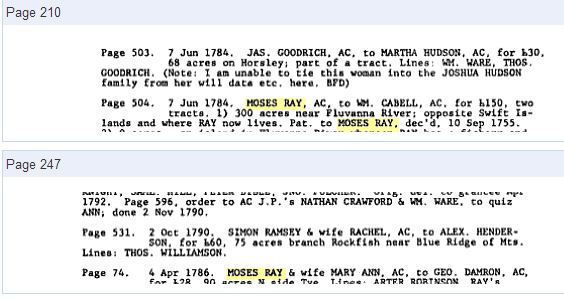
I had to make a 180 degree turn from yesterday. The reason for this is a Virginia deed book I found at Google books yesterday. I found out from the deeds that Moses Ray Jr. of Amherst and Albemarle did not match my Moses. This Moses continued to live in those areas well past the time when my Moses was known to be living in Bedford then Franklin County. This Moses had a wife named Mary Ann and my Moses' wife's name was Elizabeth. Doing a Google search using this new information I found out this Moses and Mary Ann migrated to Georgia. So most of the trees for this line posted at the Surname DNA project, and other tree sites have the wrong lineage. 
So what is the correct lineage? It would seem that a Benjamin Ray who lived in a Cabin on Magotty Creek as early as 1747 is the likely father of Moses and Joseph. They also appeared with him on tax lists around this time. It's a bit of a mystery why only Joseph appears on tax lists for the area after 1750? It could be that Benjamin Ray was exempt due to age, and they didn't bother to list him? It's probable that Moses Ray was living in the James River area during the 1750's because his son Benjamin was born there? It seems there was some sort of deed which mentioned Moses' with a wife Elizabeth related to land around James River. This may refer to my family?
Since Magotty Creek was located near a Moravian trail the entry about Benjamin "Reh" in a Moravian 1753 Diary was likely a reference to our Benjamin on Magotty Creek? This entry stated he lived off Warrick Road. The Missionary said that the Rays lived in a very Muddy low place near the creek. This Missionary also said the Rays were a friendly couple who gave his traveling party milk. So it would seem that Benjamin lived until 1753. No one has found a will for him.
A will for Joseph Ray was filed in 1767 in Bedford. The will was written in 1766 and mentioned several young children leading me to believe this is a Brother of Moses.
I noticed someone has been trying to make a connection between William Ray who came to America as an indentured servant, or was transported, about 1671 and settled in an area not far from Benjamin Ray. Maybe?
Davis, Bailey Fulton Title The deeds of Amherst County, Virginia, 1761-1807 and Albemarle County, Virginia, 1748-1763 / by Bailey Fulton Davis Pub. Info. Easley, S.C. : Southern Historical Press, c1979

Monday, August 19, 2013

Help from Facebook Cousin

Chancery Court Case naming all of the heirs of Benjamin Wray

Newspaper listing
regarding the court case
I've connected with many cousins at Facebook. My cousin Christy noticed my Thurman family surname and referred me to an administrator of the Thurman DNA Project at Family Tree DNA. As it turns out I have a mystery John Thurman line they never heard of before. I introduced them to my John Thurman who died in 1821 in Franklin County, VA. They introduced me to two different Thurman lines in the same area. One goes back to Joseph Thurman, the immigrant, born February 11, 1697 in Westminster, London, England and died 1774 or 1775 in Prince William, Virginia.  The other line goes back to a Richard Thurman born 1680 and died 1710 in Hanover County, Virginia. So I came to the conclusion I am probably related to one of these lines or neither? Still need to establish where my John Thurman fits?
I was put in touch with a descendant of Joseph Thurman who has an outstanding, well documented, tree for this family at Ancestry.com. As it turns out he is also a Wray family descendant. He also descends from Revolutionary War veteran Benjamin Wray. This got me back into researching this line again. I shared what I had collected for the Wray family with him. I searched Virginia Memory again. Found several family Deeds. I made an incredible find in the Chancery Court records which provided me with irrefutable proof that my ancestor Anderson Wray was the son of Elias Wray and Elias Wray was the son of Benjamin Wray. All of the heirs of Benjamin Wray were named in an 1849 Chancery Court case.
Now that my line is proven beyond a doubt to Benjamin Wray I felt confident enough to move forward; or backward, as we are want to do in genealogy. I have a copy of the 1802 Will of Moses Wray of Franklin County, VA, and Benjamin Wray is listed as his son. I am confident this Moses is Benjamin's father. A wife Elizabeth is mentioned in the will, but I am not certain whether she is Benjamin's mother since it was common for women to die young?
Doing a lot of searching at my usual places Ancestry, Rootsweb, Familysearch, Archive, USgenweb,and the most useful Virginia Memory I found a great deal of speculation about the family, and some concrete facts.
What can be established:

  1. Benjamin Wray son of Moses was born in a place called James River Virginia about 1757 according to his Revolutionary War Pension File.
  2. According to a map of early Franklin County, Virginia settlers Moses Wray had a land grant dated 1762 on Magotty Creek next to a Joseph Wray who settled there in 1747.
  3. A Moses Ray appeared on a 1745 Taxlist list with 5 slaves, and on later tax lists for Albemarle County, VA owning up to 12 slaves.
  4. A 1748 Tithe list for Lunenburg County, VA includes a Joseph, Benjamin, and Moses Wray. At this point in time the Magotty Creek area was in Lunenburg County, Va. I believe this Moses is the one who died in 1802, my ancestory.
  5. A Benjamin Wray was living on Magotty Creek in 1753 when a Moravian traveller, using the established Moravian Trail, came upon a Benjamin Reh and his wife living there. They were said to be 90 or 100 years old which is likely an exaggeration. He must have been too old to be taxed by 1749 because he doesn't appear on that tax list?
  6. A Moses Ray filed a will in 1768 in Amherst County, Va. Amherst was in Lunenburg County, VA in 1747, so this is likely the same man on the 1747 Tax List.
  7. A Moses Ray purchased several tracts of land on and around the James River in the 1740's and 1750's. He willed property on Bear Creek in Rich Cove to Moses Wray Jr..

One researcher believes that Benjamin Wray living on Magotty Creek was Moses Wray's father. A vast majority of the Wray researchers believe Moses Wray Sr., whose will was filed in 1768 Amherst, is Moses Wray's father since this man did mention a Moses Junior in his will. I tend to side with them. Although more research is needed to rule out Benjamin, and Joseph as his father. It sounds like a wife Elizabeth was mentioned on one Moses Wray deed, so this again points to our Moses inheriting land from his father and later selling it.
Well connecting with new distant cousins and collaborating always seems to lead to new information. It also spurs me to get more of my paperwork collection digitized.

1757 Deed Moses Ray Rich Cove

Benjamin Ray Revolutionary War Pension statement

Franklin County, VA Early Settler Map


Sunday, August 11, 2013

Connection Fail: When an inferential link doesn't pan out

Sarah Campbell's daughter Elizabeth Wray


Reviewing my DNA test results based on some advice from my cousin Nan I collected up all my matches with a 10cM and 1000 SNPs segment matches. I attempted to find an ancestral link. I found someone who lived in an area where many of my cousins families settled. I contacted that match by email, and exchanged familly surnames, but we never were able to establish a link. It must be coincidence that the Forgey cousins settle in the same area? Looking at another close match predicted to be 4 generations by Family Tree DNA I found a match; but, instead of at 4 generations it was 11 generations. I found another match also predicted to be 4 generations which is more likely 7 generations. I decided I would need to make a push to solve some of my Brickwalls and get these tree lines at least one more generation back in order to find out where the matches might connect. Although I don't believe I can ever get back as far as 11 generations on every line. I think 6-7 generations may be as far as I can take some lines?
The close match I exchanged emails with this week has ancestors who were Tennessee pioneers. I decided to work on a brickwall which might lead from Indiana to Tennessee. My ancestor Sarah Campbell's family was thought to have came from Tennessee. Her daughter Polly Thurman Hall stated on several US Censuses that her mother was born in Tennessee. Unfortunately my ancestor Sarah Campbell died before 1850. Very little information was recorded about her. Her common name, Campbell, also makes research difficult.
The first mention we have of her in any records is for her marriage to Anderson Wray in Jackson County, Indiana in 1832. This is the only place I've found her name recorded. We then find her unnamed with her husband  listed only as a female in his household on the 1840 Census. By the 1850 Census we find Anderson Wray remarried with a new 19 year old wife Elizabeth Jackson. Anderson Wray married Elizabeth Jackson in August of 1849 so we know Sarah was dead by then. 
Anderson Wray Household 1850
For years I inferred that Sarah Campbell was likely the daughter of William Campbell and Mary Gilless of Lawrence County, Indiana based on the fact Anderson Wray's family initially settled in Lawrence County, Indiana, and that was the only family I found there at the same time. Well this inferences has fallen apart since I found out William Campbell and Mary Gilless did indeed have a daughter named Sarah but she married a George Dougherty the same year my Sarah married Anderson Wray. So my years of research on this family is all for naught.
Another possible connection I had considered was Balaam Campbell as Sarah's brother which is now looking more likely. Sarah and Balaam both married in Jackson County, IN. According to several trees I've seen  posted on the internet Balaam is the son of John Campbell and Sarah Brooks of Clark County, IN. The Campbells of Clark County, IN are promising possibilities. One of Sarah Campbell's daughter's was Charlotte Temple Wray and there was a Charlotte Temple living in Jeffersonville, Clark County, IN who would have been a contemporary if Sarah Campbell.
There is also a Campbell family living in Jennings County, IN. According to someone Sarah's full name was Sarah Cloud O'Briant Campbell. Her daughter Polly Wray-Hall had a son named Bryant. The Jennings' Campbells lived near a Rolla Bryant. May be a link?
So the primary clues I have to work with now are:
  1. Daughter named Charlotte Temple Wray may be named after relative?
  2. Balaam Campbell living in Jackson County, IN may be brother?
  3. John Campbell and Sarah Brooks may be her parents plus I matched several Brooks families on my Autosomal DNA.
My fear is Sarah's father may have died when she was young and her mother may have remarried?

Tuesday, August 6, 2013

Gedmatch Demonstration Free DNA Comparison

Gedmatch is a great way to compare your DNA results with likely cousins. However, there are no hard and fast rules when comes to DNA, which can be tricky when it comes to establishing relationships. We are all descended from two individuals who lived in Africa thousands of years ago as the scientist Spencer Wells has proven. Also, more recently, the population of Europe was much smaller up until modern times. As a for instance,  if those with European ancestry trace their Family Trees back far enough they will notice they are related to the same people more than once. This is true of other parts of the world too. So sometimes when we see we share small bits of DNA segments with someone else we could be related hundreds of years ago, or, even thousands of years ago.
Another problem when trying to make connections with cousins is not all the DNA our parents inherited is passed down to us. Our siblings may have inherited different segments than we have. Since we don't inherit all of our parents DNA we can lose all traces of our early ancestors DNA eventually.

Here is a demonstration of how Gedmatch can confirm our paper trail ancestry. Here we are doing one on one kit comparisons looking for matching segments of DNA.
Nan and I have a paper trail proving our relationship as 5th cousins. We compared our DNA at Gedmatch. Here are the results:

Nan and Annette compared
Notice that Nan shares over 2,000 SNP's on each shared segment with me. This is a tip off that we are related to someone in the genealogical time frame.
I have another cousin, Sharon, who is from the same Forgey family whose results matched Nan and I. We don't have a paper trail for her relationship to us. We know through Y- DNA testing that we are cousins. She might be a 7th cousin but we're not sure? This is how she matched both Nan and I:


Annette and Nan compared to Sharon
You can see how we both share fewer SNP's on our shared segments as we lose this early generations ' DNA traces. 
Another cousin of hers, Melanie, also tested and neither Nan or I had a single matching segment with her. Sharon and Melanie have a paper trail confirming they are cousins. 
Here we have the 6th cousins Sharon and Melanie comparing:

Sharon and Melanie Compared

They share a very large DNA segment, and a whopping 4,000 SNP's which means there is no doubt they are related.
If you are comparing your DNA to someone you have a suspicion you are related to, and maybe a paper trail, or share the same surnames with, or your families lived in the same area, you may want to turn down the 700 SNP result to 400 or 500. If you don't have anything pointing to a relationship you might want to leave the SNP's at 700.
Here is an explanation of why Gedmatch sets it's results at the level they do:


"To qualify as a 'match' in the genealogical time frame, results must have a largest Autosomal segment that has at least 700 SNPs and be at least 7 cM.
It must have BOTH. Results with the largest segment less than 7 cM are highlighted in pink. To check the number of SNPs, click on the 'A' on the same line to view the one-to-one comparison detail."

Friday, August 2, 2013

My Sub Saharan African MtDNA

Moroccan box purchased in Morocco by my Uncle Cecil Forgey

I finally got my MtDNA results back yesterday! I was so surprised that my Haplogroup was the Sub Saharan African L2a, instead of Native Central American. My grandmother Graciela Del Castillo's line is my straight maternal line. In a way I was expecting the unexpected because of all the ethnic mixing in Nicaragua.
My first thought after getting the results was I might be descended from a Nicaraguan slave? This may be the case? However, after reviewing my results and reading more about L2a it sounds like it's also found in low levels in Spain, the native country of most of my Nicaraguan ancestors. How L2a got to Spain is a matter of some debate. We know Spain was involved in the slave trade so some of the L Haplo DNA arrived that way. Probably a majority of the L Haplo comes via nearby Morocco which is only 9 miles away at it's closest point to Spain. Another route for the Sub Saharan DNA is through the Arabic Moorish invasion of Spain in the 700's AD.
African Haplo
I did have some Family Finder Autosomal results pointing to some Moroccan roots. I had tested positive for several rare Moroccan SNP alleles, and Doug McDonald also found possible Moroccan in my autosomal DNA. I thought that Middle Eastern lineage was most likely from my father's Jewish line? I am now testing my mother to see if some of the Middle Eastern comes from her side?
Gedmatch admixtures and Doug McDonald did predict I had some African ancestry. Both of these sources seem to peg it at about 2%. It's really hard to say when it came into to our family? If I upgrade my MtDNA test sometime it may confirm the Moroccan theory or disprove it?
Rare Moroccan SNP in my DNA
If you don't believe racism is still prevalent in the US just read some comments regarding African Haplogroups on some of  the DNA forums. Some blond blued people have the Sub Saharan L2a Haplogroup. As one person wrote some non African European Americans "panic" when they see their result. Actually L2a does exist in Europe in small frequencies, and it's believed to have arrived in Europe thousands of years ago.
Some of my Doug McDonald autosomal anaylsis
So I've come away with the impression that L2a definitely is Native Sub Saharan African,but has spread to Northern Africa and to Southern Europe.


Thursday, August 1, 2013

John Owens Sr. Bigamy, Children and Grandchildren?

1764 Report to the Pennsylvania Provincial Council states David is the Son of a long time Indian Trader

I am back to researching my Owens family line. Back to banging my head against the wall trying to separate all the Johns, Georges, and Davids. I didn't do such a good job of recording and documenting my research last year. I'm going back over everything and will add source documentation as I have time.
Where everything stands now is we know that our ancestor James D. Owens is related to John Owens Indian Trader with a 99% probability according to DNA testing. We just don't have the documentation telling us how? The probability that James D. Owens is a direct descendant of John Owens Indian Trader is also around 99%. 
Here are some things we can conclude from the present evidence:
John Owen's Jr's "aged mother"
  • John Owens Sr. was married to an Indian Woman according to the 1756 article in the Pennsylvania Gazette, and the fact that she was daughter of the Half King is supported by the fact he was given a great deal of credit as recorded in John's trading books. 
  • John Owens Sr. was likely married to Judith who is named in a 1781 Tax List
  • John Owens Jr.'s aged mother was living with the family when he made his will April 1781 will I believe John Jr. was born in the late 1740's
  • According to someone making a report to the Provincial Council in Pennsylvania in 1764 David Owens was the son of a long time Indian Trader, and we know from David's, son David Jr., that he was George's half brother
  • Moving to James D. Owens we know he is described as James Owens Jr. in Bracken County, Ky records; which actually means he was a little younger than another James Owens who lived on Turtle Creek. 
    I tend to think James D. Owens is John Jr.'s son because he had a son Vincent and Daughter Hannah
So was John Sr. married to an Indian woman some called Maths and Judith at the same time? He did live in many places, and could have had more than one wife at a time? The fact that George and David were half brother's would suggest this also.
In 1840 David Owens Jr. describes his father David as George's half brother
Here are some family groups based on the records we have:

First Generation

John Owens and Judith/Maths?
  1. Son John Owens Jr. b. abt. 1745 (I base this on the fact John Owen Jr. owned land near John Owens Sr. in the 1760's)
  2. Son David Owens b. abt. 1750
  3. Son George Owens b. abt. 1755?
  4. Daughter Susannah

Second Generation:

John Owens Jr. b. about 1745 and Susannah
Pennsylvania Orphans Court record
  1. David (from will)
  2. John   (from will)
  3. Vincent 
  4. George
  5. Mary
  6. James
David Owens and unknown Jones?
  1. David Owens Jr. abt. 1770? based on 1840 letter
George Owens and Charity Casteel
  1. George
  2. Thomas
  3. George's  Nephew David Jr. names his family


Friday, July 26, 2013

Locating Our Families Old World Origins with DNA

I've been buried deep in Haplogroup research since my cousin's DNA results came in last Friday. Eupedia has been the best resource for finding maps and explanations of the origins of Haplogroups. I've also been looking for test results posted by distant cousins of some of my other lines using the Family Tree DNA surname projects. I found a number of surname groups for family surnames at Family Tree DNA. I had forgotten how to see the results at first. I then remembered you have to use the menu in the bar near the top of the page. I also Googled to find more family surname projects. I managed to find a few outside Family Tree DNA.
I was able to locate DNA Y results for several family lines including Melvin, Owens (which I already had), and Callahan. There were also groups for the Browning surname and Wray surname.
R1B and L21 Maps
All of the Haplos I located were for the most common Haplogroup R1b. My Callahan distant cousin had some deep clade results, meaning many SNPs were tested to narrow the families place of origin. His terminal SNP was L21. It's difficult to narrow R1b results without extensive SNP testing. If more SNPs are found then the area may be able to be narrowed further. It does look like this SNP L21 is highly concentrated in Ireland, and constitutes about 90% of  the male population in parts of Ireland. Some call it a Celtic clade?
We were lucky on our Forgey side because the I2 M284 L126 Haplo is far less common. I2 is found throughout Europe. The sub clade M284 is most common in the British Isles and probably originated there 3,000 years ago according the Eupedia. The terminal Haplo L126 is centered in Scotland and Ireland, and probably originated in Scotland according to some sources.
Depending on the rarity of a Haplogroup and related SNP's it is possible to narrow down an old world ancestral location.
Forgey Family Ancestral Haplos

Wednesday, July 24, 2013

DNA Testing Companies Database Sizes: How many people in their databases?

The Genographic project has a counter on their homepage 

I've have been curious about the total number of people who have tested with the major genealogy testing companies. It's difficult to find these numbers at most of the company sites. The numbers are important because they will affect the number of matches you'll get, and your predicted Haplogroup. Here are some of the numbers thrown out by the major testing companies:

  1. Family Tree DNA has sold 300,000 kits as of Saturday July 20, 2013
  2. As of May 2013 23 and Me sold about a 250,000 tests (their goal is 1 million by year's end)
  3. The National Genographic Project has 600,000 DNA samples as of June 2012
  4. DNA Tribes makes reference to comparing your results with 560,0000 people but doesn't say whether all these people purchased kits through their company?
  5. Haven't found any numbers for Ancestry.com
After researching all of these DNA companies I've come to the conclusion that the The Genographic Project offers the best most accurate DNA testing, which tests Y, MT, and Autosomal DNA for $200. You get much more for less money testing here. You get your deep clade at no additional cost. Deep Clade testing helps narrow down your ancestral ethnicity. Since the Genographic Project is affiliated with Family Tree DNA you can transfer your results to Family Tree DNA for free. With the size of the database and their advanced testing the Genographic project is the most reliable test available. 
I wish all of the testing companies would provide the numbers of people who have taken each of the tests they offer, so we can get a better idea of the size of the comparison pool. 

Saturday, July 20, 2013

Hurray! I confirmed I'm a member of a persecuted minority!

The passenger list for the SS Vaderland which sailed out of Antwerp to the Port of New York in 1909.
My Grandfather Rudolph is 10 months old and is returning with his mother Maria and siblings from a trip to their Grandfather Kurta's house.

For years some family members have been in denial over possible Jewish origins. I was told by my Grandmother Kapple not to worry, she looked it up and we weren't Jewish (but she also told me to get married and get rid of the "Jewish" surname). I guess there is good reason to worry about possible Jewish ancestry considering still present anti Semitism, and centuries of persecution. I really have wanted to know for certain whether our family had been Jewish at some point despite the burden of having connections to a persecuted minority. 
My Aunts with my Grandfather Rudoph Kapple
My first step in trying to find our Kapple family ethnic roots was taken after reading the book 

My Sixteen: 

A Self-Help Guide to Locating Your Sixteen Great-Great Grandparents, by Robert W. Marlin . After reading that I got a clear idea of how to proceed with my research. Using Naturalization records for my Great-Grandparents I found out the name of the village they came from. Searching the Internet I found the Burgenland Austria, Burgenland Bunch, genealogy website. My ancestors' village was in the groups area of specialization. Their website gave helpful tips on researching in that area.  They pointed me to microfilm available through the LDS Family History Library. I ordered Catholic Church records and Jewish Records. I didn't find my family in the Jewish records like I expected. They did appear in Catholic Church records for 100 years. This really puzzled me. Many of the names I found in the Catholic Church records for Ronok Parish, where my family attended church, contained surnames associated Ashkenazi Jews. I figured that my family likely converted to Catholicism, and many of my collateral  families likely did too. 
So I was stuck for a dozen without any proof regarding the true ethnic origin of my family. I got involved with a DNA project for my Forgey family a couple years ago at Family Tree DNA (by the way, congrats on selling their 300,000 test kit today!). I hesitated testing my Kapple side because I was afraid the results might be inconclusive. A few weeks ago I finally bit the bullet and asked my cousin Darryl Kapple to test and he happily agreed. We just got the results yesterday and it's obvious the family does have Jewish origins (at least tracing strait down the Kapple male line). My cousin tested as Haplo group J2 M178. This is a fairly common Haplo group among the Jewish population (although some non Jewish groups in the Mediterranean also carry it). This along with other clues would point to a 99.9% probability of Jewish ancestry.
An as yet unanswered question is whether the family was Ashkenazi or Sephardic? My cousin had one match of Portuguese origin, another of Spainish origin, another of Italian origin, and the fourth was Swedish. These were all perfect matches at 12 markers. I will need to upgrade to find out if they remain close with more markers.
So at this point the 12% middle eastern in my Autosomal results looks like it's Jewish. I'm waiting for MtDNA results which will hopefully come back next week.
All of this is a very appropriate way to mark what would have been my late father Robert Kapple's 80th birthday today, July 20, 2013.

Thursday, July 11, 2013

Hanging Out the Zirkle Dirty Laundry


Witness List Zirkle Case
The Zirkle Family Home
Like many families the Zirkles had their share of dirty laundry which was aired in court in early 19th Century Shenandoah Valley, Virginia. A full accounting of this court case can be found at Virginia Memory. It is comprised of 57 pages, which include 4 wills made by Lewis Zirkle, and the testimony of friends and neighbors. Some members of the Zirkle family came away better off than others in his last will. Changes in his wishes at the end of his life were construed by some as resulting from coercion by those living with him in his household.
My own ancestor Mary Eva Roller, Lewis Zirkle's daughter, seemed to make out better in his first wills. She would get less than 50% of the money she would have received in his first wills in his final will. You can see her declining fortunes here:

  1. Exhibit A. Will dated May 21, 1806 Will Mary Eva Zirkle/Roller received 130 pounds current money
  2. Exhibit B. Undated Will  the same Mary Eva receives 130 pounds current money
  3. Exhibit C. Will dated 1812 Mary Eva's fortunes are somewhat on the decline she now receives 110 pounds
  4. Exhibit D Will dated 10 July 1814 Mary Eva now receives only 24 pounds?


Many of her other siblings saw a similar decline in their inheritance. This spurred them to file the court case to  "break the will". Lewis and Daniel Zirkle were given the bulk of Lewis Zirkle Sr.'s property along with their mother. They lived with him before his death and may have exercised undue influence over him?
To "break the Will" the family would need to prove that Lewis Zirkle Sr. was incompetent to execute a will when the 1814 will was written. Both sides called witnesses supporting their side of the story (see image at the top of the page).
At the outset of the case the family didn't want to injure Lewis Zirkle's reputation (or their own)
so the original complaint stated he was incompetent due to illness. Later it came out that he often drank Whiskey and was sometimes drunk. Here is some of the testimony:

All of those testifying agreed that Lewis Zirkle was "fond of drink".  But they also agreed he stayed away from transacting  business when he was drinking. 

According to this Lewis Zirkle was in advanced old age when he died. He was debilitated in mind and body.
This man thought he witnessed a possible "fit" which would point to ill health.
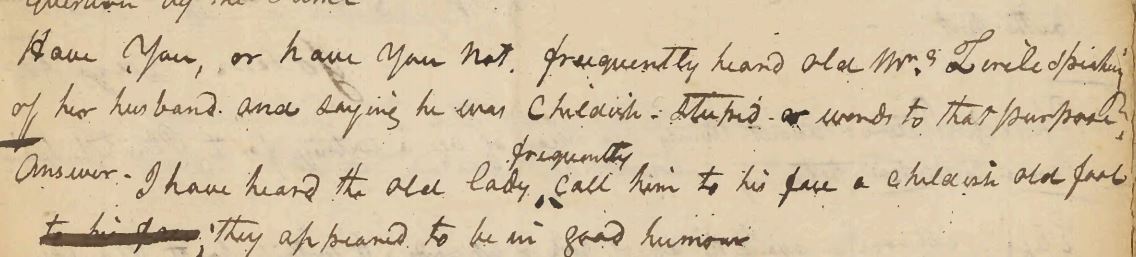
This testimony seems to speak to the issue of bullying. Son Daniel refuses to help his father Lewis, and calls him a childish fool
This testimony states Lewis' wife Mary Magdalene also called her husband Childish and Stupid, but in a playful way
More testimony by a defense witness that the Mrs. Zirkle would tease her husband in a "romancing way".
Here is prosecution testimony demonstrating that Lewis Zirkle could be bullied by his wife. This person had to screen him from her.
According to this Mr. Zirkle was worried about his will being broken before his death.
This witness said he offered a donation of $50 to break the will because it was an "unjust will".
According to this testimony Mr. Zirkle was a kind father but his children did not altogether obey.
According to Mr. Zirkle's Reverend he seemed to be sensible right up to the time of his death
According to this testimony Mrs. Zirkle ruled over Mr. Zirkle.
According to this witness Mr. Zirkle would give in to his family to avoid trouble.

Some of the witnesses may have had conflicts of interest. At least one purchased land from Daniel Zirkle from the estate, and might have to return it if the will was broken. It's tough to know who to believe without Lewis Zirkle Sr.'s testimony?