Wednesday, October 26, 2016

Jamestown Settlement vs Jamestowne Historical site & Colonial Williamsburg


On day two of our bus trip through Virginia, with Trafalgar, we started our day slowly piling out of the bus at the Jamestown Settlement (I should say coach lol. Our tour guide kept saying bus, which is a no, no. She has to pay the coach driver every time she said bus). It was a beautiful morning. I had been anticipating this particular visit for 6 months. I have a mini obsession with Jamestown, and a crush on the archeologist William Kelso. I've been reading and watching documentaries about the history, and the dig, for years. I went over some of the old material about Jamestowne in preparation for my trip.

After all the obsessing about the place I couldn't believe I was finally there. Then I had a rude surprise when I found out that I wasn't. No Jamestowne Settlement is a recreated living history site. My heart sank. We weren't going to the original settlement site. I feel like there should be some sort of explanation at the Trafalgar site regarding the fact you will not be going to the original site. I found out the original site was a mile away. I pulled our tour guide aside and said I would like to leave the group and go to the original site. She said there was no easy way of getting there from where we were. If would be a difficult 1 mile walk. I decided to follow her suggestion, and take this tour, and later get a taxi from Colonial Williamsburg to the original site. 

At Jamestown Settlement we toured a museum before going out to the recreated living history site. I didn't find the museum very interesting, honestly. The guide explained facts that most of us already knew. This museum and tour would be good for school children. We then went out to look at the Native American Village. I thought the recreated hut was interesting (I hear someone's child cried when they saw the dead animals in the hut? Maybe she's from a family of vegans?).


We then headed out to look at the replica ships, which were smaller than I expected. I thought they were very cute. We took a quick tour through one of them. Interesting to see the cramped conditions. I thought the ships were pretty to look at, but I wasn't blown away by them.

After the ships we went to the fort with it's recreated buildings. To me this was the most interesting aspect of the living history settlement. It gives you a good idea of how the earliest Jamestown settlers lived. I wouldn't recommend this settlement museum otherwise.


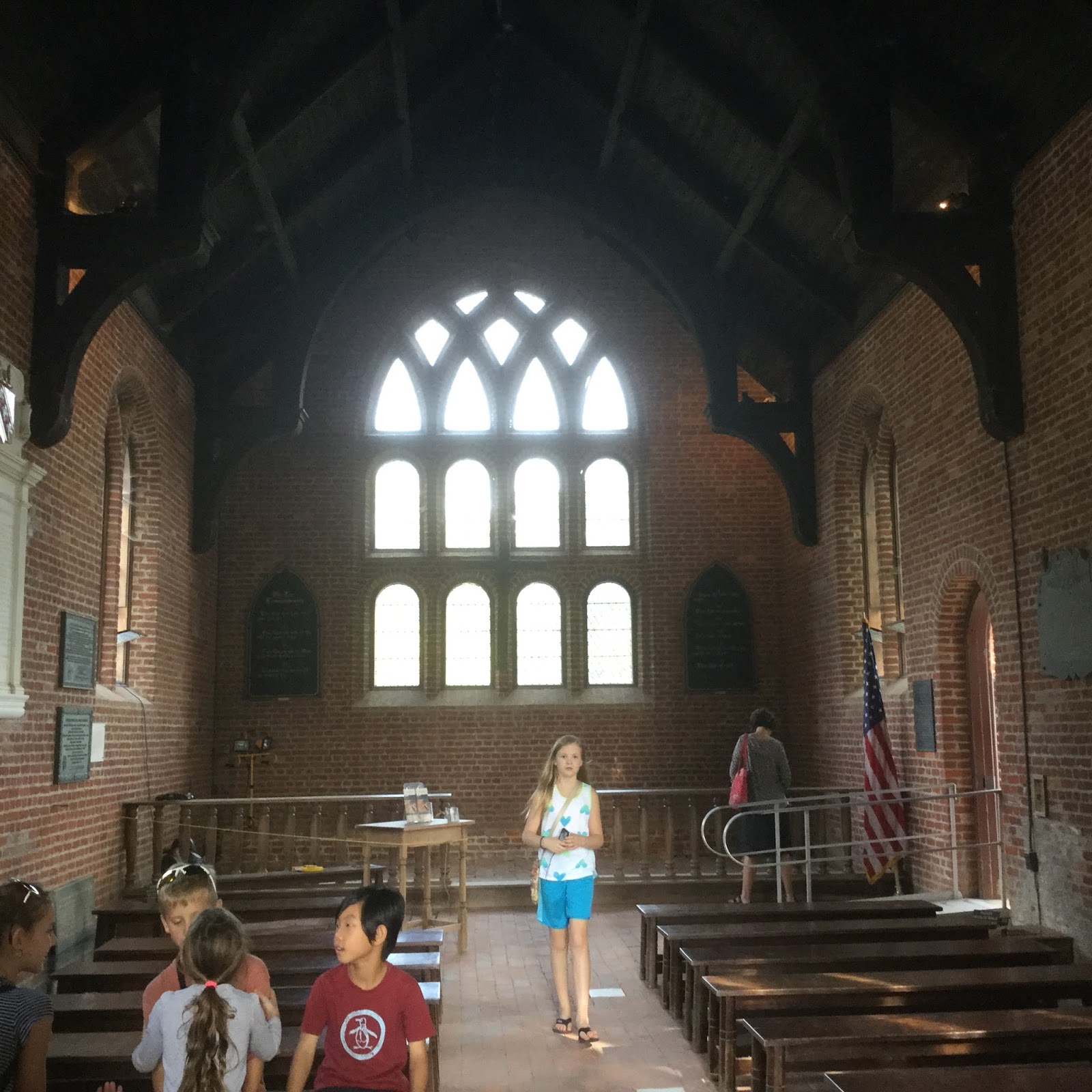
Tiny girl preaching from the pulpit


I wonder how many people visiting this museum settlement realize this isn't the original Jamestowne site? Our guide even seemed to dismiss the historic site as unproven?

We headed to Colonial Williamsburg after Jamestown Settlement. It was still very early since started off so early that morning. I decided to tour Williamsburg before taking a taxi to the original settlement. I loved it!

Williamsburg was relevant to the lives of our Virginia ancestors due to the fact it was the seat of Colonial government. The colonial seat moved from Jamestowne after a fire in 1698. The state house had been located in Jamestown for 92 years.

The Colonial legislative assembly, the House of Burgesses, was the first assembly made up of elected representatives in North America. Their state house was located in Williamsburg.

I first headed toward a church which was closed for a service. I looked around the interesting old cemetery, then decided to head over to the Governor's Mansion, and return to the church later.


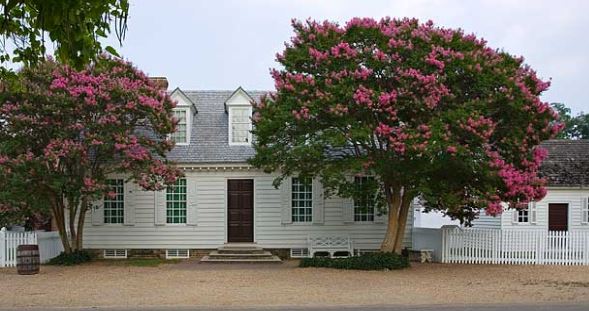
After touring the Governor's mansion I toured one of the remaining original colonial era homes. I toured the Brush/Everhard house which was built in 1718 by John Brush. It still has many original features. Clues to it's early wallpaper and other décor have been discovered beneath many renovations.

The second owner of this home was Thomas Everard who was mayor of Williamsburg in the 1760's.
Wattle and Daub Construction used in Timber poor England
was largely replaced by wood frame clapboard siding construction
in tree rich Virginia  
 
Brush/Everhard House
Surprising bright green color. This is the original color, as are the bright colors at Mt Vernon


After my house tour I walked down to the state house at the other end of the settlement. Another interesting building. I enjoyed the atmosphere and other buildings on my walk over there. It was already 2 pm at that point. If I were going to make it to the original Jamestowne site before closing I would need get a taxi over there soon. I walked back from the state house a little faster. I needed to get to the other end of the settlement in order to get a taxi easily.
 
Even though time was running short I stopped at Bruton Church, which was now open to the public. Another of the original colonial buildings, it was built in the early 18th Century. Early Governor Francis Fauquier is buried beneath the church. The church served as a hospital during the battle of Yorktown.


I took one more look at the Governor's Mansion vista before taking a Taxi to Jamestowne.


I admired beautiful William and Mary College on my way to Jamestowne. Really scenic view going over to Jamestowne. Beautiful homes, and landscape.
 
On my way over to Jamestowne I still didn't know whether I was going to the place called the settlement or the place called the historic site. I told the taxi driver the I wanted to go to the settlement. When we got there I realized I needed to go to the place called the historic site, and I rerouted the taxi driver. The mile drive to the site was through very isolated country side over a bridge crossing swampy land. I enjoyed the drive tremendously. Not hard to envision what greeted the original settlers in 1607.
 
I have not been able to trace any of my family back to Jamestowne. I'm still working out the origins of some of my family in Virginia. I do have a connection to James River as my Revolutionary War Veteran ancestor, Benjamin Wray, stated he was born in James River, Virginia. Not sure what he meant by that?
 
Benjamin Wray born in James River, Virginia?
 
I got to the site at around 3:30. One museum closed at 5 pm. So I viewed that one first. It was small, but so much more interesting than the Settlement museum. It had many artifacts unearthed at the site.
 
Artifacts from the National Parks Jamestowne Museum


The view from the bridge to the historic site is primeval. Loved the views from the bridge.
 
The first thing to greet you on the other side of the bridge is a Tercentennial Monument. It's an obelisk, which was erected in 1907 to commemorate the 300 anniversary of settlement.


The original 1639 tower and reconstructed nave of Jamestowne's Church

1909 Statue Of Jamestowne Governor John Smith


With time marching on I headed over to the other museum on the site. This museum contained more fantastic artifacts, and some human remains found at the site.


The pipes were interesting to see knowing how important they were to dating the site.
The pipes had names carved on them. Great clues for archeologists.


Leaving the museum it was nearly closing time. I wondered if I would be able to get phone reception to call the taxi?


Sadly I got there late in the day and they weren't digging


Last view of the swamp from the bridge on my way out
I could hear many nature sounds including frog sounds
 
I left just as they were locking the place up. I was able to call a taxi from this isolated. I sat out in front for about 20 minutes waiting for the taxi. I worried a little because it was getting dark. A ranger leaving asked me if I was alright? I said a taxi was coming. I was hoping. The walk out of there to the civilized world was over a mile.

I was so happy to see the English style taxi finally arrive. Below I'm heading back to the civilized world.


I arrived back at Colonial Williamsburg just in time for the Fife and drum parade. I was pretty exhausted at that point after visiting 3 sites, walking practically non stop. I rejoined the tour group for a performance at a local church. Slept well that night.

Next time, part 3,  we visit Monticello and a Richmond church.


Tuesday, October 25, 2016

My Trip Back to My Ancestors Virginia Part 1


I went on another tour of ancestral states in late September and early October. I started off staying 5 days in Washington DC where I thoroughly enjoyed learning more about our shared American history. I also learned that the DAR is planning on creating their own subscription website, when I visited their library.

On my 5th day in Washington I joined a Trafalgar tour which took us to historical sites in Virginia, then through West Virginia and Maryland, to Pennsylvania to view more historical sites. Returning to DC we even passed through a portion of Delaware. More states than I've ever been through in my 53 years.

I was surprised by how close all of our destinations were on the East Coast. Driving from where I live near Los Angeles to San Francisco is about a 7 hour drive. Everything is much more spread out here. The route some of my ancestors took from Telford, Pennsylvania  to the Shenandoah Valley in Virginia now takes about 4 and a half hours by car. If they walked that distance it would have taken around 80 hours. It probably took them a couple weeks to make their migration to Virginia.

My ancestors who made their journey from Pennsylvania to Virginia were mainly Germans. Johannes Roller and his wife Anna. Lewis Zirkle and his mother Eva Bear. Johann Roush and his wife Susanna. They all settled in the Shenandoah Valley.

I also have Scots-Irish ancestors who initially settled in Pennsylvania and migrated through Virginia to Tennessee, namely Andrew Forgey and Margaret Reynolds. I believe Andrew and Margaret likely did live in Virginia for a few years, in the 1770's before settling in Tennessee around 1780. Andrew's brother Alexander Forgey died in Virginia.

The Browning family migrated from Maryland, through Virginia, to Tennessee around 1790.

I'm not sure about the origins of two other Virginia ancestral families. My Wray family settled early in Virginia. The associated Thurman family was probably in Virginia in the 1600's.

As we made our way from Washington DC to Colonial Williamsburg I kept my eyes on the landscape which is so different from dry California. I've never seen so many trees in my life.

Our first stop was Mt. Vernon the home of our first President George Washington. Gorgeous location and beautiful home. I really enjoyed my visit. I thought about the fact some in our family have speculated that our Shenandoah ancestors may have seen Washington as he surveyed near their property.


Above George and Martha Washington's Tomb.
 
The slave burial ground is being excavated as you can see below, in order to determine how many slaves are buried there, and exactly where the graves are.
 
Slave burial ground excavation
 

Another part of the slave burial ground.


Of course I had to take a look at Washington's famous false teeth.


After spending a few hours at Mt. Vernon we headed to Yorktown. We spent a couple of hours at a Revolutionary War living history museum. Interesting to see how muskets were loaded and fired. I would have liked to have spent some time in Yorktown itself. That was one of the problems with this tour. It was a very good tour, but we went to a couple recreated sites instead of the original sites. I was going to ask about whether there is a list of Revolutionary War soldiers who were at Yorktown, but forgot. William McPike was thought to have served at Yorktown.


Traveling to Yorktown we passed through New Kent County. I'm still trying to establish descent from Richard Thurmond who lived in New Kent County in the early 1700's.

1704 Quit Rent Rolls New Kent County


We headed for Williamsburg to check into our hotel after the Yorktown tour. We headed to Colonial Williamsburg as a group for dinner at a tavern that evening. Nice ending to a very nice day.


Sunday, September 11, 2016

STR's And YFull

The STR values finally came in for Roger Forgey (descendant of Andrew Forgey and Margaret Reynolds). The STR values provided through the BigY test, and YFull, are said to be less reliable than the original FTDNA markers tests. The Big Y was not designed to be a marker test. It's designed to identify SNP's. Since our terminal SNP at this time is so old, about 800 years old, it isn't very helpful.  I see more potential in the STRs. Although if we had a closer cousin tester to Roger at Y-Full we would get a closer terminal SNP. Sounds like a combination of STR's and SNP's gives you an idea of how far back your common male ancestor lived? Still trying to understand all this.

I had hoped I could compare Roger's 37 marker test with Craig's 67 marker test. I was able to compare more markers; 61 to be exact. This does help. All matched except 3 . Another mismatch was found on a marker in the 67 marker range. The other two were in the 37 marker range. This means they still remain close matches. They probably share a common male ancestor back in the 1600's, as we already know from our paper trail.

I will upgrade my Uncle's test to the Big Y when there is a sale. That should help.

Right now Roger Forgey has 4 close matches on the STRs. Three of the four are Fergusons. The one is not in the Ferguson group, and doesn't have any surname posted. This could be a Stewart? This result makes me think the STR's though more prone to error with this particular test, are accurate enough to establish which matches are closest in time. We believe Forgey is a variant of Ferguson, and these results would seem to point in that direction. Matching up 400 STR's even if a few may be off by a digit would be great.


I have no idea what the significance of having 30 markers difference is at 400 markers? Not sure how far back in time that would put the common ancestor?

It appears that they were only able to get 431 good reads on Roger's STR's, out of 500. An average comparison of about 400 STR's between his matches. With 55 not available for comparison.

Going back to our about 800 year old terminal SNP. Four out of  seven of Roger's SNP I-B3819 matches are Fergusons. Y-Full estimates that the time to the most recent ancestor for I-BY3819 could be from 1250 years to 425 years ago. Not sure how they come up with these calculations which seem to disagree with one another? The Fergusons in the Ferguson group are actually more closely related  to each other with a newer, downstream, terminal SNP of I-BY3821 which they estimate has a Time To Most Recent Ancestor (TMRCA) of 800 to 275 years ago. They could all share a common male ancestor as recently as 275 years ago.

For those new to Y DNA testing SNPs are listed on a Y tree which looks like this:


Those related closer in time have SNP's farther down on the list, or downstream.

The STR's look like this:


The rows represent those tested. The columns are the values on each marker. The value numbers need to be exactly the same to match on that marker.

Upgrading another Forgey test to the Big Y will be helpful. It is very expensive so I wouldn't do it unless there is a good sale. Comparing 400 STR's could prove to be very helpful.

Thursday, September 1, 2016

Strenghthening The McPike And Browning Lines, Indiana and Tennessee


I made out and mailed the "First Families Of Tennessee" application. As I was doing that I was thinking how do we know the Nathan Browning in Roger Browning's 1828 Greene County, TN Will is our Nathan? Our Nathan in Indiana is definitely our progenitor because he and his wife Obedience McPike are named as parents on a couple Browning death certificates and a marriage certificate. I was thinking how would I prove the Nathan in Greene County, Tennessee was the same person as our Nathan in Indiana? This is a common problem the farther back we trace the family. How do we establish someone with the same name in another state is actually our ancestor? It's been a while sense I've looked at the Browning line. For my purposes I was convinced the Brownings in Greene County were the same, and they migrated to Indiana.

We are definitely blood relatives of Nathan Browning and Obedience McPike. My late mother has many DNA matches with descendants of this couple. Here are a few of the lines we match:


Why do we believe Nathan Browning and wife Obedience McPike originally came from Tennessee and specifically the Greene County area? We have the Roger Browning Will stating he has a son named Nathan. There were several Nathan Browning's in the US who were contemporaries of our Nathan Browning. Can we be sure which one is ours? Looking at Census records of the children of Nathan Browning (Nathan died before the 1850 Census contained birthplaces, as did his wife) the older children state they were born in Tennessee. This would support Roger Browning as being Nathan's father since there were no other Nathan Browning's in the early Tennessee records.

Probably the strongest supporting circumstantial evidence is the fact Lina Dayton, named as Roger's daughter in his 1828 will, ends up with her husband Joseph in Pleasant Run Township, Lawrence County, Indiana. The same township Nathan Browning and Obedience McPike lived in.

Roger Browning's 1828 Will Greene County, TN naming daughter Lina Dayton

How do we know Lina Dayton, named in her husband Joseph Dayton's will, is the same Lina Dayton named in her father Roger's will? A very strong piece of evidence appears in her husband Joseph Dayton's will. One of Lina and  Joseph's children is named Browning Dayton. We have to thank Joseph and Lina for solidifying the Browning connection by naming a son Browning!

Joseph Dayton's will Lawrence County, Indiana

To make these connections even firmer Nathan Browning and Obedience McPike had a daughter named Melinda. Lina's name was actually Melinda, this niece appears to have been named after her.

Here we have Melinda Browning/Ramsey 1850 Census
States she was born in Tennessee
 
My mother matched a descendant of Melinda "Lina" Browning/Dayton at AncestryDNA, which provides even more support for our Browning pedigree (we also match a descendant of Roger's daughter Sala Dewes, she was also named in his will).
.
Edna Kapple DNA match

I'm always on the lookout for more information. It would be great if a document specifically stated the Browning's of Lawrence County, Indiana came from Greene County, Tennessee. Haven't found a document with that direct statement yet. The evidence we have is strong anyway.

William McPike is the only McPike I can find on early records for Tennessee. All of Obedience McPike/Browning's children agree that she was born in Tennessee about 1789. Obedience also named a son William. I'm confident William is her father. I'll keep looking for more evidence however.

Everyone seems to have William McPike's wife, and Obedience's mother, as Obedience Holloway. I can't find any documentation to support this? Apparently William McPike and William Holloway built a road in Washington County, according to a minutes book for that county. Not sure what sort of document states that William's wife was a Holloway? I do find a William Holloway on an 1805 Taxlist for Greene County, TN. If she was a Holloway William may have been her brother?

I'm still trying to figure out where in Greene, Sullivan,  and Washington counties the Brownings and McPikes lived. I need to collect up the deeds. It appears William McPike purchased land 140 acres of land from Shadrack Hale (Washington County Deeds book 4, page 23 July 20, 1789). Since William McPike appears on a Greene County tax list in 1783 (Nolichucky Settlers) it appears he was living on land in Washington bordering Greene County? On February 8, 1796 William McPike buys 250 acres of land from William Rosberry. It was located on the Limestone Fork of Lick Creek in Greene County (book 2, page 445 Greene County Deeds). He sold this land December 28, 1796 (book 6, page 156 Greene County, TN Deeds). The following year on Christmas day William bought 220 acres on Tory creek (now Long Creek?) in Cocke County, TN. I don't have any of the actual deeds. I am hoping the actual deeds contain more family information?

As for Roger Browning I don't have any deeds or deed index information. I had associated him with Greene County more than his in-law William McPike. Now it appears William McPike was in Greene County in 1783 with the other Nolichucky Settlers. Roger doesn't appear in Greene County until around 1800. Before that he is living in Sullivan County, where his likely brother Amsey Browning also lived. He first purchased land in Sullivan County in 1789. Apparently the deed says the land is on Kendrick Creek? I'm not sure where his land in Greene County was, but it may have been near his son's land on Caney Branch?

1919 DAR magazine
I've written to the North Carolina Archives to get a copy of William McPike's Revolutionary War file. I think it may just be a voucher? I thought I saw somewhere that he hired a substitute? I may be completely wrong? According to a 1919 article from DAR magazine all of the able bodied men living in Washington County in 1780 would likely have fought at the Battle of Kings Mountain, and some would have went on to Yorktown. The McPike's seem to believe William did serve at both of these locations. There was another William McPike from Pennsylvania who was indeed at Yorktown. Not sure if two William McPike's were at Yorktown?

Naming patterns, Roger Browning's 1828 will in Greene County, TN, documents naming the birthplaces of the Browning family of Indiana, and DNA have been important in establishing our Browning lineage and roots in Tennessee.

I'll be collecting up the actual deeds, and hopefully getting a copy of the Revolutionary War document or documents soon.

Visiting the Sycamore Shoals Museum sparked my interest in finding out
whether William McPike fought at King's mountain


Saturday, August 27, 2016

Proving A Tennessee First Families Line To 1796


I just returned from the "First Families of Tennessee Reunion & Jubilee" 2016 in Knoxville. I had a wonderful time! A distant cousin provided great company, and drove me to all the family sites. Nice since I don't know anyone else in the area. I attended the conference and learned a great deal about Tennessee and Virginia research that I didn't know. I will have to do research in Virginia Civil Parish records now. The yearly property line processioning records could be useful for me. Also I need to find out who the Forgey family landlord was in Co. Louth Ireland in hopes his records contain some family information. The Scots-Irish presentation was outstanding.

I would like to join "First Families of Tennessee" and get the certificate. I'm not sure which line contains the best proof. I will read through the instructions for acceptance carefully before submitting an ancestral line. I have two, out of 3, lines which should qualify. One line is my Roger Browning line. My other line would be the Andrew Forgey  line. The Forgey family was in Tennessee by 1780.

Here is the proof for the Andrew Forgey ancestral lineage:


The obituary is proof my ancestor Andrew was in Tennessee in 1794. Although probably not the best proof since this is a secondary source.  
 
Circumstantial evidence points to a Hugh Forgey being Andrew's father. All other Forgey couples in Knox County have identified children. Hugh Forgey and Catherine Fisher are the only couple living in Knox County at the time of Andrew's birth without identified children. Also, Andrew had a brother Archibald who appears to have been named after Hugh's father-in-law Archibald Fisher. And my ancestor Hugh Forgey, Andrew's son, appears to be named after his grandfather Hugh Forgey. My Andrew born 1794 would have also been named after his Forgey grandfather. Hugh's name first appears in Tennessee records in 1786, when he signs a petition for the division of Sullivan County. Hugh's parents were Andrew Forgey and Margaret Reynolds. Andrew Forgey was granted land in Sullivan County in 1780. 
. 
Every US Census Andrew Forgey, born 1794, appeared on states he was born in Tennessee 


A Forgey family bible lists my ancestor Hugh Forgey as Andrew Forgey, born 1794's, son.  (it does not date to the time period, but instead contains entries transcribed from another older family bible along with contemporary mid to late 1800's entries)
 
The above bible entry is proof of descent from my ancestor Hugh Forgey, son of Andrew.
 
The next link in the chain to myself would be Hugh's son William Wray Forgey. I have Hugh's will and a Census record to prove this link.


William Wray Forgey's son Charles Lynn Forgey was my Grandfather. I would establish the link between Charles and his father with the 1910 US Census.
 
 
I would establish the relationship between Charles L. Forgey and his daughter, my mother, Edna with the 1940 Census.


I would use my own birth certificate to prove my relationship to my mother.
 
Proving the Browning line would begin with Roger Browning:
 
The East Tennessee Historical Society already has an approved descendant of Roger Browning. I don't need to prove Roger was in Tennessee prior to 1796, since this is already established. The First Family descendant of Roger used a 1789 deed for Sullivan County, TN as proof.
 
I would use Roger Browning's will to prove Nathan was his son:
 
 
My Ancestor Richard Washington Browning was a son of Nathan. I would use Richard's death certificate to prove that relationship. I can't find this document, unfortunately, so I will order another copy.
 
I would use my Great-Grandmother Isis Browning-Forgey's Obituary to prove her relationship to her father.
 
 
If that isn't enough I also have Isis Browning-Forgey's death certificate.


From here I would use the 1910 Census, 1940 Census, and my birth certificate.
 
William McPike:
 
Another early Tennessee settler ancestor of mine would be William McPike. I'm finding several problems with some of the research I've found posted about him. There does appear to be a payment voucher for him located at the North Carolina archives. The payment was made out to someone living in the Tennessee area, voucher #59, folio 2, special cert #3437. It is most likely for my ancestor William McPike. He is said to have fought at the Revolutionary Battle of King's Mountain. That is possible, but I thought I read somewhere that he hired a substitute? Also several people have stated he was at the battle of Yorktown. I believe that was a different William McPike. That man was fighting in a Pennsylvania regiment, not a North Carolina regiment.
 
If I were to use William McPike as my "First Families of Tennessee" ancestor I have no idea how I could prove my ancestor Obedience McPike's relationship, other than some circumstantial evidence? It looks like a number of William McPike's descendants have applied for membership in the DAR. I could order a packet of supporting documents from the DAR to see how William's children were proven?
 
I will probably join using my Roger Browning ancestor since my mother was most interested in the Browning line. I think she would approve.


Monday, June 20, 2016

At A Standstill With Autosomal DNA

Don't mistake my post as criticism of autosomal DNA. It's a very useful test. However to make use of it for genealogy purposes we need to map segments. If you are looking for your parents, siblings, 1rst cousins mapping isn't necessary. Adoptees can get results without mapping segments. Genealogists, generally, are not looking for close relatives.

The problem I've run up against is the DNA testing company with the most good matches doesn't provide exact segment information. Everyone knows this is AncestryDNA. What I have managed to do is reconfirm, over and over, that I am indeed related by blood to several paper trail ancestors.

23andMe isn't much better. They have a great chromosome browser, and now they have a great common match feature, but they don't have a way to post a tree at their site. No trees means not much progress using their site. I have, however, been able to collect some segments for my DNA mapping, which sure beats AncestryDNA. Family Tree DNA is a bust now too, because they have failed to attract enough testers. I haven't gotten a good match with them in a long time. I have in the past been able to collect some important segment data. Now that Ancestry is dominating the market for DNA testing Family Tree DNA seems to have had a steep decline in the number of testers.

Everyone says just ask your AncestryDNA matches to compare at GEDmatch. I have not been lucky enough to have many agree. My top matches, generally, have not to date agreed to upload to GEDmatch. Without being able to map my chromosomes with large segments from 2nd to 3rd cousins it's impossible to confirm where the smaller segments come from. I could put together a great chromosome map if only AncestryDNA somehow provided a chromosome browser. I would love to resolve a brickwall on my Campbell line using autosomal DNA, but can't without a chromosome map. Establishing exactly which segments relate to which families is critical to success with autosomal DNA. This can't always be done if, for instance, you are from an endogamous population. I do have ancestors who were French Canadian. This population is very interrelated. The French Canadian segments are useful anyway. They tell me these segments came from my maternal Great-Great Grandfather. Aside from the French Canadian line my family isn't endogamous.

Recently I'm noticing some matches sharing substantial amounts of DNA at AncestryDNA, such a 91 cM share. I know exactly how we are related since the match has a tree posted. I'm hoping that this match agrees to upload to GEDmatch. This alone won't be very helpful, however, without many more matches also sharing their segment information. It's the aggregate segment data that is so powerful when it comes to using autosomal.

AncestryDNA cites the danger of matches discovering inherited disease information about a match through segment data as the reason they will not provide exact segment info. I'm afraid without the exact segment information the test isn't very useful for genealogists.

AncestryDNA really painted themselves into a corner by not providing the ability to share segments early on. They've decided to ignore this important tool and provide New Ancestor Discoveries and Circles. I've written in my blog about how a 4th cousin and I shared some of the same NAD's. This line has a brickwall too, so  I was very interested in the origins of the NAD matches. I tried to workout how we were all possibly related. Those NAD's have now been removed by AncestryDNA. I guess we aren't likely related after all, or at least within the genealogical time frame. This waste of time could have been better spent mapping chromosomes.

I'll keep trying to persuade AncestryDNA matches to upload to GEDmatch. Otherwise I will remain at a standstill.


Tuesday, May 10, 2016

To Phase Or Not To Phase? Plus, She's Back?

My to Quack or not to Quack souvenir  from my recent vacation


That is the question...

Is the phasing and filtering AncestryDNA does worth the extra processing? I've wavered about this for years. It sounds like a great idea. On a theoretical basis it is. In practice not so much. The phasing AncestryDNA does attempts to use haplotypes to separate the DNA we inherit from each parent. The results are also filtered in order to remove matches who share population segments. When I listened to an Ancestry representative explain the haplotype method she did say there was an error rate with the phasing. Some haplotypes haven't been encountered before. Removing population segments, with filtering, isn't helpful for me since these segments at least tell me which ethnic group a segment comes from.

A recent update to the AncestryDNA product has many discussing the merits of this companies approach to matching. An issue was brought up at the Facebook ISOGG group which I hadn't noticed. Before the recent AncestryDNA update parents and children were said to share up to 90 segments of DNA. According to the other companies around 30 segments are shared. This vast discrepancy is due to the fact Ancestry's phasing and filtering chops up segments. The recent update has brought the number of shared segments down to the 50's. Still many more than the other companies.

I've posted about the fact that during AncestryDNA's previous update, when Timber was introduced, a 3rd cousin went missing. I checked to see if she was returned immediately after the update finished. I didn't see her listed as a 3rd or 4th cousin so I assumed she wasn't returned with this update. Going through hints yesterday I found her. She has returned. She is listed as a 5th to 8th cousin now. What does this tell me? First of all the prediction is off. Secondly it tells me the AncestryDNA product is still in a state of flux and who knows what will happen with future updates? Apparently someone can match you today, and may be removed in the future, just to possibly be returned somewhere down the line?

I didn't find that any close matches were removed this time. I did find several distant cousin matches had been removed. It's possible these matches do match DNA wise? AncestryDNA states it is possible good matches were removed.

I would rather see AncestryDNA do away with the phasing and filtering. Shuffling matches in and out of our lists doesn't make any sense. It's just confusing. Does the phasing and filtering improve match results? Not in my case. Predictions at the 3rd cousin range and beyond are impossible to get exactly right. I'm not even sure if phasing and filtering helps improve predictions for closer cousins? What it can do is remove good matches.

One thing is certain, every time AncestryDNA updates results they get publicity. As someone once said "there's no such thing as bad publicity."