Wednesday, November 12, 2014

"Finding Your Roots" Ep. 8 & The Autosomal DNA Tangle: Is AncestryDNA Right?


I really enjoyed episode 8 of "Finding Your Roots" focusing on British ancestry. I love to watch anything involving the British Empire. I mostly watch British TV programs when I watch TV. I've read more British novels than American. I have not found any proven English ancestry and would love to find some. I do have Scottish and Irish ancestry.

Sally Field's ancestry was the most fascinating. Some of her ancestors were loyalists, and one of her several times great-grandfather's was executed for treason during the American Revolution. His wife took the opportunity to relocate to Canada where she could receive free land for her family's loyalty. Sally Fields also has Mayflower ancestry that she was unaware of. One of her ancestors was a leader of the Plymouth Colony for many years, and presided over the first Thanksgiving. Sting's ancestors' lives revolved around the shipyards in England. He also had mariners in his family. The sea played such an important role in British history. Britain being an island meant they relied on sea trade to bring in commodities not available on the island. One of Stings ancestors was drowned, along with the rest of the crew, when their ship sank. Shipping was also important when it came to the lucrative Indian trade. Deepak Chopra's family benefited from the British colonization in some regards, but also suffered from some of the repercussions because of it. Deepak's father became a renowned Physician with the assistance of the British Governor of India. He was able to attend Medical school in Scotland which was a center for cutting edge medical training. When the British pulled out the unrest and relocations which resulted did negatively affect his family. As his Grandmother said the British came into India and reduced the native population to servitude  which caused the native population to lose the advanced knowledge they had previously attained. It would take generations to regain that knowledge.

Sally Field seemed to have traces of Native American ancestry in her DNA? Very likely to be true considering how long her ancestors have been in America

Rethinking the use of Autosomal DNA. I knew there were minor differences in segment size when looking at them in the company sites as compared with GEDmatch. I thought they were mostly slightly off, which is generally the case, but as I've now learned from a co-administrator of GEDmatch there can be significant differences (according to Family Tree DNA the differences are insignificant?). Entire segment deletions can occur. So this leads to the problem of who's numbers do you use when calculating relationships? If 10 cM segments and over are 99% IBD, and under that a significant number are IBS, then what if GEDmatch pronounces a segment to be over 10 cM's but Family Tree DNA has it significantly under 10 cM's? AncestryDNA has a point when they caution people about third party comparisons. The companies use complex calculations rather than just  cursory segment comparisons. They have better resources than the 3rd party citizen scientists' sites. I would still like to see a chromosome browser at AncestryDNA. If they had a chromosome browser at their own site they could oversee it, which would insure the segments are in line with their own findings, instead of risking misinterpretation at a 3rd party site.

AncestryDNA leans heavily on the often inaccurate trees, posted by testers, to suggest relationships. These tree connections can be wrong. Right now I'm dealing with a problem related to an AncestryDNA suggested relationship to a low confidence DNA match. This low confidence match is somewhat of a contradictory finding. A cousin of this Forgety match had taken the Y DNA test and did not match our Forgey testers. We assumed the close spelling of the name and proximity of the Forgetys and Forgeys on the map led to the mistaken idea they were related. This low confidence match of a Forgety to my Mom, who is a Forgey, is leading to speculation that there is a relationship after all. Since we cannot see how much DNA we share I'm not certain how valid this match is? Plus I noticed they have a Campbell line in Tennessee, and our Forgey line has a Campbell line said to have come from Tennessee.

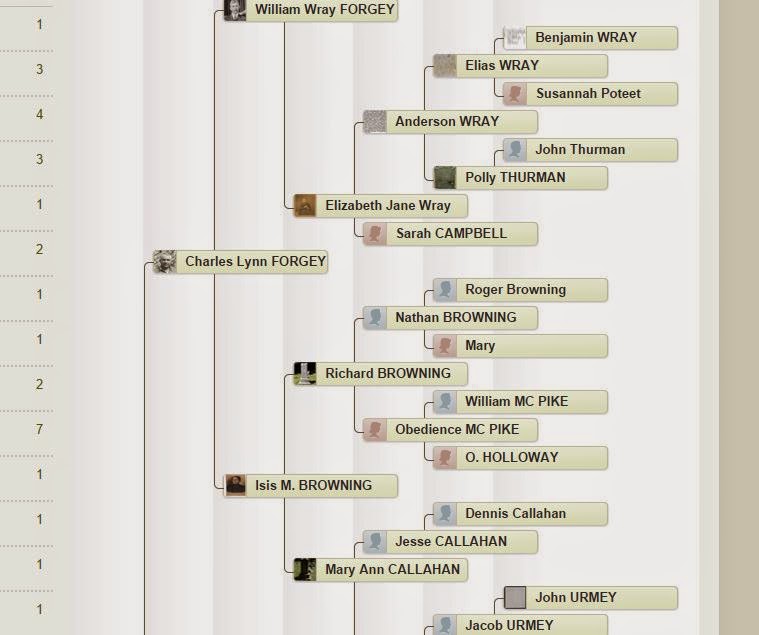
So the problem making connections with the trees is few of us have trees going back 7 to 10 generations on every line. Sarah Campbell is actually only 4 generations from me, and 3 generations from my Mom. We don't know anything at all about her parents or ancestors. The only thing I have to go on is that Sarah Campbell/Wray lived in Indiana, while married, and died in 1847 at a young age. Her only child to live long enough to give an opinion on her place of birth was Polly T. Wray/Hall. She lived until 1920 and always claimed her mother was born in Tennessee. She was only 6 yrs. old when her Mom, Sarah, died. This leaves me with some uncertainty as to whether she would have any first hand source knowledge about where her mother was born?


We are in for a very interesting several weeks at AncestryDNA. No new matches will be posted until the reprocessing of over 500,000 tests is complete. In a couple of weeks from now we should be seeing the new results with the "false" matches eliminated. This could either turn out to be great or could be a complete disaster? We'll see. Read more here.

I'm getting ready to plunge into a Time magazine special publication called "How DNA Shapes Your Life". I just got it today.

Tuesday, November 11, 2014

Happy Veterans Day 2014 To All Veterans!


It seems like I always make progress on my Family's Veteran ancestors around Veterans' day. Maybe it's because the genealogy sites promote their military collections around this time of year. My grandfather was a Veteran of WWI. He has come to mind especially this year because it's the Centenary of WWI this year.

 This time another event spurred further research into our Military history. I was so peeved that my great uncle William Kappel was misidentified by the Margraten  Netherlands American Cemetery site that I was forced to gather more information about him to prove he was indeed my great uncle. As I stated in the past my Kapple grandparents divorced and my grandmother brought all of her children to California in the late 1940's. Her ex husband, my grandfather, remained in Illinois and remarried a couple times. My father didn't talk about his father or his father's family very much, unless I asked. He never mentioned his uncle William was killed in WWII. My dad was always interested in WWII history. My mom and I were forced to sit through many documentaries about WWII. He probably knew his uncle was killed and just never wanted to talk about it.

My genealogy obsession began in the late 1990's when I started searching for more information about the Kapple line. Early on I found out  my grandparents changed the spelling of their name from Kappel to Kapple. I was so surprised when I found out my grandfather Rudolph was from a family of 11 (now I hear possibly 12). I then gathered up all the information I could find online about his siblings. I found most of his brothers in the Social Security death index. It was then that I found out William Kappel had died in 1945. I was pretty certain that entry was his because the date of birth was exact.

I asked my aunt June if William may have been killed in WWII? She said yes he was and his widow and her grandmother were locked in a battle over benefits after his death. Before the war William had been living with his mother in the family home along with his wife and son (just like my own grandparents lived in the Kappel household for a few years). William worked as a steel inspector at a steel mill in Chicago before the war, along with his brother-in-law. Mary had relied on her youngest son a great deal after the death of her husband in 1937; which was why she felt she was entitled to benefits when he was killed at the end of the war. The detail my aunt June provided left little doubt that the William Kappel who died in 1945 was my great uncle. A few years after I identified him I found out he was buried in the Netherlands American Cemetery. That puzzled me because aunt June said he was killed in the South Pacific? At  this point I did more research and discovered the soldier buried at that cemetery was from Chicago, Illinois and was Catholic like my great uncle's family. I could find no other William Kappel's sharing his birthdate who were killed in the war. I felt confident the man buried in that cemetery was my great uncle.

I've always wanted more information. A few years ago a Facebook friend found a battalion history which gave a narrative of the circumstances of William's death. He was killed at the end of the war when he was pursuing a sniper. Another Facebook friend, and distant cousin on my Forgey line, visited the Cemetery this past summer and took some great photos and a rubbing of William's cross. All of this added information has been so rewarding!

My quest to prove William Kappel was my Uncle beyond a reasonable doubt led me to consider writing for his Social Security application which would contain his parents' names. Since a few years ago privacy laws were tightened requiring proof of the applicants death, and his parents deaths, it has become more difficult to unlock that information.  I was assembling the needed information when I stumbled on some evidence which met my own standard of proof. It was the application for a grave monument. William's widow's name was given as Belle Kappel which was also the name of his wife on the 1940 Census when they were living with my great-grandmother Mary. My father's birth certificate contained the same address in 1933. This is good enough evidence for me. I'm satisfied. The cemetery site has changed William's parents from Gabriel Kappel  and Rose Kappel to my great-grandparents Frank and Mary Kappel. The wrong family was added to William's page from an Ancestry.com tree. The mix up was a good thing because it got me searching again, if I had not taken up the search again I never would have found the wonderful original documents posted at Ancestry.

Why my great uncle appears on a  National Jewish American Board record is a mystery? He was likely part ethnically Ashkenazi, but the family was Catholic for at least 200 years. My grandmother Kapple said the name Kappel was generally perceived as Jewish. The surname may have led to the mistaken belief that he was Jewish?

The entire research journey with William Kappel has been very rewarding. I appreciate his service and I'm honored he is my Great Uncle.

I would like to hear from William's son Ronald Kappel born around 1937 in Chicago. That would really be the icing on the cake!

Happy Veterans' Day to all Veterans!


Saturday, November 8, 2014

GEDmatch Says 14.7 cM's FTDNA Says 8.68? Who's Right?

Our Owens match contacted me yesterday. I found out that I was comparing with the exact same kit at GEDmatch as the one at FTDNA. So there was a 6 cM difference in the segment my Aunt shared with this match on chromosome 19. It could have something to do with the fact this kit was a transfer from AncestryDNA to Family Finder at FTDNA?

I have no idea why the results look so different at GEDmatch? I don't know if FTDNA is more accurate or GEDmatch? I just know the results don't match. If GEDmatch is less accurate than the testing companies than it may not be a good place to compare AncestryDNA results? It may be better to transfer your results to FTDNA and compare there. Although it may be that errors occur when raw data is uploaded to FTDNA? However I have compared with other transferred kits and don't see any unusual results?

Like I said before there are always slight differences in the cM numbers at GEDmatch. If anyone else has seen a cM difference of 5 or more on a segment please post a comment. I'm curious about how often this happens?

Friday, November 7, 2014

GEDmatch Segment Size May Be Different From That Reported by Your Testing Company


I found a long  awaited match on our Owens line at Family Tree DNA yesterday. This person evidently transferred her results to Family Tree DNA immediately after this service was announced in October. I copied her email address and went to GEDmatch to see if she appeared in my Aunts results. I found her listed with two kits. I compared her two kits.  Both kits showed identical results with my Aunt. Compared against my Aunt at GEDmatch I noticed their longest shared segment was 14.7. Her longest segment with my Aunt at Family Tree DNA was reported as 8.68?

A basically 6 cM difference. I've emailed this match to be sure we're comparing apples to apples. If there really is a 6 cM difference for the result on 19 (see their charts below) then there is a big problem somewhere?

Comparing results from Family Tree DNA, 23andMe, and GEDmatch there is a consistent 1 cM difference at GEDmatch with the occasional 3 cM difference. I checked to see if 23andMe was any closer to GEDmatch, but they also differ by 1 to 3 cMs (see above). I don't know how well 23andMe results compare with Family Tree DNA outside GEDmatch?

If we're using cM's to determine our relationship to a match and to triangulate it's important to have consistent numbers. Hope we can eventually compare with equivalent, agreed upon, standards. Right now I don't know whether I should accept the 14.7 result as correct or the 8.68 result? Or are we looking at different kits? Hoping to get answer soon?


Wednesday, November 5, 2014

DNA News: "Finding Your Roots" Episode 7 and Tying Loose Ends

Chart pinpointing DNA matches

Episode 7 of "Finding Your Roots" featured guests with Jewish roots. It was a very moving episode because of the stories of the persecution of the Jewish population in the 19th and 20th centuries. Ancestors of the guests were forced to leave their homes because of the poverty and persecution they suffered in Eastern Europe. The Nazi officials were psychopaths which was clearly demonstrated by the fact that a massacre they carried out, in which some of  Tony Kushner's ancestors were murdered, was called a Wedding and those murdered guests. I'm not a fan of Alan Dershowitz at all. It's to his credit that his firm aids the underprivileged; but, the fact he represented a heinous  murderer, OJ Simpson, is unforgivable. Alan's family was quite gifted at working the system and were able to rescue some relatives from the Nazi's. Carol King's story demonstrated the difficulty of tracing Jewish ancestors in Eastern Europe because, as explained, few records survive. She was extremely lucky that some records for her family were found which took one of her lines back to the 1790's. So never give up even though you've been told it's unlikely the records survived. Also Carol's family had a complete change of surnames which adds to the challenge of tracing the family.

A statement made by Prof. Gates about it being more convenient to convert to Christianity made me think about my own family. I believe my family converted to Catholicism because of persecution. I also believe they became very committed Catholics. One of my Great Grandparents' children was named Francis Xavier which demonstrates a deep affinity with the church.

I missed the fact Episode 7 didn't feature DNA results. I just finished listening to a webinar about "Finding Your Roots" and understand that episode 10 will focus much more on DNA testing, which should be interesting. Another interesting fact is 3 to 4 hours of interviews with guests are shot for each episode. According to Prof. Gates all of the guests are overjoyed by the family information they get from the show. Like most people the guests have a personal knowledge of their family history going back only a generation or two.

The changes to AncestryDNA are coming soon according to their blog. Another AncestryDNA blog post referring  to the issue of IBS matches stated that cousin matching using their current technique produced too many false matches for Hispanics and Jews. This is probably why I have so many Mexican matches when my family came from Nicaragua. Similar over estimations were found with other ethnic groups. According to the AncestryDNA blog we will be notified regarding downloading our current match information so we can keep the notes etc. on our current matches.

I've been slowly listening to the i4GG conference videos. I watched the "Getting the Most from AncestryDNA" presentation the other day. Using a fan chart to see where your matches are on your tree was a great idea I got from this presentation. It clearly shows that most of my matches are out at 5 generations and beyond. This is because we have fewer close cousins.

Another highlight of the "Getting the Most from AncestryDNA" presentation was the portion about admixture. The presenter showed her admixture results side by side with her sisters. Of course these results seemed to match up as expected (an employee of Ancestry wouldn't show any that didn't).It was so funny when someone asked from the audience what if a child had more Irish admixture than both her parents? Of course this got a laugh from the knowledgeable audience. This wasn't easily answered. It was only explained that admixture was still being worked on.

I have really enjoyed Hoosier Daddy's blog posts. His November 3 post really hit home. His experiences communicating with matches are so relatable. I've often noticed the same thing he discovered, that many of my matches on certain couples are actually close relatives to one another, who may have tested together. I've had relatives tested and so have many other people, so multiple matches with one ancestral couple actually come from a single descendant line.

Hoosier Daddy's post also made me wonder if telling matches you are looking for adoptee information is a good idea in your first communication? I'm thinking some people may be fearful of becoming involved with a possibly  touchy situation?

I'm impatiently waiting to see what happens with the AncestryDNA changes and also waiting for another sale on their kits.


Wednesday, October 29, 2014

DNA News: Episode 6 of "Finding Your Roots" & 7cM and 700 SNP Threshold


Episode 6 of "Finding Your Roots" was another interesting episode. The theme was enslaved ancestors.  A highlight of the episode was the slave receipt for one of Nas' ancestors. I've never seen one of those before. Valerie Jarrett turned out the be 49% European, which wasn't surprising. She was surprised that Native American ancestry showed up in her DNA ethnicity results. She came out to be 5 % Native American. Her slave owner ancestors were wealthy, willing and able to cultivate her ancestor's intellect and provide materially for him. One of her ancestors attended MIT. It was uncommon for the mulatto children of slave owners to be treated like their legitimate children. It was very nice to see how the former slave couples legalized their informal slave marriages after they were freed. This episode gave substance to people who were often just nameless property while enslaved.

Two whole people , so far, at AncestryDNA agreed to compare results with me at GEDmatch. These matches pointed, again,  to the problem of the too strict criteria for matches at Family Tree DNA. I had around half a dozen people to compare these matches with. When looking at the total cM's, even turning down the shared cM's to 1, some of these matches would not pass the strict matching requirements at Family Tree DNA, even though they do share DNA segments over 10 cMs and have a proven paper trail relationship to my family. The 14.1 cM segment illustrated here is an example. I found other good matches that don't add up to 20 total cM's either. I think the 7 cM and 700 SNP threshold at GEDmatch should be a model for the testing companies to follow. They can rank the matches according to their own system, but please give us all of our matches that fall in the 7 cM and 700 SNP range. Family Tree DNA is great for identifying parents and close cousins, but as a genealogist I'm interested in more distant relatives.

I watched this great video which featured a presenter from AncestryDNA. It's filled with interesting information about their DNA testing program. The number of kits being processed every month is staggering! They process 30,000 to 50,000 kits per month.

I'm not completely emotionally prepared for the coming changes to our match lists at Ancestry. When I saw the new DNA symbol on the Ancestry matches' pages I jumped. I wondered if that meant we would see the changes Ancestry has been promising sooner rather than later?  I'm hoping we don't see another Family Tree DNA scenario with limited matches. I'm hoping it's more like 23andMe, which has a reasonable threshold similar to GEDmatch.

I've been continuing to create chromosome charts with segments from our matches. I'm collecting Forgey surname related segments. I used a suggestion from Kitty's blog to name the segments after ancestral couples. Here are the people the Forgeys came from.

Wednesday, October 22, 2014

DNA News: Two Outstanding Genealogy Shows And Evaluating Matches

Last night I binged watched two excellent family history shows. CNN's "Roots Our Journey Home" and PBS' "Finding Your Roots". Didn't go to bed until 1 am (again).

"Finding Your Roots" episode 5 was one of the best of the this season. Celebrity chefs were featured in this all male episode "The Melting Pot". My Mom loved the show "Simply Ming" so he is very familiar to me. Great to see the role his family played in Chinese history. His enormous family tree was great to see rolled out. Wonderful that a stele with his ancestor's names was the only one which survived the cultural revolution in his particular ancestral location. He is very fortunate. Tom Colicchio's immigrant ancestors were much like mine. My Great-Grandmother traveled back and forth from America to her Village in Austro/Hungary. Her husband was working first in Allentown, PA then Chicago, Ill. She often made the trip with several small children accompanying her. Aaron Sanchez' family's roots are in Sonora Mexico, not far from border with the US. The family was a target of hostility during the Mexican Revolution which forced the family to flee with their large herd of cattle to the US. Aaron's DNA results were very interesting to me since I have some Central American heritage. His mix of European, Native American and African were typical for Central and South America too.

The "Roots our Journey Home" show on CNN borrowed heavily from "Finding Your Roots". The Anderson Cooper segment repeated many facts first presented when he was a guest on "Finding Your Roots". It was interesting to see Anderson visiting family graves. I thought this show was a nice mix of emotionally connecting with ancestors and tongue in check segments. They also used DNA results to fill in the blanks.

23andMe Zombies
It was announced this week that 23andMe would be partnering with My Heritage. If they integrate the trees with the DNA results like they do at AncestryDNA it could make 23andMe a more useful resource. The biggest problem at 23andMe is the lack cooperation of those who have tested with them. More than half my cousin's matches won't even share their own names let alone any ancestral surnames.

Last week a test result came back for our Owens line. Sadly Ancestry doesn't release segment information. Fortunately a descendant of John Melvin and Mary Redden (my fifth great-grandparents) agreed to compare with us at GEDmatch. We compared with his grandmother and him. We shared varying amounts of DNA from as small as 4.6 cM's up to 50 cM's total. We can now call a segment five of us share on chromosome 1 a Melvin family segment . We are all around the fourth cousin range relationship to his grandmother. After doing a few comparisons of Ancestry results at GEDmatch  I'm finding their prediction process occasionally works, but some valid cousin matches aren't showing up as close matches? Also some of the high confidence matches aren't as good as they look when you compare at GEDmatch.

The Family Tree DNA process for determining matches isn't any better. The scientists at Family Tree DNA aren't as well versed with autosomal DNA as they are with Y and mtDNA. As one of them stated at an ISOGG presentation, paraphrasing, what I tell you now may turn out to be wrong in hindsight. From a past presentation by the founder of Family Tree DNA his scientists don't believe autosomal DNA is useful beyond 4 generations. That demonstrates a lack of knowledge of the subject. Most of our matches are at 4 generations and beyond. Their use of total shared cMs as a criteria for determining matches causes many good matches to be discarded. Looking at my proven matches at Ancestry a few haven't shared the 20 total cMs required by FTDNA. I can't find any common ancestors with most of my Family Tree DNA matches. If they eliminated the 20 cM requirement and instead gave us all our matches sharing 7 cM segments or higher it would help us find more cousins.


John Melvin and Mary Redden were my 5th Great-Grandparents
I've assigned chromosome 1 to them


Saturday, October 18, 2014

DNA News: Episode 4 of "Finding Your Roots" & Overwhelmed With New Information


Episode 4 of "Finding Your Roots" was another interesting episode with fun DNA results. The episode theme was Civil Rights and Freedom. Ben Affleck's mother was a Freedom Rider in the 1960's.  It was so funny to hear the former President of the NAACP, Ben Jealous, is mostly white only 18% African. On the flip side Khandi Alexander had more African than she expected, she seemed to change her identification from black to African. The most moving story in this episode was how one of Ben Jealous' ancestors purchased his freedom, and that of his wife and children. He was able to do this because he was a trained shoemaker, an unusual occupation for a slave.

It was great to see an explanation of how DNA testing works in this episode. Instead of showing the stock film blood vials they showed the accurate testing process and explained that saliva was used. I'm sure more people would pursue a saliva test rather than a blood test. I hope this encourages more people to test.

Looking at Ben Jealous I could predict he had a high percentage of European. Another guest on a previous show was quite dark complected and turned out to have more European than he expected. This brings me to my current projects. Predictions based on appearances can turn out to be correct or incorrect. The genealogical proof standard requires inferences drawn from appearances to be checked out by doing a reasonably exhaustive search. I'm turning more and more to DNA to support my inferences.

In  mid 2001 I began focusing my genealogy research on the Mason family line. I found some information about the family posted on message boards, which were the popular social networking media at the time. I received some great leads from a 3rd cousin, Sophia Preston. She posted some information about our common Mason line. She referred me to another Mason researcher with additional information. With their help I discovered the locations of our Masson family in Quebec, Canada. It was easy to trace the family back hundreds of years due to the fact that transcriptions of the extensive record collections in Quebec were available online at this point.

After quickly putting together a huge family tree for the Mason line I moved to my ancestor Peter Mason's American wife's family. His wife was Mary Owens. That's what I started with in 2001. I had a great lead on her parents when I found two of her sister's living with the Mason family in 1880 in Mattoon, Il. It was easy to find them  living with their father in 1870 in Mattoon, Il. His name was William F. Owens. I later found a Nancy Owens wife of William F. buried in a local cemetery. She would have been in the right age range to be the mother of my Mary Mason, and her siblings. Their mother was not in his household in 1870, she was probably the Nancy I found in the cemetery who died in 1865?

According to the children of William F. he was born in Kentucky, and their mother was born in Ohio. I looked for a marriage for a William F. Owens to a Nancy. I found such a marriage in Clermont, Ohio. A William F. Owens married a Nancy Hicks in Clermont, and they matched the Census description regarding where they were born. I found them in 1850 with two sons , James H. and John W. living in Clermont, Ohio. From there I looked for them in 1860. At that point in time the online Census information was sparse and the search function didn't always show matches with similar names. It took many months before I found them listed with the name spelled Owen and initials used instead of full names. I found Mary and all her siblings including James H. and John W. from the 1850 Census. These eldest siblings had disappeared from the area in Mattoon, Illinois early on.

By March 2002 I was able to find proof that Mary's mother's maiden name was Hicks. It came from a marriage record for her sister which listed her mother as Nancy Hicks, and her father was listed as William F.. Her own marriage record from a decade before did not contain her parents' names.

It wasn't until fairly recently that I found out what became of William F. and Nancy's eldest sons. I found some information about them at Find-a-grave and made contact with descendants through this site (you can read my 2012 post here. I later exchanged info with Pam and Justin.) I also found more information posted in Ancestry trees. Pam and Justin provided me with loads of additional information. I also discovered that one of the male Owens in my line Y DNA tested which helped confirm some of my inferences about this Owens ancestral line.

I was fairly confident I had traced this line correctly. I was a little apprehensive because I didn't have very much info about my Great-Grandfather Mason. I had heard he was French Canadian and used this knowledge to find his family in the Census. I believed I found him with the correct family. I had not known that he was originally from Mattoon, Ill. I was only aware of the family living in Chicago. I asked an Aunt and she said she believed I was on the correct track, and he was from Mattoon.

All of my apprehensiveness disappeared when the third cousin I had located on the message board years earlier tested at 23andme. We compared at GEDmatch and there was absolutely no doubt we were from the same Mason family from Mattoon. We shared more DNA than most third cousins. So the Mason line was confirmed with DNA.

Darrell Owens 3rd cousin 1x and me
I purchased an AncestryDNA kit on sale in August. I decided to give it to an Owens/ Hicks line cousin to confirm this relationship and hopefully find additional cousins in these lines. The results came in on last Wednesday, exactly 3 weeks after it was received. We were predicted to be 3rd cousins by Ancestry (great news!). We are actually 3rd cousins once removed, good prediction. Unfortunately Ancestry's raw data download feature was down until yesterday. It was so hard to wait for this to be fixed. I was on pins and needles the whole time. It was incredible to see how much DNA we shared in common. We had some 30 cM segments. There was a chance we wouldn't share any DNA at all. Our Cousin Sophia shared a 9 cm segment on a different chromosome, a lot less than either my Aunt or myself. That's the fickle nature of DNA inheritance.

Susan and Nan's Aunt
Another great match came in on the same day. My 5th cousin Nan Harvey's Aunt's results also came in on Wednesday. She turned out to be a much stronger match with my Mom and I than Nan. So now we have some good sized segments for triangulation. She was predicted to be a 4th to 6th cousin to both my Mom and I, which is the correct range. My cousin Susan is actually Nan's aunt's strongest match.

With our growing segment collection I'm hoping to reconstruct some of these lines.

There are so many changes occurring in the genealogy industry. Family Tree DNA released news about many new features which will be offered to customers at their group administrator conference. They rolled out one of those changes this week offering those who upload raw data from AncestryDNA or 23andme (only v.3) the opportunity to try their service for free. They can see their highest ranked 20 matches for free. The price to see all of your matches is $39, which doesn't include the myOrigins feature. They also announced a social networking platform will be added to the site. Sharing photos and documents etc. should make the site more interesting to use. The ability for the public to search Family Tree DNA trees for their surnames should boost interest in testing. I would love to see the number of testers grow.

GEDmatch is undergoing some changes too. You will be able to access more tools if you donate $10. Using family kits to create ancestors' kit sounds interesting.

I mentioned finding an Owens cousin at Ancestry.com. The value of the trees and information attached to them can't be over estimated. Most of my breakthroughs at Ancestry have been through documents attached to trees. A Wray line cousin contacted me to let me know she uploaded some pictures and manuscripts she found at their Kansas family home. I've never been to Kansas and would never have seen all of this had it not been for the networking opportunity provided by Ancestry.com. The old forums and mailing lists were helpful but didn't allow you to share documents and photos. It's been great with sites like Ancestry and Facebook that we can share information and coordinate DNA testing and find cousins to test.

I've had so much information coming at me so fast I need to stop researching for a while and start adding my new facts to my tree and my new segment information to Genome Mate .


Sophia's only shared segment with our 3rd cousin 1x removed

Tuesday, October 14, 2014

AncestryDNA Phasing FFFFF..ail!


I listened to the explanation of the AncestryDNA phasing process via a video from i4GG. It seemed like a good idea. Now I'm thinking it's not really a good idea; especially when there is no way to see the segments you share with matches. I don't want phasing unless I can see the segments!

I found several new Ancestry matches at GEDmatch. I was shocked to find that one very low confidence match shared a 22.4 cM segment with me. I later checked to see if he matched my Mom and he shared the same 22.4 cM segment with her. This was a phasing fail because obviously I received this segment from my Mom. This was judged to be a "very" low confidence match for both of us. I can't find a common ancestor at this point. It may be that this person matches us many generations ago. It could be what CeCe Moore called a "sticky segment" which remains intact for hundreds of years? I want to see matches like these ranked higher? When AncestryDNA prunes our matches I'm hoping they don't eliminate matches with shared segments 10 cMs or larger?

We need to know more about the segments we share with matches. There is no way to get around 10,000 matches to compare at GEDmatch. If everyone at AncestryDNA uploaded to GEDmatch the servers would probably crash and burn, so that's not an option.

PS My Cousin Susan also shares the same 22.4 cM segment with the very same match (thanks Nan!)

Thursday, October 9, 2014

DNA News: "Finding Your Roots Ep.3"Light Bulb Moment Plus Improvements at FTDNA and Ancestry?

The much improved tree at FTDNA

Episode 3 of "Finding Your Roots" featured guests known for story telling. The episode focused mainly on Civil War ancestry, which was very fascinating. I love Anderson Cooper so I found his segments very interesting. I had thought his Dad also came from a wealthy family, and was surprised his roots were Southern and humble. Interesting that one of his ancestors was killed by a slave. I'll have to keep his ancestor Robert Fletcher Campbell in mind as I trace my Campell line. I'm stuck on Sarah Campbell who was born around 1810 somewhere in the South? It would be fantastic to be related to Anderson Cooper. Great to see there is a relationship between Ken Burns and Abraham Lincoln. Glad that Ken Burn's Y DNA could be linked to Robert Burns, which he had been wanting to know. The most moving parts of the episode dealt with loss of Anderson Cooper's father and brother, and Ken Burns loss of his mother.

Anna Deavere Smith's ancestors were also interesting. One of her ancestors was involved in the burial of Civil War troops at Gettysburg. Her mtDNA was used to trace her maternal line to a tribe in Africa. A light bulb went off in my brain, and I thought maybe I can use mtDNA on my Kappel/Kurta line and possibly my Owens line to glean more insight into the ethnic origins of these families. This all hinges on someone carrying the mtDNA for those lines agreeing to test. There is a good possibility I might be able to persuade a 2nd cousin or 1st cousin 1x removed to test. However, it may take some time because they don't know me and I don't know them. The Y and mtDNA tests are the most straight forward tests when it comes to interpreting the results. It's nice to get a simple answer sometimes, especially after wrestling with the admixture results from autosomal DNA.

Immediately after the show ended I began searching for information about Grandfather Rudolph Kapple's sisters. I knew one sister's married name was Salamon, and so I began Googling her full name, Bertha Salamon. I couldn't believe I immediately struck gold! I found her obituary which gave her sister Rose's married name, which I didn't have. Bertha's Obituary named her own children giving me candidates for mtDNA testing. She had 4 living named children in 2002, which included 2 daughters, and 15 grandchildren. Rose's full name, Rose Varnak, led me to her obituary in which 4 children were named and of those 2 were living. It was stated she had 15 grandchildren and 45 great-grand children. I did look for death information for them in the early 2000's and couldn't find anything. I know why I couldn't find anything then, they were still alive. I didn't expect them to live into their 90's since their brother Rudolph died in his 60's, and their parents died well before that age too. All of this is so great! I'm hoping this leads to some kind of meaningful contact with their descendants. I would love to see more pictures of my Grandfather Rudolph. I've never seen any photo of his parents or siblings, and would love to see those too. If I had known the sibling were still alive when I started out researching I would have tried to make contact immediately. I feel like I missed a great opportunity to get more information, and also just connect with some of  my Great Aunts. I was only aware of my Great-Grandparents having 11 children? One obit said there were 12. Now I'm wondering if this is true, and if so what happened to that child?

Another line which may benefit from mtDNA testing is the John Owens Indian Trader line. We know John Owens Sr. traded with Indians during the mid 1700's in Pennsylvania. We know, from a contemporary newspaper account, that he had an Indian wife. He had at least two wives. We don't know which wife our family descends from or even whether both wives were Indians ? If we could identify at least one of his wives with mtDNA we might be able to confirm whether at least some of John Owens children were half Native American. It isn't known whether he fathered any children with his Indian wife. We know he had at least a couple of daughters, and if a straight maternal line of inheritance can be found we may find the smoking gun information.

After locating the names of children and grandchildren of my great-aunts I searched on these names at Family Tree DNA. I located a tree with one of the names on it and was happy to see a new detailed view which saves time. You don't have to click to get details about an individual now. The names are now in larger print, so when you zoom in you can still read them. I'm still not crazy about the new tree layout (still too scattered), but it's easier to use with the larger names and details. I also found that one of my our Brenneman matches at AncestryDNA just showed up on my Mom's FTDNA match list.

AncestryDNA customers are in suspense right now over the impending changes that will radically change this product. Most of the details are still secret. One thing which is known is the number of matches will be drastically reduced. This was also discussed at i4gg. Ancestry had been identifying ancient segments of DNA shared by thousands of people, but supposedly not helpful because they are out the genealogical timeframe. Everyone is aware of the fact that the very low confidence matches are the most abundant, and impossible to sort through because of their number. I'm hoping this is a good change and they don't weed out good matches? Lucky I have downloaded the information for a majority of my matches. The unlucky thing is I'm waiting for more Owens DNA results at Ancestry and I'm wondering how these results might be affected? I'm hoping the changes don't go into effect until we get those results. The test kit was received on September 24, and I'm also wondering if the results will be held up by the changes?

I seem to have a pile up of segment matches on chromosome 19 at FTDNA. Reviewing these matches again, I've noticed none of them match me on my Mom's side? I'm wondering if these matches relate to me through either the French Canadian population or Ashkenazi populations?

No chromosome browser is apparently still the mantra at AncestryDNA. I don't now where the Geneticists at Ancestry got their degrees? They don't seem to understand the mechanics of segment matching for ancestry.

You can read more about the coming changes at Ancestry at Roberta Estes' blog post "DNA Day At Ancestry."
Some Segment pile up from FTDNA

Monday, October 6, 2014

DNA: Geneticists vs. Anthropologists


American's are competitive  Android  users vs. iPhone users for instance. In the academic community surrounding the human population field of study it's Geneticists vs. Social Scientists. These studies should be interdisciplinary, but the personalities of these researchers tend to clash. Does cultural identity make you a member of an ethnic group or is it genetics? It's a very interesting question. I had been identifying with Jewish community based on the perceived origin of my surname. Genetic testing isn't supporting that connection. Actually I might be Sephardic Jewish, but that's difficult to prove through DNA.

I listened to this UC Berkley lecture "From Blood to DNA, From "Tribe" to "Race": Science, Whiteness & Property."A very interesting discussion. The differences in approaching  the subject of ethnic group membership are apparent in this lecture.  I'm in the Social Sciences camp because that was my undergraduate major. Social Scientists feel cultural identity is as important as Genetic inheritance. I believe Social Scientists feel like this view point isn't shared by the Geneticists. Spencer Wells came under some criticism because Prof. Tallbear felt some of his remarks were culturally insensitive. She also questioned the scientific methods employed by the Genographic project? "Skip Gates" came under even more criticism in this lecture than Spencer Wells. The lecturers felt the results of the consumer DNA tests were questionable.

Prof. Tallbear stated that in the past land had been the commodity that was sought after by the European Americans, now it's Native American DNA. She questioned whether modern Native American DNA would be useful? It's impossible to find unmixed North American Native American populations.

Another aspect of DNA that was discussed is how some Tribes are using it to determine Tribal membership. In the past they used the blood rule of 1/4 Native American to admit someone into a tribe. This was solely based on tracing the family tree. With casino money in play the casino tribes want to limit membership. Casino tribes tend to use DNA tests for membership because this keeps the tribal membership numbers low, and payments to current members high. I thought Prof. Tallbear said the Casino tribes were using parentage DNA testing and ethnicity testing, not sure if they use the ethnicity tests? The non Casino tribes sometimes use parentage testing, but don't always require it.

The 1 drop rule and 1/4 rule were strange categorizations. Why would 1/4 Native American legally make you native American; yet one drop of African blood make you African? Racism and the need to limit the number of Native Americans created these categories.

The Lecturers also brought up a court case involving African Americans who were Naturalized as Cherokee but weren't genetically Native American. This has brought up the question of whether Cherokee membership should be based on Naturalization or genetics?

As they stated in the video they are Social Scientists and not Geneticists, so some of their statements about what can be discovered using DNA were wrong. Full sequencing individuals with large amounts of Native American ancestry would be helpful. They're right about DNA testing helping those with mainly European ancestry; and Tribes worry about the US Federal Government using the results to determine Tribal recognition. The Natives American have little to gain and potentially could lose land and benefits, but their results would help identify Native America admixture. Will those Europeans ever stop pestering the Native Americans because they need something from them? I'm feeling a little selfish now.

I'm definitely going to add Kim Tallbear's book to my reading list

Wednesday, October 1, 2014

DNA News: "Finding Your Roots" Review And Very Low Confidence Comparisons

I enjoyed the 2nd episode of the new season of "Finding Your Roots" on PBS. The last show focused on finding out more about absent fathers' lines. This show focused on sports heros. I could relate to Derek Jeter in the fact that I didn't know the origins of my Kapple surname until I did some research in the 1990's, which started my genealogy obsession. When you have an unusual surname people always ask where the name is from? It was great that it was possible to determine the origins of the name Jeter. That's a great gift for the Jeter family.

The only reservations I had about last nights episode was the language used when presenting DNA results. When Rebecca Lobo was told exactly which line her Ashkenazi admixture came from, I thought Dr. Gates was over stepping a little. It does seem, most likely, she got the admixture from the stated line (an Austrian line). Documentary evidence leads to that belief too, but you never know for sure unless you test more family members. Working with my DNA admixture results I was fooled a few times when trying to make an educated guess about where an admixture came from. It wasn't clear to me that I was wrong until I had more relatives tested. Ashkenazi is one of the admixtures which is easy to identify. The percentages are tricky though. She is predicted to be 10% Ashkenazi, so Dr. Gates surmised from that percentage that this came down from a particular great-grandparent based on rough inheritance percentages. Since inheritance is random, the only percentages we know for certain are that we inherit 50% of our DNA from each parent, after that generation there can be more variation in inheritance. For instance last week we learned that someone's father was substantially Ashkenazi according to available documents. This person's DNA results came out to be 12% percent Ashkenazi. So if we based our prediction of where this DNA came from we would guess farther back in time than parent based on estimates using average inheritance. Admixture percentages can fool you, and you can get admixture from more than one line. There is no way to say with 100% confidence which ancestor you got a particular admixture from, unless you test many relatives. When I watched this show before I got involved in autosomal testing and I heard, for instance, Dr. Gates say that a tradition of Native American ancestry was wrong based on DNA testing I believed that to be true. Since then I've learned that we don't inherit DNA from all of our ancestors; so it's possible a family tradition of Native American ancestry may be true even if you don't see it in your DNA results. So it's still possible Billy Jean King has some Native American roots?

Dr. Gates did use the word "suggests" when talking about results sometimes. The word "suggests" is often the best word to use when talking about results.

I'm convinced that Derek Jeter is descended from the family that owned his family. Y tests are more reliable than autosomal (autosomal testing is most reliable for close relatives). He is also most likely descended from the slave owner as stated. However, it's not 100% positive. I believe Dr. Gates did say that this connection was most likely the case, but didn't say 100% certain like he did with Rebecca Lobo. You can't look at DNA and say it came from a particular person or line with 100% certainty. With Y DNA you can only say you are definitely related or definitely not related using the test. It would be tricky to do a TV show and explain the intricacies of DNA testing. The general public probably isn't interested in learning about predictions either. They want to hear about definite conclusions. They might come away disappointed if they took a test after watching some of these episodes? Otherwise, I love the show and listen to the DNA test results with great interest.

Another point of interest is the DNA tests the guests took were blood tests. I wonder which company they used?

I was so happy to hear from someone in the Brenneman family line at Facebook. He and some of his family members had  their DNA tested. He, his sister and father were low confidence matches at AncestryDNA. We compared at GEDmatch and I found out he shares a 7 cM segment with my Mom. His sister and father shared an 8.9 cM segment in the same place. I would say low confidence is a good prediction based on the amount of DNA we share. I'm always interested in comparing at GEDmatch with AncestryDNA matches because the phasing process that produces the confidence levels doesn't always work. I'm very interested in the Brenneman line. I've found trees connecting my family to this one, but I can't find documentary evidence? Hoping DNA will help?

I'm hoping these segment on Chromosome 16 are from Brenneman line?


Sunday, September 28, 2014

I Think I Understand the AncestryDNA Methodology Now?? i4GG

Some of my own SNPs
One letter comes from Mom and one from Dad in a random order

I watched the i4GG video "AncestryDNA matching: large-scale findings and technology breakthroughs". I've been curious and confused about the methodology used by AncestryDNA. From the start their autosomal testing process has been a mysterious and secretive process, which has given rise to suspicions. They wouldn't release raw data to customers in the beginning. Many people felt they were hiding the fact that most matches were spurious. The fact they still don't have anything like a chromosome browser still leaves us wondering about the validity of the results? On the other hand the fact they phase their results should lead to better, more confident matches than the other companies. The phasing process hadn't been completely clear to me until I listened to Dr. Julie Granka's presentation. She explained the process in greater detail. I believe understand it now?

This is my understanding of the phasing process (I never excelled in science or math in school). If anyone has a better understanding please let me know:

Dr. Julie Granka emphasized the large size of the AncestryDNA data collection, generated from over 500,000 customers, which is leading to more accurate results. The phasing process attempts to separate your results into groups representing your parents. On a position of an SNP you'll get one marker (ACGT) from your mother and one from your father. If for instance you are an AG on a position and your mother AG at the same position of an SNP, but your father was AT at that same position we can infer the G is from your father and the A from your mother.  So your genotype, the marker combinations, come from both parents. The phasing process is designed to separate your single genotype into haplotypes  you got from your mother and father. The phasing process relies on the comparison of your genotype with those of people with known haplotypes (haplotypes are just strings of markers (SNPs) shared by groups of people, ACGT's, the building blocks of DNA).  Your haplotypes are then inferred from the results of these comparisons. This process is complicated by the fact positions contain markers for which they don't know which of the two markers we got from which parent, so they cannot be read in a continuous line. There is some sort of formula for reading these scrambled marker pairs, and separating them into haplotypes for Mom and Dad.  The process can misinterpret a block of DNA as a haplotype when actually it's a mix of different markers inherited from both parents, ACGTs, that happen to look like a known haplotype. It's also possible that one of your haplotypes has not been seen before. When a mismatch occurs it throws the rest of the phasing off. So it's important to limit mismatching. Their old phasing process took 7 to 10 hours for 1000 tests, and resulted in 3 errors per 100 heterozygous sites, the new process takes 5 minutes and results in only 1 error. So the process continues to be refined. Still around half of our thousands of matches are IBS, so it's not perfect.

The haplotypes are very important in the AncestryDNA matching process. In order to be a high confidence match your match has to share a certain amount of DNA plus belong to the same haplotype on that particular segment.

Sometimes these haplotypes proliferated because they were advantageous. Dr. Granka used the example of lactose intolerance. Ancient populations were all lactose intolerant. When animals were domesticated and their milk began being used the genetic mutation which allowed milk to be drunk was an advantage. This gave that person and their descendants an advantage which allowed them to get more nourishment and reproduce at a higher rate. So we all share some of these blocks because they provided a genetic advantage.

The fact that many people share the same DNA blocks presented AncestryDNA with a problem. Do all of these people share a common ancestor in the genealogical time frame? They determined blocks shared by huge numbers of people were IBS and should not be used for matching. This led to a smaller number of matches? I still have 11,000.

Some other very interesting points:
  1. In a group of 200 people there is a 97% chance of finding a pair of 4th cousins
  2. If you can't find evidence of an ancestor in your DNA (and they are several generations removed from you) it could be you just didn't inherit any perceptible DNA from them.
  3. "Absence of evidence isn't evidence of absence."
  4. We have 120,000 7th cousins, which increase your odds of finding a match at that distance
  5. There are 30 million 4th cousin matches at AncestryDNA out of around 500,000 in the database
  6. The average person has 5  3rd cousin matches at AncestryDNA ( I don't have any. My Mom has 7)
  7. The average person has 147 4th cousin matches at AncestryDNA
  8. At 20 generations we share DNA with around 1200 of our 1 million ancestors


Thursday, September 25, 2014

"Understanding Autosomal Biogeographical Ancestry Results" I4GG


I could be doing a number of things as I wait for a Nurse visit ( for mom). I could have cleaned the house or microwaved IPhone. Instead I decided to listen to Doug McDonald's I4GG conference presentation titled "Understanding Autosomal Biogeographical Ancestry Results".

This was an excellent presentation. I followed his suggestion and analyzed and compared the chromosome painting charts, from GEDmatch, using my Mom, Aunt, and my own kits. My Aunt represents my deceased father's line. Comparing all of our results I have a better understanding of our results. Family Tree DNA showed substantial Eastern European roots for my Aunt. Looking at one of the charts I can clearly see she has more Eastern European than I do, that's probably why I didn't have any Eastern European at Family Tree DNA. What the tests confirmed is that we are mainly European. We can infer just a little more beyond that point. The companies still have a ways to  go in order to provide us with more than vague predictions.
Notes from Presentation:
  1. 50,000 to 300,000 markers are tested (should be to 700,000?)
  2. They're all right (tests) in the big picture
  3. Use 3rd party tools for analysis GEDMatch
  4. You may not inherit an exact 1/4 DNA from your Grandparents due to recombination
  5. At 6 to 10 generations back most of our ancestors lived in areas where their ancestors and relatives lived
  6. There is a 20% chance that you would, for instance, inherit DNA from a Native American ancestor who lived 12 generations ago.
  7. At 6 generation the probability is 100% that you have inherited some DNA from that Native American ancestor, but it can be hard to identify
  8. The tests go back at least 2000 years in time
  9. Too much overlapping of populations in Europe makes identification difficult
  10. Populations less than 500 years old are too mixed to provide useful data
  11. We should consider known probabilities; i.e., we should pick and choose which test results we accept based on what we already know about our ancestors
  12. Certain groups are easier to differentiate like Ashkenazi
  13. All companies use Monte Carlo method for best population fit
  14. Important to use demixed populations
  15. Use chromosome painting at GEDmatch to better understand and analyze your results
  16. 23andme and AncestryDNA are the best when it come to ethnic breakdown
  17. Should be 50/50 cut, in the painting, for most accurate results
  18. Only trust conservative at 23andme
  19. Look at where your strong matches come from
  20. Not enough data for Native Americans
  21. Don't trust the 3 big companies for African data they use the wrong chip
  22. Don't trust African Ancestors unless you are around 90% African
  23. Affymetrix  chip is only reliable chip for Africa
  24. AncestryDNA provided him with the best ethnic fit. He feels they have the best methodology
  25. His results skew French but his ancestors were from Scotland, which points to ancient continental ancestry
  26. Chromosome painting at 23andme very good
  27. "Fully sequence lots more people in lots more groups." "400 people each in 250 groups." Look for rare mutations shared by less than 2% overall, but common to a group
  28. Results should be analyzed by humans


Wednesday, September 24, 2014

DNA News: "Finding Your Roots" Premiere And X Chromosome Match Browning


I enjoyed the first episode of the new season of "Finding Your Roots" on PBS. Stephen King's experience was very much like my own. Some of his ancestors migrated to Indiana from Tennessee; just like my ancestors. Like him, I had no idea I had southern roots until some cousins shared their research with me. That information was never passed down in our family. I also found Gloria Reuben's story very interesting. Her father's ancestry was Jewish. Apparently many Jews fled Spain during the inquisition and migrated to Jamaica, where Gloria's ancestors also settled. I was very interested in her admixture results, curious to see how much Ashkenazi would show up?  I replayed her segment and could see what I believe is 12% Ashkenazi. I suppose European Jews have substantial European admixture, and not as much Middle Eastern as I expected? Also I expected to see a higher percentage of Ashkenazi in her results? I was surprised that more Ashkenazi didn't show up in my own results?
Browning family Tree mostly circumstantial evidence

Edna Kapple 2nd to 4th cousin
Browning match
I was so surprised to find a new Browning match at Family Tree DNA. This match shared a large segment on the X chromosome with Mom, but zero on the X with me. My Mom shared an 18.9 cm segment with this Browning match, and a 5 cm segment. The 18.9 segment is the largest X chromosome share I've found in our matches. My Mom shared substantially more DNA with this match than I did. My relationship prediction, with this match, was 5th cousin remote. The prediction for my Mom was 2nd to 4th cousin. This match is a 3rd cousin 1x removed to me Mom. This same person also matches us at AncestryDNA, and is predicted to be a 4th cousin there. We also have another Browning match at Family Tree DNA. This person is a more distant cousin, and didn't match our closer cousin.

I noticed a glitch in the surname search at Family Tree DNA. Our new match has Browning in their tree, but this match doesn't show up when you search on that name?


Annette Kapple Distant Remote
 5th Cousin Match Browning
My goal on our Browning line is to confirm a circumstantial lineage. It's believed that Roger Browning of Greene County, Tennessee is the same Roger Browning mentioned in Benjamin Browning's estate records. Benjamin died in Maryland. I haven't found any source material verifying the fact Roger of Tennessee migrated from Maryland?  Unless a document surfaces we will need to support this inference with DNA testing.

My Mom and I have a remote cousin match with a descendant of Francis Browning and Rachel Marriott who were supposed to Grandparents of Benjamin Browning. My Mom shares a 16 cm segment with this match. This would be a 7th cousin to my Mom. At AncestryDNA we have a moderate match with a descendant of Benjamin's parents Edward Browning and Elizabeth.

List of Browning matches
  1. Match through Roger Browning and his Daughter Malinda. AncestryDNA very low confidence for me and moderate for my Mom.
  2. The match I talked about above is through Richard W. Browning and Obedience McPike, and son William Jennings Browning. AncestryDNA. Predicted 4th to 6th cousin to my Mom, and 5th cousin remote to me. Actually 3rd cousin 1x removed to my Mom. Family Tree DNA.
  3. Match through Roger Browning and Mary, and their son  Amzi. Down through Amzi's daughter Emma. At AncestryDNA.
  4. We have a match through Richard Washington Browning, my great-great grandfather and his son William Jennings Browning at AncestryDNA. Predicted 4th cousin, but actually 2nd cousin twice removed to my Mom.
  5. A possible match down the Francis Browning and Rachel Marriott line through son John. This tree is quite mixed up. This is a predicted 4th- 6th cousin match to my Mom, which would actually be 7th at AncestryDNA.
  6. We have another match through Richard Washington Browning, my great-great grandfather and his son William Jennings Browning at AncestryDNA. Predicted 4th- 6th cousin, but actually 3rd cousin twice removed to my Mom.
  7. Match through Edward Browning and Elizabeth  moderate match. AncestryDNA.
  8. Match through Francis Browning and son John. Ancestry DNA. Low confidence to Mom.
  9. Match through Francis Browning and daughter Catherine. Ancestry DNA. Low confidence to Mom.
  10. Another match through Nathan Browning and Obedience McPike and son William. Ancestry DNA. Very low confidence to Mom. Actually 3rd cousin 2x removed.
  11. Another match through Francis Browning and Rachel Marriott through Catherine. Ancestry match. Very low confidence to Mom.
  12. Yet another match through Francis Browning and Rachel Marriott through Catherine. Ancestry match. Very low confidence to Mom.
  13. A match through Francis and Rachel and son John. AncestryDNA. Very low confidence to Mom.
  14. Another match Edward Browning and Elizabeth through son Nathan. AncestryDNA. Very low confidence to Mom.
  15. Match through Nathan Browning and Obedience McPike and their daughter Mary (Polly). AncestryDNA match very low confidence. Actual relationship 3rd cousin 2x removed to Mom.
  16. Another match through Nathan Browning and Obedience McPike through daughter Elizabeth. AncestryDNA very low confidence match. Actually relationship 3rd cousin 2x remove to Mom.
  17. Another match through Roger Browning and his daughter Melinda's line. AncestryDNA. Very low confidence to Mom.
  18. A match through Francis Browning and Rachel Marriott through their daughter Catherine. At Family Tree DNA 4th cousin remote to Mom. Would actually be 7th cousin.
If anyone reading this matches us on the Browning line at AncestryDNA please let me know if you'd like to compare at Gedmatch? If I could get our Browning matches to compare at Gedmatch, and we can compare notes, maybe we can confirm our circumstantial lineage. I'm finding that some of the Brownings, among my matches, settled in Culpepper County, Virginia. I'll have to see what I can find in their records.

Something else that struck me is how cousin removals affect the amount of shared DNA. My Mom has many cousins in the 3rd and 4th cousin range who are removed from her by 1 to 3 generations. Most of these cousins are very low confidence matches, although some are more confident. I'll have to examine a chart showing the amount of DNA generally shared by these cousins. I wish I could see how much DNA we share, and where it is on the chromosomes at AncestryDNA.


Wednesday, September 10, 2014

DNA News: The Awkward New Tree At Family Tree DNA


The new Family Tree DNA pedigree chart was unveiled yesterday. I attended the introductory webinar. Looking at the tree via the webinar I couldn't tell how difficult the tree was to navigate. After the webinar I tried it out immediately and had difficulty navigating my large tree. I had to do a great deal of screen dragging to see everyone. I tried making the tree smaller which helped, but when I got to the best view the names were too small. Also when I resized the tree I would sometimes lose my place completely.  I didn't like the old tree much better. In the past I used the Gedcom DNA site to download gedcoms and I would view them in my family tree software, which provided me with the best pedigree chart for review. Apparently this feature has been disabled at the Gedcom website.

I hate the bottom up layout of the Family Tree pedigree charts. The top down old layout was a little better, but I prefer the left to right layout.

There are some positive features. I was able to search a match's tree for a surname, which helped me find it without having to drag the screen. I knew a match had the name Browning in their family tree, but the name was farther back in the tree than could be viewed with the old setup. The new tree displays more generations. A definite positive.

You can drag and drop matches on to your tree from a list on the left of the screen. I've attached my Mom and Aunt as matches on my tree. I was going to build out the tree and attach more matches, but I could not because all of my dozen or so positive matches are out past the Family View generations, which can be displayed.

What I do miss regarding the old tree is a more compact screen view, and the ability to shine the mouse over a name to see more information without clicking on the name.

It would be great if Family Tree DNA could partner with one of the genealogy software companies to create an outstanding, user friendly tree. The best DNA related tree layout is at AncestryDNA. I would, however, like to see details when I shine my mouse over a name . The layout at 23andme is OK, but doesn't display enough generations on one screen. So my ideal tree would be the left to right layout, with the maxim number of generations on one screen, and the ability to see more detail when you shine your mouse over a name. I also prefer scrolling to dragging the screen.
AncestryDNA Tree


23andme Tree