Tuesday, January 14, 2014

How long does it take to make a family tree?


A first cousin of mine needed help researching his maternal family tree. He wanted to know whether his grandfather was Native American because he was born on the Pala Mission Indian reservation in San Diego County, CA.
I began researching his tree with only the names of his grandparents, Robert Ridge and Mildred, and place Southern California. No maiden name for Mildred.
So how long did it take to put together the outline of his family tree?
I began at 3:04 pm on Saturday January 11, 2014.
3:04 pm My first stop was the 1940 US Census records since these are the most recent and complete records that would include his grandparents.


3:06 pm I noticed he was born in California.I knew abstracts of birth records for California were online. I checked to see if I could find his birth record but instead found birth records for his children. At 3:06 I had my cousin's grandmother's maiden name.

3:11 pm I had located his grandparents on the 1930 Census. Now I had birthplaces for Robert Ridge's parents which should help me identify his parents in 1920.


3:26 pm It took me a little while to locate Robert with his family on an earlier Census. Once I did locate him in 1910 I also found him with his parents Gertude B. and Mang Ridge. I had never heard of the name Mang before. I wondered if it was Native American? I knew that with an unusual first name it would be simple to identify Mang Ridge on earlier records.


3.48 pm Found the Mang with his father after I took a little break for a snack. I now had his full name Mangrum Ridge and his parents, Robert and Nancy's, names and birthplaces. At this point it looked like they were not Native American. They lived on the Pala Mission Indian reservation in 1880, but were not descended from tribal members.

3:54 pm I decided to check Ancestry.com trees thinking it would be easy to find a Mangrum Ridge if someone had made a tree for the family. I immediately found several trees for him. All of the Census data matched the Mangrum on these trees. These trees included attached records and old photos of  Mangrum and Gertude's family from the early 20th Century. I found more of his ancestors on these trees too. 

I know these tree can contain erroneous information so I needed to read through their attached records. The trees looked accurate after analyzing the information contained in the records. I did wonder about one of his ancestors said to have been killed in the Civil War. When I looked at the attached record it said he was a private in a colored regiment. I don't think this ancestor was African America so I believe this is a wrong connection?
I decided to try to see if I could push his line back farther than the mid 19th Century. I hit the same brickwalls previous researchers did. I was not able to locate the Kohrs family in 1920. I also could not locate the Ridge family in 1860 or before.
5:59 pm. I found my cousin's possible Kohrs great grandparents. This is the closest match I could find in 1910 Colorado. Unfortunately Mildred wasn't born until May 1910, and April was the Census month. It sounds like Mildred's parents names were not included in her 1978 Oregon death certificate? Her social security application would be another source for their names.
I continued to research the family until I went to bed at 11 pm without any more success. 
I did manage to locate the Ridge family on the 1870 Census for El Monte, California and I found Robert Ridge and Nancy Rice's marriage record. 
Without the trees I found at Ancestry.com it would have taken much longer for me to put all this information together. I've put my tree together over many years. It will take this family more time and effort to surmount the 19th brickwalls. It really takes years to assemble and document a family tree. 


Friday, January 10, 2014

Binders vs. Books

Here are the books I've printed seen near an oxygen tank. See the same tank and binders below to get a better idea of compactness the books.


I've been scanning the documents I've collect over the years and filed away in binders. I had them arranged by surnames, and placed the documents in page protectors. The page protectors made the binders very heavy. It's good exercise lugging these around. Since Lulu books are so inexpensive to publish I decided to print my important documents and information into 8 1/2 by 11 paperback books. So far I have 4 books published, and they are pretty comprehensive covering all of the important documents, stories, and data about my ancestors up to the current time.
I'm not going to throw the binders away. They still contain some material not in the books and they contain some original copies, and original documents. I am enjoying these books. I thumb through them from time to time, and love seeing both the documents and family photos without having to lug out heavy binders.


Wednesday, January 1, 2014

Genealogy Resolutions and Year in Review


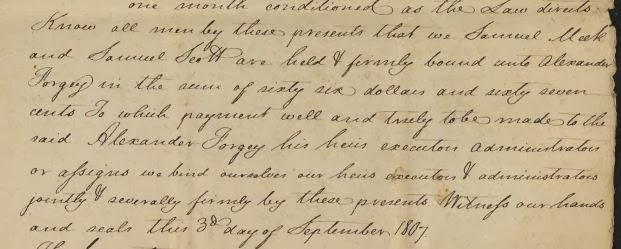
The End of the Alexander Forgey paper trail  is 1807, picking up from here in 2014

Happy New Year 2014! 

It's been such a fruitful year genealogy wise; it's hard to recall every single new find, there were so many.

  1. My mother took the Family Finder autosomal test through MtDNA in August. This has led to finding more distant cousins. The best outcome of this is that she looks like a DNA match to a distant Forgey cousin, further cementing our relationship to the McMinn, Tennessee Forgeys.
  2. My cousin Darryl Kapple took the Y DNA test and we now have a Haplo group of J2b. So we know our family had been in the Mediterranean area at some point.
  3. I took the MtDNA full sequence test and found out I belong to the African Haplo L2a1F. 
  4. Some of my Forgey first cousins took the 23andme DNA test.
  5. A third cousin, Sophia Preston, tested with 23andme and we discovered we share the maximum DNA that a third cousin is likely to share.
  6. The Virginia Memory Chancery court project led to more indepth information about the Lewis Zirkle family, plus great stories! The same database contained a court case naming Benjamin Wray's children and grandchildren, which is conclusive proof we descend from him.
  7. Another big breakthrough came from Ohio court records. Eve Urmey is named as a sister of John Urmey in his Ohio will. This John is son of Jacob Urmey and Susannah Brower. This is satisfactory proof, for me, that Eve is their daughter. 
  8. After adding Brower to the tree I was able to find some great information about this family and their origins in Germany. I've also collected up Urmey and Brower wills this year.
  9. It looks like Edward Browning's wife was Elizabeth Drane.
  10.  This past week I've added another name to the Kapple tree, the name Rottenstummer. I did this with the help of a Kleinmurbisch, Austria cousin. Rottenstummer seems to have originated in the village of Kleinmurbisch.
My to do list for 2014
  1. I think my number one priority this year is going to be trying to find out more about the mysterious Alexander Forgey of Washington County, Virginia. We don't know who his children are, and we don't know where or when he died? We lose all track of him in 1807.
  2. While researching the Brower family I saw Brenneman given as Susannah Brower's mother Eve's maiden name. I can't confirm this. I would like some documentation for this?
  3. I've been doing some Browning family research this year. I would like to find more documentation linking the Tennessee Brownings with Maryland. Also need to find documentation that Elizabeth Drane was Edward's wife.
  4. I still don't have any photos of Frank Kappel and Mary Kurta, my great-grand parents, so I will be continuing to search for those.
  5. Another carry over from previous years is finding the death information for Patrick Mullen and Mary Huvane who died in Ireland.
  6. The partnership of Ancestry.com and Familysearch will produced more records to search, and I plan on using them as soon as they are available. When I don't know?
  7. Another resolution from years past is learning more about my Nicaraguan ancestors. I did look into getting more information about them, but was disappointed to find out that the vital records office for Granada, Nicaragua doesn't respond to mailed in requests. You must request records in person. So finding out more on this line may mean a trip to Granada, Nicaragua?
  8. I'll continue searching War of 1812 records as they come available.
  9. I've upgraded my cousin Darryl Kapple's Y DNA test, and should get the results in a few weeks. We'll see if there as any matches at 37 markers?
In conclusion I've made some great headway, and confirmed the parentage of Eve Urmey and Elias Wray, this year. We've confirmed our paper trails using DNA. We've also added some great stories, so we have more than statistical information. I've compiled much of what we have so far into several books I've printed, through Lulu, this year. This included printing this blog into a book. If next year is as fruitful I will be very grateful!

Welcome Catharina Rottenstummer to our tree!


Monday, December 30, 2013

Coming up to speed with MtDNA


I received my Full Sequence MtDNA results in December. Of course I had no matches at this level, because so few people have tested at this level. I saw a figure of about 18,000 testers at the full sequence level (this number is probably outdated by one year or so). I would need a large number of Nicaraguans testing to find a close match at his level.
I've done a lot of research on the L2a1, and specifically the F subclade. L Haplo is African and about 55,000 years old. I found out that subclade F is anywhere from 2,000 to 10,000 years old. As you can imagine this subclade could travel far and wide throughout Africa over thousands of years. It is widespread in Northern and Central Africa, and made in roads into the Middle East. It is found in Saudi Arabia, and seems to have been spread into Europe by the Jews.
Example 1
We do now have Nicaraguans testing with Family Tree DNA, and I hope to have a close match at some point.
My results mismatched the L2a1f subclade by two mutations, and I have a number of extra mutations. It looks like this will lead to another subclade, which may eventually lead to a more specific location of origin for my ancestors.
Example 2
I've been attending the new series of webinars presented by Family Tree DNA. The MtDNA session was so enlightening! I really had no idea how to read the results page. Example 2 shows the mutations, or differences, I have in my DNA from the Reference model used. These mutations occur among individuals and are disseminated throughout a population through the generations. In earlier eras, when migration was less frequent, these mutations would be limited to individuals living in a small region. Example 2 shows a letter before and after the number. The first letter represents the reference model, and the second represents our own difference from this reference. For example the first position here is A16129G, and we see the first letter is A and the last G . Position 16129 is A in the reference, and is G in my own sequence. These differences are used to place everyone into a Haplo group and subclades. A and G often shift positions, along with C and T.
I found another site besides Mitosearch and Sorenson to upload my full sequence results and compare; namely the MtDNA Community.org. I found one match there. Not an exact match so we probably share an ancestors hundreds or thousands of years ago.
My best hope for a breakthrough with MtDNA would be a perfect match. I also hope we had a mutation in my line fairly recently, because that would mean we share an ancestor in the genealogical time frame.

Tuesday, December 3, 2013

The short life of Isis Forgey

My Aunt Isis lived to be about 5 months old, but her short has always fascinated me. She was born while my Grandfather Charles Lynn Forgey served in the US Marines. My Grandfather married my Grandmother Graciela Del Castillo in Nicaragua on 10 January 1919. Since Isis died in Nicaragua it's been difficult getting any information about her death. I've tried for a decade writing to various record offices in Nicaragua in an effort to get any additional bits of information about my ancestors there. I generally got no response at all. I did get one response from a Catholic Priest stating he could not find any information.
Thankfully the vital records for Managua, Nicaragua were filmed by the Family History Library in Salt Lake City, Utah. These records have been digitized and uploaded to Familysearch and are fully searchable (I am hoping they eventually film the records in Granada).
I've asked my mother and her siblings about their sister Isis, but they didn't know very much about her other than she died very young in Nicaragua. My mother was under the impression Isis had broken her neck? She may have come to this conclusion after looking at a photo of Isis taken after her death. Her rigid position after her death may have made it look like her neck was broken? The family seemed to avoid talking about Isis, probably not wanting to bring back the memory of a painful event. No one knew her date of birth or death.
I've located 3 records mentioning Isis Forgey (she was named after her Grandmother Isis Browning Forgey). I now have her birth record, a 1920 US Census record, and a Death Record.
What I learned from these documents is:

  1. Isis was born on 26 January 1920 in Managua, Nicaragua
  2. Isis died on 3 May 1920 in Managua
  3. Isis died of a Gastro intestinal infection, and not a broken neck


Isis Forgey's birth record says her father Charles L. Forgey was in the Military
Isis Forgey's death record
1920 Census for Marine Legation Managua Nicaragua
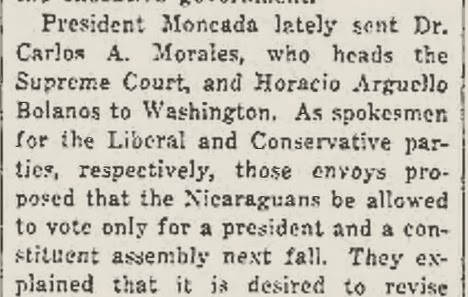
 By April 1921 my Grandmother was back in her home city of Granada where my mother was born. My grandfather was out of the country in Honduras working in a goldmine at the time, he was discharged from the Marines in June 1920. My mother was born in the home of Horatio Arguello Bolanos. I found a newspaper clipping about him below. He may have been a cousin of my Grandmother?


My mother Edna Forgey-Kapple's Birth Certificate 

Sunday, November 24, 2013

Roadwork Books lead to more Brainstorming

Andrew Forgey Knox County, TN Roadwork book 1802
I ordered a microfilm of the Roadwork books for Knox County, Tennessee from the Family History Library. I went to the FHC at the first opportunity when I got the call it came in. I was looking for any mentions of the Forgey, Fisher, and Reynolds families which might provide more information about the family. I had hoped that Archibald Forgey might have done some roadwork creating a connection for him with Knox County, TN. The first item on the microfilm was disappointing with no mentions of any family. The second and third items on the film were for the late 19th Century, which would be well past the time my family lived there.
I finally had a stroke of luck with older books again reappearing towards the middle of the film. After scanning through about 20 pages I finally hit a Forgey entry. This was for Andrew Forgey, a few pages past this I found my ancestor Hugh Forgey. These entries were for the years 1802 to 1804. I never ran across Archibald. It's estimated that he was born in 1790. The family left the Knox County area in 1806. Doing more research on the ages of men who were recruited for roadwork I found the age range of those who were required to perform the work. "Under a legislative act of 1804, counties were authorized to build roads and to require every able-bodied man between the ages of 18 and 50 to work on the roads or to hire a substitute to work in his place." So it is likely Archibald was too young to have been involved in roadwork. 
Deed witnessed by Elen and
 Andrew in Knox Couty, TN
The two Andrew Forgey entries raised the question again about who this Andrew is? We believe he is Andrew Forgey who married Eleanor Randall and later relocated to Maury County, TN. We know this Andrew was associated with Alexander Forgey who married Elizabeth Sawyers (daughter of John Sawyers). We know Alexander and Andrew split a 500 acre land grant which was sold to them by James Forgey. The roadwork book regards the appointment of Andrew Forgey to be overseer of the Road in front of John Sawyers property. This is another in a series of documents linking Andrew of with the Sawyers family. Andrew also witnessed the Will of Hannah Sawyers' wife of James Sawyers, sister-in-law of John. We later find Andrew Forgey of Maury County, TN serving as an administrator of Betsy Sawyers estate in1818, and we find him purchasing most of her estate. This is what led us to believe there was a connection between this Andrew, of Maury County, and the one found earlier in Knox County. I later found a deed witnessed by Andrew and an Elen in Knox County. This would again points to Andrew living in Knox County previously since his wife was sometimes called Elen. 
Hannah Sawyers will Knox County, TN

If we could connect Betsy Sawyers with the Sawyers family in Knox County that would prove with little doubt Andrew of Maury County is related to the family in Knox County. Unfortunately, I can't find a connection. I've found a William Sawyers on a tax list for that area, around Maury County, in 1812. This may be Betsy's husband? I believe Betsy is a relation of Andrew, perhaps a sister or sister-in-law? I've been researching the names of all the Sawyers in Knox County early on. So far I am just finding Colonel John Sawyers Family, and his sister-in-law Hannah and her family. Several males in these families married Elizabeths; but, not this Betsy in Maury County? John Sawyers had a son named William and there are conflicting dates of death given for him ranging from dying at birth to 1867. He is named in his father's 1828 will so we assume he is alive then. This could be Betsy's husband? They may have separated? William married Elizabeth Cassady in 1827. He was born in 1791 which would make an 1827 marriage a late one. William served in the Military during the War of 1812, and could have been in that frontier area in 1812. Sawyers deeds in Maury County,TN may be the only way to establish who Betsy was?  
Here are the names of James Sawyers family:
This is John Sawyers family:
Betsy Sawyers' administrator Andrew Forgey is named here in this Maury County, TN  document


Hugh Forgey serves on roadwork crew in 1804 Knox County, TN


Monday, November 11, 2013

Comparing DNA results with First Cousin

My ethnic breakdown autosomal DNA 
My First Cousin's Ethnic breakdown


My first cousin Susan DNA tested with 23andme and her results just came in. Susan shares my maternal line. When I saw the results I immediately noticed that she did not have any Middle Eastern? Her mother being my mother's sister I thought this was strange. My mother's results included 18 percent Middle Eastern. My results showed 13 percent Middle Eastern. My mother and I tested with Family Tree DNA. My mother's Middle Eastern was said to be Mozabite. I also thought it was odd that no Spanish showed up in Susan's results? Odd considering her grandmother Forgey was from Nicaragua?
Some of this inconsistent information probably has to do with the different testing procedures at the two companies. Also, ethnicity predictions are subject to debate. It's possible to determine the continent of origin of our ancestors using DNA testing, but pinpointing the exact country of origin is generally not possible. Isolated populations are probably much easier to make a connection with. Since Susan would have inherited half of her autosomal DNA from her mother it's possible that she didn't inherit the Middle Eastern associated markers? It's also possible that Aunt Dorothy didn't inherit as many Middle Eastern markers.
My cousin and I share approximately the same amount of Native American DNA, so this result seems quite accurate. Family Tree DNA doesn't show trace amounts of DNA such as the 1.4 percent Sub Saharan African Susan got from the 23andme test. I did find those traces when I used the Gedmatch admixtures and Doug McDonald also found a small amount. After taking the MtDNA test I discovered my maternal MtDNA Haplo group was Sub Saharan African. My cousins MtDNA is also Sub Saharan L2a, so we have confirmed that is correct. She actually got a more specific Haplo group of L2a1. I had heard that haplo L2a1c was Northern African but after doing more research it seems to be more widespread. So our Sub Saharan African is either from a slave from central Africa or a North African?  I had assumed that this result was connected with the Mozabite but it could be unrelated. Since MtDNA mutates very slowly and can remain unchanged for thousands of years it can be tricky to make assumptions based on it. Half of those who matched me on the HRV1 portion of the MtDNA test have African roots, and are descendants of former slaves, and the other half had Semitic roots. When I uploaded my HRV1 and HRV2 results to the Sorenson DNA site I found an exact match from Mali. This would tend to point to our L2a being from an African slave. It's probably impossible to say for certain though. Sometimes these tests raise more questions than they answer.

Sorenson MtDNA match

Sunday, October 27, 2013

Are we Jewish or not?

It seemed like I may have had a solution to my question after learning the Kapple/Kappel Koppel's male line DNA Haplo type was J2. Since many Jewish males have that haplo type, and our surname is associated with Ashkenazi Jews, I felt like the question was answered. I received an email from the Burgenland Bunch DNA study a few days ago with some analysis of the group results to date. The J2's in my families village area tend to be related to Aromun/Illyrian, which would mean they are from the Balkans or Greece. I will eventually upgrade my cousin Darryl's test kit to narrow down the sub group. My cousin's ultimate SNP is likely going to be around M241 which could be Balkan? It also may be semitic if it's L25? More testing may clarify.
It's interesting that most of my cousin's matches are Spanish. This may change after testing more markers. I sorted out my Family Finder matches separating my mother's side from my father's. I was very surprised to find I had a match on my father's side and they had hispanic roots. My father has no hispanic roots that I am aware of?
It is interesting that Northern Burgenlanders are more Germanic than those of the south, where my family is from. It does look like my Burgenland family is a mix of ethnicities. I have some Hungarian matches on my father's side. 
Considering my mother's Middle Eastern results were just Mozabite and mine included Palestinian; it's possible that the Palestinian is from my father? I'll upgrade the test when I have a chance and see if it can provide anymore insight?


Saturday, October 19, 2013

Irish Relatives Drunk in Public?

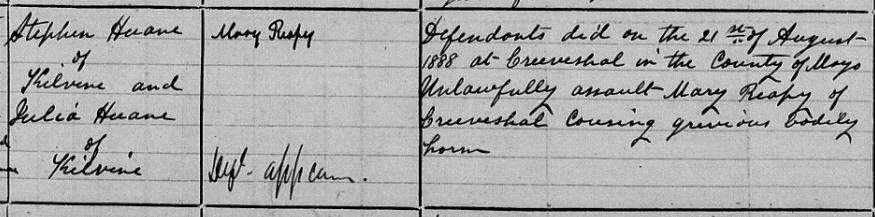
Failing to pay the Poor Rate could land you in court as with Thomas and Stephen Huane. I believe they abandoned their property in Ireland.
It seems my Irish relatives in Mayo, Ireland weren't teetotalers. I used my Find My Past free trial to look at their court records collection. I was not able to determine whether my Mullen ancestors appeared in court due to the fact the Galway court records are not set up like the Mayo records. Not enough detail on the Galway side to establish the identity of someone with a common name.
The surname Huane is so uncommon and limited to a small area in Ireland, so it was easy to spot our family court records. The Huanes appeared in court a number of times; generally after having a few too many. Some of our Irish female ancestors were known to have a hair trigger temper (I would say that we generally tell the truth and people think it is hell, as Truman once said). We can see all of the rumors about the family verified in the records. Happily no one was ever seriously hurt in some of these skirmishes; Praise be to God!


Sounds like this may have been mutual combat, and charges were dropped

Most of the Huane court appearances had to do with the following circumstances; "Defendant were found drunk on the public road contrary to law."
This court case helped me to identify the location of my ancestors property. Griffith's Valuation of Ireland gave me an approximate location for Thomas Huane's property. Thomas Huane's cow strayed onto a neighbors property, and he sued because of this. The neighbor's property was in another townland, which leads me to believe Thomas Huane's land was located on the Townland boundary line with Bunduff. These records are interesting, and add to our knowledge of  the lives family members.


Thursday, October 10, 2013

Backtracking and DNA Analysis

My Pie Chart

My Mother's DNA test results finally came in yesterday. It has caused me to rethink my previous conclusions. I had assumed since my father's surname was likely Jewish that all of my middle eastern came through his side of the family. My Mother, however, has even more Middle Eastern than I do.

My Mother Edna Forgey -Kapple's ethnic breakdown
My mother's Middle Eastern result of 18% leads me to believe that it is possible I may have inherited only 5% of my Middle Eastern from my father. As we can see with my Native American result the percentages go down by about half with each generation. I had heard that happens but now I see my mother's about 11% and my 5%.
According to my mother's population result she is 18% Mozabite. According to my result my Middle Eastern is Bedouin, Mozabite, Palestinian
My mother has 232 total matches. I have 219 matches. We share 93 common matches. So far I've found a Nicaraguan 3rd to 5th cousin match in my mother's match list. I've also found a Zirkle/Roush relative who is a match. to her but not me. I am happy that my mother shared even more DNA with a descendant of John Forgey of Tennessee which supports our inference that we are related. Stop and start places are not exact so it's a little hard to establish there actual location.
My mother Edna Kapple and Marion Kerr

My comparison with Marion

Comparing my confirmed 5th cousin Nan with my mother I get different numbers at FTDNA than I do at gedmatch. According to FTDNA their largest shared segment is 12.73(which is exactly what Nan and I share). According to Gedmatch it's 16 on Chromo 2 and 15 for me?  Who's right?

Nan and I
Nan Harvey and Edna Forgey-Kapple


I am making a list of the matches which fall on my father's side. FTDNA provides in common with match list, and a not in common with list. I downloaded the excel spreadsheet for these lists. I will note which matches are my mother's and which could be my father's, for all the lists then merge them.

Here is a comparison of Dodecad 13b charts between my mother and I:

Annette Kapple 

Edna Kapple

Wednesday, October 2, 2013

Family Tree Maker vs RootsMagic Software

Right off the bat I have to say I would not recommend purchasing Family Tree Maker 2014, which just came out a few weeks ago, until it's fixed. It's going to take some time for them to work out several problems with the new version. 
I decided to purchase the 2014 version of Family Tree Maker because of the ability it gives you to sync your online tree with your personal software on your computer. I had spent many hours attaching and uploading information to that tree since 2010. I wanted to have a personal copy of it. You can download a gedcom of your tree, but that doesn't include media. I had been using Rootsmagic since 2010 as my personal genealogy software. Before Rootsmagic I used PAF which is similar but has fewer features.
Since I have some experience now using both softwares I decided to compare some of the features I use most often here:
First of all starting the program there is a difference in the time it takes for them to load. Rootsmagic generally loads immediately. Family Tree Maker never loads quickly. It can take between 1 to 3 minutes to load, and other times won't load at all? Family Tree Maker is also prone to freezing up while you are using it.
Looking at the primary screen Family Tree Maker lays out a great deal of data on one page, which can be useful when it comes to analyzing your data.


You can see that the primary page for Rootsmagic is much less busy. You can click on the tabs across the top to see family groups etc.. I prefer the less busy screen of Rootsmagic.


One thing I would change about RootsMagic is the dialog box that comes up when you want to import a file or Photos. I use date and name search to look for files on my computer. It is time consuming trying to locate a file without that feature in the dialog box.
The hated no search dialog box at Rootsmagic
The preferred Family Tree Maker searchable dialog box
Another place where Family Tree Maker shines is with their media viewer. You can flip through your images and look at them in the media viewer. You can only view one image at a time with Rootsmagic. You can scroll through thumbnails of your images at Rootsmagic. When you want to see them at a larger size you have to click on each one individually. The resolution of the image isn't as sharp at Rootsmagic either.

You can see the difference when you compare this image from Rootsmagic with the FTM viewer below

Family Tree Maker media viewer


My primary reason for using genealogy software is to keep a record of my research so I can refer back to it, which I often do, during my research process. Another way I enjoy using the software is generating books and charts to share with family. I like the Rootmagic book generating feature better than Family Tree Maker. The FTM book generating process is more clumsy and time consuming. Rootsmagic takes all of the facts you've imputed for each individual ancestor and creates a narrative summary of with these facts. You can produce a narrative report which includes all your ancestors, very quickly, and includes notes. Family Tree Maker Smart Stories produces a better narrative with the facts in your database. It sounds less computer generated; plus, you can type info to the report. The only problem is you have to create a smart story for each ancestor then combine the stories using the publish book feature. Since I would like to include a couple hundred narratives this might be time consuming.

This is the narrative generated by Rootsmagic
Smart Story Family Tree Maker
Rootsmagic produces a very attractive scrapbook. I have not found this feature at Family Tree Maker.
Page produced with Rootsmagic scrapbook.
In closing, I now have two genealogy software programs on my computer (plus still have paf). I think I'll be using features from both to create a book. I might use the comprehensive narrative report from Rootsmagic, and the Smart Story from Family Tree Maker for ancestors I want more indepth stories for. I would also use some of the Scrapbook pages from Rootsmagic. Since Rootsmagic opens faster I would probably refer to it more during research. I will be using the syncing feature at Family Tree maker if they can get it working properly. The FamilySearch tree access at Rootsmagic is also a useful feature. You can compare your tree with FamilySearch's tree and add any information you don't already have. Having several genealogy programs is nice, I can use the best features of  all of them.