Monday, November 28, 2011

My DNA Wish List for Santa! Plus link to Our Group

Most wanted DNA  Made my list for Santa and it's all about DNA ;)! Considering we didn't have a DNA project before August 2011 we have made great progress so far! Here is a link to our Group Forgey/Forgy/Forgie: http://www.familytreedna.com/public/ForgeyForgyForgie/  Just use the tabs across the top to see other pages. Click the Y DNA drop down menu to see the actual results so far. We should have more results by late December.
We can always use more participants in our Forgey/Forgy & Forgie project. The larger the number of testers the more we can learn. DNA testing requires comparisons between matches, and patterns only come to light after groups of cousins pool results.
Here is my most wanted Y DNA:

  1. Forgety line
  2. Gabriel Forgey line
  3. Archibald Forgey line
  4. Alexander Forgey line 
  5. Hugh Forgey Bourbon Kentucky line
  6. William Forgey supposed French line
  7. John Forgy Cumberland, PA line (someone already tested on this line but I am not sure about the results?)
  8. Canadian Forgies
I have added in red those who have tested for each line in to the chart below (we are DNA testing to better determine the lines so some of these are guesses). Clinton Forgy has not returned his test yet and is testing in Samuel's line. We need to fill in the empty boxes, and we can use more testers in the Andrew line. Test prices start at $99 for 12 markers. We have a Forgey, Forgy, Forgie group at FT DNA http://www.familytreedna.com/


Click on chart to get better image


Thursday, November 24, 2011

Happy Thanksgiving!

Charles and Graciela Forgey Family 1951
This is the Gravy Boat From the picture above, my mother believes it's from the early 1900s.
Made by Ridgeway England


Tuesday, November 22, 2011

FT DNA Beta + Final DNA comparisons at 37 markers

New beta site and finals to date When I saw that Mike Forgy's 37 marker results came in I noticed major changes to the FT DNA site. Here is the explanation I found posted there:  "Beginning today, 11/21/2011, Project Administrators will have exclusive access to our new myFTDNA 2.0 BETA.  Use the kit links within your project to access the new personal pages." It took me a few minutes to understand the new layout. I like it . There are some new ways to sort results such as by surname. I have to play with this after Thanksgiving to see what else you can do.  I copied some of the new reports below. As you can see below the number of markers mismatched is now posted with the name on the far left hand side.
was very satisfied with the rest of Mike's results. Here is what we can infer so far with the 3 tests complete:
  1. Forgey is a variant spelling of Ferguson. Mike had 11 Ferguson matches and Roger had 5 ( see last two images in this post for Ferguson ONLY matches.
  2. There was a mutation in one of Mike's first 12 markers which was not shared by either Darren or Roger or any of the Fergusons which means this is a unique mutation in his line.
  3. Two mutations occurred in Darren's line which were not shared by either Roger or Mike. So they are unique to this line and can be used to set them apart.
  4. One marker tested in the last set for Mike did not match either Darren or Roger, but did match many Fergusons. So I wonder if Darren and Roger's line's both experienced a mutation at a later date?
  5. Larry Laughlin has been a close match to all three men and a perfect match for Mike. This may just be a coincidence or maybe a non paternity event? Some lines do have very few mutations so it's possible he is related before the adoption of fixed surnames?
  6. Many of the Forgey/Forgy matches tested positive for the Scottish Clade which I discussed before. So it looks like Roger and Darren will test positive when their results come back in late December (the new beta site shows deep clade results for matches).


We should have more test results by late December. It is odd that Roger and Mike have two marker mismatches and Mike's supposed closer relative Darren mismatched by 4. Hopefully we can clarify this with next set of results; which should be for my uncle.


Mike Forgy 
Mike Forgy
         Mike Forgey 3 marker mismatches   Roger Forgey 3 marker 


    Mike Forgy 4 marker mismatches  Roger Forgey ditto          Darren Forgy ditto

Mike Forgy's Ferguson Matches
Roger Forgey


Saturday, November 12, 2011

Comparing Marker Matches so Far

Comparisons so far It sounds like the FT DNA lab was closed for Veterans' Day yesterday; so the rest of Mike's test results have not been posted (I am really anxious to see them!!!). We expect the rest of his results next week.
This is where we are so far. We have a completed test for Roger Forgey representing the Andrew Forgey and Margaret Reynolds line and we have two testers who share a most recent common in 1726 i.e. Samuel Forgey or Forgy. We have completed results for Darren. All three men are confirmed related through DNA testing so far. Roger and Darren share a genetic distance of  2. So they are confirmed to be related. It will be very interesting to see whether the two markers which separate both of them are shared by Mike Forgy? We will then have an idea of when those mutations occurred. After or before 1726? If they happened before then, Roger's line would have shared a common ancestor likely more than 100 year earlier. If the mutation occurred after 1726 they likely shared a common ancestor somewhere around the 1726 era.
It appears that Roger's line experienced fewer mutations in their DNA than Darren's and Mike's lines? I surmise this from the number of matches Roger had with the members of the Ferguson group. Ferguson does seem to be the root name for Forgey. Darren matched some of the same Ferguson group members at a genetic distance of 5. This would mean he is only possibly related to them unless, someone in his line tests closer ( which would mean an extra mutation occurred recently).
Mike Forgy already has a mutation not shared by the others with only 12 markers tested. This mutation occurred after 1726. I am expecting the Fergusons who matched Roger and Darren to resurface again when the rest of Mike's test results come in. 
I've copied all of the match results so far below. Actually Wayne Forgie is also only one marker off Mike at 12 markers (I guess FT DNA only lists those member matches with nearly exact name spellings in this catagory i.e. genetic distance 1. Forgie didn't register as a close spelling?).

Wayne Forgie is also one marker off Mike Forgy.
                                     
          
               Roger Forgey                                             Darren Forgy
    Roger Forgey                          Darren Forgy

       Roger Forgey                                                                                               Darren Forgy had no matches here

        Roger Forgey                                Darren Forgy

Friday, November 11, 2011

William Kappel anti aircraft gun battalion

William Kappel's Grave Netherlands American  Cemetery

Remembering Veterans on Veterans Day 2011 We do honor the sacrifice of all veterans today. I especially honor my Great Uncle William Kappel, who was a member of the 462 Anti Aircraft Gun Battalion. A few years ago I discovered that he was killed in Europe at the end of  WWII. He was buried at the American Cemetery in the Netherlands. I have been unable to find out the circumstances of his death due a fire, and  the loss of those records. When I asked my aunt if she knew anything about his service she said she thought he served in the South Pacific? I have verified that he was indeed buried in Europe, so I assume he was killed there. My father never really said nothing about his aunts and uncles; so I have only discovered most of my info about them through my own research.
The only thing I have been able to glean from my questioning of family and research is that William Kappel was one of  the 11 children of my great-grand parents Frank Kappel and Mary Kurta. He was born in Cudahy, Milwaukee, Wisconsin on 20 Sep 1915. He did marry, and was married when he was killed. Don't know if they had any children? 
My father Robert Kapple was born in 1933. My aunt June said that one Christmas my father got a train set (my father did love trains, and came to California from Chicago, IL by train). She said that my Grandfather Rudolph and his Uncle William hogged the train set on Christmas morning, and my father was upset because he couldn't play with it. In retrospect is nice to know that Uncle William had fun that Christmas with my Dad's train set :).


Tuesday, November 8, 2011

What can DNA really prove?


What can DNA really prove? I've been mulling that over since receiving test results for another Forgey family line. I had read articles about DNA testing before actually becoming involved myself in August. I had a vague idea of how it would work, and what it would tell me. After two months experience working with results I am getting a much more realistic view of DNA testing for family history.
So far we seem to have a match between Roger Forgey representing the Andrew Forgey, TN, line, and Darren Forgy representing the Samuel Forgey, NC, line. Another person representing the John Forgey line in PA had tested earlier and was not a match. We have at least four other family members who are somewhere in the process of testing, and three others who have at least preliminary results (with 25 markers in for Darren Forgy he is one marker off from Roger Forgey = Genetic distance 1).

What DNA has achieved for us so far:
  1. It's confirmed that at least two Forgey lines are related which was impossible to do using traditional genealogy research. They apparently share a common ancestor in Ulster Ireland. We know from our research that the common ancestor link occurred before 1720, which is impossible to document with records.
  2. It may have eliminated a relationship with the John Forgy line? Although it is possible that a non   paternity event occurred. It is good practice to have more than one person per line test in case of this kind of event.
  3. It has confirmed family tradition i.e. that the family was Scots-Irish.
  4. The link between the name Forgey and the name Ferguson has been verified.
  5. We have found more distant relations (Gilbert Ferguson, Kenneth Ferguson, George Robert Ferguson, John David Ferguson and Wayne Forgie).
  6. A link between our Forgeys and Co. Down Ireland is confirmed. Wayne Forgie's family is from Co. Down.
So what can be expected when we get all of the results back. 
  • Comparison of complete sets of results will hopefully give us more data about relationships, and a time frame for the most recent shared ancestor
  • A more precise Haplo group which will help confirm or refute a possible French origin or confirm the family had lived in Scotland for thousands of year
  • Answer the question regarding whether all the early Forgey/Forgys to settle in America were related or at least come close to answering that question
In conclusion, what DNA can do is tell you is whether you are related to someone at some point in time. It can't tell you exactly when. If you match someone else on every marker except 3 or 4 markers, on a 37 marker test, then you can be reasonably sure the common ancestor lived hundreds of years ago. I was thinking yesterday what if all the Forgeys match perfectly and I can't differentiate the family lines? I remembered that is where all of the research I've collected, and others have shared with me comes in. With 11 years of research on my family line and the DNA test results to back up my assumptions I believe I will have a very well documented accurate family tree when all is said and done. 

    Wednesday, November 2, 2011

    Just when I thought I had it figured...a new clade?

    The I- M284 subclade I mentioned the subclade I- M284 associated with the British Isles in a previous post. I did not know it was a subclade of M223. I thought these two were totally separate. Below is a chart showing the relationship between the subclades. Roger was placed in the M223 clade by FT DNA. According to the Ferguson DNA project Roger's matches are in the subclade M284? Since there is a 99 percent probability that  Roger is related to Wayne Forgie and Gabriel Ferguson at some point in time he must also share the British Isles clade. It sounds like one of the matches may have upgraded to a deep clade test. This is the way Ft DNA explains the test: "Family Tree DNA now offers its Y-DNA customers Deep Clade tests to determine or confirm the exact subclade or branch of their haplogroup. " It's also possible that differences in 3 markers led to a more specific subclade assignment for one of the other matches? I will contact the Ferguson project and ask about the reason for the M284 subclade assignment?
    According to Wikipedia:" I-M284, has been found almost exclusively among the population of Great Britain, which has been taken to suggest that the clade may have a very long history in that island". The Scottish branch of 284 might be 1,500 years old. So Roger's line may have been in Scotland for more than 1,500 years; and possibly as many as 3,000 years ago. So Roger's family may have descended from the ancient Pict population of Scotland.
    The Forgeys do seem to match the description of others assigned to this subclade. The M284 subclade is strongly associated with western Scotland. "The Fergus(s)on in this group show a strong connection with Ayrshire and Dumfriesshire. Sir James Fergusson of Kilkerran wrote: "there is some evidence strongly suggesting that the south-western Fergussons, living in Ayrshire and Dumfriesshire, took their name from Fergus, Prince of Galloway, a much less shadowy personage, who was an important figure in the reigns of David I and Malcolm IV." By less shadowy he was refering to Fergus Mor and the attendant Dalriada genealogy."
    My goal now is to find the exact subclade for the Forgey. I really need to verify the Ferguson groups conclusion.

    Monday, October 31, 2011

    Happy Halloween!

    Aunt Grace  Forgey-Wilmot and Uncle Bill Wilmot  at Forgey family Halloween Party

    Friday, October 28, 2011

    Put Yourself in the Picture

    Great-Great Grandfather Hugh Forgey and I


    Photo editing software. I've been playing with photo-editing software available for free online. Face in the Hole is fun. You can upload your own photo or use their template photos. I found some fun photos when I searched the site using the word "Victorian". I found the photo above which I used; and added my great-great grandfather Hugh Forgey and my picture to. I also uploaded a picture of my great grandmother Isis Browning-Forgey and her sister. I removed her sister's face and replaced it with my own. It's fun to play with this. You can snip a copy of your creation and edit it with free Picasa photo-editing software. The Halloween effects at Picnik are also fun to play with. Being a typical genealogist I love cemeteries. The cemetery over lay at Picnik is a fun, spooky, effect to add to photos. You can get to Picnik through Picasa photo-editing.

    Thursday, October 20, 2011

    Tracking Down DNA Matches and Digging Deeper


    Tracking Down Matches The newest match for Roger Forgey came in yesterday and was a 25 marker match with Kenneth Ferguson who had a genetic distance of 2.  It seems like there is a match every week now. This is due to the efforts of the The Ferguson DNA project which seems to be growing tremendously. We are lucky to have a large project relating to our surname.
    Above is a list of Roger Forgey's DNA matches. I decided to copy the image from FT DNA and add the places of origin for his matches. I got this info from emails sent to me by matches, and family histories posted at the Y Search DNA website.Several of the matches had no place of origin in the old country for their ancestors. A quick survey of the places does confirm our belief that the Forgeys were Scots Irish. All of the families, except a Hernandez match, appear to be Scottish or Scots Irish. Also the Scottish matches have Southwest Scotland origins. These people settled Ulster in large numbers. 
    Digging Deeper The chart below is from the Ferguson DNA project which shows marker associations for I2b1 British Isles subclade. It seems that the Gabriel Joseph match and Wayne Forgie match share the markers most often found in those from Cavan and the Belfast area of Ulster.


    There is an I2b1 study at FT DNA. You can see all of the participants and their countries of origin here http://www.familytreedna.com/public/M223-Y-Clan/default.aspx?section=yresults . The countries of origin for this Haplo group also confirm Scottish origins for Roger Forgey's line. Something which stands out is the prevalence of the I2b1 group in Germany. After doing some additional research I have come the conclusion that the early Forgeys might have migrated to Southwest Scotland from England. I believe the Forgeys were likely Anglo-Saxons or Norse. The Anglo-Saxons had invaded England in the 5th century A.D. Most experts agree that the I2b1 Haplo group mainly stem from two sources, Norse and Anglo Saxon invaders. About 200,000 Saxons invaded England. Southern Scotland was heavily populated by Anglo Saxons, French, and Flemish settlers.The Saxons took refuge in Scotland where they fled from the Norman invaders.With the I2b1 Haplo being more common in Saxony, Germany the most likely scenario is that the Forgeys were Anglo Saxons, with a more slight possibility that they were Norse. According to some the I2b1 haplo type originated in Saxony 9,000 years ago. 
    As more research and DNA testing is completed we should be able to get a better idea of our Forgey family origins.


    Thursday, October 13, 2011

    Ancestry.com's DNA Group Layout


    Comparing the FT DNA Group layout to Ancestry.com. 
    Ancestry.com has a more user friendly layout. It's more ascetically interesting to look at. The ability to add photos make this site more interesting and accessible to non DNA geeks. It's a very basic site which makes it easier to use than FT DNA.  You can compare results between members, add files, photos and videos. You don't have to have tested with ancestry.com to join a group. The cons are a smaller database of individuals to compare with; as opposed to a larger database at FT DNA. Of course Ancestry.com's mission is much broader than FT DNA. They are not solely in the DNA testing business. This is reflected in the group layout at ancestry.com which is much less scientifically oriented, and more personal. FT DNA, with it's scientific orientation, provides many tools for  advanced analysis of DNA results. The charts and statistical info are useful tools for in depth analysis. I think that FT DNA is best for large surname studies. The Ancestry.com group model is best for small family group studies.
    A downside to FT DNA is that many people use it as a quick easy way to discover their family history. Some members have not done any traditional genealogy research. This makes finding a common ancestor with matches difficult. I find myself researching match's family histories in order to find the common ancestor. This can be time consuming and frustrating. I don't have any experience with matches at Ancestry.com but assume they have done some research using the databases at Ancestry? I have heard of people having successes using both sites. The most important thing is completing  some research before testing, and hopefully having a someone else to test against in the database.

    Thursday, October 6, 2011

    Are you curious about the group site layout at Family Tree DNA?

    This is what the Member info page looks like 

    Our surname DNA Project is growing :)! Not quite as large as the Benjamin Franklin study but growing :) (by the way there is a wonderful website for that project http://www.roperld.com/franklinbendna.htm). Here are some pages from the group website at Family Tree DNA. There are some great tools for comparison of DNA results. FT DNA also offers webinars and other educational opportunities which are displayed at the home page. Test kits can be purchased from the group site at a discount.
    The only drawback to FT DNA's project groups is the fact that you have to buy a test in order to join. Ancestry's DNA groups allow anyone to join whether or not you purchase a test through them.

    This is the Homepage with News and links
    This is a list of the links to helpful info and charts for comparison of results
    Here is an example of the discounts available through a group. Some tests are only available through projects such as the Y 12 marker test. 

    An example of a chart. This is a chart showing project joins statistics.


    Tuesday, September 27, 2011

    The Adoption of Fixed Surnames & DNA


    I was a little confused by the DNA matches for Roger Forgey. Most of the matches didn't share the same surname?? You would expect to find only same surname matches given the fact that the Y chromosome is only passed from fathers to sons. Well after doing some research at Family Tree DNA and elsewhere I found that these matches indicate a relationship before fixed surnames were adopted.
    Not being clear about when surnames were first adopted I did some research. It seems that before 1350 many common people did not have fixed inherited surnames.The aristocracy was the first group to adopt surnames. Taxation made more precise identification necessary and was a catalyst for the development of surnames . The growth of the military and civil bureaucracy led to the standardization of surnames.
    A few of the non Forgey surname matches were only two or three markers off at 37 markers. This leads me to believe that the Forgeys adopted a fixed surname relatively late. The lowlands Scots, as the Forgeys were, tended to adopt fixed surnames later than those in Southern England. They may have adopted a fixed surname in the 1400 or 1500's or even later. The first appearance of the name Ferguson (the root name of Forgey in Scotland) seems to have been on a 1466 land record (the 15th century seems to be when Ferguson was first adopted). This record transferred land from John Ferguson to his son. Ferguson appears to be a patronymic name referring to men who were sons of a Fergus. Previous to the  adoption of the surname Ferguson they were referred to only as "sons of Fergus."
     In the past people changed surnames for various reasons,and early names were not always carried down in families. An example apprentices sometimes took their masters surnames. Many of the earliest surnames were not inherited by descendants and died out.
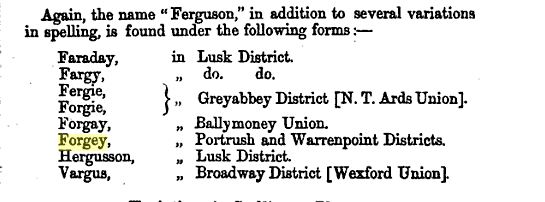
    Varieties and synonymes of
    surnames and Christian names in Ireland
    I think previous family researchers miscalculated the date of the adoption of our family name. Some felt that the Forgies came from Normandy with William the Conqueror in 1066, and the name dated from that time period. This seems unlikely. Most of those who came with William the Conqueror had surnames which related to the place they came from in France, and were preceded by "de" meaning "of". I have not found any references to de Forgies in western Scotland. Most experts on the subject agree Forgey is a variant of the surname Ferguson. As a matter of fact a couple of Fergusons were close DNA matches. So I tend to agree that at least in our line the name derives from Ferguson. It is likely that there are other origins for this surname in other places. Our family origins seemed to be rooted in Scotland; which is supported by the DNA testing. There may also be a French origin of the name? The William Forgey line which settled in Allegheny County, PA in the late 18th Century claimed French ancestry. This illustrates the difficulty which arises when trying to trace someone based solely on their surname. Surnames change over time. Similar surnames may be used in several countries.So sharing a surname does not represent proof of a blood relationship.
    Progressive Men of the State of Montana Volume 2


    Wednesday, September 21, 2011

    Journey of Man: The Genetic Journey of the Forgeys/Forgy & Forgies

    The only Forgey marker we have so far is M223 (click to enlarge map)

    We now have the predicted Haplo type for Roger Forgey and Wayne Forgie's lines. It's haplo group I2b1, M223. This is what wikipedia has to say about it: "Former I2b1 in the Y2010 tree. I2a2a (M223) has a peak in Germany and another in eastern Sweden, but also appears in Russia, Greece, Italy and around the Black Sea.[21] Haplogroup I2a2a has been found in over 4% of the population only in Germany, the Netherlands, Belgium, Denmark, England (not including Wales or Cornwall), Scotland, and the southern tips of Sweden and Norway in Northwest Europe; the provinces of Normandy, Maine, Anjou, and Perche in northwestern France; the province of Provence in southeastern France; the regions of Tuscany,Umbria, and Latium in Italy; and Moldavia and the area around Russia's Ryazan Oblast and Republic of Mordovia in Eastern Europe. Of historical note, both haplogroups I1 and I2b appear at a low frequency in the historical regions of Bithynia and Galatia in Turkey, possibly descendants of the Varangians, who are historically recorded to have invaded those parts of Anatolia from the 9th to 11th centuries."  
    The I2b sub group, called Isles, is found almost exclusively in the British Isles with a heavy concentration in Scotland.  
    The marker 223 also is interesting.  "The founder of this marker lived somewhere in the northwestern regions of the European continent, perhaps even in what seems a very unlikely place: the bed of what is now the North Sea." This place is now referred to as Doggerland by scientists. As stated  previously it's now located in the North Sea.  Here is a description  “…Doggerland would have covered an area about the size of England, a tundra landscape across which vast herds of reindeer and horses plodded, where salmon spawned in its prolific rivers. As the climate warmed, oak woodland colonized the valleys and hills. Red deer, roe deer and wild pig replaced the barren-ground reindeer. It remained an ideal hunting ground….+ http://freepages.genealogy.rootsweb.ancestry.com/~robert/TheFirstPeople.htm
    One of my all time favorite TV programs is the Journey of Man which I embedded below (to see all of the parts just click the the Youtube link). I think this show helps put the Forgey DNA results into context.


    Wednesday, September 14, 2011

    Y DNA12 Markers and 25 to GO!


    We received Roger Forgey's 12 marker test results last Friday (still waiting for the last 25 markers). He was a perfect 12 of 12 match with someone currently using the Forgie variant spelling of the name. At the 12 marker stage if you match with a person with the same surname or variant then you are considered to be related. This person originally tested as a part of the Genographic Project sponsored by the National Geographic Society. He is currently upgrading his 12 marker test and testing with Family Tree DNA. It's puzzling that there is no match with the Forgys (Iowa, USA) who also first settled in Cumberland County, PA like my family.  Since only one person tested it is possible that a non paternity event occurred and more testing needs to be done?  A test is in the works right now for my Uncle Charles Forgey.

    Oddly there were also two other matches with men with different surnames. If these results hold up at 37 markers we will have to compare notes to see where we may be related?

    The Forgie match would mean that our family descends from the Forgey/ Forgies of Co. Down Ireland. The shared ancestor would have been many generations ago since my Forgey family came to this Country about 1767 and our match's family came much later about 1870. I had some suspicions that the family had descended from the Co. Down Forgey/Forgie line. It looked like a migration from Down to Armagh took place. It did not look like the Forgey family was in the Armagh area very long. I couldn't find any burial records, births, marriages or deaths there. It looks like the family resided there briefly in the 1760's just before emigrating.


    Varieties and synonymes of
    surnames and Christian names in Ireland
     According to a report by Robert E. Matheson, Registrar General 1901, the spelling Forgey was common in Warren Point, Co. Down. We believe my ancestor Andrew Forgey is listed on the 1766 Religious Census for Ireland. He seems to be listed in Creggan Parish, Armagh along with his father-in-law Hugh Reynolds. This area being only 12 miles from Warren Point Co. Down; so it seems like there may be some relationship? A James Forgy also listed on that Census did not emigrate to America. I do wonder if some of his descendants settled in Warren Point Co. Down?

    The ancestors of our match lived in Millisle, Parish Donaghadee, Co. Down. This area is on the Ards Peninsula.  We really don't know how many Forgey/ Forgie families settled on the Ards Peninsula; but we might assume from the numbers of people with the surname in public records it wasn't many. The earliest Forgey/ Forgies were brought over from Scotland to Ards by Sir Hugh Montgomery, who was part of a private plantation scheme which aimed to plant the area with Protestant Scottish settlers. Gregory Livingstone found a Forgie on a 1606 Rent Roll, which would be the earliest appearance of the name in Irish records. Gregory also gave me this info " mentioned in the Montgomery manuscripts, they came in 1603, with Sir Hugh and helped build the harbour and town of Donaghadee, simply list of surnames of individuals.A James Forgie is mentioned as living in Ballyrolly 1616, a townland 1/2 mile from Millisle." We note here the same place names as mentioned by our match's family. Due to heavy record losses it's nearly impossible to trace a family back to the 1600's so we can only guess that our family may have descended from these early Forgeys.
    Nathaniel Forgy Rent Roll 1690's Ards Co. Down, Ire

    Thursday, September 8, 2011

    The Forgeys and Slavery

    Former Forgey Slaves

    I remember back when Helen Irene Forgey visited our family in the early 1990s and told our family about our origins. When she said the family was originally from Tennessee I was quite surprised. I wondered whether the family had anything to do with slavery? It looks like only one of my direct ancestors owned a slave, namely Andrew Forgey born in Ireland. His slave was listed on Andrew's Will and his name was Bacchus. He was Willed to sons Andrew and Hugh Forgey to share. 
    Andrew's son James, and his line, were the largest slave holders in the Forgey family. Although they would have been considered small slave holders. The slaves consisted mainly of single family groups. The Census describes two former Forgey slaves as Mulatto, so I wonder if they might have Forgey blood? There was also a mulatto boy?
    Mary Forgey 1870 Census Mulatto

    Margaret Forgey Mulatto 1870 Census

     From James Forgey's 1831 Will "Item 10. I leave my yellow boy (yellow would be mulatto)  Joseph and his wife Peggy to my beloved wife during her life, and at her decease for them and their issue to be equally divided amongst my daughters, and it is my request that James would keep them at a moderate price and for them not (to be) separated themselves, but their children may be divided between the girls." From his son James R. Forgey's 1853 Will: , "and also that each of my daughters have two servants girls to be selected by my wife. Given under my hand and seal the date above written." From his wife Raechal's will : "Manerva and Matilda Forgey and my own daughter Susan Forgey, have each one negro girl"..."James R. Forgey Jr. the sum of six thousand dollars in cash or negroes belonging to my Estate".

    An interesting description of slavery in Tennessee can be found in "Tennessee a Guide to the State". According to this account: "The lot of the Tennessee slave was perhaps less unfortunate than that of many of his brethren. Tennessee's slave code guaranteed the Negro shelter, food, clothing, and medical attention. It protected him when he ceased to be useful, gave him the right to contract for his freedom, and in 1835 granted him the right of trial by jury - a privilege accorded to slaves in only four other States."

    Don't know what happened to the former slaves who took the name Forgey? Don't know whether any descendants still carry the name Forgey? Joe Forgey's family seemed to be the only remaining African American family in the area in 1920 (Joseph and Margaret were names handed down in that family. James Forgey's slaves, husband and wife, were Joseph and Margaret).
    Joe Forgey Family Mulatto 1920 US Census Knox County, TN